
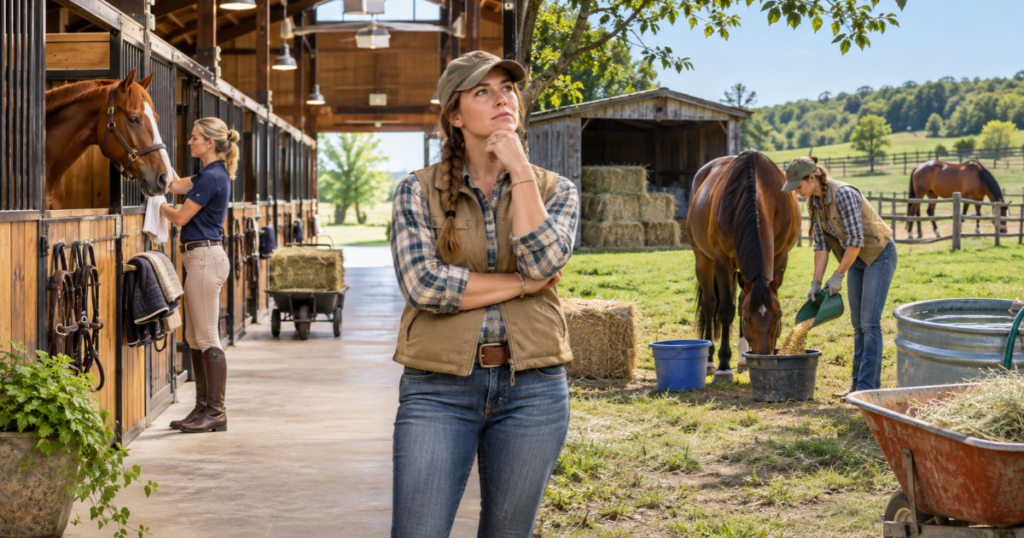
For many Colorado horse owners, the monthly board bill is the biggest line in the horse budget. Sooner or later the question comes up: would it cost less to buy a place and keep the horses at home?
The short answer: Boarding usually costs less for one horse. Keeping horses at home starts to pay off at about two horses when you compare it with Colorado’s median full-board rate of $550 a month, and sooner in higher-priced markets like Loveland or Boulder County. That math assumes your own time is free and treats the property itself as a separate real estate decision.
Below, we break down what boarding costs in Colorado, what keeping a horse at home costs line by line, and where the break-even point falls, using current USDA hay prices and published Colorado boarding rates.
Board Your Horses or Keep Them Home? Cost Comparison
Quick Summary: Boarding vs. Home at a Glance
- Colorado board runs about $525 a month at the median: Board and Stable's November 2026 count of 78 Colorado barns that publish rates puts most between $345 and $795, with a $550 median for barns that offer only full board.
- Hay is the biggest cost of keeping horses at home: USDA's November 5, 2026 Colorado hay report lists bundled small squares of grass and alfalfa hay at about $14.50 to $16 a bale at retail in northeast Colorado. A 1,000-pound horse eating 2 percent of its body weight goes through about 120 sixty-pound bales a year.
- Break-even arrives at about two horses: In our worked example, keeping one horse at home costs about $3,150 a year more than median full board. Two horses save about $950 a year, and four save about $9,150.
- Pleasure horses don't lower your property taxes: Colorado assessors and courts have held that grazing pleasure horses does not qualify land for agricultural classification.
Boarding vs. Keeping Horses at Home: Side-by-Side Costs
Boarding bundles feed, labor, and facilities into one monthly fee. At home, you pay each of those separately, plus the cost of owning the place.
| Cost | Full-Care Boarding | Keeping Horses at Home |
|---|---|---|
| Monthly fee | Median about $525 to $550 in Colorado | None |
| Hay and feed | Usually included; ask whether hay is capped | You buy and store it; about $1,900 per horse per year in our example |
| Bedding, minerals, utilities | Usually included | You pay; about $600 per horse per year in our example |
| Daily labor | Included | Your time, twice a day, every day |
| Barn, fencing, equipment | The barn's cost | Yours to build, insure, and repair |
| Farrier and vet | You pay | You pay the same either way |
| Arena, trainer, trails | Often on site | Only what you build or can reach |
| Property taxes | Not affected | Pleasure horses don't qualify land for ag classification |
1. How Much Does Horse Boarding Cost in Colorado?
Horse boarding in Colorado has a median rate of about $525 a month, or roughly $6,300 a year, and most barns charge between $345 and $795. Full-care barns near Denver and Boulder sit at the top of that range or above it, while pasture board on the eastern plains costs the least.
What the Numbers Show
Board and Stable tracked 78 Colorado barns that publish monthly rates as of November 2026. Among barns offering only full board, the median was $550. Published rates ran from $200 a month in Peyton to $3,200 in Littleton, and the city medians ranged from $425 in Fort Collins to $800 in Loveland.
Competition barns with heated indoor arenas and on-site trainers can cost far more. Our Front Range equestrian living guide covers premium board in more detail.
Types of Board
- Full care: the barn feeds, waters, cleans, and turns out your horse. Hay is usually included.
- Partial care: the barn handles some chores and you handle the rest, often for a lower fee.
- Pasture board: your horse lives in a pasture with a shared shelter, usually the cheapest option.
- Self-care: you rent the space and do all the feeding and cleaning yourself.
Questions to Ask About Extras
Board and Stable advises asking whether hay is included and capped, and whether winter blanketing or arena use costs extra. Trailer parking, lessons, training rides, and holding your horse for the vet or farrier can also add to the monthly bill.
2. What Does It Cost to Keep a Horse at Home?
The day-to-day cost of keeping one horse at home in Colorado runs about $2,500 a year in our worked example, and hay is about three-quarters of it. That figure covers feed, bedding, and utilities only. The barn, fencing, and your time come on top of it.
Hay
University of Minnesota Extension notes that a 1,000-pound horse eats about 2 percent of its body weight a day, or roughly 20 pounds of hay. That adds up to about 7,300 pounds, or 3.65 tons, a year.
The USDA Colorado Direct Hay Report for November 5, 2026 lists bundled small squares in northeast Colorado at $14.50 for brome, $14.50 to $15 for alfalfa, and $16 for timothy, with premium prairie grass trading at $12.75 a bale in the southeast. At $14.50 for a 60-pound bale, a year of hay costs about $1,770. Allowing for some waste brings it to about $1,900 per horse.
The same report puts Colorado diesel at about $6.31 a gallon, up $2.69 from a year earlier, which shows up in delivery charges and in your own trips to haul hay.
Bedding, Minerals, and Utilities
Shavings for stalls, salt and mineral blocks, fly control, and electricity for heated waterers and lights add up. Our worked example budgets about $600 per horse per year. Horses kept in pens with run-in shelters use much less bedding than stalled horses.
Farrier and Vet: The Same Either Way
Trims, shoes, vaccines, dental work, and deworming cost the same whether your horse boards or lives at home, so they don't change the comparison. Budget for them anyway. One veterinarian quoted by The Horse estimated that routine care, including vaccinations, a dental exam, and a Coggins test and health certificate, approaches $1,500 a year.
3. What Are the Fixed Costs of Owning Horse Property?
The fixed costs of keeping horses at home are the barn, fencing, equipment, water, insurance, and upkeep you pay for whether you own one horse or four. Spreading those costs across more horses is what makes keeping them at home pay off.
Barns and Shelters
A Colorado pole-barn builder puts a basic two- to three-stall barn at about $70,000 to $100,000, depending on size and finish. Our worked example spreads an $85,000 barn over 20 years, or $4,250 a year. Many owners start with run-in sheds and pens, which cost far less.
Fencing, Equipment, and Repairs
Fence repair, a tractor or utility vehicle, a manure spreader, gates, and waterers all wear out. Our worked example budgets $2,000 a year for repairs and replacement, plus $1,000 for liability coverage and manure removal.
Water
Check the well permit before you buy. CSU Extension explains that most Colorado wells drilled on or after May 8, 1972 on parcels under 35 acres are permitted for household use only, which does not allow watering livestock.
Property Taxes
Keeping your own horses does not earn agricultural tax status in Colorado. In Palmer v. Board of Equalization of Eagle County (1998), the Colorado Court of Appeals held that grazing and boarding pleasure horses is not a ranching use, because the horses are not used for food, breeding, draft, or profit. The Douglas County Assessor states the same rule on its classification questionnaire.
The Land Itself
Horse-zoned acreage costs more than a comparable house on a city lot, but it is also a real estate asset that can appreciate. We treat it as its own decision in Boarding Horses vs. Buying Property in Colorado and Do Horse Properties Appreciate Like Regular Homes?
4. How Many Horses Does It Take to Break Even?
At Colorado's median full-board rate, keeping horses at home breaks even at about two horses. Below that, boarding costs less; above it, every added horse saves you about $4,100 a year, because the barn, fencing, and upkeep are already paid for.
| Herd size | Full board | At home |
|---|---|---|
| 1 horse | $6,600 | $9,750 |
| 2 horses | $13,200 | $12,250 |
| 3 horses | $19,800 | $14,750 |
| 4 horses | $26,400 | $17,250 |
The Assumptions Behind the Chart
| Item | Annual Amount | Basis |
|---|---|---|
| Full-care board | $6,600 per horse | $550 a month, the Colorado full-board median |
| Barn, spread over 20 years | $4,250 | Midpoint of a $70,000 to $100,000 barn |
| Repairs and equipment | $2,000 | Our planning estimate |
| Liability coverage and manure removal | $1,000 | Our planning estimate |
| Hay | $1,900 per horse | 20 pounds a day at $14.50 a bale, plus waste |
| Bedding, minerals, utilities | $600 per horse | Our planning estimate |
The example leaves out three things that are the same in both cases or are better judged on their own: farrier and vet care, the price of the land, and your time.
How Your Local Board Rate Changes the Answer
The break-even point moves with what boarding costs near you. Using the same home costs, it drops to about one horse at Loveland's $800 median and rises to about three horses at Fort Collins' $425 median. Swap in your own barn's rate and your own hay price before you decide.
5. What Is Your Time Worth?
The biggest cost the chart leaves out is your labor. Boarding fees pay someone else to feed, water, and clean every day; at home that work is yours, twice a day, 365 days a year, including Christmas morning and the week of a blizzard.
Daily and Seasonal Chores
Morning and evening feeding, checking water, and cleaning stalls or pens are the daily baseline. On top of that come stacking hay at harvest, dragging pastures, fixing fence after wind storms, and keeping waterers thawed through a Colorado winter.
Coverage When You're Away
Every trip, illness, or long workday needs a plan for who feeds the horses. Line up a reliable neighbor or paid horse sitter before you need one, and include that cost in your budget.
Putting a Number on It
If you'd rather spend those hours riding, working, or with family, multiply your weekly chore time by what an hour of your time is worth to you. If that figure is larger than the savings in Section 4, boarding may still be the better deal even with several horses.
6. What Matters Besides Cost?
Beyond the numbers, the choice comes down to companionship for your horse, how closely you want to watch its care, and whether you need an arena, a trainer, and a riding community close by.
Horses Need Company
Horses are herd animals, and most do poorly living alone. If you bring one horse home, plan for a second horse or another companion animal. That second animal is one reason the two-horse break-even matters in practice.
Watching Care Closely
At home, you see your horses every day. You notice right away when one leaves its hay, stands off by itself, or comes up lame, and you control the hay, the turnout, and the feeding schedule.
Facilities, Trainers, and Community
A good boarding barn may offer an indoor arena, a trainer, trail access, and other riders to ride with. Building an indoor arena at home is a major expense, and Colorado winters make one hard to do without if you ride seriously year-round.
Emergencies
At a boarding barn, staff are usually on site. At home, you need a trailer that's ready to go, a vet you can reach after hours, and an evacuation plan, especially on wildfire-prone ground.
7. Which Option Makes Sense for You?
Board if you have one horse, travel often, or depend on an arena and trainer. Keep horses at home if you have two or more, want daily hands-on care, and plan to stay on the property long enough for the barn and fencing to pay for themselves.
Boarding Usually Wins If...
You own one horse, ride mostly in lessons or with a trainer, can't commit to chores twice a day, or expect to move within a few years.
Keeping Horses at Home Usually Wins If...
You own two or more horses, live in an area where board runs above the state median, enjoy the daily work, and want land as a long-term investment.
How It Affects the Property You Buy
If you plan to keep horses at home, the property has to support it. Look for a livestock-approved well, safe fencing, shelter, a dry place to store hay, and room for a sacrifice area. Existing improvements can save tens of thousands of dollars over building from scratch, and well-kept horse facilities widen your pool of buyers when you sell. Our guide on how to calculate ROI on a working ranch walks through valuing those improvements.
We Help Colorado Riders Run the Numbers
Deciding whether to keep boarding or buy a place for your horses is a budget question and a real estate question at the same time.
When Mark Eibner's team works with you, we help you compare your current board against the real cost of a specific property: the well permit, the barn and fencing already in place, the hay storage, and what the land is likely to be worth when you sell. We'll show you properties that fit your herd size, not just your house wish list.
Contact us today at coloradohorseproperty.com to find premium horse properties Colorado buyers trust.
Browse active Colorado horse ranches for sale or search by location with our Search by County and Search by City tools.
About the Author
Mark Eibner is broker/owner of Realty Oasis and leads Team Eibner with MB Metro Brokers. His team represents buyers and sellers of horse and acreage property across the Denver metro and Colorado Front Range.
Frequently Asked Questions (FAQ) About Boarding vs. Keeping Horses at Home
Is it cheaper to board a horse or keep it at home in Colorado?
For one horse, boarding is usually cheaper, because the barn, fencing, and equipment you need at home cost about the same for one horse as for several. In our worked example, keeping horses at home breaks even at about two horses against Colorado's $550 median full-board rate, and every horse after that saves roughly $4,100 a year, before counting your time.
How much does it cost to board a horse in Colorado?
Board and Stable's November 2026 data on 78 Colorado barns that publish rates shows a median of $525 a month, with most between $345 and $795. Barns offering only full board had a $550 median. Rates vary by city, from a $425 median in Fort Collins to $800 in Loveland, and premium competition barns charge more.
How much hay does a horse eat in a year?
A 1,000-pound horse eats about 2 percent of its body weight a day, or roughly 20 pounds of hay. That works out to about 3.65 tons, or about 120 sixty-pound small square bales, a year. Plan for extra to cover waste and winter, when horses need more feed to stay warm.
Can I keep just one horse at home?
You can, but most horses do poorly alone because they are herd animals. Plan on a second horse or another companion animal. Adding that companion also spreads your fixed costs, which is part of why keeping horses at home tends to make financial sense at two horses or more.
Do horses lower my property taxes in Colorado?
Not if they are pleasure horses. Colorado courts and county assessors have held that grazing or boarding horses kept for riding does not qualify land for agricultural classification. Horses can count as livestock only when they are used for food, breeding, draft, or profit, so ask your county assessor before counting on a lower tax bill.
How many acres do I need to keep horses at home?
It depends on whether you plan to graze or feed hay. Many Colorado owners keep horses on a few acres with a dry lot and feed hay year-round. If you want pasture to supply most of the feed, an Extension expert has suggested about 25 acres of dryland pasture per horse. Check county zoning too, since many counties limit animals by lot size.
Sources
- Board and Stable: Colorado horse boarding costs
- University of Minnesota Extension: Managing and composting horse manure
- USDA: Colorado Direct Hay Report
- The Horse: Routine horse care costs
- Peak Pole Barns: Boarding costs compared with building
- CSU Extension: Colorado well permits
- Palmer v. Board of Equalization of Eagle County (1998)
- Douglas County Assessor: Agricultural Land Classification Questionnaire