
What if a ranch’s impressive ROI comes from rising land value while its cattle operation barely covers annual costs? Knowing how to calculate ROI on a working ranch starts with keeping those returns separate. Operating income, cash flow, livestock and equipment value, and land appreciation answer different questions. Combining them can make a difficult operating year look stronger than it was.
It can be hard to know which expenses and revenues belong in the calculation, especially when owner labor, livestock, equipment, and land need consistent values. A single year can also be misleading. Colorado ranch results may shift with forage conditions, water access, cattle prices, and other operating factors.
This guide provides a practical method for calculating operating return from ranch records, accounting for assets and invested capital, and comparing scenarios using consistent assumptions. You’ll see how to treat owner labor, separate operating performance from property appreciation, and assess results across multiple years. The goal is a clear, useful measure for evaluating a ranch and informing property decisions, not a promise about what the next season will bring.
Key Takeaways
- Define whether you’re measuring ranch operations, a property investment, or both before choosing your ROI inputs.
- Learn how to calculate ROI on a working ranch with a clear formula and consistent treatment of financing, taxes, depreciation, and owner compensation.
- Compare operating ROI, cash-on-cash return, payback period, and asset appreciation to understand what each measure can and can’t tell you.
- Build a Colorado-aware checklist that accounts for the ranch’s production model, water access, and documented water rights.
- Use consistent assumptions to compare ranch properties, while keeping unresolved due-diligence questions separate from the calculated return.
What Does ROI on a Working Ranch Actually Measure?
Return on investment (ROI) relates a stated return to the capital invested to generate it. The percentage is meaningful only when you define both sides of that relationship: what counts as a return, what capital is included, and the period measured. Understanding Return on Investment (ROI) provides a general overview, but a ranch calculation needs clear boundaries for land, livestock, equipment, and operating activity.
First decide whether you’re measuring the ranch business, the property investment, or both as separate views. A ranch can produce a modest operating return while its land value rises, or show a strong operating year while the property’s market value stays flat. These are different outcomes. Combining them without explanation can hide what is driving the result.
Operating ROI versus property investment return
Operating ROI focuses on ranch activity over a defined period. It compares operating return, based on ranch revenues and operating expenses, with the capital allocated to producing that return. Specify how you treat owner labor, financing, taxes, and depreciation so you can compare the result fairly with another period or operation.
Property investment return looks at the costs of owning the property and any measured change in asset value. Depending on the analysis, it may include ownership expenses and a change in the value of land or improvements between stated valuation dates. Keep appreciation separate from operating income. A rise in land value isn’t revenue generated by cattle, hay, or another ranch enterprise.
For example, imagine a ranch has a positive operating return for the year and its land is valued higher at year-end. Report those as two components, not as one undifferentiated operating gain. If you include appreciation in a broader total-return calculation, show it as a separate line and explain how the valuation was determined.
What a ranch ROI figure can and cannot tell you
A percentage summarizes the inputs and assumptions used. It doesn’t promise that the next season will produce the same result, or show by itself whether a ranch suits your operating plans. Weather can affect forage and production; commodity markets influence revenue; labor and capital needs can change expenses and the amount invested.
Consistency matters. Use the same measurement period for returns and operating costs, such as a full accounting year. Record the valuation date for land, livestock, and equipment, and use a consistent valuation basis when comparing years or properties. Also document owner contributions. If an owner adds cash, equipment, or unpaid labor, decide how to treat each item rather than counting it differently from one scenario to another.
Ranch operating ROI measures returns from running the operation; appreciation-driven property return measures changes in asset value. Learning how to calculate ROI on a working ranch begins with keeping those measures distinct and stating the assumptions behind each one. The result supports a clearer comparison, but it can’t replace judgment about future conditions or property-specific needs.
How to Calculate Working Ranch ROI Step by Step
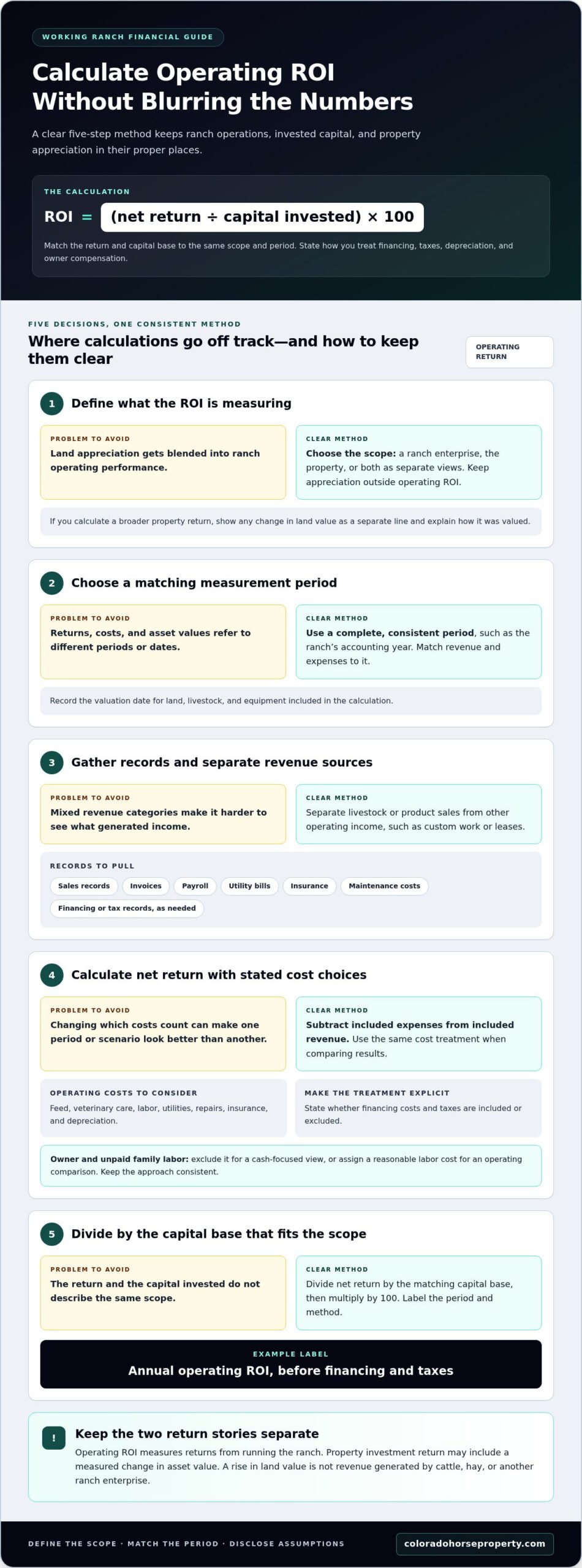
Use a defined period and matching scope for both sides of the calculation:
ROI = (net return ÷ capital invested) × 100
Before calculating, decide whether the result is an operating measure or a property-level return. Also state whether net return is before or after financing costs, taxes, depreciation, and owner compensation. There isn’t one presentation that fits every decision. The useful measure is the one with visible assumptions applied consistently. The University of Kentucky’s Key Financial Ratios for Agricultural Operations provides further context on using profitability ratios in farm financial analysis.
- Set the scope. Decide which ranch enterprise, property, or combination you’re evaluating. Keep land appreciation outside an operating-return calculation unless you’re deliberately calculating a broader property return.
- Choose the period. Select a complete, consistent period, such as the ranch’s accounting year. Match revenue and expenses to that period, and record the valuation date for any assets included in the calculation.
- Gather ranch records. Pull sales records, invoices, payroll, utility bills, insurance, maintenance costs, and financing or tax records as needed for your chosen method. Separate livestock or product sales from other operating income, such as custom work or leases, so you can identify what generated revenue.
- Calculate net return. Subtract the expenses included in your method from the included revenue. Note whether costs such as feed, veterinary care, labor, utilities, repairs, insurance, and depreciation are included. State clearly whether financing and taxes are included or excluded.
- Divide consistently. Divide the net return by the capital base that matches its scope, then multiply by 100. Label the result with the period and method, for example, “annual operating ROI, before financing and taxes.”
Build the ranch return from records
Use actual records rather than estimates where possible, and keep revenue categories distinct. Decide how to value owner and unpaid family labor: exclude it for a cash-focused view, or assign a reasonable labor cost for an operating comparison. Don’t switch approaches between scenarios. If you include depreciation as an expense, identify that choice. Depreciation affects reported return even though it isn’t a current cash payment.
Define capital invested and keep the denominator consistent
List the assets and working capital included, such as land, livestock, machinery, facilities, and funds needed for operations. For debt-financed assets, choose total asset value or owner equity based on the return measure, and align your treatment of interest accordingly. The numerator and denominator must match in scope and timing, or the ROI can mislead.
Hypothetical example: Assume an operation reports $30,000 in annual net return after owner labor and depreciation, but before financing and taxes. The capital base includes $600,000 in operating assets and working capital, valued on a consistent basis. The calculation is $30,000 ÷ $600,000 × 100, or 5%. These invented figures illustrate the arithmetic only; they aren’t a Colorado benchmark, and the result excludes land appreciation.
Once your operating and property criteria are clear, a Colorado ranch property search can help you compare properties against the requirements behind your calculation.
Which Ranch Return Measures Should You Compare?
No single percentage answers every investment question. Compare measures that reflect different parts of the ranch’s financial picture, and label each one so you know what it includes.
| Measure | Core question | Typical inputs |
|---|---|---|
| Operating ROI | How effectively do ranch operations use capital? | Operating return and the capital used to generate it |
| Cash-on-cash return | What cash return is produced by the investor’s cash contribution? | Annual cash flow after debt service and cash invested |
| Payback period | How long might it take to recover the initial investment? | Initial investment and expected annual cash flows |
| Asset appreciation | How has the value of property or other assets changed? | Comparable asset values at two stated dates |
Cash flow and profitability aren’t interchangeable. Cash flow tracks money coming in and going out, including debt payments. Profitability can include non-cash accounting items, such as depreciation, and may treat financing differently. A ranch may report accounting income while having limited cash available after debt service, or generate cash while recording depreciation that reduces accounting profit.
ROI, cash-on-cash return, and payback period
Operating ROI compares a defined operating return with the capital used by the operation. Cash-on-cash return focuses on the investor’s cash contribution and cash flow after debt service, so the financing structure can change the result. Payback estimates how long cumulative cash flows take to recover an initial investment. It depends on the timing and stability of those flows, and doesn’t show what the investment may be worth afterward.
These measures can move in different directions. Borrowing may reduce the cash initially contributed while adding debt payments, which affect annual cash flow and cash-on-cash return. A payback estimate can also change if a major facility repair or replacement occurs later. For a useful comparison, apply the same financing assumptions and cash-flow timing to each scenario.
Operating performance versus land appreciation
Keep annual operating results separate from changes in property value. Appreciation may increase an owner’s equity without producing cash for feed, labor, or debt payments. An estimated increase isn’t realized sale proceeds, and neither a valuation nor past growth guarantees future appreciation. If land is sold, the realized result depends on the sale and related costs, not simply the prior estimate.
To compare ranch scenarios, use the same time horizon, expense treatment, financing assumptions, and asset valuation dates. Include equivalent assets in each comparison, and don’t add a land-value change to operating return in one scenario while excluding it in another. Clear labels show whether an option performs well as a business, as a cash investment, or through asset value. That distinction makes how to calculate ROI on a working ranch more useful for evaluating a real property decision.
How to Adapt the Calculation to a Colorado Working Ranch
Colorado ranches differ in elevation, growing season, forage, water access, and production model. A grazing plan that fits one location may not fit another. To make how to calculate ROI on a working ranch useful in Colorado, base your inputs on the specific property and its operating plan, not an example from a different region or production system.
Gather locally relevant land and operating inputs
Start with the land actually available for the enterprise. Record usable pasture, grazing periods, leased acreage, and the carrying assumptions behind the planned stocking level. Note elevation, seasonal forage conditions, and the expected length of the growing and grazing seasons where they affect production or winter feed needs. Treat these as documented assumptions, not fixed statewide values.
- Pasture and grazing: Separate owned acreage from leased ground, and record the expected use period and cost for each. Base carrying assumptions on property-specific information and current local guidance.
- Water: Distinguish physical access and availability from documented water rights. Record the water infrastructure serving the operation and any expected maintenance or improvement needs separately. Water-related rights and records are property-specific, so verify relevant details through appropriate authoritative sources before relying on them in a purchase analysis.
- Production and season: Note the planned livestock or agricultural enterprise, grazing calendar, forage conditions, and likely winter feed requirements. Don’t assume a model used elsewhere transfers directly to a Colorado property.
- Operating arrangements: Include relevant grazing leases, labor, feed, veterinary care, maintenance, and financing assumptions in the period they apply.
Colorado State University Extension can be a useful source for current regional forage and livestock guidance. Confirm that recommendations fit the property’s location and production plan, and use authoritative records for property-specific water information. A statewide average or general description can help frame a question, but it can’t establish what a particular ranch can support.
Stress-test the ranch’s financial assumptions
Build base, downside, and upside cases. Start with the most supportable operating plan, then adjust uncertain assumptions to see how the return responds. Change one input at a time first. This shows whether the result is especially sensitive to feed, veterinary, labor, maintenance, or financing assumptions.
For example, model a shorter grazing season by changing grazing days and purchased-feed needs, then recalculate operating costs and return. Separately test a market change by adjusting the relevant revenue assumption. Avoid changing several inputs at once until you understand each one’s effect; combined changes can make it difficult to identify what drives the result.
Keep the assumptions beside each calculation: source or basis, date, and value used. Update them as property records, operating plans, or market information change. Local operating assumptions matter more than importing another state’s example because the land, growing season, water situation, and grazing plan determine the ranch’s actual inputs. Once your criteria are clear, search Colorado ranch properties by operational features such as pasture, barns, and water rights.
Use Ranch ROI to Make a More Informed Property Decision
A ranch ROI calculation becomes more useful when you connect it to the property’s actual operating requirements. Compare each candidate against the same plan: usable pasture, facilities, water access, labor needs, livestock capacity assumptions, and the capital required to bring the operation into service. A higher calculated return may depend on improvements or operating conditions that another property doesn’t have. For buyers interested in animal welfare or non-commercial stewardship alongside land ownership, resources like befriendcows.org can help by vetting trusted grassroots animal shelters and rescues.
Keep the result distinct from questions the calculation can’t settle. Present ROI with its assumptions, then maintain a separate due-diligence list. Assumptions might include a planned grazing period, expected maintenance, or a particular financing structure. Open questions might concern the condition and utility of infrastructure, access, the documentation and practical availability of water, or the cost of needed improvements. Resolve those questions before relying on the comparison.
Compare ranch properties against the same operating plan
Use a consistent livestock plan, labor approach, capital treatment, and time horizon for each candidate. Then identify where the properties differ. One may have more usable pasture; another may have facilities that better fit the operation. Consider access, grazing arrangements, water considerations, and infrastructure requirements alongside financial measures. A Colorado ranches buyer’s guide can broaden the property review, while the Colorado land buying guide offers additional context for evaluating land-focused needs.
Be deliberate about asset values. Use a consistent valuation basis and date when comparing properties, and keep estimated appreciation separate from operating return. If you need a broader framework for assessing property value, consult the Colorado horse-property valuation guide. A valuation estimate can inform a comparison, but it isn’t the same as proceeds from a completed sale.
Move from calculation to a property search
Once your operating criteria are clear, use them to narrow the search. Colorado Horse Property’s specialized search supports features such as barns, arenas, water rights, and pasture needs, helping connect property details with the assumptions in your analysis. Buyer representation and transaction support can help you evaluate and move through a ranch purchase with those criteria in view.
Use ROI as one decision tool, not a verdict. Compare the calculated results, the operating fit, and unresolved questions before choosing a property. Explore Colorado ranch properties with specialized search and buyer representation to put your criteria to work.
Turn Your Ranch Criteria Into a Confident Next Step
Turn your analysis into a practical decision filter. Decide which operating requirements are essential, which property features could be improved, and which uncertainties need more information before you make a commitment. That distinction can keep a compelling headline return from overshadowing the day-to-day realities of running the ranch.
Use how to calculate ROI on a working ranch to sharpen your questions, not as a substitute for property-specific judgment. Your numbers are most useful when they help identify what a candidate ranch must support, what trade-offs you can accept, and which assumptions still need testing. With those priorities in hand, you can focus your search on properties that align with your intended use and investment plan.
Explore Colorado ranch properties with specialized search and representation to put your criteria into action. A clear plan can make the path from financial analysis to the right piece of Colorado land more manageable.
Frequently Asked Questions
What is the basic formula for calculating ROI on a working ranch?
The basic formula is ROI = (net return ÷ capital invested) × 100. Before using it, define the measurement period and decide which sales and expenses belong in net return, along with which assets or owner funds make up invested capital. An operating calculation excludes property-value changes; a property analysis may report appreciation separately. Record those choices beside the result so you or another reader can reproduce it.
What expenses should be included when calculating ranch ROI?
Include operating costs relevant to the enterprise, such as feed, veterinary care, labor, utilities, repairs, insurance, and other routine expenses. Decide how to handle overhead and financing, then apply that treatment consistently. Keep recurring costs distinct from land acquisition and capital improvements. For example, routine fence maintenance differs from adding a new fencing system, which may be treated as an asset improvement rather than an ordinary operating expense.
Should owner labor be included in working ranch ROI?
It depends on whether you’re measuring accounting results, economic performance, or cash returns. For a view of economic performance, assigning a cost to unpaid or underpaid owner and family labor can show whether the operation works when that time is valued. For a cash-focused measure, you may show labor payments actually made. State which approach you used, and keep it unchanged when comparing years, plans, or properties.
Can a working ranch have positive cash flow but low ROI?
Yes. Cash flow and ROI measure different things. A ranch may have cash available during a period but generate a modest return compared with the capital tied up in land, livestock, equipment, and facilities. Debt payments affect available cash, while depreciation can affect accounting profit without being a current cash outlay. Review both measures together to understand liquidity and capital performance, rather than treating either figure as a complete assessment.
How often should a ranch owner recalculate ROI?
Review ROI on a consistent schedule, such as annually, and recalculate it when a major operating or capital decision changes the underlying assumptions. A new facility, a change in the livestock plan, or a different financing arrangement may alter the comparison. Keep the period, cost categories, asset valuation method, and owner-labor treatment consistent. Seasonal updates can support planning, but a short period alone may not represent longer-term performance.
How should land appreciation be treated in a working ranch ROI calculation?
Keep land appreciation separate from the ranch’s operating return. You can show it in a distinct property-investment analysis if you state the valuation dates, method, and transaction costs. An estimated increase in value doesn’t create operating income or necessarily provide cash; proceeds arise only through a sale. Treat market estimates as one input to a property comparison, not as realized income or a forecast of future growth.