
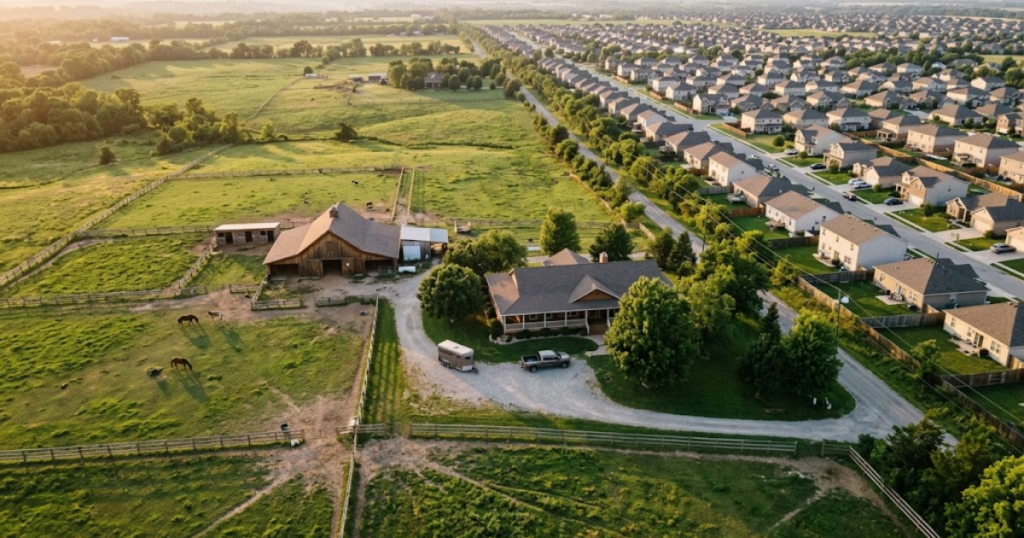
You read local real estate headlines and see suburban home values across the Colorado Front Range have climbed steadily over the last decade. You look out at your custom twenty-acre horse property, tally what you spent building an indoor arena, adding custom timber stalls, and installing automatic heated waterers, and assume your farm has seen the same percentage growth in equity.
When you prepare to list your property or refinance your mortgage, however, you receive an unpleasant surprise. The appraiser delivers a valuation that seems shockingly low compared to the price gains seen in nearby suburban subdivisions.
When searching for horse properties in Colorado, buyers and investors constantly ask whether an equestrian estate is a reliable wealth-building vehicle. The short answer is that horse properties do appreciate, but not like regular residential homes.
A suburban tract house is an easily quantifiable, predictable asset class where appreciation is tied to school districts, neighborhood comps, and square footage. An equestrian facility, by contrast, is a hybrid asset, part residential dwelling, part raw agricultural land, and part specialized commercial facility.
To understand how your rural equity grows and how to position your ranch for maximum financial appreciation, you must look at the distinct economic forces driving equestrian real estate in Colorado.
Do Horse Properties Appreciate Like Regular Homes?
Quick Summary: The Appreciation Reality
- Land Versus Structure Divergence: In Colorado, raw dirt and water generally appreciate faster than suburban residential lots, but specialized equestrian outbuildings depreciate quickly from wear and tear and limited utility.
- The Appraisal Gap and Buyer Pool: Horse properties have a much smaller buyer pool than tract homes, so appreciation is rarely linear and depends heavily on finding a buyer whose equine discipline matches the existing infrastructure.
- The Carrying Cost Drag: Maintaining miles of fencing, private roads, septic systems, and indoor arenas requires ongoing capital expenditure, which eats into net investment returns compared to standard suburban housing.
- The Encroachment Premium: Properties in transitional counties like Douglas, Weld, or Elbert often see massive land appreciation as suburban development expands outward, turning agricultural acreage into high-value development dirt.
1. Land Appreciation Versus Building Depreciation
To understand how horse properties appreciate, separate the dirt from the structures built on it.
In a traditional suburban neighborhood, the physical house typically accounts for eighty to ninety percent of the total assessed property value, while the small parcel of dirt underneath accounts for the remaining ten to twenty percent.
Over time, as home prices climb, the entire package appreciates in unison because the broader residential market demands that specific neighborhood.
The Value of Land
On an equestrian property, that dynamic is flipped on its head. A major portion of your purchase price is tied up in acreage, water rights, and raw dirt.
In Colorado, land is a strictly finite resource. As the state population grows, large contiguous parcels with functional agricultural zoning become increasingly rare and valuable.
Raw acreage in counties like Douglas, Elbert, and Larimer has historically appreciated significantly over the long term because developers, agricultural producers, and lifestyle buyers compete for the same limited inventory.
The Depreciation of Specialized Infrastructure
The outbuildings, however, tell the opposite story. While the land itself is gaining value, specialized equine infrastructure is actively depreciating.
Barns, arenas, loafing sheds, and paddocks take a beating from weather, dust, and heavy animals.
These outbuildings also suffer from what appraisers call functional obsolescence. If you build a half-million-dollar reining arena with specialized sliding tracks, a dressage rider buying your farm will not pay full replacement value because it does not match their training needs.
While the land appreciates, your outbuildings can drag down your total valuation unless they are meticulously maintained and broadly designed.
2. Buyer Pool Economics and the Liquidity Premium
Suburban tract homes are highly liquid financial assets. If you price a three-bedroom house correctly in an active market, thousands of qualified buyers can purchase it.
The buyer pool is deep, competition is high, and bidding wars quickly drive appreciation.
Equestrian properties operate in a shallow, highly specialized buyer pool. Only a tiny fraction of the general homebuying population has the financial capital, livestock knowledge, and equipment necessary to manage a working farm.
When you limit your market to horse owners, you narrow that pool even further by riding discipline. A hunter-jumper trainer, a western team roper, and a casual trail rider all require completely different facilities.
The Illiquidity Discount
Because the buyer pool is small, horse properties carry an illiquidity discount.
During economic booms, luxury ranch values can surge as affluent buyers seek rural sanctuaries. However, during market corrections or periods of high interest rates, equestrian listings can sit on the market for months or years.
You cannot capture appreciation on paper until you find the single buyer who values your specific layout, meaning price appreciation tends to occur in long, staggered plateaus rather than smooth, continuous upward lines.
3. The Hidden Cost of Equity
When comparing the financial returns of horse properties to regular homes, most owners forget to factor in the substantial capital expenditure required to maintain rural equity.
On a standard residential home, maintenance is relatively straightforward. You replace the roof every twenty years, paint the exterior siding every seven years, and service the air-conditioning unit.
On an equestrian property, maintaining the infrastructure is a constant, expensive battle against the elements and livestock.
Fencing Maintenance
Horses lean on fence lines, chew wood boards, and rub against posts. Miles of fencing require constant post replacement, wire tensioning, and repainting to prevent the property from looking run down.
Arena Maintenance
Premium footing degrades over time. Sand breaks down into fine dust, requiring laser grading, base compaction, and the periodic importation of fresh sand or expensive synthetic fibers like GGT footing.
Road and Driveway Upkeep
Heavy hay trucks and multi-horse gooseneck trailers quickly destroy private roads, demanding thousands of dollars in gravel delivery, culvert repairs, and tractor grading every spring.
Winter Mechanicals
Freezing temperatures destroy water lines, burn out heated waterer elements, and damage barn plumbing if winterization protocols fail.
If you spend $20,000 a year to keep your barns, fencing, and roads in working order, that operational expense directly offsets your appreciation gains.
A suburban home that appreciates five percent a year with minimal maintenance often delivers a better net financial return than a farm that appreciates at the same rate on paper.
4. The Encroachment Premium in Growth Corridors
While specialized outbuildings can drag down returns, one scenario can make horse properties appreciate at rates that leave regular homes behind: suburban encroachment.
Across the Colorado Front Range, suburban sprawl is continuously pushing eastward and southward into historic ranching country.
Towns like Parker, Elizabeth, Castle Rock, and Berthoud were once isolated agricultural hubs. Today, master-planned residential communities and commercial shopping centers border long-standing horse farms.
If you own a twenty- or forty-acre equestrian property directly in the path of municipal growth, your appreciation is no longer tied to agricultural sales. Instead, your property becomes speculative development land.
The Development Land Premium
Developers will pay an astronomical premium for large parcels that feature road access and proximity to municipal water lines.
In these transitional zones, the value of the dirt skyrockets, making the barns and houses almost irrelevant.
Many longtime Colorado ranch owners have generated life-changing generational wealth simply by holding acreage on the urban fringe until municipal expansion transformed their pastures into valuable commercial or residential development tracts.
5. Water Rights as an Independent Growth Driver
In standard real estate, water supply is a utility bill that adds nothing to a home's equity. In Colorado rural real estate, water is an independent, highly appreciating asset.
Because Colorado operates under the Prior Appropriation Doctrine, water rights are treated as separate, deeded real property.
As municipal demand for water rises to sustain growing Front Range cities, the open-market value of historic surface water rights and ditch company shares has climbed exponentially.
Senior Water Rights and Ditch Shares
If your horse property includes senior decreed water rights, adjudicated storage rights, or mutual ditch shares, that water portfolio often appreciates much faster than the land itself.
Cities and private water brokers frequently purchase agricultural water rights from rural properties, sometimes leasing the water back to the owner or transferring it downstream.
The Cost of Vulnerable Water
Conversely, a horse property with a vulnerable water situation, such as a low-yielding well or an exempt permit restricted strictly to household use only, will see its appreciation severely capped.
As buyers become more educated about western water shortages, properties with guaranteed, legal livestock water command a massive valuation premium.
6. Zoning Protection and Animal Density Scarcity
Another reason horse properties retain and grow value over long time horizons is the increasing scarcity of permissive agricultural zoning.
As counties become more urbanized, local governments routinely tighten land-use regulations. Counties are enacting stricter animal-density limits, requiring larger minimum lot sizes to keep livestock, and imposing heavy restrictions on building commercial barns or riding arenas.
When a county changes its zoning codes to make keeping horses more difficult, existing equestrian properties with grandfathered agricultural rights or favorable zoning classifications, such as Agricultural One or Large Rural Residential, become rare commodities.
Buyers who want to keep four, six, or eight horses are legally boxed out of newer subdivisions and must seek older, established farms with the zoning to accommodate their herd.
This regulatory scarcity creates a protective floor under horse property valuations, shielding them from the steep price drops that can impact oversaturated residential neighborhoods.
7. How to Maximize Appreciation
To maximize appreciation on your equestrian estate, make strategic, disciplined decisions about improvements and maintenance.
Avoid Hyper-Specialization
Do not build facilities that only serve one obscure equestrian discipline.
Build barns with standard 12-by-12-foot stalls that can be easily reconfigured. Construct arenas with standard, functional dimensions that appeal to both English and Western riders.
Design outbuildings that can double as car storage, workshops, or boat storage if a non-equestrian buyer tours the home.
Protect Your Legal Infrastructure
Never build an outbuilding without county permits. Unpermitted arenas and barns cannot be assigned positive value by mortgage appraisers and will destroy your resale potential.
Ensure your well permit allows for Domestic and Livestock use, and keep detailed records of your well flow tests and septic pumping history.
Maintain Visual Curb Appeal
Neglected fencing, rusted gates, and mud-filled paddocks create a psychological discount in a buyer's mind.
Invest in durable, low-maintenance fencing materials like pipe rail or coated wire, grade your driveways regularly, and maintain dedicated sacrifice lots to preserve your front pastures.
A property that looks tidy, safe, and turnkey will always capture top-of-market pricing.
We Know the Economics of Colorado Land
Valuing a horse property requires an agent who looks past residential comps and understands agricultural equity, water appreciation, and rural development trends.
When Mark Eibner's team represents you, we help you understand your investment's true financial trajectory. We analyze the underlying land value, evaluate the replacement cost of your infrastructure, verify your water rights, and assess local municipal growth patterns.
We ensure that you buy land positioned for long-term wealth preservation. When you are ready to sell, we know how to defend your equity against standard appraisers who fail to understand the value of rural infrastructure.
Contact us today at coloradohorseproperty.com to find premium horse properties Colorado buyers trust.
Browse active Colorado horse ranches for sale or ask our team about finding a functional horse property for rent in Colorado. You can also explore the investment potential of rural real estate.
Frequently Asked Questions (FAQ) About Horse Property Appreciation
Do horse properties appreciate more slowly during economic recessions?
Typically, yes. Because horse properties are luxury lifestyle assets with high monthly operating costs, discretionary demand softens during broader economic downturns. Luxury ranch properties often sit on the market longer and see deeper price adjustments during recessions than entry-level suburban homes, which essential housing demand supports.
Does building a covered or indoor arena guarantee a high return on investment?
Rarely in the short term. While an indoor arena is an incredible amenity that makes a property much easier to sell in Colorado, the cost to build one often exceeds the immediate appraised value it adds. This is known as the appraisal gap. Build an arena for your personal training enjoyment, not as a quick fix to artificially inflate your resale equity.
How much does high-quality equine fencing add to property value?
Fencing rarely adds a dollar-for-dollar increase to an appraisal, but it has a massive impact on marketability and buyer demand. A property that already has safe pipe rail or no-climb wire eliminates a $60,000 capital expense for a prospective buyer. Turnkey fencing helps you sell closer to your full asking price and significantly reduces your days on market.
Can an equestrian property be converted to a commercial business to increase value?
Yes, if the zoning allows it. Properties that secure Conditional Use Permits or commercial zoning to operate public boarding stables, training facilities, or wedding venues can be valued using the income approach rather than the sales comparison approach. If the property generates consistent, verifiable commercial revenue, its valuation can climb significantly above standard residential comps.
Why do appraisers struggle to value horse properties accurately?
Standard appraisers rely on finding three closed sales of similar properties within a one-mile radius over the prior six months. In rural real estate, finding identical properties with the same acreage, barn size, arena quality, and water rights is virtually impossible. Appraisers often have to search across multiple counties, making accurate valuation adjustments difficult unless they specialize in agricultural and rural real estate.