
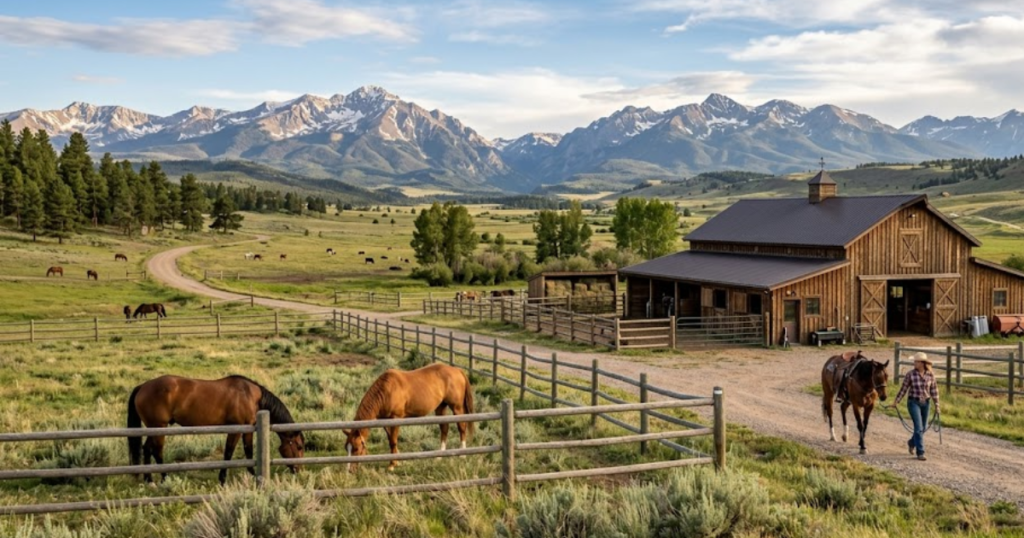
You have a budget of $700,000 and dream of a nice house with a small barn on 5 acres. You start looking in Douglas and Boulder counties, only to find that your budget barely covers a small, aging house on a 1-acre lot with no equestrian facilities.
Frustrated, you expand your search radius 45 minutes straight east out onto the plains. Suddenly, you find a listing for 35 wide-open acres for a surprisingly low price. You buy the land, thrilled by the bargain. But when you start calling contractors, the reality sets in: drilling a 600-foot water well will cost $40,000, bringing electricity down the half-mile driveway costs $25,000, and fencing the perimeter with safe horse wire costs another $30,000. You bought cheap land, but you cannot afford to put your horses on it.
When buyers search for horse properties in Colorado, they are often shocked by the price tags near the major cities. Affordability absolutely exists in Colorado, but it requires a strategic shift in geography and a deep understanding of infrastructure costs.
Here is a breakdown of where to find the most affordable equestrian land and what you need to know before you buy it.
Which Colorado Counties Have the Most Affordable Land for Horse Properties?
Quick Summary: The “Drive Till You Qualify” Reality
- The I-25 Premium: Buyers seeking a horse property within roughly 30 minutes of Denver, Boulder, or Fort Collins will generally pay a substantial location premium in counties such as Douglas, Boulder, and Larimer.
- The Eastern Plains Advantage: Greater affordability is often found by expanding the search east. Elbert County, eastern Weld County, and eastern El Paso County offer larger rural parcels for considerably less than many immediate Front Range locations.
- The Southern Value: Buyers willing to look south of Colorado Springs toward Pueblo, Fremont, and Huerfano counties may find lower prices per acre, along with somewhat milder winter conditions in certain areas.
- The Raw-Land Trap: Cheap land is frequently undeveloped land. A lower purchase price may be offset by the cost of drilling a deep well, extending electricity, improving access, installing septic infrastructure, building shelters, and fencing the acreage safely.
Do not compare properties by purchase price alone. Compare the total cost required to make each property legally habitable, operationally reliable, and safe for horses.
1. The Eastern Plains Shift: Elbert and Weld Counties
Buyers who still need access to Denver or Northern Colorado but are priced out of the immediate suburbs often find their strongest options on the Eastern Plains.
- Weld County, East of Greeley: Western Weld County near Interstate 25 can be expensive, but communities farther east—such as Keenesburg, Briggsdale, and Grover—offer broad open landscapes and potentially more affordable acreage. The tradeoffs often include longer commutes, flatter terrain, fewer trees, and greater wind exposure.
- Elbert County: Located east of Parker and Castle Rock, communities such as Kiowa, Agate, and Simla retain a strong agricultural identity. Buyers may find rolling 35-acre parcels for prices that would purchase substantially less acreage closer to the Denver metro area.
- The 35-Acre Pattern: Exactly 35-acre parcels are common throughout rural Colorado because parcels at or above that size are generally treated differently under state subdivision law. Buyers should still verify subdivision status, zoning, well-permit eligibility, and approved water uses for the specific parcel.
Eastern Plains properties can provide substantially more acreage for the money, but the buyer must account for wind, distance, water depth, limited natural shelter, and the cost of constructing equestrian improvements.
2. The Southern Value: Pueblo and Fremont Counties
Buyers who work remotely or do not require frequent access to Denver may find compelling equestrian value in southern Colorado.
- Pueblo County: Areas east and west of Pueblo, including portions of Pueblo West and Boone, may offer lower land prices than the northern Front Range. Many locations also experience somewhat milder winter conditions and reduced snow accumulation.
- Fremont County: The Cañon City and Penrose areas sit within a comparatively mild regional climate often described as a banana belt. The area combines rural acreage, an established agricultural community, and easier winter management than many high-elevation locations.
- The Forage Tradeoff: Southern Colorado is dry. Buyers may obtain more land for their budget, but native-grass carrying capacity can be low. Many properties will require substantial supplemental hay rather than supporting heavy seasonal grazing.
Evaluate soil, precipitation, pasture species, historic stocking levels, and legal irrigation access before assuming that a larger parcel will materially reduce the annual hay budget.
3. Evaluating the Raw-Land Infrastructure Trap
The least expensive counties frequently contain undeveloped parcels. Before closing, calculate what it will cost to turn the land into a functional horse property.
- The Fencing Equation: A 35-acre parcel has a substantial perimeter. Price the posts, braces, gates, wire, installation labor, equipment access, and ongoing maintenance required for horse-safe fencing.
- Electrical Service: Determine where the nearest utility connection is located. Extending service across a long driveway may require new poles, transformers, trenching, easements, or substantial utility-company fees.
- Road and Driveway Access: Confirm that the existing road and driveway can support hay trucks, horse trailers, well-drilling rigs, septic equipment, fire engines, and construction vehicles in wet and snowy conditions.
- Shelter From the Elements: Affordable Plains parcels often lack mature trees and natural terrain protection. Lightweight shelters may not be adequate for severe wind and blizzard conditions. Budget for engineered windbreaks, run-in sheds, or enclosed barns.
- Septic and Site Work: Raw acreage may require soil testing, engineered septic design, grading, drainage improvements, building permits, and impact fees before residential or agricultural construction can begin.
4. The Hidden Cost of Water
Affordable acreage has little equestrian value if the property cannot provide dependable, legal, and palatable water.
- The Depth-to-Water Risk: Groundwater can be extremely deep in portions of eastern Colorado. A seemingly inexpensive parcel may require a well hundreds of feet deep, creating a major upfront drilling and pump-system expense.
- The Production Test: Well depth alone does not determine performance. Review surrounding well logs and evaluate expected gallons per minute, static water level, recovery rate, pump-set depth, and seasonal drawdown.
- Water Quality: Test for bacteria, total dissolved solids, hardness, sulfur, iron, nitrates, and salinity. Water that is technically available may still require expensive treatment or may be unpalatable to horses.
- The Legal-Use Limitation: Verify exactly what the anticipated or existing well permit allows. Household, domestic, livestock, and irrigation uses are not interchangeable.
- The Cistern Alternative: On a low-producing well, a large storage cistern and booster-pump system may provide dependable pressure. That solution should be included in the acquisition and infrastructure budget rather than treated as an unexpected repair later.
Pull nearby well logs, obtain drilling estimates, test any existing water source, and confirm the property’s legal water uses with the appropriate state and county authorities.
We Calculate the True Cost Before You Buy
We do not just look at the listing price; we calculate the cost to build, operate, and maintain the property.
When Mark Eibner and Belinda Seville represent you in a rural property search, we help compare commute times, infrastructure requirements, water availability, and operating costs across Colorado’s more affordable counties. We review available well information and help determine whether buying undeveloped acreage farther from the city is truly a better value than purchasing a smaller, established equestrian facility closer to town.
Contact Us Today to find premium horse properties Colorado buyers can evaluate confidently across a wide range of budgets.
Browse Active Colorado Horse Properties: Explore current Colorado horse ranch, acreage, and equestrian-property listings
Frequently Asked Questions (FAQ) About Affordable Horse Properties
Can I live in an RV on affordable land while I build my house or horse barn?
Often, not on a permanent or open-ended basis. Many Colorado counties restrict long-term RV occupancy unless it is connected to an active, permitted residential construction project or another specifically approved use. Before buying land, verify the county’s zoning, temporary-use, sanitation, and occupancy requirements in writing.
Is native grass on the Eastern Plains suitable for horses?
Native Eastern Plains grasses, including Blue Grama and Buffalo grass, can provide nutritious horse forage. However, low rainfall means the grass grows slowly and sparsely. A property may require substantial acreage per horse, careful rotational grazing, and supplemental hay during dormant periods and winter.
Why are there so many 35-acre properties for sale in rural Colorado?
Thirty-five-acre parcels are common because Colorado subdivision law generally treats parcels of that size differently from smaller subdivisions. The parcel size may also provide a more straightforward path to certain well permits, but buyers should never assume that every 35-acre parcel has identical water rights or approved uses. Verify the exact subdivision history, zoning, well-permit eligibility, and water-use limitations before closing.