
What if the most valuable asset on your 500-acre property isn’t the soil or the views, but a legal decree tucked away in a water court file? You already know that buying ranch land in Colorado is a high-stakes investment where technical details often outweigh the aesthetic ones. You’re likely looking for more than just a home; you want a legacy property that stands up to the shifting legal and environmental landscape of 2026.
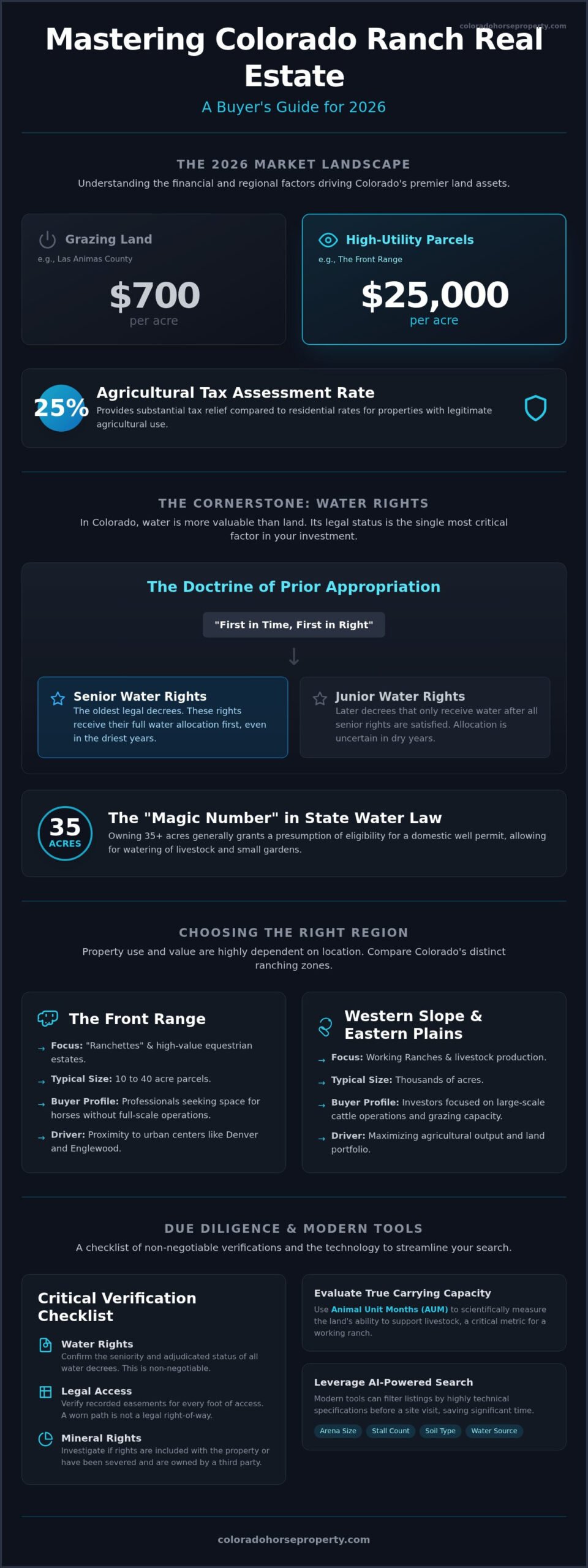
This guide provides a professional framework to master the complexities of Colorado ranch real estate. We’ll show you how to secure protected water rights amidst the expiration of the 2007 Colorado River guidelines and how to navigate the 25% agricultural property tax assessment rate. You’ll learn to differentiate between $700-per-acre grazing land in Las Animas County and high-utility Front Range parcels that can command $25,000 per acre. We’ll preview the impact of House Bill 26-1340 on land use and explain how modern AI-powered search tools can efficiently filter listings for specific equestrian infrastructure and soil types.
Key Takeaways
- Understand the 2026 market dynamics and the 25% agricultural tax assessment rate to maximize your investment’s long-term efficiency.
- Master the “Prior Appropriation” doctrine to ensure your water rights are senior and legally protected as a separate real property interest.
- Identify critical regional price and utility variances when buying ranch land in Colorado, comparing the equestrian-focused Front Range to the Western Slope.
- Evaluate a property’s true carrying capacity using Animal Unit Months (AUM) and modern infrastructure requirements for rotational grazing.
- Leverage AI-powered search technology to filter listings by technical specifications like arena size and stall count before scheduling a site visit.
Understanding the Colorado Ranch Real Estate Landscape in 2026
The 2026 market has solidified Colorado ranch land as a premier hedge against inflation. While urban assets fluctuate, tangible land with senior water rights maintains intrinsic value. Buying ranch land in Colorado today requires a technical understanding of how these assets differ from standard residential real estate. Most investors prioritize either a “Horse Property,” which emphasizes specialized equestrian infrastructure, or a “Working Ranch,” which focuses on livestock production and grazing capacity.
Understanding the history of ranching in North America helps clarify why Colorado’s legal framework is so protective of agricultural use. For example, the 35-acre parcel remains the “magic number” in state water law. Owning at least 35 acres generally grants a presumption of eligibility for a domestic well permit, allowing for the watering of livestock and small gardens. This threshold is a critical filter for anyone looking to secure a self-sustaining legacy property.
To better understand the scale and potential of these properties, watch this helpful video showing the utility of a 35-acre parcel:
The 2026 Market Outlook for Colorado Acreage
Demand remains bifurcated between the Front Range and the Western Slope. Near Denver and Englewood, high-value equestrian estates are driven by the “ranchette” trend. Professionals working remotely seek 10 to 40-acre parcels that offer space for horses without the management burden of a full-scale operation. Conversely, the Western Slope and Eastern Plains continue to see interest in large-scale cattle ranches where acreage counts are in the thousands. Interest rate stability in early 2026 has encouraged high-value agricultural transactions, as buyers move capital into land to escape market volatility.
Agricultural vs. Residential Zoning
The financial distinction between zoning types is significant. In 2026, the agricultural property tax assessment rate is 25% of the actual value. This provides substantial relief compared to residential rates, provided the owner can prove legitimate agricultural use. Each county has specific minimum requirements for livestock counts or crop production to maintain this status. Navigating “Right to Farm” laws is also essential. These regulations protect your ability to conduct agricultural operations, such as running machinery or moving livestock, even as residential development creeps closer to your fence line. Conservation easements offer another tool for buyers, providing tax benefits in exchange for a permanent commitment to preserve the land’s agricultural legacy.
Essential Due Diligence: Water Rights, Mineral Rights, and Access
In Colorado, water rights exist as a separate, transferable real property interest that does not automatically convey with the land. This legal distinction is the most critical factor to verify when buying ranch land in Colorado. You aren’t just purchasing acreage; you are acquiring a position in a complex hierarchy of resource use. The “Prior Appropriation” doctrine governs this system, operating on the principle of “first in time, first in right.” This means the oldest water decrees get their full allocation during dry years before junior owners receive a single drop. The seniority of your water decree is often more valuable than the physical stream flowing through the property.
Legal access is another due diligence pillar that buyers frequently overlook. Never assume a well-worn dirt road constitutes a legal right-of-way. You must verify that every foot of the path leading to your gate is supported by recorded easements. A “secluded” ranch is only an asset if you have the undisputed legal right to reach it without trespassing on a neighbor’s property. Landlocked parcels are common in rural counties, and resolving these issues after closing is both expensive and uncertain.
Navigating Colorado Water Law
Adjudicated water rights have been confirmed by a court to establish their specific quantity, location, and type of use. Non-adjudicated rights are risky and often impossible to enforce against neighbors. If your ranch is in a restricted basin, you may need an “augmentation plan” to replace any water you pump from a well. According to the USDA Census of Agriculture, the value of irrigated land remains significantly higher than dryland, emphasizing why you must verify every decree during the escrow process.
Mineral Rights and Surface Use Agreements
It is common for mineral rights to be severed from the surface estate in Colorado. This means a third party could own the right to extract oil, gas, or minerals from beneath your pastures. A Surface Use Agreement (SUA) is an essential tool to protect your equestrian infrastructure, such as barns and arenas, from industrial activity. Because of these layers of ownership, a specialized title search from Meridian Title & Escrow is non-negotiable to uncover hidden encumbrances. You should ensure your transaction management team has thoroughly vetted the title commitment for any severed rights before you waive your contingencies.
Choosing the Right Region: From the Front Range to the Western Slope
Colorado’s geography dictates the utility and price of its land. Buying ranch land in Colorado varies wildly based on the zip code, and you must match your operational goals with the specific regional climate and soil. The state is divided into distinct zones, each offering different advantages for the modern investor. Whether you’re seeking a high-end equestrian estate or a vast production ranch, understanding these regional variances is the first step toward a successful acquisition.
The Front Range Equestrian Corridor
Douglas and Elbert counties remain the gold standard for horse property for sale in Colorado. This region offers unmatched proximity to the Denver metro economy and Englewood’s professional centers while providing access to world-class veterinary clinics and show arenas. Investors should focus on soil management here. Expansive soils are common along the Front Range; these clay-heavy deposits shift with moisture levels and require specialized engineering for stable barn foundations and indoor arenas.
Western Slope and High Country Utility
For those seeking legacy agricultural operations, ranches for sale colorado on the Western Slope provide vast acreage and often carry senior water rights. This is where Colorado’s Doctrine of Prior Appropriation becomes a tangible asset. Senior rights ensure your livestock have water even during drought cycles. However, high-altitude ranching isn’t without its challenges. Snow load is a critical factor in construction costs. Every structure must be engineered for heavy winter accumulation. Many owners in this region utilize grazing leases on BLM or National Forest land to expand their carrying capacity, though these require strict adherence to federal land management schedules.
The High Rockies offer premier hunting ground and recreational seclusion, but the short growing season limits traditional crop production. Conversely, the Central Plains provide the most affordable acreage in the state. While traditionally used for cattle and dryland farming, the Plains are increasingly attractive for their wind and solar potential. This allows ranch owners to diversify their income through renewable energy leases while maintaining traditional agricultural operations on the same footprint.
Land Management and Infrastructure Checklist
Successfully buying ranch land in Colorado requires a shift from viewing a property as a residence to viewing it as a production facility. The infrastructure must support your livestock and your lifestyle without becoming a financial drain. Start with the perimeter. Fencing is your first line of defense; however, internal cross-fencing is what allows for effective rotational grazing. This practice preserves your soil health and maximizes your Animal Unit Months (AUM), which is the amount of forage needed by one cow and her calf for one month. Without proper cross-fencing, livestock will overgraze preferred grasses, leading to erosion and a decrease in the land’s carrying capacity.
The debate between buying existing structures or building from scratch often centers on the Barn vs. Arena conflict. If you find a property with a perfect location but poor outbuildings, you must calculate the cost of site prep and construction. Exploring horse barns for sale can help you decide if retrofitting an older structure is worth the investment or if a clean slate is more efficient. Building an indoor riding arena from the ground up involves significant earthwork and permitting, which can easily exceed the cost of the structure itself.
Evaluating Existing Structures
Inspecting foundations and drainage for indoor riding arenas is vital. Colorado’s freeze-thaw cycles can wreak havoc on poorly drained footings, leading to heaving and structural cracks. Look for “grandfathered” structures. These are buildings that might not meet modern setback or height requirements but remain legal because they predated current zoning. If you tear them down, you might lose that footprint forever. Verify that any old barns are structurally sound and capable of handling modern snow load requirements for your specific elevation.
Soil and Vegetation Analysis
Noxious weeds like leafy spurge or Canada thistle are more than just a nuisance. They are a legal liability and a management expense. Mitigation costs can reach thousands of dollars annually, and some counties strictly enforce weed management plans. Test for soil salinity and nutrient levels, especially if you plan on hay production. Understanding the carrying capacity of your specific acreage prevents the long-term degradation of the pasture. Soil quality varies by region, and what works for grazing in the High Rockies will differ significantly from the sandy loams of the Central Plains.
Off-grid potential is increasingly popular, but it requires a realistic audit of power, septic, and connectivity. High-speed satellite internet has made remote ranching viable for those who still need to manage businesses from the field. Ensure your septic system is rated for the number of bathrooms and that your power supply can handle the load of heated waterers during a Colorado winter. If you aren’t tied to the grid, your solar or generator systems must be redundant to ensure livestock safety during storm events.
To find properties that already meet these rigorous technical standards, use our AI-powered horse property search to filter by specific infrastructure requirements.
Navigating Your Purchase with AI-Powered Expertise
Buying ranch land in Colorado involves more than just a handshake and a deed. It requires a synthesis of modern technology and deep-rooted local knowledge to avoid the pitfalls of complex agricultural transactions. While traditional searches might show you basic acreage, our proprietary AI-powered horse property search filters for the technical specifications that actually matter. You can identify properties based on precise equestrian features, such as indoor arena dimensions, stall counts, or the presence of sub-irrigated meadows. This data-driven approach removes the guesswork from the initial discovery phase and ensures you only visit properties that meet your operational standards.
The AI Advantage in Niche Real Estate
Our AI technology isn’t just about convenience; it’s about accuracy in a high-stakes market. By using data-driven filters, you can locate properties with specific water rights or soil types suited for hay production before you even step foot on the land. This efficiency significantly reduces the “search-to-close” timeline. Additionally, the Realty Oasis network provides access to off-market opportunities that never hit the public MLS. This gives our clients a competitive edge in a market where the best legacy properties often trade quietly between established ranching families.
From Contract to Closing: The Team Approach
Choosing the right team for equestrian real estate Colorado representation is a critical risk-mitigation strategy. Mark and Alison Eibner bring 40 years of Front Range experience to every transaction, providing a no-nonsense framework to secure your investment. We understand that you’re looking for more than a home; you’re looking for a legacy. By combining our four decades of local history with modern AI tools, we help you navigate the complexities of the 2026 market with confidence and clarity. You don’t have to manage these technical hurdles alone when you have a seasoned partner to guide the way.
Securing Your Legacy in the Colorado High Country
Successful acquisition in 2026 hinges on rigorous technical due diligence. You must verify water seniority under the Prior Appropriation doctrine and understand how the 25% agricultural tax assessment rate affects your bottom line. Regional nuances, from Front Range expansive soils to Western Slope grazing leases, dictate the long-term utility and value of your acreage. Buying ranch land in Colorado is a strategic resource play that requires both modern data tools and decades of boots-on-the-ground experience.
With 40 years of specialized equestrian and agricultural expertise, Mark and Alison Eibner provide the framework you need to move from initial search to a successful closing. Our proprietary AI search tool allows you to filter listings by the precise features that define a premier property, from arena size to sub-irrigated pasture. Start your AI-powered search for Colorado ranch land today to find a property that matches your vision. Your ideal legacy ranch is within reach, and we have the technology and history to help you secure it.
Frequently Asked Questions
How many acres do I need for a horse property in Colorado?
You generally need at least 35 acres to qualify for a domestic well permit that allows for livestock watering in most Colorado basins. While smaller parcels may allow horses under specific county zoning, 35 acres is the legal threshold for securing independent water access. This size also provides enough space for essential infrastructure like barns and arenas while maintaining adequate forage for rotational grazing programs.
Do water rights always transfer with the land in Colorado?
No, water rights do not automatically transfer with the land because they are considered a separate real property interest. When buying ranch land in Colorado, you must specifically include the water rights in the deed or a separate conveyance document. If the water rights have been severed or sold to a municipality by a previous owner, the land may only have value as dry grazing acreage.
What is the difference between a ranch and a ranchette?
A ranchette is typically a smaller lifestyle property ranging from 10 to 40 acres, often located near urban centers like Englewood or Denver. A ranch is a larger, production-oriented operation designed for livestock or crop income. While ranchettes focus on residential and equestrian enjoyment, ranches require significant land management and often involve thousands of acres to remain economically viable for the owner.
Can I build a second home on my Colorado ranch land?
Building a second home depends entirely on your specific county’s zoning regulations and the availability of additional well permits or water taps. Many Colorado counties allow for an Accessory Dwelling Unit (ADU) for ranch hands or family, but density restrictions often prevent a second full-sized residence on a single parcel. You must verify the “legal buildable” status with the county planning department before closing.
What are the typical property taxes for agricultural land in Colorado?
In 2026, the agricultural property tax assessment rate is 25% of the actual value. This rate is significantly lower than residential rates, but the property must meet strict county requirements for legitimate agricultural production or grazing to qualify. Maintaining this status is a key financial benefit when buying ranch land in Colorado, as it provides substantial long-term tax relief for large-acreage owners.
How do I verify if a property has adjudicated water rights?
You verify adjudicated water rights by searching the Colorado Division of Water Resources (DWR) database for specific court decrees. These documents confirm the quantity, priority date, and allowed use of the water. It’s essential to review the “decreed point of diversion” to ensure the water is legally tied to your specific parcel and hasn’t been abandoned through non-use over a ten-year period.
Is mineral ownership included in a standard land sale?
Mineral ownership is frequently severed from the surface estate and is not guaranteed in a standard land sale. In Colorado, it’s common for a third party to own the rights to the oil, gas, or minerals beneath your property. You should always conduct a specialized mineral title search to identify any severed interests and negotiate a Surface Use Agreement to protect your equestrian facilities from future extraction activities.