
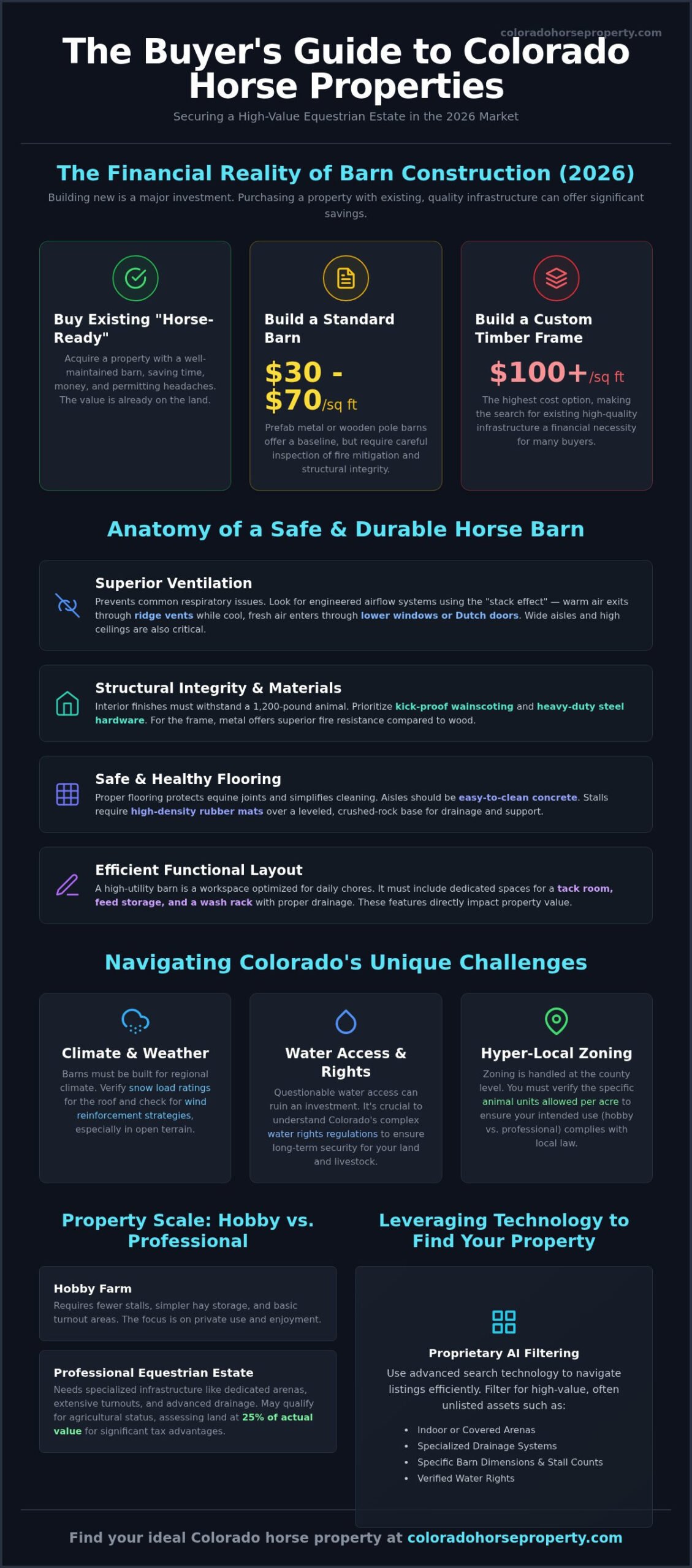
In 2026, building a custom timber frame horse barn in Colorado can cost upwards of $100 per square foot, making the search for existing infrastructure a financial necessity for many buyers. You likely understand that finding the perfect equestrian estate isn’t just about a beautiful home. It’s about the safety of your horses and the long term security of your land. It’s stressful to browse Colorado properties with horse barns for sale only to find structures that lack proper ventilation or properties with questionable water access. We understand that a barn is a specialized tool, and its quality can make or break your real estate investment.
This guide will help you identify move-in ready properties that meet professional standards for animal husbandry and structural durability. You’ll learn how to navigate the latest Colorado water rights regulations, including the impacts of House Bill 26-1340, and how to use proprietary AI technology to filter for specific barn specifications. We’ll examine the ROI of existing equestrian infrastructure versus new construction to ensure you secure a property that offers both lifestyle fulfillment and financial growth. From zoning nuances to livestock capacity, this is your roadmap to finding a functional, high-value horse property in the current market.
Key Takeaways
- Evaluate stall dimensions and ventilation designs to prevent common respiratory issues and ensure your horses remain healthy in a confined environment.
- Assess structural integrity for regional climate challenges, including specific snow load ratings and wind reinforcement strategies for different Colorado terrains.
- Compare the financial benefits of purchasing established equestrian estates against the 2026 costs of building new facilities from the ground up.
- Use proprietary AI technology to navigate Colorado properties with horse barns for sale by filtering for high-value assets like indoor arenas and specialized drainage.
- Differentiate between hobby and professional zoning requirements to ensure your intended use for the land complies with hyper-local county regulations.
Evaluating Colorado Properties with Horse Barns for Sale
The 2026 Colorado real estate market shows a trend toward stability, with median home prices hovering around $550,000 statewide. For buyers seeking specialized acreage, the value isn’t just in the residential square footage. It lies in the quality of the outbuildings. Identifying high-value Colorado properties with horse barns for sale requires a shift in perspective. You must look past the aesthetic appeal of a property and evaluate its functional capacity to support livestock safely and efficiently.
A critical distinction exists between “horse-friendly” land and “horse-ready” properties. A horse-friendly property might have the correct zoning and enough acreage, but it lacks the infrastructure to house animals immediately. A horse-ready property features a barn that acts as a turnkey asset, saving you the high costs and permit headaches of new construction. With 40 years of experience in the Front Range, we’ve seen that a well-built barn often represents the most significant value-add on rural acreage.
To visualize the standard for high-end equestrian infrastructure in the Front Range, watch this tour of a premier community:
Hobby Farms vs. Full-Scale Equestrian Estates
Your search strategy depends on whether you’re looking for a private hobby farm or a professional training facility. A hobby farm typically requires fewer stalls and simpler hay storage. Professional estates need specialized drainage, dedicated arenas, and extensive turnout areas. Zoning is handled at the county level in Colorado, so you must verify the specific animal units allowed per acre before committing. For the 2026 tax year, agricultural land is assessed at 25% of its actual value. This can provide significant tax advantages if your operation meets state requirements for agricultural status.
Key Features of a High-Utility Horse Barn
A well-designed barn is more than a shelter; it’s a workspace. When evaluating existing structures, prioritize layout efficiency for daily chores. A high-utility barn includes dedicated spaces for a tack room, feed storage, and a wash rack with proper drainage. These features are essential components of Equestrian Facility Design that directly impact the resale value of the property. Look for structures with wide aisles and high-clearance doors to ensure proper air circulation. Fixer-upper barns often hide structural issues like rotting posts or poor ventilation, which can lead to expensive repairs and health risks for your horses. Focus on finding “move-in ready” Colorado properties with horse barns for sale to avoid the rising costs of building materials and labor.
Technical Inspection: What Makes a Horse Barn Safe and Durable?
When inspecting Colorado properties with horse barns for sale, you must look beyond the paint. A barn’s structural integrity directly impacts your insurance premiums and your horses’ safety. Wooden pole barns remain popular, costing between $35 and $70 per square foot in 2026, yet they require rigorous fire mitigation. Prefabricated metal barns offer a lower entry point at $30 to $50 per square foot and provide superior fire resistance. Regardless of the frame, the interior finishes must withstand the force of a 1,200-pound animal. Look for kick-proof wainscoting and heavy-duty steel hardware on all gates.
Ventilation is a critical technical feature that prevents equine respiratory issues. High-quality Colorado properties with horse barns for sale often feature engineered airflow systems that utilize the stack effect. This is where warm air rises through ridge vents and pulls fresh air in through lower windows or Dutch doors. Flooring also plays a role in long-term health. While concrete aisles are easy to clean, stalls require high-density rubber mats over a leveled crushed-rock base to protect equine joints. If you’re unsure how to find these specific features in a listing, our AI-powered horse property search can help you filter for premium infrastructure.
Stall Design and Safety Standards
Standard 12×12 stalls are the baseline for most breeds, but larger drafts or broodmares require 12×14 or 14×14 spaces. Walls should be constructed from 2-inch thick tongue-and-groove lumber to prevent splintering during kicks. Safe latching mechanisms must be operable from both sides and flush-mounted to prevent snagging. The gold standard for stall ventilation in 2026 is the integration of mesh-top partitions and exterior Dutch doors to ensure constant cross-flow at the horse’s head level.
Storage and Utility Infrastructure
Safe hay storage is a priority for fire prevention. Ideally, hay should be kept in a separate building or a bay with a fire-rated ceiling. Moisture control is equally vital to prevent spontaneous combustion and mold. For utilities, all electrical wiring must be housed in rigid conduit to prevent rodents from chewing through lines. Dust-proof fixtures are mandatory in hay-heavy environments. Plumbing requires deep-bury lines and heat tape for automatic waterers to survive sub-zero Colorado winters. Managing these utilities often intersects with complex Colorado Water Rights, which dictate how much water you can legally pump for livestock use.
Colorado-Specific Challenges: Weather, Water, and Zoning
Colorado’s climate presents unique architectural demands that general real estate listings often overlook. When evaluating Colorado properties with horse barns for sale, you must consider the specific environmental stressors of your target sub-region. A barn built for the milder Front Range may not survive a winter in the High Country without significant reinforcement. Building placement is also critical. Positioning a barn to utilize natural windbreaks can reduce heating costs and protect livestock from the state’s notorious 70-mph wind gusts.
Soil quality and drainage are often more important than the barn itself. Mud is more than a nuisance; it’s a breeding ground for thrush and other hoof ailments. Properties with sandy loam or well-drained gravel bases are highly coveted. If a property sits on expansive clay, you’ll need to invest in professional mud management systems like geotextile fabrics and specialized paddock footing to keep your horses sound and your barn entries dry.
Weather-Proofing Your Equestrian Investment
Extreme temperature swings are a Colorado staple. High-performance insulation is mandatory to prevent interior condensation, which can lead to mold and respiratory issues. Roof design is another safety factor. Snow-shed patterns must ensure that heavy loads slide off away from high-traffic areas. This prevents dangerous ice dams from forming over stall doors or wash racks. In 2026, many buyers are also prioritizing fire-resistant landscaping around their barns to mitigate the risks associated with the state’s increasingly long wildfire seasons.
Understanding Water Rights and Livestock Zoning
Water reliability is the single most important factor for rural buyers in 2026. You must distinguish between a domestic-only well and one permitted for livestock. For a deep dive into these complexities, see our guide on Water Rights in Colorado: What Every Buyer Must Know. New regulations like House Bill 26-1340 now require owners in the Arkansas River Basin to revegetate land when transferring irrigation water, adding a layer of legal due diligence to the purchase process.
Zoning regulations for Colorado properties with horse barns for sale are handled at the county level. While one county might allow four horses on a five-acre parcel, a neighboring county might limit you to two. These “animal unit” calculations often include specific setbacks for manure storage and arena placement. We leverage 40 years of local expertise to help you navigate these hyper-local rules, ensuring your equestrian goals align with legal land use before you sign a contract.
The Financial Impact: ROI of Equestrian Infrastructure
Infrastructure is a force multiplier for land value. When appraisers evaluate Colorado properties with horse barns for sale, they don’t just see a building; they see a specialized facility that dictates the property’s highest and best use. High-quality equestrian improvements can significantly boost a property’s market position, especially when those improvements are move-in ready. In 2026, the demand for A-Class ranch properties remains strong, and buyers are willing to pay a premium for facilities that don’t require immediate capital expenditure or a two-year permitting battle.
Maintenance and depreciation also play a role in long-term ROI. While a timber frame barn offers undeniable aesthetic appeal, its maintenance schedule is more rigorous than a metal-clad structure. Buyers in the current market prioritize functionality and durability. A barn with poor drainage or aging roofing materials won’t just fail to add value; it can become a liability during the inspection phase. Investing in high-utility assets like arenas and heated stalls ensures your property remains competitive in a stable but discerning market.
Buying vs. Building Your Colorado Equestrian Dream
Building a new facility in 2026 is a complex financial undertaking. A standard 30×40 pole barn currently costs between $45,000 and $80,000, while a prefabricated metal barn ranges from $30 to $50 per square foot. These figures don’t include the cost of permits, utility trenching, or engineered plans, which are mandatory in most Colorado counties. Existing “grandfathered” barns often sit on footprints that would no longer be allowed under modern setback or density regulations. This makes them incredibly valuable assets. To weigh your options further, read our detailed analysis: Horse Barns for Sale: Buying vs. Building Your Colorado Equestrian Dream.
Maximizing Resale Value Through Infrastructure
Specific features drive the highest premiums in the Colorado market. Indoor riding arenas are the ultimate value-add, though they typically require an investment starting at $300,000 and can exceed $1 million depending on size and footing. Heated barns and wash racks with hot water also attract high-tier buyers who want year-round utility. Curb appeal isn’t just for the main house; a cohesive design across all outbuildings signals a well-managed estate. In 2026, steel-frame barns typically offer a higher long-term ROI due to lower maintenance costs and superior fire resistance compared to traditional pole-barn structures. If you want to skip the construction phase and secure a property with these high-value assets already in place, view our current listings for barn-ready estates.
Leveraging AI to Find the Best Horse Barns in Colorado
Traditional real estate platforms often fail equestrian buyers because they treat outbuildings as generic checkboxes. A search for “barn” on a standard site might yield a property with a small garden shed or a dilapidated storage unit rather than a functional facility. This lack of specificity wastes hours of your time. When searching for Colorado properties with horse barns for sale, you need a system that understands the technical nuances of equine infrastructure. Our AI-powered search bridges this gap by analyzing listing data to identify specific assets like matted stalls, indoor arenas, and ventilated hay lofts.
Efficiency is paramount in a market where A-Class properties are scarce. Our system doesn’t just look for barns; it cross-references those structures with critical land data. It filters for specific acreage requirements, valid livestock water rights, and hyper-local zoning regulations simultaneously. This ensures that every property you view is actually capable of supporting your horses legally and physically. We understand that your time is better spent in the saddle than scrolling through irrelevant listings.
The Colorado Horse Property AI Advantage
Our proprietary tool scans thousands of data points to find equestrian-specific infrastructure that traditional filters miss. Instead of manually clicking through hundreds of photos to see if a “barn” actually has stalls, our AI identifies these features for you. This technology is backed by our 40 years of Front Range experience, allowing us to program the search parameters with the same scrutiny a professional trainer would use. You can set up custom alerts for new “barn-ready” Colorado properties with horse barns for sale in your target county, ensuring you’re the first to know when a high-value estate hits the market. For a deeper look at the process, explore our Equestrian Real Estate Colorado: A Complete Buyer’s Guide.
Next Steps: From Search to Closing
Technology finds the property, but expert representation secures it. Once our AI identifies a potential match, the human element becomes essential. Mark and Alison Eibner provide the specialized buyer representation needed to navigate complex rural transactions, including transaction management and title services. Before your first property tour, we recommend preparing a checklist that includes stall dimensions, drainage patterns, and proximity to equine veterinarians. During the walkthrough, we’ll help you evaluate the structural integrity points discussed in previous sections, from snow load ratings to electrical conduit safety. We manage the entire process to ensure your investment is protected from the first search to the final signature. Start your AI-powered search for Colorado horse properties today to find a facility that meets your professional standards.
Secure Your Equestrian Future in Colorado
Buying a horse property is a significant life milestone that demands both technical scrutiny and local knowledge. You’ve learned that evaluating Colorado properties with horse barns for sale involves more than just counting stalls. It requires a deep dive into water rights, climate-resilient construction, and the long-term ROI of existing infrastructure. By prioritizing structural safety and legal land use, you ensure that your acreage remains a sanctuary for your horses and a stable asset for your portfolio.
Our team brings 40 years of specialized expertise to every transaction, backed by the professional support of the Licensed Realty Oasis brokerage. We use proprietary AI-powered niche filtering to cut through the noise of general listings, identifying functional facilities that meet your exact specifications for drainage, ventilation, and zoning. This data-driven approach removes the guesswork from your search, allowing you to focus on the properties that truly fit your equestrian goals.
Find your dream Colorado horse property with our AI search tool.
Your ideal Colorado lifestyle is within reach, and we’re here to help you secure the land and infrastructure you need to thrive.
Frequently Asked Questions
What is the minimum acreage required for a horse property in Colorado?
Minimum acreage for Colorado properties with horse barns for sale varies significantly by county. While some residential zones allow horses on 2.5 to 5 acres, you’ll typically need 35 acres or more to qualify for full agricultural status. Always verify the specific “animal unit” density with the local planning department to ensure the land can legally support the number of horses you intend to keep.
How do I check if a property has water rights for horses?
You check water rights by searching the Colorado Division of Water Resources database using the property’s well permit number. It’s vital to confirm if the permit specifically allows for “livestock use” rather than just domestic household use. In the Arkansas River Basin, 2026 regulations under House Bill 26-1340 add extra layers of due diligence for water transfers that you must investigate before closing.
What is the difference between a pole barn and a steel-frame barn for horses?
A pole barn uses wooden posts buried in the ground as the primary support, while a steel-frame barn utilizes a rigid metal structure. In 2026, prefabricated metal barns are often more cost-effective, ranging from $30 to $50 per square foot. Steel structures offer superior fire resistance and lower maintenance requirements compared to traditional wood-based pole barns, though pole barns remain popular for their aesthetic appeal.
Are there specific zoning laws for horse boarding in Colorado?
Yes, zoning for commercial horse boarding is managed at the county level and often requires a Special Use Permit. Even if a property is zoned for private livestock, running a boarding business may be prohibited or restricted by the number of animals allowed. You must consult the specific county’s land use code to ensure your business plans align with local agricultural and commercial regulations.
How much does it cost to build a 4-stall horse barn in Colorado?
Building a 4-stall horse barn typically costs between $45,000 and $80,000 for a standard 30×40 pole-style structure in 2026. This price range covers the basic shell and stalls but excludes the cost of utilities, specialized arena footing, or permit fees. If you choose a premium timber frame or post and beam design, costs can easily exceed $100 per square foot depending on the finishes.
What should I look for when inspecting a barn’s foundation in the Front Range?
Front Range buyers should look for signs of structural shifting caused by expansive clay soils, such as slab cracks or misaligned stall doors. Ensure the barn features a professional perimeter drainage system to move water away from the foundation. Because of these soil conditions, many high-quality Colorado properties with horse barns for sale utilize engineered piers or reinforced concrete to prevent long-term settling issues.
Can I get a mortgage for a property with a significant agricultural barn?
You can get a mortgage for these properties, but traditional residential lenders may limit the value they attribute to large agricultural outbuildings. If the barn’s value is a major portion of the purchase price, you might need a specialized farm and ranch loan. These specialized products often require different down payment structures but are designed to handle the complexities of productive equestrian estates.
Is fire mitigation mandatory for horse barns in Colorado mountain regions?
Fire mitigation is frequently mandatory for new construction in Colorado’s Wildland-Urban Interface (WUI) zones. While rules for existing barns vary by county, insurance providers in 2026 increasingly require a defensible space of 30 to 100 feet around all structures. Maintaining this buffer by removing brush and using fire-resistant roofing materials is essential for protecting your livestock and securing affordable property insurance.