
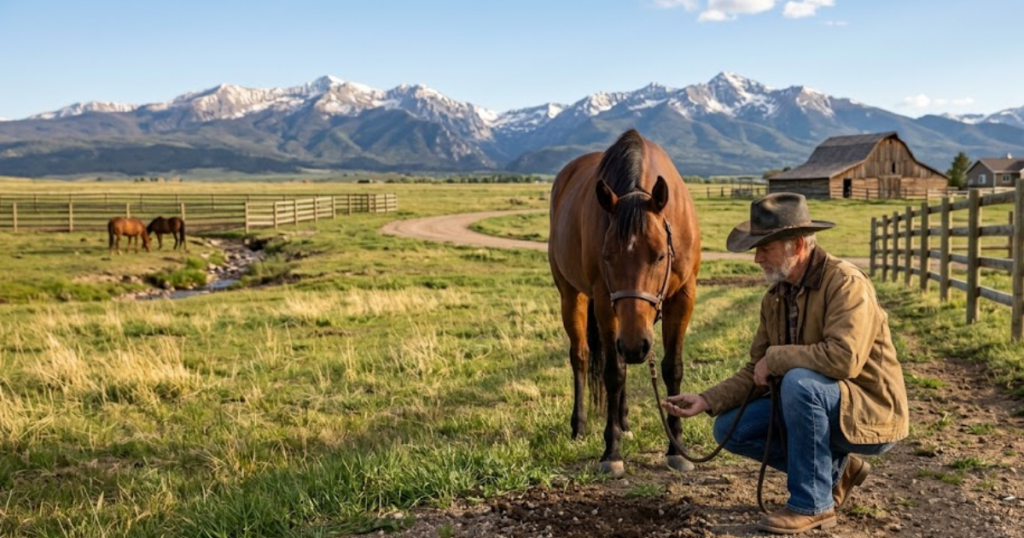
You tour a breathtaking 10-acre horse property in late September. The ground is dry, the grass is golden, and the paddocks look perfectly flat and usable. You make a full-price offer, move in your herd, and prepare for your first Colorado winter.
When the heavy spring snows finally melt in April, the reality of the property’s geology sets in. The flat paddocks you loved are actually sitting on a thick bed of Bentonite clay. With nowhere to drain, the snowmelt pools on the surface. Within days, your horses are standing in knee-deep, freezing mud. You cannot get the tractor out of the barn without getting stuck, your gelding develops a severe bacterial hoof infection, and you are forced to spend thousands of dollars on crushed gravel to create a dry path to the water troughs.
When searching for horse properties in Colorado, buyers often obsess over the style of the barn or the view from the porch. But the daily reality of horse ownership is dictated by what lies six inches below your boots.
Here is how to evaluate the soil composition, drainage, and topography of a property before you buy the farm.
What Type of Soil and Drainage Should I Look For When Evaluating a Colorado Horse Property?
Quick Summary: The Mud Trap
- The Clay Catastrophe: Heavy clay soils retain water like sponges. In Colorado, a property with poor-draining clay will turn into a deep, sucking mud pit during the spring melt and summer monsoons, causing severe hoof rot (thrush) and making daily chores a nightmare.
- The Sandy Sweet Spot: The ideal equestrian property features loamy or sandy-loam soil. This composition drains water quickly while retaining enough organic nutrients to support strong, drought-resistant pasture grasses.
- The Topography Test: You must assess the land's natural slope. Even great soil will fail if the property sits in a topographical “bowl” where runoff from surrounding hillsides funnels directly into the barns and paddocks.
- The Bedrock and Sinkhole Warning: In certain areas, shallow limestone bedrock or prevalent sinkholes can severely limit where you can build an arena, drill a well, or safely install a septic system.
1. Identifying the Soil Profile
The composition of the dirt determines both the health of your grass and the health of your horses' hooves.
- The Loam Ideal: You are looking for “loam,” a balanced mixture of sand, silt, and clay. Sandy loam is the gold standard for horse properties. It drains rapidly after a heavy rain (preventing mud), yet retains enough moisture and nutrients to grow high-quality pasture grass.
- The Clay Curse: Heavy clay soils are the enemy of the equestrian. Clay particles are microscopic and pack tightly together, making the ground rock-hard in the summer drought and a slippery, impassable bog during the wet season. If you grab a handful of damp soil and it easily molds into a sticky, dense ball, you are dealing with heavy clay.
- The Soil Test: Never guess the soil quality. A premium real estate agent will help you pull a soil sample and send it to the local Colorado State University Extension office. For a minimal fee, you will receive a detailed analysis of the soil's pH, nutrient density (phosphorus, calcium, potassium), and physical composition.
2. The Mechanics of Property Drainage
Water always wins. You must evaluate how the property handles massive volumes of runoff during spring melts and summer monsoons.
- The 2% Rule: Walk the perimeter of the barns, the outdoor arena, and the primary sacrifice paddocks. The ground should slope away from these high-traffic structures at a minimum grade of 2%. If the land is perfectly flat, or worse, slopes toward the barn, you will flood every time it rains.
- The Topographical “Bowl”: Look beyond the property lines. Is the farm situated at the bottom of a valley or a long hill? If so, you will be receiving all the drainage from your uphill neighbors. You must verify the presence of deep interceptor swales or French drains designed to catch and redirect that incoming water around your facilities.
- Vegetation as a Clue: You don't need it to be raining to spot a drainage problem. Look at the natural vegetation in the pastures. If you see thick patches of willow, sedge grasses, or cattails, you are looking at a seasonal wetland or a high water table that will become a muddy disaster when horses are introduced.
3. The Sacrifice Area Requirement
Even on perfect soil, Colorado's wet seasons will challenge the land. A sustainable farm must have a dedicated high-traffic zone.
- The Confinement Strategy: To protect your fragile pasture grass during the muddy spring melt, you need a “sacrifice area,” a smaller, dedicated paddock where the horses are confined when the pastures are wet.
- Engineered Footing: This sacrifice area cannot consist solely of native dirt. It must be excavated, graded for drainage, and backfilled with a heavy layer of compacted crushed rock or road base (often covered with a softer layer of sand or pea gravel). This engineered footing keeps the horses out of the mud and prevents them from destroying the root systems of your grazing pastures.
4. Septic Systems and Soil Percolation
The soil doesn't just affect the horses; it dictates whether you can legally live on the property.
- The Percolation (“Perc”) Test: If you are buying raw land or a property with an older septic system, the soil must be able to “perc.” This means the ground must be sufficiently porous to allow wastewater from the leach field to filter into the earth slowly.
- The Clay Failure: If the property is dominated by heavy clay or shallow bedrock, a standard septic system will fail. You will be forced to install a highly engineered above-ground mound system, which can easily add $30,000 to $50,000 to the property's cost.
We Evaluate the Dirt Before You Buy
We do not just look at the acreage; we analyze the geology.
When Mark Eibner and Belinda Seville represent you in the purchase of a rural estate, we look closely at the topography and soil structure. We help you identify potential drainage nightmares, interpret soil test results, and ensure the land can support both your herd and your infrastructure. We want to ensure you are buying a sustainable agricultural property, not a seasonal mud pit.
Contact Us Today to find premium horse properties Colorado buyers trust for excellent drainage, rich soil, and sustainable layouts.
Browse Active Colorado Horse Properties: Browse active Colorado horse ranches for sale or ask our team about finding a functional horse property for rent in Colorado while you search for the perfect estate
Frequently Asked Questions (FAQ) About Soil and Drainage
Can I add sand to a muddy clay paddock to fix the drainage?
No, this is a very common and expensive mistake. If you dump loose sand directly on top of wet clay, the horse's hooves will immediately churn the two together. Sand mixed with clay essentially creates low-grade concrete. To fix a clay paddock, you must excavate the topsoil, lay down a geotextile fabric barrier, and then add a compacted layer of crushed angular rock (road base).
What is a French drain, and do I need one?
A French drain is a trench filled with gravel containing a perforated pipe that redirects surface water and groundwater away from a specific area. They are highly effective for intercepting water runoff from hillsides before it reaches your barn or arena, making them a vital piece of infrastructure on sloped properties.
Are there any specific minerals in Colorado soil I should worry about?
Yes, some localized areas in Colorado have soils naturally high in selenium. While horses need trace amounts of selenium, excessive grazing on high-selenium soils (or eating hay grown on them) can cause selenium toxicity, leading to mane and tail hair loss and severe hoof deformities. A soil test will identify this risk.