
In Colorado, a thousand acres of land is just a scenic view if it doesn’t come with the right paper trail for the water. You likely already understand that a productive ranch is a business asset first and a lifestyle choice second. Finding the right Colorado working ranches for sale requires more than just checking fence lines. It demands a rigorous analysis of senior water rights, soil health, and the structural integrity of existing infrastructure.
This 2026 guide will help you master the technicalities of ranch acquisition, from navigating the $25.64 per AUM base rate for state grazing leases to securing your interests under the latest federal water management plans. We’ll analyze the ROI differences between cattle and hay operations, explain the impact of the May 2026 “buy and dry” legislation, and show you how AI-powered search tools can identify properties with the specific infrastructure your business requires. You’ll gain the clarity needed to move from browsing listings to managing a high-performance agricultural operation.
Key Takeaways
- Distinguish between recreational land and operational assets by prioritizing essential infrastructure like livestock handling facilities and solar-powered water delivery systems.
- Evaluate the true economic viability of a property by understanding the specific legal and financial differences between deeded acreage and public land grazing leases.
- Protect your investment by performing deep due diligence on water seniority and the Doctrine of Prior Appropriation to ensure reliable irrigation during drought conditions.
- Efficiently source Colorado working ranches for sale using AI-powered search technology that identifies niche features like specific soil types or zoning requirements.
- Gain a competitive advantage by partnering with seasoned experts who provide full-cycle transaction management, including specialized title and escrow services.
Defining the Colorado Working Ranch in 2026
A true working ranch is an agricultural business enterprise. It’s not just a place to stay; it’s a property designed for intensive livestock, hay, or crop production. While many buyers seek the aesthetic of the West, professional operators look for soil quality, forage capacity, and resource security. What is a Working Ranch? At its core, it’s a system where the land provides the primary revenue, distinguishing it from a hobby farm or a purely recreational retreat. In 2026, the distinction is sharper than ever as production costs and land values continue to climb.
The 2026 market for Colorado working ranches for sale is characterized by tight inventory and selective buyers. USDA data from late 2025 estimated national farm real estate averages at $4,350 per acre, but Colorado’s productive acreage often commands a premium due to water scarcity. Buyers today don’t just look at the view. They analyze AUM (Animal Unit Month) capacities and the seniority of water rights to ensure the operation remains viable through drought cycles. Success in this market requires a move away from emotional purchasing toward data-driven acquisition.
To see how these operational features look on the ground, watch this overview of a functional property:
Working Ranches vs. Lifestyle Estates
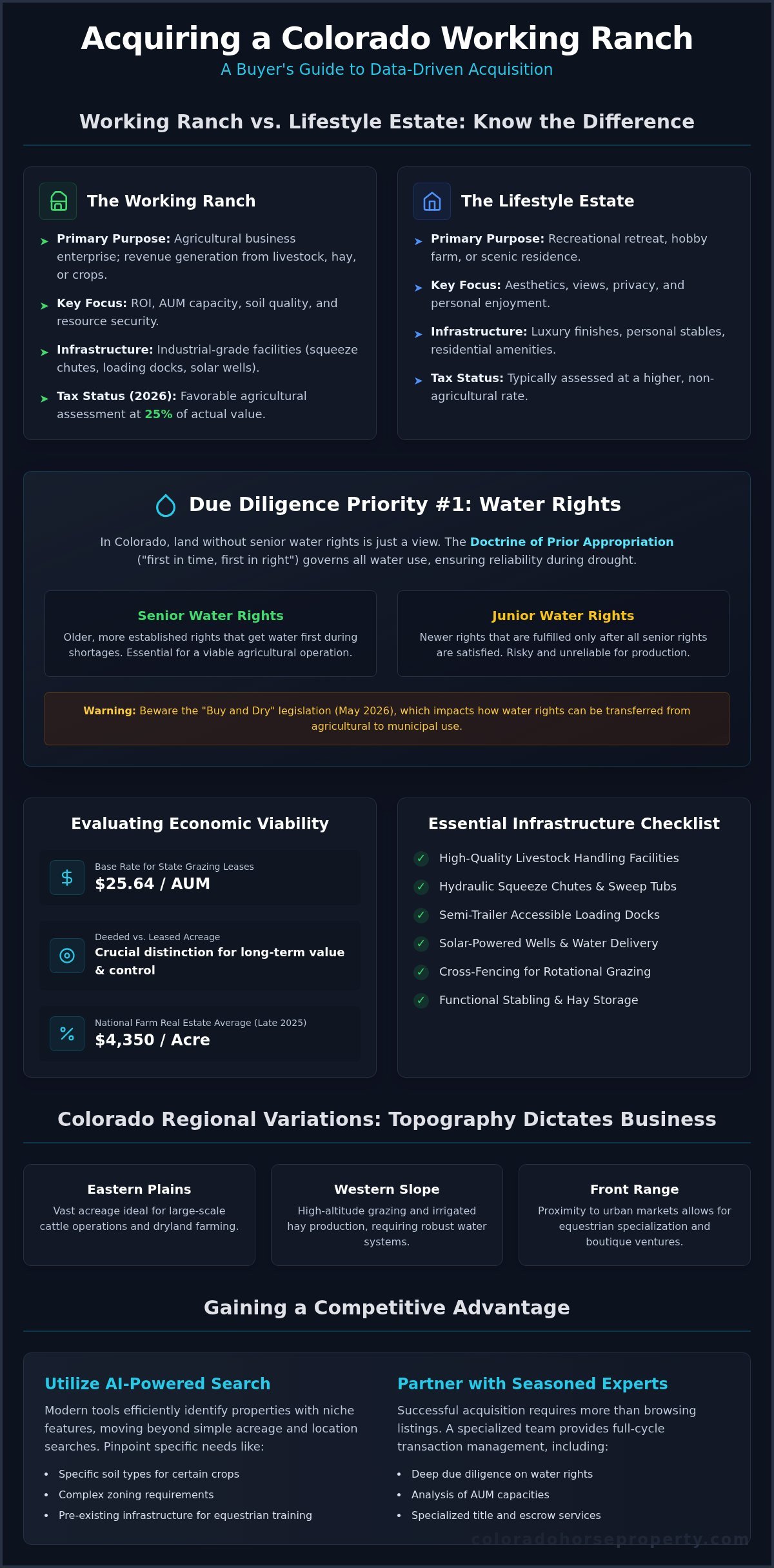
The primary revenue drivers for a working operation are cattle, hay, and specialized equestrian services. Unlike a lifestyle estate, a working ranch requires industrial-grade infrastructure. You’ll need squeeze chutes, loading docks, and reliable solar-powered wells to manage a herd effectively. One of the most significant advantages of a true operation is the tax status. For the 2026 tax year, agricultural property in Colorado is assessed at 25% of its actual value. This lower assessment rate is a critical component of maintaining a profitable bottom line.
Regional Variations in Colorado Ranching
Topography dictates your business model. On the Eastern Plains, you’ll find large-scale cattle operations and dryland farming where acreage is vast. The Western Slope offers a different challenge with high-altitude grazing and irrigated hay production. Along the Front Range, proximity to urban markets allows for equestrian specialization and boutique agricultural ventures. When searching for Colorado working ranches for sale, your choice of region must align with your specific production goals. Each landscape carries its own set of zoning rules and resource management needs.
Essential Infrastructure for a Productive Ranch
While the land itself provides the raw potential, the infrastructure determines the daily efficiency of an operation. When evaluating Colorado working ranches for sale, you must look past the scenery and inspect the functional assets. A productive ranch requires a layout that minimizes labor and maximizes animal health. This starts with high-quality livestock handling facilities. Look for sturdy pens, sweep tubs, and hydraulic squeeze chutes that allow for safe, one-person operation. Loading docks should be accessible for semi-trailers, ensuring you can move livestock to market without logistical delays.
Water delivery is the lifeblood of the property. Beyond the legalities of Colorado water rights, the physical system must be robust. Solar wells and miles of underground pipeline are often necessary to reach remote pastures. Reliable tanks with freeze-protection are essential for high-altitude winters. Fencing strategies also play a role in productivity. While perimeter fencing secures the boundary, cross-fencing allows for intensive rotational grazing. This practice preserves soil health and increases the carrying capacity of your acreage.
The Working Equestrian Component
Working horses are the backbone of many operations. You’ll need stabling that prioritizes ventilation and safety over luxury finishes. Proximity is key. Place hay storage near feeding areas to reduce daily travel time. For those focused on training, indoor and outdoor riding arenas are indispensable for conditioning animals regardless of the weather. If you’re deciding between existing structures or starting fresh, it’s helpful to research horse barns for sale to understand the cost-benefit of buying versus building.
Equipment and Shop Requirements
Colorado winters aren’t kind to machinery left outdoors. A large, insulated shop is a requirement, not a luxury. You’ll need space for tractors, balers, and skid steers, along with dedicated areas for year-round maintenance. Ensure the shop has high-clearance doors and reinforced concrete floors. Fuel storage must meet safety regulations and be positioned for easy access by delivery trucks. Finding a property with this specific mix of infrastructure is easier when you use an AI-powered search tool designed for ranching needs.
Evaluating Economic Viability: Leases and Resources
A ranch’s value is often measured by its carrying capacity, not just its boundary lines. Carrying capacity is calculated in Animal Unit Months (AUM), representing the forage needed for one cow and calf for 30 days. When you evaluate Colorado working ranches for sale, you’re looking at a mix of deeded acreage and potential lease agreements. Deeded land offers the highest security and control, but leased land allows you to scale your operation without the massive capital outlay of a direct purchase. High-quality soil and reliable irrigation systems are the primary drivers of a property’s AUM rating.
Diversification is another key to long-term viability. Many owners supplement agricultural income with hunting leases or recreational permits. If the property has significant elk or deer populations, these leases can cover a substantial portion of annual property taxes. Integrating specialized services, such as those found in equestrian real estate Colorado, can also provide a steady revenue stream that isn’t tied strictly to commodity cattle prices. It’s about building a multi-layered business model that survives market volatility.
Grazing Permits and Public Land Access
Public land grazing permits through the BLM or US Forest Service are valuable assets, but they come with specific strings attached. These permits don’t “belong” to the land; they are privileges that must be transferred through the respective agency during a sale. You’ll need to maintain a positive relationship with federal land managers to ensure continued access. For the 2026 term, the Colorado State Land Board set the base rate at $25.64 per AUM. If you own the improvements on that leased land, you might qualify for a Tier 2 rate of $20.51 per AUM, which significantly lowers your overhead.
Agricultural Revenue Streams
Your business model will likely focus on either cattle or hay. Cow-calf operations are common in Colorado, offering a more stable, long-term investment. Yearling operations are higher risk but can provide quicker returns depending on market fluctuations. According to a 2026 CSU Extension survey, private grazing lease rates range from $10.00 to $50.00 per head per month. Hay production remains a staple for many, especially on the Western Slope. Irrigated yields far outperform dryland crops. This makes senior water rights the ultimate economic multiplier for any working ranch, as they ensure your crop doesn’t fail during a dry season.
Due Diligence: Water Rights and Legal Protections
In Colorado, land without water is just a place to watch the sunset. The state operates under the Doctrine of Prior Appropriation, a system often summarized as “first in time, first in right.” This means the first person to put water to a beneficial use holds the senior right. When you evaluate Colorado working ranches for sale, you aren’t just buying acreage; you’re buying a specific place in the water hierarchy. Senior rights are protected during drought, while junior rights may be “called” or shut off entirely to satisfy those further up the line. In March 2026, the activation of Phase 2 of the state’s Drought Response Plan made these senior rights the most valuable asset on any property.
Mineral rights add another layer of complexity. These rights are frequently severed from the surface estate, meaning a third party could own the resources beneath your pastures. You must identify if the mineral estate is intact and understand the surface owner protections that govern access. Zoning restrictions and conservation easements also impact long-term value. While an easement can provide significant tax relief, it also limits your ability to subdivide or develop the land in the future. You need to ensure the property’s legal status aligns with your 20-year business plan.
Securing Water for Crops and Livestock
Surface water rights usually involve shares in a ditch company. You’ll need to verify the delivery history and the physical condition of the delivery infrastructure. Groundwater is different, as it relies on well permits that specify the allowed volume and type of use. An augmentation plan is a court-approved document that allows a water user to divert water out of priority by replacing the depletions to the stream system with other water sources. These plans are vital for new operations that don’t hold historic senior decrees. For expert guidance on managing these legal complexities, contact our team for buyer representation.
Title, Escrow, and Land Use
A standard residential title search won’t uncover the nuances of a working ranch. You need a deep dive into historic easements, grazing permits, and right-of-way issues that could interfere with livestock movement. We work closely with Meridian Title & Escrow because they specialize in agricultural closings and the unique documentation required for water transfers. If you’re researching land for sale in colorado, don’t overlook these technical details. A single hidden easement can disrupt your fencing plan or prevent you from building essential outbuildings.
Finding Your Legacy with Colorado Horse Property
The 2026 market for Colorado working ranches for sale is competitive and moves quickly. Success often depends on having information before it hits the open market. Through the Realty Oasis network, we provide our clients with access to off-market listings and private opportunities that aren’t available on national search portals. We position ourselves as your peer and partner. We understand the unique needs of land and livestock owners because we share your connection to the regional landscape. Our goal is to make the complex process of purchasing a ranch as simple and transparent as possible.
Why AI Search Matters for Ranch Buyers
Generic real estate platforms often fail to capture the nuances of agricultural land. Our AI-Powered Horse Property Search allows you to filter listings by the specific features that define a productive operation. You can search for properties based on water seniority, soil types, or the presence of specific infrastructure like hydraulic squeeze chutes and insulated shops. This technology bridges the gap for those looking for horse property for sale in colorado by identifying “working-ready” parcels that others might miss. It saves weeks of manual research and prevents you from touring properties that don’t meet your operational requirements.
Your Partner in Colorado Ranching
We act as your dedicated representative in complex agricultural deals. Our expertise extends beyond the initial search to include long-term resource planning and title and escrow coordination. We know how to navigate the intersection of personal goals and property utility. We ensure that every fence line and water well aligns with your vision for the land. We’re here to provide the seasoned, no-nonsense expertise you need to make a confident investment. Start your AI-powered ranch search today to find a property that aligns with your professional goals and your personal legacy.
Secure Your Agricultural Future in Colorado
Purchasing a productive ranch is a significant business move that requires more than just capital. Success hinges on your ability to verify senior water rights and evaluate the true carrying capacity of the land. You now understand how infrastructure, from solar wells to hydraulic chutes, determines your daily efficiency and long-term profitability. As you navigate the market for Colorado working ranches for sale, remember that rigorous technical due diligence is your best protection against environmental and market volatility.
For those who value land stewardship beyond the domestic market, exploring global examples like an exclusive use bioreserve stay South Africa can provide a broader perspective on how to balance private ownership with ecological conservation.
We offer more than just listings. With over 40 years of Colorado real estate expertise, we provide specialized Transaction Management services to handle the complexities of agricultural title and escrow. Our proprietary AI-powered property filtering allows you to bypass generic results and find acreage that meets your specific operational needs. You don’t have to manage these technical hurdles alone. Browse Colorado Working Ranches with our AI Search Tool to identify your next investment with confidence. Your legacy on the land starts with the right data and a seasoned partner by your side.
Frequently Asked Questions
What is the difference between a working ranch and a recreational ranch?
A working ranch is a functional business enterprise designed for agricultural production, while a recreational ranch focuses on leisure and aesthetic value. You’ll identify a working ranch by its revenue-generating infrastructure, such as loading docks, squeeze chutes, and irrigated hay fields. Recreational properties often prioritize luxury lodges and wildlife habitat over the specialized facilities needed for livestock handling.
How many acres do I need for a profitable cattle ranch in Colorado?
Profitability depends on the forage capacity, or Animal Unit Month (AUM) rating, rather than a flat acre count. In the Eastern Plains, you might need 20 to 40 acres per cow, whereas irrigated parcels on the Western Slope support higher densities. You must calculate the total carrying capacity against your operational costs to determine the minimum acreage required for a sustainable business model.
How do water rights affect the price of Colorado working ranches?
Water rights are the primary driver of property value because they ensure the land remains productive during dry cycles. Senior water rights command a significant premium for Colorado working ranches for sale because they hold priority during “calls” on a stream. Junior rights are more volatile and may be restricted under the Phase 2 Drought Response Plan activated in March 2026.
What are BLM grazing permits and do they come with the land?
BLM grazing permits are privileges to use federal land and are not owned by the rancher. These permits don’t automatically transfer with a deed; instead, they require agency approval during a property sale. While they add significant forage value to an operation, you must maintain a positive relationship with federal land managers to ensure the permits remain active and transferable.
Can I buy a working ranch with a standard residential mortgage?
You typically can’t use a standard residential mortgage for a working ranch because lenders classify these properties as commercial agricultural assets. Most buyers secure specialized ranch loans or agricultural credit that accounts for the property’s income-producing potential. These loans often require different down payment structures and a deeper analysis of the ranch’s business viability and infrastructure.
What should I look for in a ranch inspection besides the house?
An inspection should prioritize the operational infrastructure, including solar well pumps, irrigation headgates, and livestock handling facilities. Check the structural integrity of shops and barns, and walk the fence lines to evaluate the cost of immediate repairs. You also need to verify the soil quality and forage health to ensure the land can support your intended herd size and production goals.
How do mineral rights work for ranch owners in Colorado?
Mineral rights in Colorado are frequently severed, meaning the surface owner and mineral owner are different entities. If you don’t own the mineral estate, a third party could have the legal right to access your land for resource extraction. You must perform a specialized title search to identify who owns these rights and what surface protections are in place for the landowner.
Why is agricultural zoning important for my ranch investment?
Agricultural zoning is essential for maintaining your bottom line because it qualifies the property for a 25% tax assessment rate in 2026. This status also provides legal protections for standard farming practices, such as running machinery or managing livestock, which might otherwise face local noise or odor complaints. It’s a critical component of any long-term ranch investment and resource management strategy.