
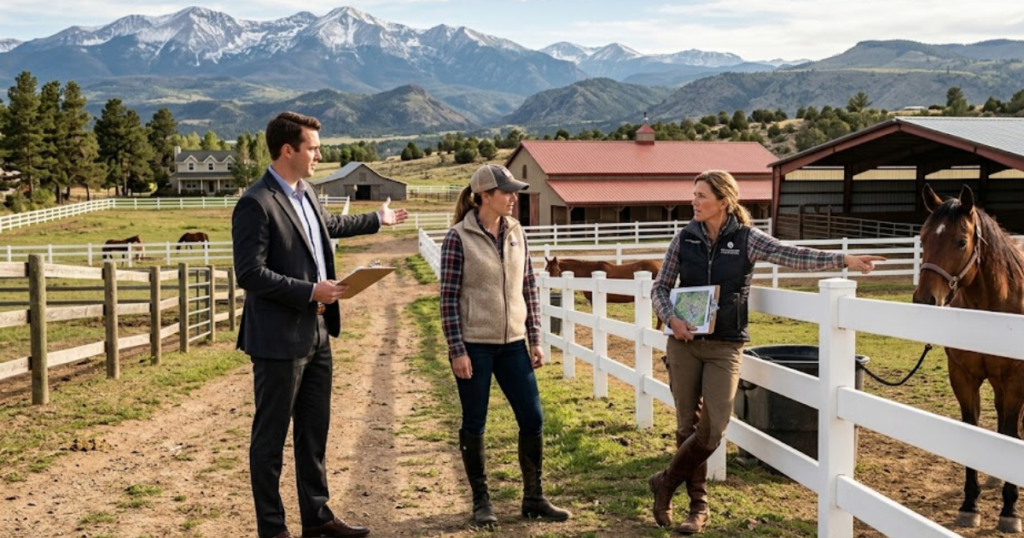
You find a stunning 10-acre property online. The house is completely updated, and there is a gorgeous four-stall barn out back. Your current real estate agent, a family friend who usually sells suburban homes, helps you write a competitive offer and you close the deal.
Three weeks after moving in, you hook up a hose to fill the water troughs for your four horses. A month later, you receive a cease-and-desist letter from the Colorado Division of Water Resources. Your agent never checked the well permit, and it turns out the property has a “Household Use Only” well. It is legally restricted to indoor domestic use, meaning you cannot use a single drop to water your horses or irrigate your pastures. Simultaneously, the county code enforcement officer stops by to inform you that your specific residential zoning only allows for two horses total.
You now own a property that is functionally useless for your herd.
When searching for horse properties colorado, the agent you hire is just as important as the property you buy. Equestrian real estate is essentially a commercial agricultural transaction disguised as a residential home purchase. You cannot afford to work with a generalist.
Here are the critical differences between a standard residential agent and an equestrian specialist.
What Is the Difference Between a Standard Real Estate Agent and an Equestrian Specialist When Buying Horse Property in Colorado?
Quick Summary: The Specialist Advantage
- The Residential Blind Spot: Standard agents are trained to evaluate granite countertops, school districts, and roof ages. They rarely know how to calculate animal density zoning, verify well permits, or evaluate soil drainage.
- The Water Rights Reality: In Colorado, water access dictates property value. An equestrian specialist knows how to verify if a property's well permit actually allows for watering livestock, while a standard agent might just see a functioning tap.
- The Zoning Decoder: Just because a property has 10 acres does not mean horses are legally allowed. An expert will cross-reference county agricultural zoning, HOA covenants, and commercial use codes before you ever schedule a showing.
- The Infrastructure Eye: A standard agent looks at the house first. A true equestrian agent evaluates the land first, looking at pasture fencing, arena drainage, barn safety, and trailer access.
1. Mastery of Colorado Water Law
In the arid West, water dictates property usability. If an agent does not understand the Division of Water Resources, they cannot protect your herd.
- The Standard Agent: A residential agent will turn on the kitchen faucet, verify the water pressure is good, and move on. They assume all wells function the same way.
- The Equestrian Specialist: An expert will pull the actual well permit before the showing. They know the difference between a "Household Use Only" permit, which makes outside watering illegal, and a "Domestic and Livestock" permit. They also know how to verify deeded surface water rights and ditch company shares for irrigated pastures.
2. Fluency in Zoning and Animal Density
Acreage does not equal permission. Your agent must act as a zoning investigator.
- The Standard Agent: A generalist looks at the lot size. If they see five acres, they assume you can keep horses, completely ignoring local zoning overlay districts or HOA covenants that might ban livestock entirely.
- The Equestrian Specialist: Every Colorado county dictates how many horses are allowed based on zoning districts. An expert will calculate the legal carrying capacity of the land, check for commercial "Use by Right" zoning if you want to run a boarding facility, and pull HOA documents to spot hidden fencing or trailer parking restrictions.
3. Evaluating Equine Infrastructure and Safety
An equestrian agent evaluates a property from the horse's perspective first, and the human's perspective second.
- The Standard Agent: They will admire the look of a custom barn, note the number of stalls, and compliment the painted wood fencing.
- The Equestrian Specialist: They will spot safety hazards that residential agents miss. They check for inadequate ceiling height in the stalls, lack of ventilation, dangerous wire fencing, and proper base drainage in the riding arena. They also ensure heavy hooves are not kept over a septic leach field, protecting the home's critical infrastructure.
4. Accurate Valuation of Agricultural Assets
Standard appraisers often struggle to value equestrian properties, which can kill your financing.
- The Standard Agent: A standard agent relies purely on residential comparable sales, often failing to articulate the value of a $100,000 indoor arena to an appraiser.
- The Equestrian Specialist: An expert knows how to pull niche agricultural comps. They will aggressively defend the value of outbuildings, specialized fencing, and irrigation infrastructure to the bank's appraiser, ensuring your loan gets approved.
We Know Colorado Equestrian Real Estate
We do not just sell homes with land, we sell operational horse farms.
When Mark Eibner's team represents you, we pull the well permits, map out the zoning, and evaluate the pasture infrastructure before we even write the offer. We protect you from the hidden legal and agricultural traps that generalist agents miss, ensuring your next farm is a safe, legal, and functional home for your herd.
Contact us today at coloradohorseproperty.com to find premium horse properties colorado buyers trust for verified water rights and zoning.
Browse active colorado horse ranches for sale or ask our team about finding a functional horse property for rent colorado with the right infrastructure.
Frequently Asked Questions (FAQ) About Equestrian Agents
Can I use my regular residential real estate agent to buy a horse property?
You can, but it carries immense risk. Standard residential contracts and inspection periods are not designed to cover agricultural well testing, soil quality, barn permitting, or ditch rider agreements. An equine specialist protects you from catastrophic agricultural oversights.
What is a "Household Use Only" well permit?
Issued by the Colorado Division of Water Resources, this permit restricts well water solely to indoor domestic use. It is illegal to use this water for livestock, gardens, or pastures. An equestrian agent will verify that a property has a "Domestic and Livestock" well permit instead.
How do I know if the arena or barn on the property was built legally?
Your equestrian agent should pull the county permit history. If the previous owner built a massive barn or riding arena without pulling the proper agricultural or structural permits, the county could force you, the new owner, to tear it down or face heavy fines.