
In Colorado, owning the dirt is only half the battle. Owning the water is what determines if that acreage is a functional ranch or a dusty liability. If you are searching for colorado land with water rights for sale, you likely already know that a beautiful green pasture means nothing without the legal authority to keep it that way. The fear of accidentally purchasing a “dry” parcel is a valid concern for anyone looking to support horses or livestock.
It is easy to feel overwhelmed by the “First in Time, First in Right” doctrine and the confusing overlap of well permits versus surface rights. This 2026 guide will help you master the complexities of Colorado water law so you can secure a property that actually provides the water your horses require. You will learn how to interpret the specific water decree on a listing and verify every claim before you reach the closing table. We will walk through the technical steps needed to ensure your investment is protected by senior rights and reliable infrastructure.
Key Takeaways
- Learn why the seniority of a water right is the most critical factor in determining the long-term viability and value of your ranch.
- Navigate the technical differences between tributary and non-tributary groundwater when searching for colorado land with water rights for sale.
- Master the two-step verification process to confirm legal decrees and well permits through the Division of Water Resources before you sign a contract.
- Understand how basin-specific regulations in areas like the South Platte and Arkansas River impact your legal ability to irrigate pastures.
- Discover how to leverage AI-powered search tools to filter for properties that meet your specific requirements for livestock and land management.
Understanding Colorado Water Rights: The Foundation of Land Value
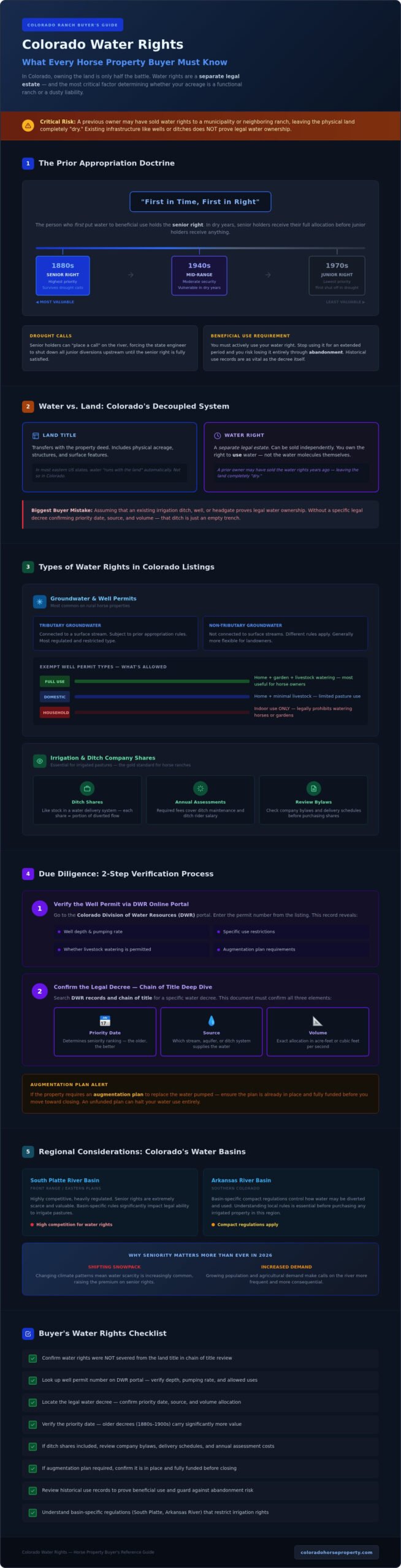
In Colorado, a beautiful stream running through a property doesn’t mean you have the right to touch a single drop. Water is a separate legal estate. When you browse listings for colorado land with water rights for sale, you are looking at two distinct assets bundled into one transaction. You don’t actually “own” the water molecules; you own a perpetual right to use a specific amount of water for a specific purpose at a specific time. Understanding this legal framework is the only way to protect your livestock and your investment.
The Prior Appropriation Doctrine Explained
Colorado operates under the Prior Appropriation Doctrine, often summarized as “first in time, first in right.” This means the person who first put the water to “beneficial use” holds the senior right. In dry years, senior holders get their full allocation before junior holders receive anything. When water levels drop, a senior holder can “place a call” on the river. This forces the state engineer to shut down upstream junior diversions until the senior right is satisfied.
As we move through 2026, shifting snowpack patterns and increased demand make these senior rights more valuable than ever. A decree from the 1880s is worth significantly more than one from the 1970s because it is much more likely to survive a call on the river. You must also prove “beneficial use” regularly. If you stop using your water for an extended period, you risk losing the right entirely through abandonment. This makes historical use records just as important as the legal decree itself.
Real Estate vs. Water: A Decoupled System
Unlike many eastern states, Colorado water does not automatically “run with the land.” It is a “decoupled” system. A previous owner could have sold the water rights to a municipality or a neighboring ranch decades ago, leaving the physical land “dry.” Identifying severed rights requires a deep dive into the chain of title and the records at the Colorado Division of Water Resources. You cannot rely on a visual inspection of a well or a headgate to confirm your rights.
You are looking for a specific legal decree that confirms the right’s priority date, source, and volume. Without this documentation, that irrigation ditch is just an empty trench. The greatest risk for a new buyer is purchasing a property under the assumption that existing infrastructure implies legal ownership, only to find the water rights were severed years prior.
Types of Water Rights You’ll Encounter in Colorado Listings
Generic real estate sites often list “water rights” as a simple binary feature, but this tells you nothing about the property’s actual utility. When you evaluate colorado land with water rights for sale, you must distinguish between the legal right to pump from the ground and the right to divert from a stream. These rights are governed by different rules, and choosing the wrong one could leave you with a beautiful barn but no way to hydrate your animals.
Groundwater and Well Permits
Most rural properties rely on groundwater. The legal status of your well depends on whether the water is tributary, meaning it’s connected to a surface stream, or non-tributary. This distinction is critical. An “exempt” well permit is the standard for most small acreages, typically allowing for one or two homes and the watering of domestic animals. However, you must be careful. Some permits are strictly for “household use only,” which legally prohibits you from watering a garden or even a single horse.
Always verify the well permit number through the Colorado Division of Water Resources (DWR) online portal. This record shows the depth, the allowed pumping rate, and any specific restrictions tied to the land. If the property requires an augmentation plan to replace the water you pump, ensure that plan is already in place and fully funded before you move toward a closing.
Irrigation and Ditch Shares
Surface water rights are frequently managed through mutual ditch companies. Owning shares in a ditch company is essentially like owning stock in a water delivery system. This is a primary feature in equestrian real estate Colorado because it provides the volume of water necessary for maintaining healthy, irrigated pastures. Each share represents a portion of the water diverted by the company, but it also comes with responsibilities.
You’ll be responsible for annual assessments to cover ditch maintenance and the salary of the ditch rider. Before purchasing, examine the company’s bylaws and delivery schedules. A share on paper doesn’t guarantee water at your headgate if the infrastructure is failing or if the company has a history of internal disputes. It’s also wise to check the “shrinkage” rate, which is the amount of water lost to evaporation or seepage before it reaches your property.
Finally, look for decreed rights rather than conditional ones. A decreed right has been confirmed by a water court and is ready for use. A conditional right is merely a “placeholder” in the priority line. To maintain a conditional right, you must prove to the court every six years that you are making diligent progress toward using that water. For a functional horse property, a conditional right is an aspirational asset, not a reliable source for your daily operations. You can use our AI-powered search to specifically target parcels that already have these complex water assets verified and in place.
Due Diligence: Verifying Water Rights Before You Close
Finding a property that claims to have water is only the beginning. When you evaluate colorado land with water rights for sale, your due diligence period must include a rigorous verification process. You aren’t just checking the fences and the roof; you’re auditing a legal history that might stretch back over a century. Skipping these steps can lead to a “dry” purchase that loses significant value the moment a drought hits.
- Step 1: Obtain the legal decree or well permit number directly from the seller or their listing agent.
- Step 2: Research the priority date and historical use records at the Colorado Division of Water Resources (DWR). Their online portal provides the most accurate data on whether a right has been consistently used or is at risk of being declared abandoned.
- Step 3: Order a specialized Water Title Search to confirm the seller actually owns the rights they are claiming.
- Step 4: Inspect the physical infrastructure, including pumps, headgates, and delivery ditches.
- Step 5: For complex decrees involving multiple users or augmentation plans, consult a specialized water attorney to review the paperwork.
The Role of the Water Title Search
Standard title insurance policies usually protect the land and buildings but often explicitly exclude water rights. This gap creates a massive risk for buyers. You need a specialized title company, such as Meridian Title & Escrow, that understands how to trace water ownership through decades of deeds and court decrees. They will ensure the “Statement of Authority” is correctly filed. This document is essential for a legal transfer, as it identifies who has the power to sign for the water assets on behalf of an entity or estate. Without a clear chain of title, you might find yourself in a legal battle with a neighbor over a right you thought you bought.
Physical vs. Legal Water
Don’t confuse a legal permit with “wet water.” A well permit might authorize you to pump 15 gallons per minute, but if the aquifer has dropped or the infrastructure is failing, you might only get five. This is a common issue when looking at Colorado ranches for sale, where aging pumps and silted-in headgates are frequent. Always conduct a formal well production test during your inspection period. You need to know the actual GPM (gallons per minute) and the recovery rate of the well to ensure it can support your livestock and irrigation needs throughout the peak of summer. If the infrastructure is old, factor the replacement costs into your offer price immediately.
Regional Considerations: Where to Find the Best Watered Land
Water availability in Colorado is dictated by geography and legal basins rather than municipal boundaries. When searching for colorado land with water rights for sale, you must look at the specific basin’s rules. Each region has a different “water personality” based on its historical usage and proximity to growing cities. Understanding these regional nuances prevents you from buying a property in a “closed” basin where new water uses are legally impossible.
Front Range Challenges and Augmentation
The South Platte Basin, which serves the Front Range, faces intense pressure from urban growth. Here, you will frequently encounter the term “Augmentation Plan.” This is a court-approved legal framework that allows you to pump water from a well by replacing that water elsewhere in the river system to prevent injury to senior holders. If you are looking for land for sale in Colorado near Denver or Fort Collins, buying a property with a pre-approved augmentation plan is a major advantage. It saves you the high cost and multi-year legal process of creating a new plan for your horses.
In the Arkansas River Basin to the south, strict regulations govern every drop. This region has been heavily impacted by “buy and dry” trends, where municipalities purchase senior water rights from agricultural land and move that water to cities. This leaves behind dry parcels that can no longer support intensive grazing. Buyers in this basin must be extra vigilant to ensure the water rights haven’t been stripped from the land through previous municipal sales.
Western Slope Opportunities
The Western Slope, particularly the Uncompahgre and Colorado River basins, often holds some of the most senior irrigation rights in the state. These valleys were developed early for agriculture, meaning many parcels have priority dates that survive even severe drought calls. However, buyers must be aware of the Colorado River Compact. This federal agreement dictates how much water must flow to downstream states. While local senior rights are currently protected, long-term federal compact issues could influence future water management across the entire Western Slope.
Look for “sub-irrigated” pastures in these regions. These are areas where the water table is naturally high enough to keep grass green without active ditch irrigation. This reduces your labor and infrastructure maintenance. These specialized features are exactly what we help you identify when you use our AI-powered property search tool to find resource-heavy acreage.
High country ranches offer a different set of challenges. These properties are entirely dependent on seasonal snowpack. While they may have abundant water during the spring runoff, seasonal streams can dry up by late summer. If your livestock requires year-round hydration, you must verify the presence of storage ponds or deep wells that aren’t solely dependent on surface flow. Always check if the property has a “decreed” storage right, which allows you to capture runoff when it’s available and use it when the streams go dry.
Finding the Perfect Property with Colorado Horse Property
Searching for colorado land with water rights for sale is a technical challenge that requires more than a standard real estate search. You shouldn’t have to wade through thousands of “dry” parcels to find the few that actually meet your livestock and irrigation needs. We’ve built a specialized system that does the heavy lifting for you, ensuring that every property you tour has the potential to support your lifestyle. Our approach combines cutting-edge technology with decades of boots-on-the-ground experience in the Colorado ranch market.
Our AI-Powered Advantage
Our proprietary AI-powered search technology is designed specifically for the equestrian and agricultural community. Unlike standard platforms that treat water as a simple footnote, our tool filters for specific legal attributes like decreed water rights and irrigation ditch shares. This allows you to find a horse property for sale in Colorado that matches your exact resource requirements from day one. You can customize alerts to monitor specific basins or priority dates, saving you weeks of manual research and excluding parcels that don’t meet your criteria.
Expert Guidance from Mark and Alison Eibner
Mark and Alison Eibner bring 40 years of experience to every transaction via Realty Oasis. We don’t just show you land; we provide a no-nonsense evaluation of a property’s true resource value. This includes a full-cycle brokerage approach where we coordinate with specialized water engineers and attorneys to verify decrees and well permits during the transaction management phase. We understand that a misunderstanding of “First in Time, First in Right” can be a devastating financial error for a buyer. We act as your expert advocate to ensure the water you see is the water you legally get.
Our deep roots in the Colorado agricultural community also give us access to off-market listings and “pocket” ranches that never reach the public MLS. These properties often hold the most senior water rights in the state and are only available through specialized networks. When you are ready to invest in colorado land with water rights for sale, you need a partner who understands that the soil is only as good as the decree behind it. You can Search our current land listings with water rights to find a property that truly delivers on its promises.
Secure Your Legacy with Water-Rich Land
Securing a functional ranch in 2026 requires more than a handshake and a visual check of the irrigation ditches. You’ve learned that the legal seniority of a water right determines whether your pastures stay green during a drought call. Verifying well permits and surface decrees before closing is the only way to protect your investment from becoming a “dry” liability. Whether you’re navigating the augmentation plans of the Front Range or the senior rights of the Western Slope, specialized expertise is essential.
At Colorado Horse Property, we combine 40 years of local expertise with proprietary AI-powered property filtering to find the exact resource-heavy acreage you need. As a specialized equestrian brokerage, we handle the technical due diligence so you can focus on building your dream. Don’t leave your water security to chance when searching for colorado land with water rights for sale. Your future ranch depends on the legal strength of its water assets.
Find Your Ideal Colorado Land with Water Rights Using Our AI Search Tool
The right property is out there, and with the proper due diligence, you can secure a landscape that sustains your horses for generations to come.
Frequently Asked Questions
Can I use my domestic well to water my horses in Colorado?
It depends on the specific permit type issued by the Division of Water Resources. Most standard domestic well permits allow for the watering of non-commercial domestic animals, including horses. However, if your permit is strictly for “household use only,” you are legally prohibited from using that water for livestock or even a small garden. Always check the permit’s “Conditions of Approval” to confirm your usage limits before bringing animals onto the property.
What is the difference between a senior and junior water right?
Seniority is determined by the date the water was first put to beneficial use and decreed by a court. A senior water right has an earlier priority date and must be fully satisfied before any junior rights receive water during times of shortage. In drought years, junior holders are often shut off completely to ensure senior holders get their full legal allocation. This hierarchy is the backbone of Colorado’s “First in Time, First in Right” system.
Do I need a lawyer to buy land with water rights in Colorado?
While not legally required, consulting a specialized water attorney is highly recommended for complex transactions involving irrigation decrees. Water law is a distinct legal field in Colorado with its own court system and technical requirements. An attorney can review the chain of title and specific decrees to ensure you are actually receiving the rights described in the listing. For standard well permit transfers, an experienced broker can often handle the paperwork, but high-value rights usually require legal oversight.
How much does a water right add to the value of Colorado land?
A reliable water right can double or even triple the value of a parcel compared to a dry lot of the same size. When searching for colorado land with water rights for sale, you’ll find that irrigated acreage commands a significant premium because it offers agricultural productivity and long-term drought resilience. Without water, land value is often limited to its potential for dry-land grazing or residential use without any external landscaping or gardens.
What happens if I don’t use my water rights for several years?
You risk losing the right through a legal process called abandonment. Colorado law requires that water be put to “beneficial use” to maintain the right. If a right is not used for ten years or more, the state can place it on the abandonment list. Once a right is officially declared abandoned by the water court, it is permanently terminated. Consistent use and thorough documentation are vital for protecting your property’s value and future utility.
Are ditch shares the same as owning the water?
No, owning ditch shares means you own stock in a mutual ditch company that owns the underlying water rights. Your shares entitle you to a proportional delivery of the company’s water based on their priority date and the current seasonal supply. You are also responsible for paying annual assessments for ditch maintenance and infrastructure repairs. Unlike a direct flow right, your access is governed by the company’s specific bylaws and the physical condition of the delivery system.
How do I find out if a property has a well permit?
You can search for well permits through the Colorado Division of Water Resources (DWR) online Map Viewer or their database portal. You will need the permit number, the legal description of the land, or the current owner’s name. This search will reveal the well’s depth, pumping rate, and allowed uses. Verifying this data is a standard step when evaluating colorado land with water rights for sale to ensure the existing infrastructure is legal and functional.
What is an augmentation plan and do I need one for my ranch?
An augmentation plan is a court-approved program that allows you to use water out of priority by replacing the amount you consume. This is common in “over-appropriated” basins where new wells would otherwise injure senior holders. You typically need one if you plan to pump more water than a standard domestic permit allows, such as for large-scale irrigation or commercial livestock. Many horse properties near the Front Range operate under these plans to ensure they have enough water year-round.