
Did you know that irrigation water rights in the Colorado Front Range can now trade for as much as $85,000 per acre-foot? While the dream of owning an equestrian estate is deeply rooted in the Western lifestyle, the financial reality of keeping it operational in 2026 is becoming increasingly complex. You likely recognize that land ownership is a major investment, but the actual cost of maintaining a horse ranch in Colorado often hinges on variables that catch even seasoned owners off guard. Between volatile hay prices reaching $483 per ton and the technical demands of well maintenance in a semi-arid climate, the overhead can escalate quickly if you aren’t prepared.
We understand that you want a ranch that serves as a sanctuary, not a source of financial stress. This guide provides a transparent breakdown of the monthly and annual expenses required to run a functional estate today. You’ll gain a clear line-item budget for infrastructure upkeep and an expert understanding of Colorado-specific legal and climate costs. We will preview the essential numbers for veterinary care, fencing repairs, and manure management to ensure you have the confidence to choose or manage a property that remains efficient for years to come.
Key Takeaways
- Learn to distinguish between individual animal care and the fixed operational costs of running a Colorado estate, including property taxes and specialized insurance.
- Identify the recurring maintenance requirements for professional-grade barns and arenas to ensure long-term structural integrity and safety.
- Get a line-item breakdown of the cost of maintaining a horse ranch in Colorado, focusing on water rights management and pasture irrigation systems.
- Understand how to budget for climate-driven expenses such as fluctuating hay prices and efficient manure disposal strategies.
- Discover how using AI-powered search tools can help you identify properties with high-quality existing infrastructure that reduces your total cost of ownership.
Fixed vs. Variable: Defining the Colorado Horse Ranch Budget
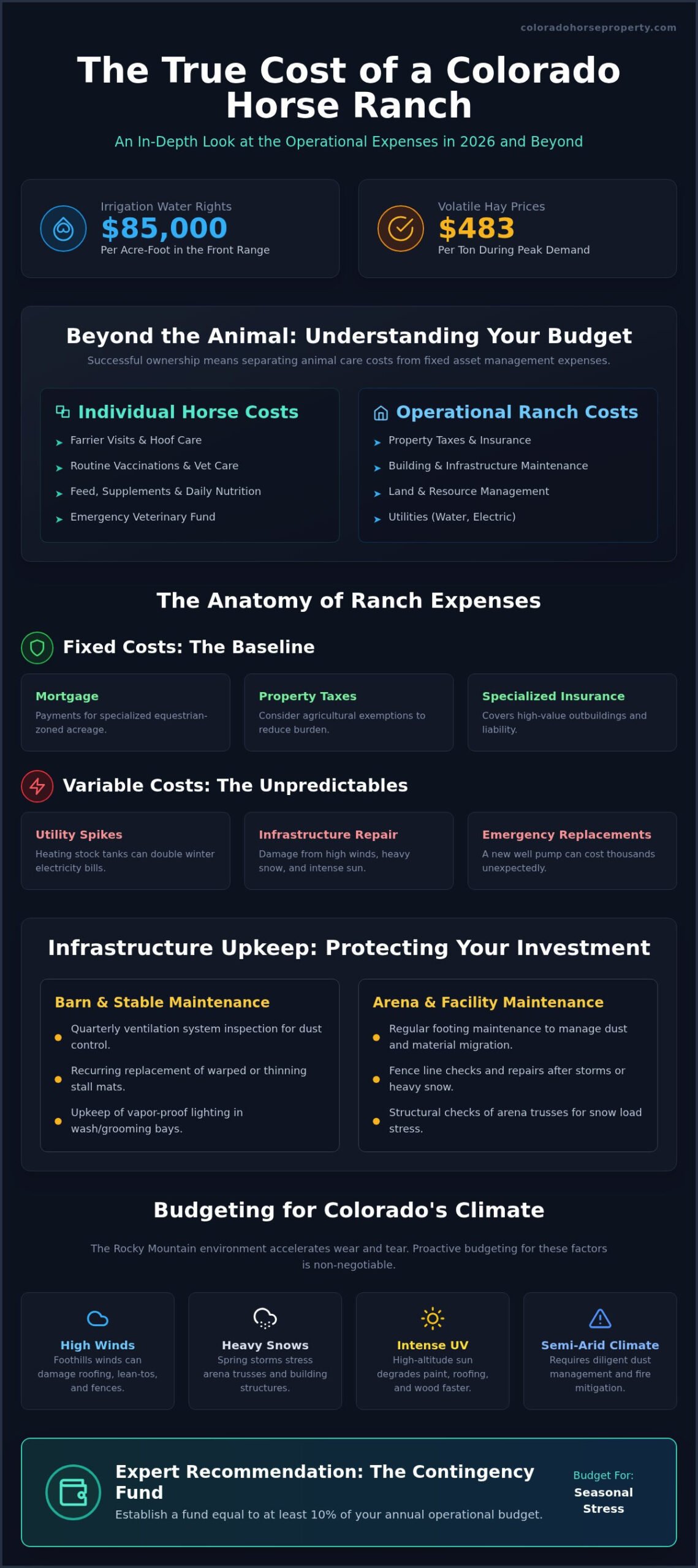
Running an equestrian estate requires a mental shift from animal husbandry to asset management. While a monthly board check at a commercial stable is predictable, the cost of maintaining a horse ranch in Colorado involves managing a complex infrastructure where land and livestock expenses intersect. You must separate “horse costs,” such as farrier visits and vaccinations, from “ranch costs,” which include property taxes, building maintenance, and resource management. This distinction is vital for long-term financial health.
Fixed costs are the baseline of your operation. These remain relatively steady regardless of how many horses are in your stalls. In the Colorado Front Range, property taxes are a significant consideration, though many properties qualify for agricultural exemptions that drastically reduce the tax burden. Maintaining this status often requires specific land use documentation or production proof. Specialized equestrian insurance is also a fixed necessity. Standard homeowners’ policies rarely cover outbuildings like professional-grade arenas or the liability risks associated with horse management and guest riders. Understanding these variables is essential for anyone calculating the true cost of maintaining a horse ranch in Colorado before signing a purchase agreement.
Fixed Monthly Expenses for Ranch Owners
Mortgage payments for equestrian-zoned acreage are often higher than residential loans due to the specialized nature of the land. You also need to budget for comprehensive insurance that covers high-value structures like hay sheds and barns. In Colorado, zoning regulations may dictate certain maintenance tasks, such as fire mitigation or noxious weed control. These carry their own administrative or labor costs to stay compliant with local agricultural tax benefits. Failing to meet these requirements can lead to a sudden, expensive spike in property taxes.
Budgeting for the Unexpected in the Rockies
Variable costs are where many new owners struggle. Colorado’s climate is notoriously harsh on infrastructure. High winds in the foothills can damage roof metal or lean-tos, while heavy spring snows stress arena trusses. You should also account for energy spikes; keeping stock tanks from freezing during a February cold snap can double your utility bill. Unlike an emergency vet call for a horse, an emergency well pump replacement can cost thousands and halt your entire operation. We recommend establishing a 10% contingency fund specifically for seasonal infrastructure stress. This “rainy day” fund ensures that when hay prices spike due to drought or a fence line fails, your ranch remains functional without compromising your long-term budget.
Infrastructure Maintenance: Keeping Your Barn and Arena ‘Horse-Ready’
Many new owners approach their budget by looking at the Finances of Horse Ownership through the lens of vet bills and feed. However, the physical structures on your property represent a massive portion of your long-term investment. In the Front Range, the cost of maintaining a horse ranch in Colorado is heavily influenced by high altitude, intense UV exposure, and shifting soils. These environmental factors degrade building materials faster than in more temperate climates, making a proactive maintenance schedule essential for safety and property value.
Professional Barn and Stable Upkeep
Equine respiratory health depends on the barn’s design and cleanliness. Colorado’s dry air makes dust management a daily struggle, so you’ll need to inspect ventilation systems quarterly to ensure airflow remains unobstructed. Stall mats are another recurring expense; they eventually warp or thin, requiring replacement to protect your horses’ joints. Lighting systems should be vapor-proof to withstand the moisture in wash racks and grooming bays. If you’re weighing the pros and cons of different layouts, our guide on horse barns for sale provides deeper building vs. buying insights.
Maintaining Riding Arenas and Training Facilities
A professional-grade riding arena is a high-maintenance asset. Footing is not a one-time purchase. Over time, sand or rubber mixes pulverize into fine dust or migrate to the arena’s edges. You’ll need specialized grooming equipment to drag the surface, keeping it level and cushioned for your horse’s soundness. Dust suppression is equally vital. In our semi-arid climate, watering an arena can consume significant resources. Some owners invest in chemical stabilizers to reduce the frequency of watering, which adds a predictable line item to the annual budget. Round pens and turnouts also require regular safety checks to prevent injuries from loose boards or shifted footing.
Fencing stewardship is your first line of defense. In 2026, prices for installed fencing vary based on the material’s lifecycle. While wire fencing is affordable at $1 to $3 per linear foot, high-end vinyl or pipe fencing can reach $40 per linear foot. Vinyl offers superior longevity against the Colorado sun, whereas wood requires frequent staining and board replacement to prevent rot. Beyond materials, you must budget for the machinery that makes this work possible. A reliable tractor with a front-end loader and a manure spreader is non-negotiable for daily operations. These machines require their own maintenance and fuel, further influencing the total cost of maintaining a horse ranch in Colorado. To find estates with pre-installed, professional-grade infrastructure, you can start a horse property search tailored to your specific needs.
Land and Resource Management: The Price of Water and Grass
In the semi-arid climate of the Front Range, your land is either a self-sustaining asset or a significant financial liability. The cost of maintaining a horse ranch in Colorado is inextricably linked to how you manage your two most precious resources: water and grass. Unlike greener regions in the East, Colorado soil requires active intervention to remain productive. Neglecting pasture health doesn’t just damage the landscape; it forces you to rely entirely on expensive supplemental hay. With some hay prices reaching as high as $483 per ton in 2026, every acre of healthy grazing land you maintain directly offsets your monthly operational overhead.
The Reality of Colorado Water Rights
Water is the single most complex factor in Western land ownership. Adjudicated water rights determine exactly how much water you can legally pull from the ground or a stream and for what specific purpose. Currently, Colorado Front Range water rights (CBT units) trade between $52,000 and $85,000 per acre-foot. Even if your property has an existing well, you must account for the operational costs of well permits and the periodic maintenance of deep-well pumps and cisterns. Winter adds another layer of expense. You’ll need reliable energy sources to keep automatic waterers and hydrants from freezing during sub-zero stretches. The legal distinction between junior and senior water rights also dictates your ranch’s operational capacity during drought cycles, making professional evaluation a requirement during the acquisition phase.
Pasture Stewardship and Grazing Costs
Effective pasture management prevents the “dust bowl” effect common on overgrazed properties. You should budget for annual professional soil testing and targeted fertilization to maximize your grazing potential. A robust rotation schedule, supported by durable internal cross-fencing, allows grass to recover and prevents the destruction of root systems. Weed mitigation is another non-negotiable expense. In the Front Range, invasive species like leafy spurge can quickly overtake a pasture if not addressed with professional spraying. If you are currently evaluating acreage for a new project, our guide on land for sale in Colorado offers a strategic framework for acreage planning and soil assessment.
Ultimately, your goal is to balance your stocking rate with the land’s actual carrying capacity. Overgrazing leads to soil erosion and increased weed pressure, both of which are expensive to remediate. By investing in reseeding and efficient irrigation infrastructure early, you stabilize the cost of maintaining a horse ranch in Colorado by extending your grazing season and reducing your vulnerability to the volatile feed market.
Operational Expenses: Hay, Waste, and Climate-Driven Costs
Daily operations represent the recurring liquidity required to keep your ranch solvent. While land and infrastructure are capital investments, the cost of maintaining a horse ranch in Colorado is often dictated by the price of consumables and the energy required to fight the elements. In 2026, these costs are heavily influenced by regional drought conditions and shifting environmental regulations that impact how you manage your land and livestock.
Colorado Hay Market Trends for 2026
Feed is your largest variable expense. As of August 2026, about 42% of U.S. hay-producing land is experiencing drought, which has pushed prices for a ton of hay as high as $483 in some Colorado regions. Fluctuating moisture levels across the Front Range mean that prices can shift $1 per bale within a single month. To mitigate this volatility, high-capacity hay storage is a strategic asset. Buying in bulk during the summer harvest and storing it on-site can save thousands over a 12-month period. Additionally, horses living at high altitudes have higher caloric requirements to maintain body condition, especially during the extreme temperature swings of a Rockies winter.
Waste Management and Environmental Compliance
Managing what comes out of the horse is as vital as what goes in. An average horse produces approximately 350 pounds of manure per week, totaling nearly 9 tons per year. In Colorado, environmental compliance is strictly enforced to protect water quality. You must store manure at least 150 feet down-gradient from wells and 100 feet from floodplains. To stay on the right side of local zoning, stockpiles should also be 200 feet away from your neighbors. You have several choices for disposal:
- On-site composting: Reduces waste volume but requires labor and equipment.
- Spreading: Beneficial for soil health if you have the acreage to support it.
- Professional removal: The most expensive option but necessary for smaller parcels.
Bedding also impacts your waste volume and budget. While straw is traditional, many Colorado owners prefer wood pellets or shavings for their superior absorbency in dry climates. These materials add to your disposal mass but can improve barn air quality. When evaluating a potential purchase, check for existing manure pads and composting bays. You can find estates with these features already in place by browsing our horse property for sale in Colorado guide.
Beyond feed and waste, energy consumption spikes during the winter months. Heating stock tanks to prevent ice and providing supplemental heat in foaling stalls or wash racks can significantly impact your utility bills. Planning for these climate-driven costs is essential for a realistic budget. If you’re ready to find a property designed for operational efficiency, start your specialized property search today.
Minimizing Overhead: The Value of Specialized Real Estate Search
The financial health of an equestrian estate is often determined long before the first mortgage payment is processed. While the daily cost of maintaining a horse ranch in Colorado is influenced by the operational variables discussed in previous sections, your long-term overhead is dictated by the quality of the property’s existing infrastructure. Transitioning from a casual visitor at a dude ranch to a savvy estate owner requires a shift in perspective. You aren’t just buying a home; you are acquiring a specialized agricultural facility. Identifying a property that is “efficient” to run can save you hundreds of thousands of dollars in deferred maintenance and construction costs over the life of your ownership.
Using AI to Filter for Low-Maintenance Features
Traditional real estate platforms are built for residential neighborhoods, not working ranches. They often fail to distinguish between a decorative barn and a professional-grade facility with proper ventilation and drainage. Our proprietary AI-powered search tool changes this dynamic by allowing you to filter for specific high-value assets. You can target properties with adjudicated water rights, drought-resistant pastures, or arenas with pre-installed professional footing. By focusing on these details, you avoid the massive capital expenditure of building from scratch. Buying a ranch with existing, high-quality outbuildings typically offers a much higher ROI than attempting to retrofit a poorly designed parcel. Find your efficient Colorado horse ranch with our AI search to see how specific infrastructure data can guide your investment.
The Eibner Advantage: 40 Years of Ranch Expertise
Expert buyer representation is your best defense against “hidden” infrastructure issues that can bloat the cost of maintaining a horse ranch in Colorado. Mark and Alison Eibner bring 40 years of experience in the Colorado Front Range to every transaction. They understand the nuances of soil quality, the legal complexities of water rights adjudication, and the structural requirements of mountain-climate barns. This deep expertise allows them to spot a failing well pump or a poorly graded arena before you reach the closing table.
Beyond land evaluation, the Colorado Horse Property ecosystem streamlines the entire purchase process. Our full-service approach includes transaction management, title services, and escrow coordination. This integrated model ensures that the legal and financial aspects of your ranch acquisition are as robust as the physical land itself. We help you find a legacy property that balances your passion for horses with long-term financial sustainability. By combining advanced technology with decades of boots-on-the-ground knowledge, you can move forward with the confidence that your new estate is built for operational efficiency and lasting value.
Securing Your Equestrian Legacy in the Front Range
Owning a functional ranch is a rewarding pursuit that requires a firm grasp of regional logistics. From navigating complex water rights to budgeting for high-capacity hay storage, your success depends on proactive planning. By distinguishing between fixed property expenses and variable operational needs, you can protect your investment against the unpredictable nature of the Rockies. Understanding the true cost of maintaining a horse ranch in Colorado ensures that your passion remains financially sustainable for years to come.
The most effective way to minimize overhead is to start with a property built for efficiency. Led by industry veterans Mark and Alison Eibner, our team leverages 40 years of Colorado Front Range real estate expertise to help you identify high-quality infrastructure. Our proprietary AI-powered search allows you to filter for specific equestrian features, such as adjudicated water rights and professional-grade barns, before you even schedule a tour. Don’t leave your ranching dream to chance. Find Your Perfect Colorado Horse Ranch with Our AI Search Tool today and take the first step toward a smarter, more efficient lifestyle on the land.
Frequently Asked Questions
How many acres do I need for a horse ranch in Colorado?
You typically need at least 2 to 5 acres of productive land per horse if you intend to rely on grazing for nutrition. However, many Front Range counties have specific zoning laws that dictate livestock density regardless of soil quality. If your acreage is smaller, you must budget for a significant increase in supplemental hay to prevent overgrazing and soil erosion.
What is the average annual cost of maintaining a horse ranch in Colorado?
The cost of maintaining a horse ranch in Colorado generally ranges from $5,000 to $15,000 for basic property and infrastructure upkeep. This figure covers barn maintenance, fence repairs, and weed control, but excludes individual animal care like veterinary or farrier fees. Your total will vary based on the age of your outbuildings and the complexity of your irrigation systems.
Do I need special insurance for a horse ranch property?
Yes, a standard homeowners policy rarely covers the unique risks of an equestrian estate. You need a specialized farm and ranch policy to protect high-value structures like indoor arenas and hay sheds. These policies also provide essential liability coverage for equine-related activities, which is vital if guests or trainers utilize your facilities.
What are adjudicated water rights, and why do they affect my budget?
Adjudicated water rights are legal decrees that grant you the right to use a specific amount of water for irrigation or livestock. They are a massive factor in property value and operational costs. Properties with senior water rights are more expensive to purchase but offer much lower long-term costs because you can grow your own forage instead of buying expensive hay.
Is it more expensive to maintain a ranch at high altitude?
Maintaining a ranch at high altitude is generally more expensive due to extreme UV exposure and harsh winter cycles. Building materials like wood and paint degrade faster in the thin air, requiring more frequent restoration. Horses living at higher elevations also have higher caloric needs to maintain body heat, which increases your annual feed requirements and overall overhead.
How much should I budget for hay in Colorado for 2026?
You should budget between $300 and $500 per ton for quality grass hay in 2026. Prices reached as high as $483 per ton during recent drought cycles, and volatility remains a concern. To stabilize your budget, invest in a high-capacity hay shed that allows you to buy in bulk during the summer harvest when prices are typically at their lowest.
Can agricultural zoning help reduce my property taxes on a ranch?
Agricultural zoning can drastically reduce your property taxes by allowing the land to be assessed based on its productive capacity rather than its market value. To qualify, you must demonstrate that the land is used for a primary purpose like grazing or hay production. This status is a key strategy for managing the long-term cost of maintaining a horse ranch in Colorado.
What is the most expensive part of ranch maintenance?
Infrastructure and asset management is the most expensive component of ranch maintenance. While feed and water are recurring monthly costs, the sudden expense of a well pump failure or the periodic need to replace arena footing can cost thousands of dollars. Proactive stewardship of your barns, fences, and machinery is the only way to prevent these large, unexpected financial hits.