
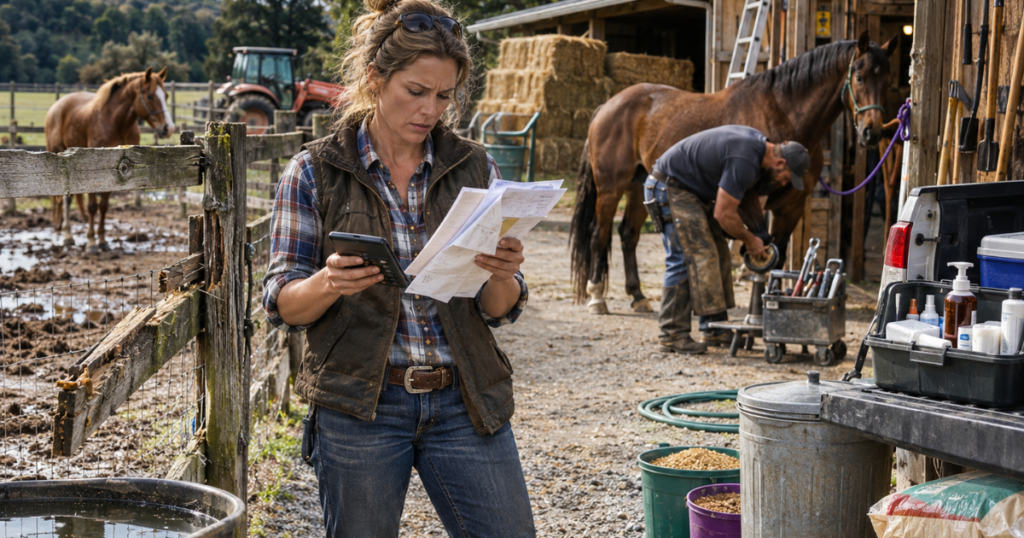
The price on a horse property listing is only where the spending starts. The barn needs a new roof, the well pump quits in August, the county sends a letter about the knapweed along your fence line, and your insurance agent wants to know who else rides your horses.
The short answer: The biggest hidden costs of owning a horse property in Colorado are water (well permits, pumps, and ditch assessments), fence and barn upkeep, insurance and liability, noxious weed control, equipment and fuel, septic and permit compliance, and property taxes that don’t drop just because you keep horses. You can spot most of them before you buy if you know where to look.
Below, we walk through each one with Colorado rules and current figures, then lay out how to budget and inspect before you make an offer.
What Hidden Costs Come With Owning a Horse Property?
Quick Summary: Hidden Costs at a Glance
- Water causes the most expensive surprises: CSU Extension explains that most Colorado wells drilled on or after May 8, 1972 on parcels under 35 acres are permitted for household use only, which rules out watering horses.
- Pleasure horses don't cut your property taxes: Colorado courts and county assessors have held that grazing or boarding horses kept for riding does not qualify land for agricultural classification.
- Weed control is a legal duty: Colorado's Noxious Weed Act requires landowners to manage listed noxious weeds, and counties can manage them for you and send you the bill.
- Insurance can be hard to place: The Colorado FAIR Plan, the state's last-resort insurer, caps residential dwelling coverage at $750,000 and does not include liability coverage, which horse owners need.
Hidden Cost Checklist: When Each One Shows Up
Most hidden costs arrive on a schedule you can predict. Use this list to know what to check before you make an offer.
| Hidden Cost | When It Shows Up | How to Check Before You Buy |
|---|---|---|
| Well permit limits and pump repair | The first dry summer, or when you add horses | Pull the permit from the Division of Water Resources; order a flow and water quality test |
| Ditch assessments and irrigation work | Every spring | Ask the ditch company for assessments and delivery schedules |
| Fence and barn repair | After wind, snow, and years of use | Walk every fence line; have a contractor inspect roofs and footings |
| Insurance and liability | At closing and every renewal | Get quotes during the inspection period, including horse liability |
| Property taxes | Every year | Ask the county assessor how the parcel is classified |
| Noxious weeds | Every growing season | Walk the pasture; call the county weed manager |
| Equipment and fuel | Right after you move in | Price a tractor, trailer, and snow removal |
| Septic compliance | At sale, or when you add a bathroom or living space | Check the septic permit and county transfer rules |
| Unpermitted structures | At appraisal, refinance, or resale | Search county permit records for the barn, arena, and sheds |
1. What Does Water Really Cost on a Horse Property?
Water costs on a Colorado horse property include more than the well. You may also pay for permit limits that force you to haul water, pump and pressure-tank repairs, yearly water testing, heated waterers, and ditch company assessments if the land is irrigated.
Well Permits That Don't Allow Horses
CSU Extension's guide to Colorado well permits explains that most wells drilled on or after May 8, 1972 on parcels under 35 acres are permitted for household use only. That water can be used only inside the home, not for livestock. Parcels of 35 acres or more can usually get a domestic and livestock permit. A buyer who misses this may end up hauling water or paying to change the water supply.
Pumps, Testing, and Winter Water
Well pumps and pressure tanks wear out, and a failure in summer can leave horses without water. The CSU Soil, Water and Plant Testing Laboratory recommends that private well owners test for nitrates at least once a year. In winter, heated waterers and heat tape keep water open but add to the electric bill.
Ditch Shares and Irrigation
Irrigated pasture is a valuable feature, but it comes with annual ditch company assessments, delivery schedules you have to follow, and headgates and ditches you have to maintain. In some areas, well use also depends on an augmentation plan. Ask the ditch company what the current assessment is before you close.
2. How Much Upkeep Do Fences, Barns, and Arenas Need?
Horse facilities wear out faster than a house does. Horses lean on fences, chew wood, kick walls, and churn footing, and Colorado wind, hail, and snow add their own damage. Budget for steady repairs and plan for replacing big items over time.
Fencing
Fence is often the first repair a new owner faces. Wood rails crack and get chewed, wire loosens, and posts heave or rot. Gates sag and latches fail. Walk every foot of fence before you buy and note what needs fixing now.
Barns and Shelters
Roofs, doors, stall mats, and lighting all need regular work. Replacement is the big number: a Colorado pole-barn builder puts a basic two- to three-stall barn at about $70,000 to $100,000. In the mountains, buildings must also carry heavier snow loads, which adds to the cost of any repair or addition.
Arenas
Arena footing breaks down, blows away, and needs to be topped up, dragged, and watered to control dust. Drainage problems turn an arena into mud for days after a storm. Ask the seller how old the footing is and when it was last replenished.
Unpermitted Structures
A barn, arena cover, or apartment built without county permits can cause trouble at appraisal, refinance, or resale. Check county permit records for every structure before you buy, not after.
3. What Insurance and Liability Costs Should You Expect?
Horse property owners usually pay more for insurance than a typical homeowner, for two reasons: much of Colorado's acreage sits in wildfire country, and horses bring liability risk when other people ride, visit, or board. Get quotes during your inspection period so the premium doesn't surprise you after closing.
Wildfire and Property Coverage
The Colorado State Forest Service estimates that more than 1 million Coloradans live where wildfire risk is moderate to very high. Owners who can't find private coverage can turn to the Colorado FAIR Plan, but United Policyholders notes it caps dwelling coverage at $750,000, and PropertyCasualty360 reports that its policy carries no liability coverage. That leaves FAIR Plan owners buying liability insurance separately.
Horse Liability
Colorado's equine activity statute, section 13-21-119, limits liability for injuries caused by the inherent risks of horses. It has exceptions, though, including faulty tack, failing to judge whether a rider can safely take part, and known dangerous conditions without a warning. The Equine Land Conservation Resource notes that the statute requires specific language on signs and in contracts.
The statute doesn't replace insurance. Ask your agent whether your policy covers friends riding your horses, lessons, and other people's horses on your land. Boarding or training for pay may count as a business and need its own policy.
Recreational Access
If you let neighbors or the public ride or hike on your land, Colorado's recreational use statute was updated in 2024 to add a warning-sign provision for landowners. Ask an attorney what signs your situation calls for.
4. Do Horses Lower Your Property Taxes in Colorado?
No, not if they are pleasure horses. Many buyers assume a horse property is taxed as agricultural land, but in Colorado, keeping horses for riding does not qualify land for the lower agricultural rate.
What the Law Says
In Palmer v. Board of Equalization of Eagle County (1998), the Colorado Court of Appeals held that grazing and boarding pleasure horses is not a ranching use. Horses count as livestock only when they are used for food, breeding, draft, or profit. The Douglas County Assessor states the same rule, noting that horse boarding operations are also a non-qualifying use.
When Agricultural Classification Can Apply
Land may qualify if horses are bred or raised for sale at a profit, or if you lease the land to a rancher who grazes livestock for profit under a written lease. The El Paso County Assessor says land must be used for farming or ranching for three continuous years to establish agricultural classification, and it is subject to inspection.
The Trap for Buyers
If the seller had agricultural classification because a neighbor ran cattle on the land, that status can end when the use changes. Ask the assessor how the parcel is classified today and what your tax bill would be if it were reclassified as residential.
5. What Do Weeds, Pasture, and Manure Cost?
Land management is a yearly expense that's easy to overlook. You'll pay to control noxious weeds, which Colorado law requires, to keep pasture productive, and to deal with several tons of manure per horse each year.
Noxious Weeds Are Your Legal Responsibility
Colorado's Noxious Weed Act, section 35-5.5-104, makes it the duty of every landowner to manage listed noxious weeds that are likely to damage neighboring land, as Eagle County summarizes it. Under section 35-5.5-109, the county can notify a landowner to manage the weeds and, if the landowner doesn't, manage them and charge the cost.
Many noxious weeds are also unpalatable or harmful to horses, so control protects your pasture as well as your standing with the county. Your county weed manager can identify what's growing, and some counties, such as Fremont County, offer herbicide cost-share help.
Pasture Upkeep
Overgrazed pasture has to be rested, sometimes reseeded, and fertilized based on a soil test. Until it recovers, you're buying more hay.
Manure
CSU Extension in Adams County estimates that an average 1,000-pound horse produces about 50 pounds of manure a day, or roughly 9 tons a year. You'll need a place to compost it, equipment to spread it, or a hauler to take it away.
6. What Equipment, Fuel, and Snow Removal Will You Need?
A horse property needs machinery a city lot never does: a tractor or utility vehicle, a manure spreader or arena drag, a truck that can pull a loaded trailer, and somewhere dry to store hay. Fuel and snow removal add ongoing costs on top of the equipment itself.
Equipment
Most owners end up with a tractor or skid steer for moving hay and manure, a drag for the arena, and a truck and trailer for vet trips, shows, and evacuations. Even used equipment is a significant purchase, and every machine needs maintenance and a place to park it out of the weather.
Fuel
The USDA Colorado Direct Hay Report for November 5, 2026 put Colorado's average diesel price at about $6.31 a gallon, up $2.69 from a year earlier. That shows up in tractor fuel, hauling, and hay delivery charges.
Hay Storage
Hay left out in sun, rain, and snow loses quality fast. The same USDA report lists bundled small squares of grass and alfalfa hay at about $14.50 to $16 a bale at retail in northeast Colorado, so protecting a winter's supply with a covered hay barn or tarps pays for itself.
Roads and Snow
Many rural parcels sit on private roads. Find out who plows and maintains the road, whether there's a road maintenance agreement or HOA fee, and whether you'll need your own plow or a contractor to keep the driveway open for hay and vet trucks.
7. What About Septic, Zoning, and HOA Rules?
Septic systems, zoning limits, and covenants can force repairs or block your plans, and the rules change from county to county. Check all three before you're under contract, while you still have time to negotiate.
Septic Rules Vary by County
Colorado sets statewide septic standards under Regulation 43, but transfer rules are local. Douglas County requires sellers to get a septic use permit before the sale. Gilpin County requires an inspection and use permit before a home goes under contract. Teller County began requiring a licensed inspection at sale on July 24, 2026, while El Paso County recently dropped its requirement.
Even where no inspection is required, order one. A failed system found after closing becomes your bill, and adding a bathroom to a barn or a guest apartment may require a permit and a larger system.
Zoning and Animal Limits
County zoning often limits how many horses you can keep based on lot size, and it controls where barns and arenas can go. Confirm the zoning allows the herd and buildings you plan before you buy.
HOAs and Covenants
Some rural subdivisions have covenants that limit the number of horses, fence types, building colors, or outbuilding size, and many carry dues or road fees. Read the covenants and any road maintenance agreement during your due diligence period.
8. How Should You Budget and Inspect Before Buying?
The best protection against hidden costs is a due diligence checklist built for horse property, plus a yearly repair reserve sized to what the inspections find. A standard home inspection looks at the house; it usually doesn't cover the well, septic, fences, barn, arena, or water rights.
Your Pre-Offer and Inspection Checklist
- Pull the well permit from the Colorado Division of Water Resources and confirm it allows livestock watering.
- Order a well flow test and a water quality test.
- Confirm any ditch shares or water rights convey, and get the current assessment.
- Ask the county assessor how the parcel is classified and what the taxes would be as residential.
- Get insurance quotes for the home, outbuildings, and horse liability.
- Check the septic permit and the county's transfer-of-title rules, and order an inspection.
- Have a contractor walk the barn, roofs, fences, and arena.
- Search county permit records for every structure.
- Walk the pasture with an eye for noxious weeds and bare ground.
- Read the zoning, covenants, and any road maintenance agreement.
Build a Repair Reserve
Use what the inspections turn up to set aside money each year for the big-ticket items: a new roof, a well pump, a fence line, or arena footing. Add the recurring costs from this guide, such as weed control, fuel, manure removal, and insurance, to your monthly budget before you decide what you can afford.
For the ongoing cost of horse care itself, see our boarding vs. keeping horses at home cost comparison. For how improvements affect value, see how to calculate ROI on a working ranch.
We Help Buyers Find the Costs Before Closing
The costs that hurt are the ones nobody mentioned until after closing. Finding them early takes an agent who knows what to look for on horse property.
When Mark Eibner's team represents you, we pull the well permit and water rights records, check the tax classification and septic rules for the county, flag unpermitted structures, and line up the right inspectors for the barn, fences, and arena. You'll know what the property will really cost to own before you commit.
Contact us today at coloradohorseproperty.com to find premium horse properties Colorado buyers trust.
Browse active Colorado horse ranches for sale or search by location with our Search by County and Search by City tools.
About the Author
Mark Eibner is broker/owner of Realty Oasis and leads Team Eibner with MB Metro Brokers. His team represents buyers and sellers of horse and acreage property across the Denver metro and Colorado Front Range.
Frequently Asked Questions (FAQ) About the Hidden Costs of Horse Property
What are the hidden costs of owning a horse property?
The most common hidden costs are water (well permit limits, pump repairs, testing, and ditch assessments), fence and barn repairs, higher insurance and horse liability coverage, noxious weed control, equipment and fuel, manure handling, septic compliance, and property taxes. Many buyers also discover unpermitted structures or covenants that limit how many horses they can keep.
Do horses lower property taxes in Colorado?
No, not if they are kept for riding. Colorado courts and county assessors have held that grazing or boarding pleasure horses does not qualify land for agricultural classification. Horses count as livestock only when used for food, breeding, draft, or profit, and counties require several years of documented agricultural use before they will classify land as agricultural.
Can I water horses from my well in Colorado?
Only if the well permit allows livestock watering. Most Colorado wells drilled on or after May 8, 1972 on parcels under 35 acres are permitted for household use only, which means indoor use and no livestock. Parcels of 35 acres or more can usually get a domestic and livestock permit. Check the actual permit before you buy.
Who pays for noxious weed control on my property?
You do. Colorado's Noxious Weed Act makes it the landowner's duty to manage listed noxious weeds that are likely to damage neighboring land. If you don't, the county can notify you, manage the weeds itself, and charge you for the work. Some counties offer cost-share help for herbicides.
Do I need special insurance for horses on my property?
Usually, yes. Ask your agent whether your policy covers liability for friends riding your horses, lessons, and other people's horses on your land. Boarding or training for pay may need a separate business policy. If you end up on the Colorado FAIR Plan, buy liability coverage separately, because the FAIR Plan policy doesn't include it.
Does Colorado require a septic inspection when you buy a property?
It depends on the county. Douglas and Gilpin counties require a use permit before sale, Teller County added an inspection requirement in July 2026, and El Paso County dropped its requirement. Order a septic inspection anyway, because repairs found after closing are the new owner's cost.
Sources
- CSU Extension: Colorado well permits
- CSU Soil, Water and Plant Testing Laboratory: Water sampling
- Peak Pole Barns: Colorado horse barn costs
- Colorado State Forest Service: Wildfire risk
- United Policyholders: Insurance information for Colorado residents
- PropertyCasualty360: Colorado FAIR Plan policy analysis
- Equine Land Conservation Resource: Colorado
- Colorado General Assembly: Senate Bill 24-058
- Palmer v. Board of Equalization of Eagle County (1998)
- Douglas County Assessor: Agricultural Land Classification Questionnaire
- El Paso County Assessor: Agricultural classification
- Eagle County: Noxious weed enforcement
- Colorado Revised Statutes: Section 35-5.5-109
- CSU Extension in Adams County: Managing manure and mud
- USDA: Colorado Direct Hay Report
- Douglas County: Septic use permits
- Gilpin County: Septic and well information
- The Gazette: Teller County septic inspection requirement
- El Paso County Public Health: Septic transfer requirements