
Buying a turnkey equestrian facility in Colorado isn’t just about finding a barn with four walls; it’s about securing a functional legacy where the infrastructure meets the rigorous demands of the Rocky Mountain climate from day one. You’ve likely spent hours scrolling through listings, only to wonder if a “move-in ready” claim holds up against local zoning laws or your specific training needs. Finding a high-quality turnkey equestrian facility Colorado offers means looking past the aesthetic to the structural and legal integrity of the land.
We understand that the jump from a standard residential purchase to a specialized agricultural estate is a significant undertaking. You want to avoid the pitfalls of improper drainage, inadequate water rights, or the financing hurdles that often stall unprepared buyers. This guide provides the essential framework you need to evaluate specialized infrastructure, understand financing options for horse properties, and manage the complex zoning regulations unique to our region. We’ll preview the must-have features for 2026 and show you how to work with seasoned experts who bring forty years of local experience to your search. By the end of this article, you’ll have the clarity needed to identify a property that isn’t just a house, but a fully operational facility.
Key Takeaways
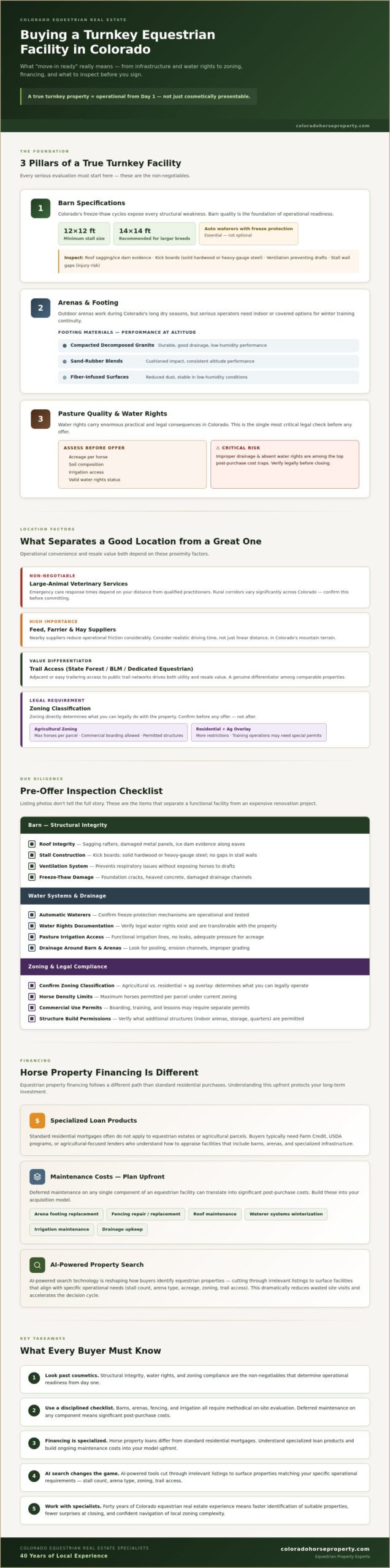
- A true turnkey equestrian facility Colorado buyers should target goes beyond cosmetic appeal — structural integrity, water rights, and zoning compliance are the non-negotiables that determine operational readiness from day one.
- Evaluating barns, arenas, fencing, and irrigation systems requires a disciplined checklist approach, as deferred maintenance on any one component can translate into significant post-purchase costs.
- Financing a horse property follows a different path than a standard residential purchase, and understanding the specialized loan products and ongoing maintenance costs upfront protects your long-term investment.
- AI-powered search technology is reshaping how buyers identify and match with equestrian properties, cutting through irrelevant listings to surface facilities that align with specific operational needs.
- Working with specialists like Mark and Alison Eibner — backed by forty years of Colorado equestrian real estate experience — can streamline every stage of the buying process, from initial search to closing.
Understanding Turnkey Equestrian Facilities in Colorado
A turnkey equestrian facility is exactly what the term implies: you close on the property, open the gate, and begin operations without a construction phase standing between you and your first ride. That means functional infrastructure is already in place, from the barn and arena to water systems and fencing. But “functional” carries significant weight here. A true turnkey equestrian facility Colorado buyers can rely on must be operationally ready for horses on day one, not just cosmetically presentable for a listing photo.
Colorado’s appeal for equestrian buyers is straightforward. The state offers a combination of open acreage, access to public trail networks, a strong equestrian community, and a climate that, while demanding, rewards well-designed facilities. The Rocky Mountain region spans a wide range of equestrian disciplines and facility requirements, from Western pleasure and cutting to dressage and competitive jumping, and the best properties here are built to accommodate that variety.
Key Features of a Turnkey Equestrian Facility
Barn specifications are the foundation. A functional barn in Colorado’s climate requires adequate square footage per stall (typically a minimum of 12×12 feet for standard stalls), durable materials that handle freeze-thaw cycles, and ventilation systems that prevent respiratory issues without exposing horses to drafts. Automatic waterers with freeze protection aren’t optional in this region; they’re essential.
Arenas deserve equal scrutiny. An outdoor arena works well during Colorado’s long dry seasons, but serious operators need an indoor or covered option for winter training continuity. Footing material matters: compacted decomposed granite, sand-rubber blends, and fiber-infused surfaces each perform differently at altitude and in low-humidity conditions. Pasture quality is the third pillar. Assess acreage per horse, soil composition, irrigation access, and whether the land carries valid water rights, a legal consideration that carries enormous practical consequences in Colorado.
Location Considerations for Equestrian Properties
Proximity to large-animal veterinary services is non-negotiable. Emergency care response times depend on your distance from qualified practitioners, and Colorado’s rural corridors vary significantly in this regard. Feed stores, farriers, and hay suppliers within a reasonable radius reduce operational friction considerably.
Trail access is a genuine differentiator. Properties adjacent to or within easy trailering distance of state forest land, BLM acreage, or dedicated equestrian trail systems command both higher utility and stronger resale value. Local zoning classifications, specifically whether your parcel is designated agricultural or residential with agricultural overlay, directly govern how many horses you can keep, whether you can operate a commercial boarding or training facility, and what structures you’re permitted to build. Confirming zoning compliance before any offer is a fundamental step, not an afterthought.
Evaluating Turnkey Equestrian Facilities: What to Look For
Listing photos don’t tell the full story. A property marketed as a turnkey equestrian facility Colorado buyers can operate immediately may still carry hidden infrastructure deficiencies that surface only after a disciplined on-site evaluation. The difference between a functional facility and an expensive renovation project often comes down to what you know to inspect before signing anything.
Assessing Infrastructure: Condition and Suitability
Start with the barn. Colorado’s freeze-thaw cycles are relentless, and they expose every structural weakness over time. During your inspection, look specifically for:
- Roof integrity: Check for sagging rafters, damaged metal panels, and ice dam evidence along the eaves. A compromised roof is an immediate safety issue and a significant cost.
- Stall construction: Kick boards should be solid hardwood or heavy-gauge steel. Gaps in stall walls create injury risks. Confirm that stall dimensions meet the minimum 12×12 standard for standard stalls, with 14×14 for larger breeds.
- Ventilation and electrical: Ridge vents and sidewall openings should allow air movement without creating cross-drafts at horse level. All electrical must be up to code with covered wiring inaccessible to horses.
- Automatic waterers: Confirm freeze protection is functional. Non-heated waterers in a Colorado barn are a liability, not a feature.
Arena footing deserves its own evaluation. Outdoor arenas should drain within 24 hours of a heavy precipitation event. Poor drainage creates compaction, uneven surfaces, and lameness risk. For indoor arenas, ask for the footing material specifications and its maintenance history. Sand-rubber blends and fiber-infused surfaces perform well at Colorado’s altitude and low humidity, but only when maintained consistently. A neglected surface can take months and considerable expense to restore.
Fencing inspection is straightforward but non-negotiable. Walk every perimeter line. Look for post rot at ground level, broken boards, sagging wire, and gate hardware that doesn’t latch securely. Board fencing, no-climb wire, and pipe rail each have trade-offs in cost and durability, but condition matters more than material type at the point of purchase.
Legal Considerations: Zoning and Water Rights
Colorado water law operates on the prior appropriation doctrine: first in time, first in right. Senior water rights are those with an earlier priority date, meaning they’re satisfied before junior rights during periods of shortage. For equestrian properties, holding senior irrigation rights is a practical advantage that directly affects whether your pastures receive water during dry years when calls are placed on the river system. Always request a copy of the water rights decree and have a water attorney review it before closing.
Zoning classifications carry equal weight. Agricultural zoning typically permits livestock at higher densities and allows commercial operations like boarding or training, while residential-agricultural overlays impose stricter limits. Confirm the current classification directly with the county, not just through the seller’s representations. Colorado State University Extension agricultural resources provide research-backed guidance on land use and pasture management that can help you assess whether a property’s acreage is realistically suited to your planned horse count.
Conservation easements are a separate layer of legal consideration. Some Colorado properties carry easements that restrict development, subdividing, or changes in land use in exchange for tax benefits the previous owner received. An easement isn’t automatically a problem, but it must be reviewed carefully to confirm it doesn’t conflict with your operational plans.
Evaluating all of these factors simultaneously is where specialized knowledge pays off. Working with professionals who understand Colorado’s agricultural property landscape, like the team at Colorado Horse Property, ensures that no critical detail gets overlooked during due diligence on a turnkey equestrian facility Colorado buyers are considering.
Financing Your Turnkey Equestrian Facility
Purchasing a turnkey equestrian facility Colorado buyers have been eyeing requires a fundamentally different financial strategy than a standard residential transaction. Lenders evaluate these properties through an agricultural and commercial lens simultaneously, which means your financing path, your insurance requirements, and your ongoing cost structure all operate under different rules. Getting ahead of that complexity before you make an offer protects your position considerably.
Cost Considerations for Horse Property Owners
Operational costs begin the day you close, not the day you bring horses on property. Routine maintenance on a functional equestrian facility includes arena footing replenishment, fencing repairs, well pump servicing, and barn systems upkeep. Emergency repairs, a failed automatic waterer in January or a compromised roof after a heavy snow load, don’t wait for convenient timing; for expert assistance with winter property access, check out Snow Removal Denver. Budget a dedicated reserve for unplanned expenses from the outset.
Insurance requirements for equestrian properties extend well beyond a standard homeowner’s policy. You’ll typically need:
- Farm and ranch insurance: Covers structures, equipment, and liability specific to agricultural operations
- Equine liability coverage: Protects against third-party injury claims involving horses on your property
- Commercial liability riders: Required if you operate boarding, training, or lesson programs on-site
- Mortality and major medical insurance: For the horses themselves, separate from property coverage
Colorado’s agricultural property classification also carries tax implications worth understanding before closing. Properties designated as agricultural may qualify for lower assessment rates under Colorado’s agricultural land classification, but that status requires meeting specific use thresholds. Confirm with the county assessor whether the property currently holds that classification and what’s required to maintain it under your planned operation.
Working with Lenders and Financial Advisors
Standard mortgage products aren’t designed for properties with barns, arenas, and water rights. Farm Credit Services, AgAmerica, and USDA Farm Service Agency loan programs are built specifically for agricultural real estate and understand how to value equestrian infrastructure. Some regional banks with agricultural lending divisions also offer competitive products for horse properties.
Prepare your financial documentation carefully. Lenders will want to see income documentation, a clear picture of the property’s agricultural use history, and in some cases a business plan if you intend to operate commercially. Appraisals on equestrian properties require specialists who understand how to value arena footing, stall counts, and water rights alongside the residential component.
This is where working with experienced professionals pays a direct financial dividend. The team at Colorado Horse Property understands the full financial landscape of acquiring a turnkey equestrian facility Colorado buyers are targeting, and can connect you with lenders and advisors who won’t treat your barn as a liability on the appraisal.
Using Technology to Find Your Ideal Equestrian Property
The traditional property search process was never built for equestrian buyers. Generic listing platforms surface results based on bedroom counts and square footage, leaving you to manually sift through hundreds of irrelevant properties in hopes of finding one with a functional barn, arena footing specifications, and adequate acreage per horse. That inefficiency costs time you don’t have when the right property can move quickly in a competitive market.
Technology is changing that equation. AI-powered search tools designed specifically for agricultural and equestrian real estate can analyze property features at a granular level, matching listings to your operational requirements rather than just your geographic radius. For buyers targeting a turnkey equestrian facility Colorado market, this shift from broad search to precision filtering is a practical advantage with real consequences for what you find and how fast you find it.
The Role of AI in Property Searches
AI-driven search tools work by parsing property data against a defined set of criteria simultaneously. Instead of filtering by price and acreage alone, the system can cross-reference stall counts, arena presence, water rights documentation, zoning classifications, and proximity to veterinary services in a single query. The result is a curated shortlist of properties that actually match your facility requirements, not a list you have to manually screen for disqualifying factors.
Colorado Horse Property’s AI-powered search tool applies this logic specifically to equestrian and agricultural listings. You can filter for features that matter to horse operations: barn size, covered arena availability, irrigation access, and property acreage configured for livestock. That specificity eliminates the noise that generic platforms can’t filter out.
Maximizing Your Search: Tips and Strategies
Getting the most from any property search tool comes down to how precisely you define your requirements upfront. Before you run your first search, document your non-negotiables:
- Minimum stall count and barn square footage based on your current and projected horse count
- Arena type (outdoor, covered, or indoor) and approximate dimensions required for your discipline
- Acreage threshold that supports your planned horse-to-pasture ratio
- County or region preferences tied to proximity to veterinary services and trail access
- Zoning requirements if you plan to operate a commercial boarding or training program
Set up listing alerts once your parameters are defined. New equestrian properties in Colorado don’t sit long, and an alert system ensures you’re notified the moment a qualifying listing enters the market. Use map-based search views to assess a property’s surrounding land context: neighboring parcels, road access, and proximity to public trail networks are visible at the map level before you ever schedule a showing.
No search tool replaces local knowledge. The most effective approach combines AI-powered filtering with direct access to specialists who understand how Colorado’s water rights, zoning classifications, and agricultural property nuances affect each listing’s real operational value. Search Colorado Horse Property’s equestrian listings to see how precision filtering and forty years of local expertise work together to surface properties worth your time.
Start Your Journey to Buying a Turnkey Equestrian Facility Today
You’ve done the research. You understand what separates a genuinely operational property from a cosmetic listing, how Colorado water rights function in practice, and why financing a horse property requires a different approach than a standard residential purchase. The next step is putting that knowledge to work with professionals who’ve spent four decades building expertise in exactly this market.
The Eibner Advantage: Expertise and Trust
Mark and Alison Eibner bring over forty years of combined Colorado real estate experience to every transaction, and that depth matters in a market where the details are unforgiving. Generic platforms can surface a list of properties. They can’t tell you whether a listed water right is junior or senior, whether a county’s agricultural overlay permits commercial boarding, or whether an arena’s footing has been maintained to a standard that holds up at altitude. That’s institutional knowledge built through decades of closing equestrian transactions across Colorado’s diverse regions.
What distinguishes the Eibner approach isn’t just longevity; it’s the combination of personalized representation with tools that match the complexity of the search. Buyers working with Mark and Alison aren’t handed a login and left to scroll. They receive direct, consultative guidance through every stage, from initial criteria definition through due diligence and closing. That kind of representation is particularly valuable when you’re evaluating a turnkey equestrian facility Colorado sellers have priced to reflect specialized infrastructure, because the negotiation requires someone who can accurately assess what that infrastructure is actually worth.
Expert representation also creates a buffer against costly oversights. Missed conservation easements, unverified water rights, and zoning misclassifications are the errors that surface after closing without experienced guidance. Having specialists in your corner during due diligence isn’t a luxury on a transaction of this complexity; it’s a practical risk management decision.
Get Started with Your Equestrian Property Search
The most direct path forward is to use the tools built specifically for this search. Colorado Horse Property’s AI-powered search platform filters equestrian listings by the criteria that actually matter to horse operations: stall counts, arena type, acreage, water access, and zoning classification. That precision eliminates the noise that generic platforms can’t filter out, putting qualifying properties in front of you faster.
Ready to find your property? Find your turnkey equestrian facility now and put forty years of Colorado equestrian real estate expertise to work for your search.
Your Next Step Toward a Fully Operational Equestrian Property
Securing a turnkey equestrian facility Colorado buyers can rely on requires more than a compelling listing. It demands rigorous infrastructure evaluation, a clear understanding of water rights and zoning, and a financing strategy built for agricultural real estate. Those aren’t small details; they’re the difference between a property that works from day one and one that drains resources before a single horse is stabled.
The right combination of tools and expertise makes that process significantly more manageable. AI-powered search technology filters for the criteria that actually matter to horse operations, while forty years of Colorado equestrian real estate experience ensures nothing critical slips through during due diligence. That’s a practical advantage at every stage of your search.
Don’t leave your search to a generic platform that wasn’t built for this market. Find your turnkey equestrian facility with our AI-powered search tool and work with specialists who understand exactly what you’re looking for. The right property is out there, and you’re now equipped to find it.
Frequently Asked Questions About Buying a Turnkey Equestrian Facility in Colorado
What features should I look for in a turnkey equestrian facility?
Prioritize infrastructure that’s operational on day one: stalls sized at minimum 12×12 feet with solid kick boards, freeze-protected automatic waterers, adequate barn ventilation, and an arena with properly maintained footing. Beyond the barn, confirm that fencing perimeters are intact, gates latch securely, and pasture acreage is realistic for your planned horse count. A property that looks ready but has deferred maintenance on any one of these components isn’t truly turnkey.
How do I evaluate water rights when purchasing a horse property?
Request a copy of the water rights decree and have a water attorney review it before closing. Colorado operates under the prior appropriation doctrine, so the priority date on a water right determines whether your pastures actually receive irrigation during dry years when senior rights holders place calls on the system. Don’t rely on a seller’s verbal assurances; the decree language and priority date are what govern your access in practice.
What financing options are available for buying equestrian real estate?
Standard residential mortgages aren’t designed for properties with barns, arenas, and water rights attached. Farm Credit Services, AgAmerica, and USDA Farm Service Agency programs are built specifically for agricultural real estate and understand how to appraise equestrian infrastructure. Some regional banks with agricultural lending divisions also offer competitive products. Prepare income documentation and be ready for an appraisal conducted by a specialist who values agricultural components accurately.
Are there zoning restrictions for equestrian properties in Colorado?
Yes, and they vary significantly by county. Agricultural zoning typically allows higher livestock densities and permits commercial operations like boarding or training, while residential-agricultural overlays impose stricter limits on both. Some properties also carry conservation easements that restrict development or changes in land use. Always confirm the current zoning classification directly with the county assessor’s office rather than relying solely on listing representations or seller disclosures.
What is the average cost of maintaining a turnkey equestrian facility?
Maintenance costs vary based on facility size, horse count, and infrastructure age, so no single figure applies universally. Plan for recurring expenses including arena footing replenishment, fencing repairs, well pump servicing, and barn systems upkeep. Beyond routine costs, set aside a dedicated reserve for unplanned repairs; a failed waterer in January or snow-load roof damage won’t wait for a convenient budget cycle. Confirm whether the property holds agricultural land classification with the county assessor, as that status can reduce your tax assessment.
How can technology help me find the right equestrian property?
AI-powered search tools built for equestrian real estate filter listings by criteria that actually matter to horse operations: stall counts, arena type, water access, acreage thresholds, and zoning classifications. That’s a practical advantage over generic platforms that sort by bedroom count and square footage. Colorado Horse Property’s AI-powered search tool applies this logic specifically to equestrian listings, letting you define your non-negotiables upfront and surface qualifying properties faster in a market where the right turnkey equestrian facility Colorado buyers want doesn’t stay listed long.
What are the benefits of working with a specialized equestrian real estate agent?
A specialist brings institutional knowledge that a generalist simply doesn’t have. They can assess whether a listed water right is junior or senior, identify conservation easement language that conflicts with your plans, and evaluate whether an arena’s footing has been maintained to a functional standard. Mark and Alison Eibner bring forty years of Colorado equestrian real estate experience to every transaction, which means fewer costly oversights during due diligence and representation from someone who understands how to negotiate on specialized infrastructure accurately.
How do I ensure the property meets my equestrian requirements?
Document your non-negotiables before you view a single property: minimum stall count, arena type, acreage per horse, required zoning classification, and proximity to large-animal veterinary services. Walk every fence line during your on-site visit, test waterers, inspect the roof, and ask for the arena’s footing maintenance history. Pair that checklist with specialists who understand Colorado’s agricultural property nuances, because the gap between a property that looks ready and one that’s genuinely operational often lives in the details a standard inspection won’t catch.