
What if letting go of your land isn’t a betrayal of your ancestors, but the only way to protect your family’s true legacy? Facing the emotional side of selling a multi-generational ranch is often as painful as grieving the loss of a loved one. You likely carry a crushing guilt over ending decades of stewardship. Meanwhile, unresolved friction between heirs with competing financial goals creates bitter division, and the dread of developers carving up historical pastures keeps you awake at night.
Your ranch legacy lives in family stewardship, not in continuous land ownership. In this guide, you will find permission to grieve this transition without feeling like a failure. We outline practical ways to align divergent family interests, resolve inheritance tensions, and structure a transition that places your acreage into the hands of an honorable, conservation-minded steward. Here is how to navigate the complex road ahead with clarity, dignity, and peace of mind.
Key Takeaways
- Acknowledge disenfranchised grief and understand the emotional side of selling a multi-generational ranch, separating business realities from feelings of family betrayal.
- Bridge the divide between operating heirs invested in sweat equity and non-operating heirs seeking financial inheritance with structured communication paths.
- Evaluate flexible exit strategies, such as conservation easements, that relieve heavy operational burdens while permanently protecting water rights and historical pastures.
- Use specialized listing strategies and buyer vetting to secure a dedicated steward who will honor the land rather than subdivide it.
- Establish intentional closure rituals and physical archives to keep your family’s agricultural heritage alive long after the final transaction closes.
Understanding the Grief: Why Selling a Heritage Ranch Hurts So Deeply
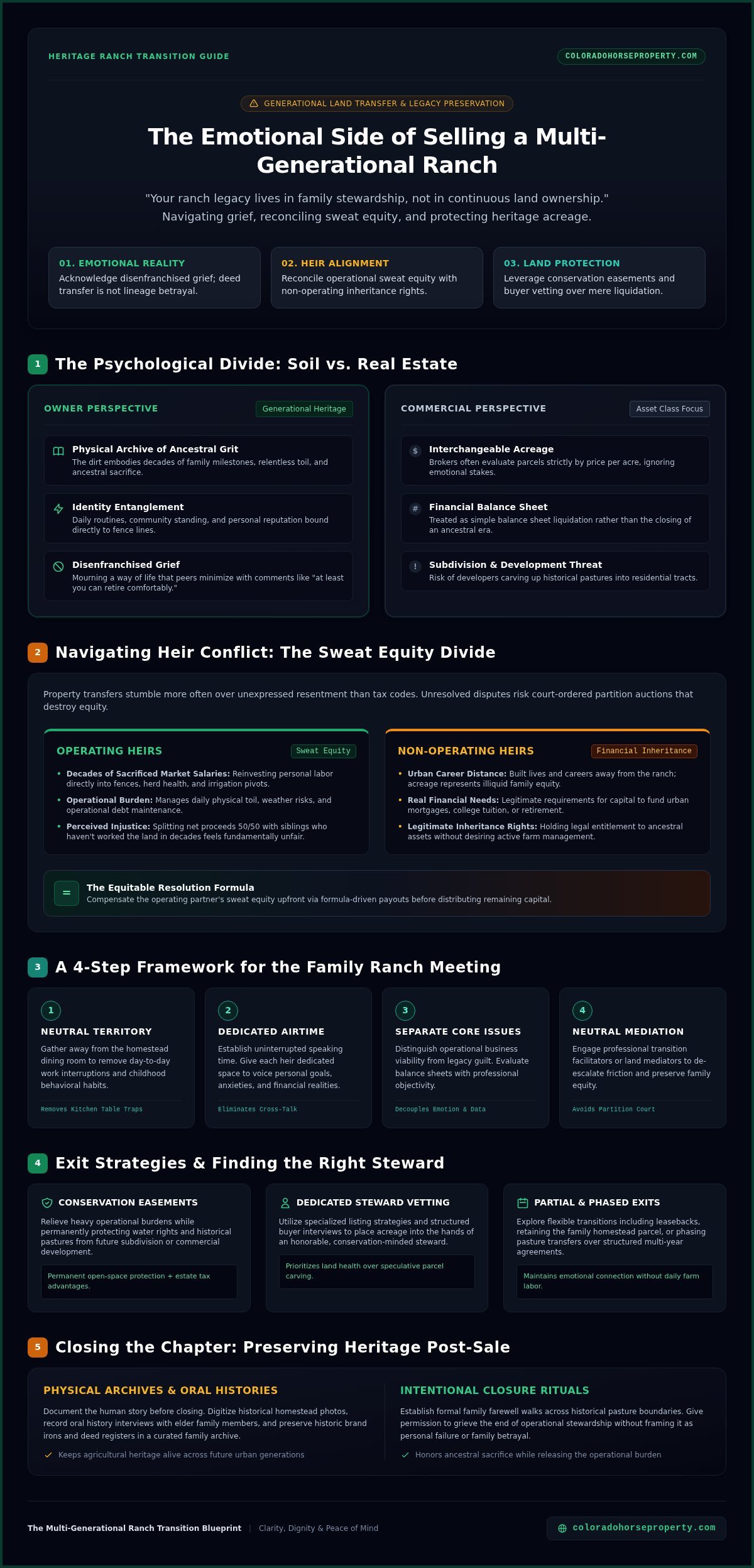
When you steward generational acreage, the dirt is never just soil. A historic family farm or cattle outfit serves as a physical archive of ancestral grit, family milestones, and relentless toil. Stepping away can feel like an erasure of your lineage and a personal betrayal of the generations who sacrificed to keep the gates open.
Most commercial property brokers treat acreage as an interchangeable asset class, ignoring the emotional side of selling a multi-generational ranch. The psychological toll of parting with family pastures is intense. Many owners grapple with a quiet, persistent fear that they are breaking a sacred family chain.
To better understand the emotional roller coaster and personal gravity that comes with letting go of a long-held property, watch this insightful discussion:
The Concept of Agricultural Disenfranchised Grief
Mourning land mirrors the psychological weight of losing an immediate family member. Unfortunately, urban peers often fail to understand this despair. Well-meaning acquaintances might focus on the sale price, saying things like, “At least you can retire comfortably.” They don’t understand that financial proceeds cannot heal severed roots. This lack of social acknowledgment creates disenfranchised grief, leaving ranchers feeling isolated while mourning a way of life that society treats merely as real estate.
Untangling Personal Identity from the Physical Acreage
A deed does not define your character. For decades, your daily routines, community reputation, and morning chores tied directly to specific fence lines and pastures. Yet, ranching heritage is carried in blood, work ethic, and shared knowledge, not recorded title documents.
True agricultural stewardship is an enduring family value, not a boundary line on a county survey. You can honor your family’s past without running cattle on the same section of dirt until your body breaks. Giving yourself permission to close that chapter allows generational pride to survive intact long after the deed transfers.
Navigating Intergenerational Conflict: Operating Heirs vs. Non-Operating Heirs
Few issues strain a ranching family faster than an impending transition. Generational property transfers stumble most often over unexpressed resentment rather than tax codes or market timing. Addressing the emotional side of selling a multi-generational ranch requires tackling this friction directly before unresolved disputes trigger court-ordered partition auctions that erode family equity.
Discord usually stems from fundamentally divergent viewpoints. Operating heirs view the ground through the lens of sweat equity, early mornings, and deferred compensation. Non-operating heirs, who often built careers in urban centers, look at the acreage as an illiquid financial inheritance needed for mortgages or college tuition. Both perspectives carry validity, but failing to reconcile them turns real estate transactions into family battlegrounds.
Addressing the Sweat Equity Disparity
Operating heirs routinely sacrifice market-rate salaries for decades, pouring physical labor back into pasture fences, irrigation pivots, and herd health. Expecting them to divide gross sale proceeds equally with siblings who haven’t turned a wrench in twenty years feels unjust. Conversely, off-ranch siblings have legitimate rights to their inheritance. Resolving this disparity requires establishing equitable, formula-driven payouts that compensate the operating partner’s sweat equity upfront before distributing remaining capital.
A 4-Step Framework for the Family Ranch Meeting
Structured communication keeps legacy discussions productive. Follow these four practical steps to build alignment across all stakeholders:
- Meet on neutral territory: Gather away from the homestead dining room to remove day-to-day work interruptions and childhood behavioral habits.
- Establish uninterrupted speaking time: Give each heir dedicated space to voice personal goals, anxieties, and financial realities without debate.
- Review cold operational metrics: Lay bare real production yields, water rights maintenance requirements, aging infrastructure costs, and actual estate tax liabilities.
- Agree on unified exit objectives: Define acceptable buyer profiles and timing milestones before engaging an equestrian real estate Colorado specialist to market the property.
Working through these friction points with an empathetic advisor ensures everyone feels heard. If your family is ready to explore disposition paths while safeguarding personal relationships, consult the experienced team at Colorado Horse Property to help navigate the market with care.
Evaluating Alternatives to an Outright Sale: Conservation and Partial Exits
Liquidating the entire property in a single transaction isn’t the only way forward. Many ranch owners assume their choices are binary: keep working until exhaustion or sell every acre to the highest bidder. This stark framing intensifies the emotional side of selling a multi-generational ranch. In reality, modern land planning provides strategic middle paths that alleviate daily physical strain while keeping your legacy protected.
Partial exit strategies allow families to extract needed capital, eliminate debt, or pay off non-operating heirs without abandoning the dirt completely. Exploring these alternatives early gives owners control over the pace of change.
Conservation Easements as an Emotional Compromise
For families terrified of seeing historic acreage subdivided into dense residential subdivisions, a conservation easement provides permanent peace of mind. By partnering with a qualified land trust, you voluntarily forfeit future residential or commercial development rights. In exchange, the deed permanently preserves working agricultural open space, native wildlife habitat, and historic water rights.
Easements also offer meaningful financial benefits:
- Federal charitable deductions: Landowners can deduct the appraised value of the donated development rights against their adjusted gross income. Qualified farmers and ranchers may deduct up to 100% of their AGI, with carry-forward options lasting up to 15 years.
- State income tax credits: In states like Colorado, conservation credits can be used against state liabilities or sold for immediate cash liquidity.
- Permanent protection: The restrictions remain tied to the title forever, binding all subsequent purchasers.
Carve-Outs, Life Estates, and Long-Term Agricultural Leases
You can also restructure ownership boundaries to preserve personal roots. Splitting off and selling peripheral pastures generates capital to modernize core equestrian infrastructure or fund retirement accounts. Before partitioning land, review local zoning regulations and water decree separations outlined in buying Colorado land in 2026.
If physical labor has become unmanageable, consider a long-term agricultural lease. Leasing pasture and hay fields to neighboring operators preserves favorable agricultural property tax status while producing recurring annual income. Another proven mechanism is a life estate, where the land transfers to a new steward while granting aging family members legal rights to remain living in the original homestead for life. These flexible frameworks prove that easing operational pressure does not require losing your emotional connection to the property.
Finding the Right Steward: Protecting Your Land’s Future
Handing over the keys to a heritage property is not just a closing statement and wire transfer. Achieving genuine closure on the emotional side of selling a multi-generational ranch requires knowing your pastures won’t be carved into cookie-cutter housing developments. When you vet potential purchasers for genuine land stewardship rather than accepting the first high-dollar institutional offer, you protect decades of family labor and honor your agricultural roots.
Traditional listing services often cast an undifferentiated net, pulling in speculative investors who view your native grass as raw development dirt. Protecting your soil requires a targeted marketing strategy that presents your acreage directly to operational livestock managers, equestrian enthusiasts, and conservation buyers who value intact acreage.
Screening Buyers for Stewardship and Community Compatibility
Financial pre-qualification proves an applicant can afford the purchase, but it says nothing about how they will treat the landscape. A comprehensive screening process looks beyond bank balance sheets to evaluate whether a buyer’s operational philosophy aligns with your land’s history.
- Request a vision statement: Require prospective buyers to submit their planned operational use for the barns, grazing pastures, and water resources along with their purchase offer.
- Conduct informal property tours: Walk the fence lines together. Listen carefully to how they talk about local livestock practices, timber management, and neighborhood relationships.
- Target active lifestyle buyers: Our detailed Colorado ranches for sale guide outlines the exact buyer profiles currently acquiring Western acreage for authentic equestrian and agricultural operations.
Safeguarding Vital Water Rights and Natural Features
Water is the lifeblood of Western land. During disposition, unprincipled developers frequently strip senior water rights from the underlying dirt to sell them to growing municipalities downstream, leaving historically lush acreage parched and barren. You can prevent this outcome by structuring strict legal guardrails into the real estate contract.
Work with qualified agricultural legal counsel to place binding covenants directly on the deed. Ensure senior ditch shares and tributary well adjudications remain appurtenant to the ranch. You can also craft enforceable restrictions that protect mature riparian buffers and limit commercial footprint expansions. These legal steps ensure future owners maintain the property’s natural integrity.
If you want to secure an honorable buyer who will cherish your property as much as your ancestors did, explore our real estate listing services to connect with qualified land stewards today.
Closing the Chapter: Emotional Closure and Life After the Sale
Signing deed conveyances at the closing table concludes a legal transaction, but it rarely settles the heart. Walking away from pastures that anchored your daily routine for half a century requires intentional transition rituals. Managing the emotional side of selling a multi-generational ranch means making space for family closure and planning what comes next, rather than drifting into an empty post-sale vacuum.
A sudden exit without preparation often leads to grief and disorientation. You spent a lifetime working with livestock, weather patterns, and soil conditions. Designing proactive closure steps protects your emotional well-being as you hand over the reins.
Memorializing the Ranch’s Historical Narrative
Before packing up equipment and handing over gate keys, build a permanent family archive. Future generations who grow up in town will still want to understand the ground where their family story began.
- Commission an agricultural photographer: Capture high-resolution visual records of working branding pens, weathered barn timbers, irrigation ditches, and sunrise ridgelines.
- Record family oral histories: Conduct video or audio interviews with older family members, documenting historic droughts, blizzards, and major ranch milestones in their own words.
- Preserve tangible artifacts: Keep the original iron branding tools, antique tack, registered brand certificates, and architectural accents from the original homestead cabin.
Establishing Identity and Purpose Beyond the Ranch Gates
Leaving behind morning chores and livestock care can trigger a sudden loss of identity. You don’t have to abandon your agricultural roots just because you no longer own commercial acreage. Many former operators channel decades of land management expertise into advisory seats on local conservation districts, regional fair boards, or equine non-profit organizations.
Downsizing to a manageable ranchette offers another healthy path forward. It lets you keep a couple of personal horses and enjoy open horizons without the grueling physical labor of maintaining hundreds of acres. Having empathetic professionals by your side ensures the final transition remains respectful of your past. Connect with the specialized listing team at Colorado Horse Property to step into your next chapter with confidence, dignity, and peace of mind.
Preserving Your Family Legacy While Embracing What Lies Ahead
Letting go of working ground is never a simple calculation. Successfully navigating the emotional side of selling a multi-generational ranch means honoring the natural grief of transition, reconciling divergent heir priorities through structured dialogue, and finding buyers who genuinely respect your stewardship values. Your heritage isn’t trapped in county deed books; it endures in the character, work ethic, and shared memories your family carries forward.
With over 40 years of Front Range real estate tenure, Colorado Horse Property combines deep expertise in agricultural zoning, equestrian facilities, and Colorado water law with genuine sensitivity to multi-generational dynamics. You don’t have to carry this psychological weight alone or rush the process before everyone feels ready. When you want an experienced ally to help guide the journey, speak with our compassionate ranch specialists to explore your options confidentially and step into your next chapter with total peace of mind.
Frequently Asked Questions
Is it normal to feel intense guilt when selling a family ranch?
Yes, experiencing profound guilt is entirely normal and expected. Mourning land mirrors the psychological weight of losing an immediate family member. Navigating the emotional side of selling a multi-generational ranch involves processing real grief over ending decades of stewardship. Remember that deciding to sell does not erase your family’s history or mean you failed previous generations. Agricultural values survive in the character of your family, not in real estate deeds.
How do we handle family members who refuse to sell the ranch?
Host a structured family meeting on neutral ground led by an objective facilitator. Conflict usually arises between operating heirs who invested decades of sweat equity and non-operating heirs seeking liquid assets. Lay out real operational expenses, deferred maintenance debts, and estate tax realities clearly. Exploring structured buyouts, long-term leasing arrangements, or partial land sales often resolves standoffs without triggering destructive court-mandated partition lawsuits.
Can we sell our Colorado ranch and still keep living in the main house?
Yes, you can structure the disposition to remain on the homestead. Establishing a legal life estate allows you to sell the underlying acreage while retaining the permanent right to occupy the residence for the rest of your life. Alternatively, you can complete a formal parcel carve-out to separate the home and a few surrounding acres from the commercial agricultural pastures prior to listing.
How can we stop a developer from subdividing our heritage land after the sale?
You can permanently eliminate subdivision rights by placing a conservation easement on the deed before or during the sale. Working with local land trusts ensures the property remains working agricultural open space forever. Additionally, placing restrictive agricultural covenants directly on the deed restricts commercial development, binding all subsequent purchasers regardless of future zoning shifts.
What happens to our historical water rights during a multi-generational ranch sale?
Water rights do not automatically transfer with the land unless explicitly conveyed in the real estate contract. When managing the emotional side of selling a multi-generational ranch, you must decide whether senior ditch rights and adjudicated well permits remain appurtenant to the acreage. An experienced rural brokerage ensures water decrees stay attached to protect the land’s ongoing agricultural viability rather than being stripped by outside municipal buyers.
How long does the process of selling a large Colorado ranch usually take?
Selling a large ranch typically takes between six and eighteen months from listing to closing. Legacy properties require specialized positioning, precise water rights documentation, and tailored marketing to reach qualified equestrian and agricultural stewards rather than casual buyers. Rushing this timeline often leads to seller regret, while a deliberate pace allows family members adequate time to process the emotional transition.