
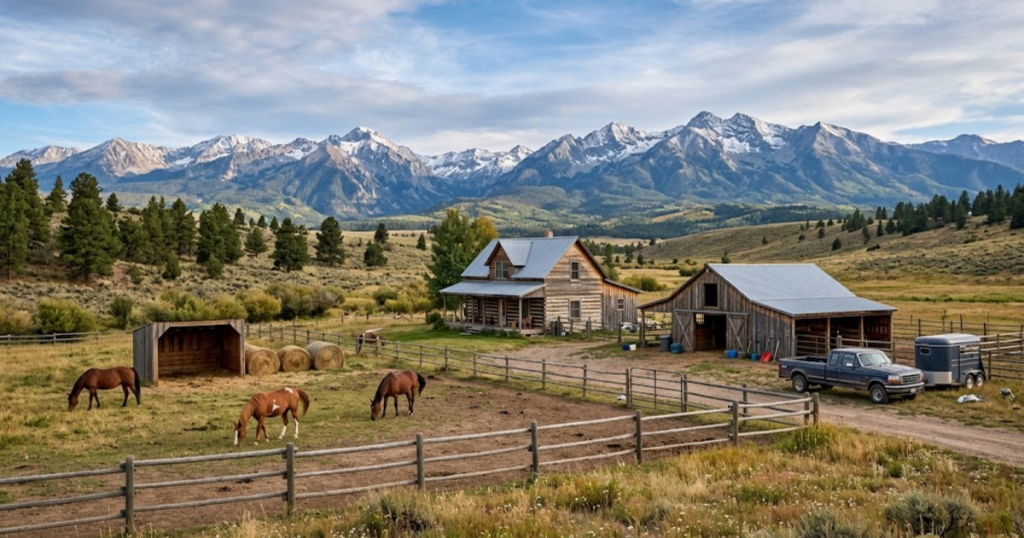
You have a strict budget, a few horses, and a dream of owning property in Colorado. You start browsing real estate listings in the foothills near Denver and immediately experience severe sticker shock. Every property with a decent barn and five acres carries a multi-million-dollar price tag. You start to wonder if buying an equestrian property in Colorado on a middle-class budget is even possible anymore.
The short answer is yes, but it requires a radical shift in your search strategy.
When searching for horse properties in Colorado, the word “budget” is entirely relative. Ten years ago, you could find a turnkey horse property for under $400,000. Today, finding a functional, legally zoned equestrian property under $700,000 requires extreme patience, geographic flexibility, and a real estate team that knows how to spot hidden value.
If you are trying to stretch your capital to buy a safe home for your herd, here is a comprehensive guide to buying horse property on a budget in Colorado.
Can You Buy Horse Property on a Budget in Colorado?
Quick Summary: Redefining Affordable Equestrian Real Estate
- The New Baseline: "Budget" in the modern Colorado real estate market rarely means cheap. It means maximizing every dollar and avoiding properties with hidden, catastrophic infrastructure costs.
- The Raw Land Myth: Buying cheap raw acreage and building a barn is almost always more expensive than buying an established, older property with a well and fencing.
- Geographic Compromises: You will not find budget acreage in Boulder or Douglas counties. Affordable horse properties require looking east toward the plains or south toward Pueblo and Fremont counties.
- House Versus Land: The secret to buying on a budget is compromising on the square footage and updates of the primary residence, while refusing to compromise on water rights, safe fencing, and agricultural zoning.
1. The Raw Land Trap
The most common mistake budget-conscious buyers make is assuming they can save money by purchasing raw, undeveloped acreage. They find a cheap 35-acre parcel on the eastern plains for $150,000 and assume they can build a modular home and a pole barn with the rest of their cash.
In rural Colorado, development costs will instantly destroy a tight budget.
Well Drilling
Drilling a new well into the deep Denver Basin aquifers can easily cost $30,000 to $50,000 before you even run the plumbing to the surface.
Power and Septic
Pulling electrical lines from the county road to your building site, plus engineering and installing a new septic system, can add another $30,000 to $40,000.
Fencing and Excavation
Fencing 35 acres with safe equine materials and grading the earth for a barn pad requires massive upfront capital.
By the time you finish the basic infrastructure, you have spent more money than you would have if you purchased an older, established property. The absolute best way to buy on a budget is to find a property where the previous owner already absorbed the brutal costs of installing the well, the septic system, and the perimeter fencing.
2. Look East and South: The Affordable Geographies
You cannot buy on a budget in Boulder, Jefferson, or Douglas counties. Land values are too high, driven by luxury buyers and proximity to the Denver metro area. To find affordability, you must drive until the prices drop.
The Eastern Plains
Counties like Elbert, Lincoln, and eastern Weld County offer the best price per acre ratios in the state. Towns like Kiowa, Calhan, and Yoder offer wide-open spaces and deeply rooted agricultural communities.
While the commute to Denver or Colorado Springs is longer, the property taxes are often lower, and the zoning codes are highly favorable to livestock owners.
Southern Colorado
If you want mountain views on a budget, look toward Fremont and Pueblo counties. Areas near Cotopaxi, Florence, or Pueblo West often feature older, modest homes on acreage at a fraction of the cost of the northern Front Range.
However, buyers must closely scrutinize water rights, as the southern climate is extremely dry, and bringing in supplemental water can erase any savings you made on the purchase price.
3. Compromise on the House, Never the Land
When your budget is tight, you cannot have the luxury kitchen, the heated barn, and the perfect location all at once. You must prioritize the assets that keep your horses safe and legal.
The secret to a successful budget purchase is finding a property with a completely outdated, modest primary residence that sits on excellent land. You can slowly remodel a 1980s kitchen over the next decade as your budget allows. You cannot, however, easily fix a dry water well, a steep canyon that horses cannot graze, or a restrictive county zoning code that makes your animals illegal.
If you have to choose between a beautifully updated house on two acres with restrictive covenants, or an ugly house on ten acres with unrestricted agricultural zoning, you must always choose the land. You are buying an agricultural facility first and a residence second.
4. Beware the Hidden Costs of "Cheap" Properties
Sometimes a property is priced aggressively low for a very dangerous reason. A budget buyer cannot afford to buy a money pit. When evaluating a cheap listing, your equestrian real estate agent must aggressively investigate the property for fatal flaws.
The Household-Use-Only Well
A seller might list a property cheaply because the well permit strictly prohibits outside watering. If you buy it, you have no legal way to water your horses, making the property entirely useless for an equestrian.
Digging a new well or petitioning the state for a water augmentation plan is often financially impossible for a budget buyer.
Unpermitted Outbuildings
A budget property might feature a massive hay shed or barn that the previous owner built without county permits. If the county code enforcement office discovers this during the transaction or after closing, they can force you to tear the building down at your own expense.
You lose the asset and have to pay for the demolition.
Toxic Weeds and Dead Pastures
A property severely overgrazed for years will be taken over by toxic weeds. Rehabilitating dead soil and reseeding a massive pasture requires thousands of dollars in heavy equipment, specialized herbicides, and seed.
A cheap property with destroyed land will cost you thousands of dollars a year in imported hay to keep your horses fed.
5. Alternative Financing and Seller Concessions
If you are stretching your budget, you'll need to get creative with your financing strategy.
Instead of relying purely on conventional residential lenders who often balk at agricultural outbuildings, look into agricultural portfolio lenders or Farm Credit services. These institutions specialize in rural land and might offer longer amortization schedules or more flexible terms for acreage properties.
Additionally, in a shifting or balanced real estate market, a skilled equestrian agent can aggressively negotiate for seller concessions. This means the seller agrees to credit you a percentage of the purchase price at closing.
You can use these funds to permanently buy down your mortgage interest rate, drastically lowering your monthly payment and making the property more affordable. You can also use seller concessions to offset the massive closing costs associated with rural land surveys and environmental inspections.
We Find Hidden Value in Colorado
Buying on a budget does not mean you have to settle for unsafe or illegal land. It simply means you need an expert to help you navigate the lower end of the market and aggressively vet the infrastructure.
When Mark Eibner's team represents you, we tear apart the cheap listings to find the true diamonds in the rough. We verify the well permits, pull the county zoning codes, evaluate the fencing, and ensure the property is actually a good deal, rather than a looming legal nightmare. We know how to stretch your capital to get you the safe, functional acreage your horses require.
Contact us today at coloradohorseproperty.com to find premium horse properties Colorado buyers trust.
Browse active Colorado horse ranches for sale or ask our team about finding a functional horse property for rent in Colorado while you save for your down payment.
Frequently Asked Questions (FAQ) About Budget Horse Properties
Where is the cheapest place to buy horse property in Colorado?
Generally, the eastern plains, such as Elbert, Lincoln, and eastern El Paso counties, and the southern regions, such as Pueblo, Fremont, and Otero counties, offer the lowest price per acre. The further you get from the I-25 corridor and the major ski resorts, the more affordable the land becomes.
Is it cheaper to buy land with no fence and install it myself?
Rarely. Equestrian-grade fencing, such as pipe rail, vinyl, or no-climb wire, is incredibly expensive in both materials and labor. Buying a property that already has secure, safe perimeter fencing will almost always save you a lot of money in the long run.
Can I keep horses on a cheap lot inside a residential subdivision?
You must check the homeowners association covenants and the county zoning. Many affordable lots in rural subdivisions ban livestock or limit you to one horse, regardless of acreage. A cheap lot is worthless if it bans your herd.
What is the absolute minimum acreage I should look for on a budget?
While some zoning allows horses on one or two acres, buying small acreage means you will have no grazing grass. You will have to feed imported hay 365 days a year, which drastically increases your monthly operating budget. If you want to save money on feed, you need at least five to ten acres for rotational dryland grazing.