
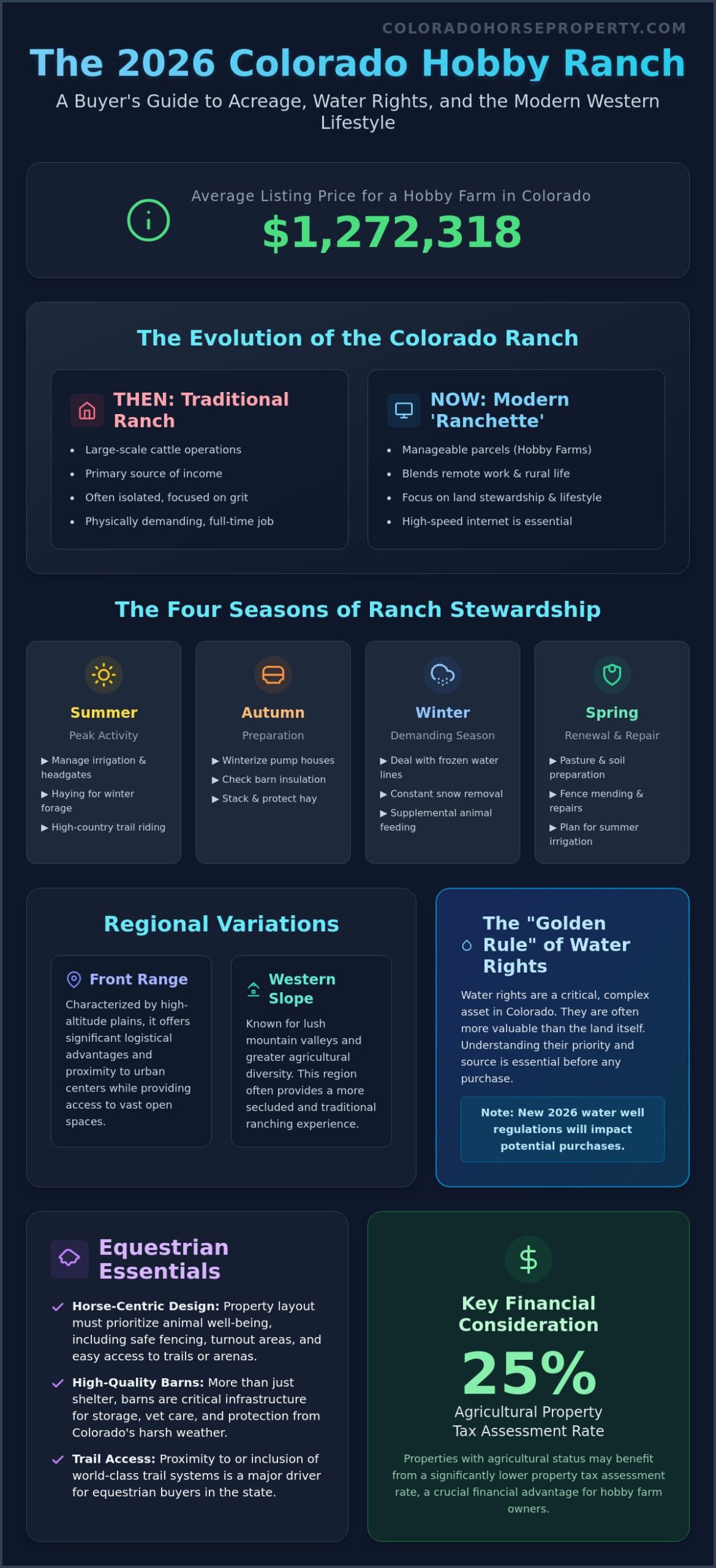
With the average listing price for a hobby farm in Colorado reaching $1,272,318 in 2026, the dream of western living is more popular than ever. You aren’t alone if you’re drawn to the idea of buying a hobby ranch in Colorado to secure your own piece of the Centennial State’s expansive landscape. It’s a lifestyle that promises unmatched freedom and a deep connection to the land. However, it’s natural to feel a bit apprehensive about the technicalities. You might worry about the physical demands of land stewardship or the legendary complexity of Western water rights.
We understand that the transition from a suburban lot to a working ranch is a significant leap. This guide will provide the clarity you need to move forward with confidence. You’ll discover the reality of daily life on the range, from managing rotational grazing to navigating the 25% agricultural property tax assessment rate. We’ll break down the regional differences across the state and explain how the 2026 water well regulations impact your potential purchase. By the end of this article, you’ll have a clear roadmap to finding a property that fits both your equestrian ambitions and your lifestyle goals.
Key Takeaways
- Learn how the 2026 ranch lifestyle blends rugged independence with modern connectivity, shifting from traditional cattle operations to manageable “ranchettes.”
- Understand the seasonal rhythm of land stewardship, including critical summer irrigation management and preparing your infrastructure for the Colorado winter.
- Discover why horse-centric property design and high-quality barns are essential when buying a hobby ranch in Colorado to ensure your animals’ well-being.
- Compare the logistical advantages of the Front Range against the agricultural diversity of the Western Slope while mastering the “Golden Rule” of water rights.
- Use AI-powered search tools to filter properties based on specific equestrian features, helping you distinguish between essential infrastructure and luxury upgrades.
Defining the Colorado Hobby Ranch Lifestyle in 2026
The 2026 Colorado ranch lifestyle is no longer defined solely by isolated grit. It has evolved into a sophisticated blend of rugged independence and modern connectivity. When you’re considering buying a hobby ranch in Colorado, you’re looking for more than just acreage. You’re seeking a balance where high-speed satellite internet meets the quiet of a mountain morning. This shift allows owners to manage professional careers while maintaining a direct connection to the land. It’s a choice to trade the noise of the city for the rhythm of the seasons.
Historically, a Ranch was primarily a large-scale cattle operation. Today, the market has seen a significant transition toward “ranchettes.” These smaller, manageable parcels offer the benefits of agricultural life without the overwhelming demands of a commercial enterprise. Land stewardship is the core value here. Owners act as guardians of Colorado’s open spaces, preserving the natural habitat and ensuring the state’s beauty remains intact. This preservation effort is a key motivator for those buying a hobby ranch in Colorado. It’s about active participation in the ecosystem, requiring a practical approach to daily chores and a willingness to learn the nuances of the local climate.
To better understand the potential of these smaller parcels and the beauty of the landscape, watch this look at available acreage in the state:
The Modern Rancher Profile
The faces you see in the rural community have changed. In 2026, the modern rancher is often a remote worker or a retiree who prioritizes outdoor activity over city convenience. Equestrian enthusiasts are also a primary force in this market. There’s a noticeable shift toward sustainable and regenerative practices. People aren’t just living on the land; they’re actively improving soil health and water retention to combat the dry climate. Balancing a digital professional life with the physical responsibilities of a hobby ranch has become the new standard for success. It requires discipline, but the reward is a lifestyle of genuine autonomy.
Why Colorado is the Epicenter of Ranching
Colorado offers a unique geographic diversity that few other states can match. From the high-altitude plains of the Front Range to the lush mountain valleys of the Western Slope, the options for horse property for sale in colorado are vast. The state provides immediate access to world-class trail systems and a robust network of professional equestrian events. This infrastructure supports a “Land and Legacy” mindset. Buyers aren’t just purchasing real estate; they’re investing in a heritage that values wide-open space, local wildlife, and the enduring spirit of the American West. The community is built on mutual respect for the land and the animals that call it home.
The Four Seasons of Ranching: What to Expect Daily
Life on a ranch is dictated by the sun and the thermometer rather than a clock. When you’re buying a hobby ranch in Colorado, you’re signing up for a rhythmic lifestyle that changes significantly with the seasons. Summer is the peak of activity. You’ll spend your mornings managing irrigation ditches and monitoring headgates to keep pastures green. Given the drought conditions and Stage 1 restrictions seen in 2026, understanding Colorado water rights is essential for summer survival. This is also the season for high-country trail riding and the intensive labor of haying, ensuring you have enough forage to last through the colder months.
Autumn brings a shift toward preparation. As the aspen leaves turn gold, your focus moves to infrastructure. You’ll need to winterize pump houses, check barn insulation, and ensure your hay is properly stacked and protected. Winter is arguably the most demanding season for a rancher. You’ll face frozen water lines, the constant need for snow removal, and the physical task of supplemental feeding when pastures are buried. Spring, while beautiful with calving and foaling, is often called “mud month” in the Rockies. The thaw creates a slurry of slush and soil that makes every chore twice as difficult, requiring durable equipment and a patient mindset.
The Daily Routine: Boots on the Ground
Your morning begins before dawn with chores. Feeding livestock and checking water troughs are non-negotiable tasks, regardless of the weather. You’ll spend a significant amount of time on fence maintenance; a single downed wire can lead to hours of searching for stray animals. This is where “Fence Line Diplomacy” becomes vital. Maintaining a good relationship with your neighbors is practical, as they’re often the ones who will call you if a gate is left open or a steer wanders off. Many modern owners now use IoT sensors to monitor tank levels and gate latches remotely, which provides peace of mind when you’re away from the property. If you’re still in the planning stages, you can search for properties that already feature updated, tech-ready infrastructure.
Managing Colorado’s Unique Climate
Colorado’s geography creates a “rain shadow” effect, where mountains block moisture, leaving some valleys significantly drier than the surrounding peaks. This makes wildfire preparedness a year-round priority. You must maintain defensible space around your ranch buildings by clearing brush and managing timber. Transpiration is the process where moisture is carried through plants from roots to small pores on the leaves, where it changes to vapor and is released into the atmosphere, making it a critical metric for pasture health in our semi-arid climate. Successful owners adapt their grazing schedules to match these environmental realities, ensuring the land remains productive for years to come.
Equestrian Living: Designing Your Life Around the Horse
For those committed to the equestrian lifestyle, the horse is the primary architect of the property. When you’re buying a hobby ranch in Colorado, the site plan should focus on practical workflow, from the distance between the hayloft and the stalls to the proximity of the tack room to the arena. Integrated riding trails that loop through your own acreage provide a private sanctuary for training and relaxation. This design-first approach ensures that your daily routine remains efficient and your animals stay healthy. It’s about creating a space where the needs of the horse and the owner are seamlessly aligned.
Beyond the physical boundaries of your fence, joining the state’s equestrian community offers significant social and practical benefits. Local riding clubs and regional events provide a network of specialized veterinarians, farriers, and trainers who understand the unique challenges of high-altitude horse care. This community is particularly vital when navigating Colorado’s Prior Appropriation water laws. Shared local knowledge often helps new owners understand how historical water usage impacts their current well permits, especially regarding the legal limits of watering livestock during drought cycles.
Essential Equestrian Infrastructure
High-quality horse barns for sale often serve as the functional centerpiece of a hobby ranch. While an outdoor arena is suitable for summer use, an indoor arena is a necessity for year-round training in the Rockies. Proper drainage in paddocks and stalls is crucial to prevent the “mud month” issues that can lead to hoof health problems. In Colorado’s dry climate, hay storage must be well-ventilated but protected from the sun to prevent nutrient loss and minimize fire risks. A well-organized tack room with climate control will also preserve the life of your leather gear.
Acres and Pasture Management
Determining how many acres you actually need is a critical first step. While demand for 5 to 20-acre parcels increased by 12% in recent years, the actual carrying capacity depends heavily on irrigation. On non-irrigated, arid land, you may need 30 acres or more per horse to avoid overgrazing and land degradation. Rotational grazing strategies are essential to protect fragile native grasses and maintain soil health. Utilizing specialized equestrian real estate Colorado services helps you identify properties with horse-ready soil and established forage. This data-driven approach prevents the common mistake of overstocking a small parcel and ensures long-term sustainability.
Regional Variations and the “Golden Rule” of Water Rights
Colorado’s diverse geography means that buying a hobby ranch in Colorado is not a one-size-fits-all process. Your choice of region dictates everything from your property tax bill to how often you’ll need to plow snow. Along the Front Range, you’ll find the highest property values due to proximity to Denver and Colorado Springs. This area is perfect for those who want a rural lifestyle while maintaining a short commute to corporate hubs. Conversely, the Eastern Plains offer wide-open spaces and significantly lower costs per acre, making it the preferred choice for traditional cattle operations and those seeking true solitude.
The Western Slope provides a different flavor of ranching, often featuring a mix of fruit orchards, vineyards, and mountain pastures. If you’re drawn to the High Country, prepare for life at 8,000 feet or higher. These properties offer breathtaking views and cooler summers, but the growing season is notably short, often requiring you to buy in most of your winter hay. Each region has its own set of challenges, particularly regarding the 2026 climate conditions that continue to influence land management across the state.
Water Rights: The Golden Rule of Western Real Estate
In the West, water is a separate and often more valuable asset than the land itself. Understanding the hierarchy of senior versus junior rights is critical before you sign a contract. Under the “first in time, first in right” doctrine, senior holders get their full allocation before junior holders receive a drop. You must verify whether a property includes ditch rights or relies solely on a well. As of January 1, 2026, any new well construction for beneficial use requires a “Well Construction and Yield Estimate Report” filed with the Colorado Division of Water Resources. It’s wise to consult experts on colorado land to confirm that your intended water use is legally permitted. You can search for equestrian estates that already have verified water documentation to simplify your due diligence.
Zoning and Agricultural Tax Status
One of the biggest financial advantages of ranching is the “Ag Status” property tax assessment. For the 2026 tax year, the assessment rate for agricultural property is 25 percent, which remains lower than the 26 percent rate for most other non-residential property classifications. To qualify, the land must have been used for agricultural purposes for the previous two years. You must also navigate local zoning laws that dictate livestock density and the size of outbuildings. Some properties may also be under conservation easements, which can protect the ranch legacy for future generations but may limit your ability to subdivide the land. Always check the county-level data to understand the specific zoning restrictions for your target acreage.
Transitioning to Ranch Life: From Aspiration to Acreage
Moving from a conceptual dream to a physical property requires a shift in focus from aesthetics to utility. When you’re buying a hobby ranch in Colorado, your initial search should prioritize “Must-Haves” that cannot be easily changed, such as senior water rights, soil quality, and legal zoning. “Nice-to-Haves,” like a heated tack room or specific fence materials, can always be added later. A successful transition depends on your ability to look past a beautiful view and evaluate the property’s capacity to support your specific livestock and lifestyle goals. This phase of the journey is where data must lead your decision making.
The due diligence period for a ranch is far more intensive than a standard residential purchase. You aren’t just inspecting a roof and a foundation; you’re verifying well yields, testing soil for mineral deficiencies, and confirming the integrity of irrigation infrastructure. In 2026, this includes ensuring that the “Well Construction and Yield Estimate Report” is accurate and filed correctly with the state. Partnering with a niche specialist who understands the horse real estate for sale market is the best way to ensure no technical detail is overlooked during this critical window.
The Role of Technology in Your Search
Modern technology has simplified the process of filtering through thousands of listings to find the right match. AI-powered search tools now allow you to filter for highly specific equestrian features, such as the exact dimensions of an indoor arena or the presence of a specific barn style. Satellite imagery is another vital tool, helping you assess pasture health and topography before you even step foot on the land. For out-of-state buyers, virtual tours provide a realistic look at ranches for sale colorado, saving time and focusing your travel on the most viable candidates. These tools act as the bridge between your initial aspiration and the data required to make a confident offer.
Building Your Local Support Network
Owning a ranch is a collaborative effort that requires a reliable team of local professionals. You’ll need to establish relationships with large-animal veterinarians, farriers, and potentially part-time ranch hands before your animals arrive. Connecting with the local 4-H chapter or a regional cattlemen’s association can provide invaluable insights into local hay suppliers and seasonal weather patterns. This is where the value of a seasoned expert becomes clear. Mark and Alison Eibner’s 40-year network in the Front Range community gives buyers immediate access to trusted service providers who understand the unique demands of Colorado land. Buying a hobby ranch in Colorado isn’t just about the dirt; it’s about joining a community that values hard work and land stewardship.
Securing Your Legacy on the Range
Living the western dream in 2026 requires a balance of passion and practical data. You now understand that a successful ranch depends on more than just a beautiful view. It requires a deep knowledge of regional climate shifts, the legal nuances of water rights, and the specific infrastructure needed to support your horses. Whether you’re drawn to the high-altitude plains of the Front Range or the productive valleys of the Western Slope, your journey toward buying a hobby ranch in Colorado is a commitment to land stewardship and personal freedom.
Navigating this complex market is easier when you have the right tools and seasoned expertise. Led by Mark and Alison Eibner, our team brings 40 years of specialized Colorado real estate experience to your search. We provide the technical insight needed to verify water documentation and evaluate arena quality before you make an offer. You can start your Colorado ranch search with our AI property tool to filter for the exact barn sizes, water rights, and soil types you need. The lifestyle you’ve imagined is within reach, and with the right preparation, you’ll be ready to thrive in the Centennial State.
Frequently Asked Questions
How much does a ranch in Colorado typically cost in 2026?
The average listing price for a hobby farm in Colorado in 2026 is $1,272,318. This reflects an average cost per acre of $64,935 across the state. These figures vary drastically based on location; rural acreage in the San Luis Valley can be found for a few hundred dollars per acre, while prime Front Range parcels near urban centers command significantly higher premiums. For investors comparing these domestic rates to international markets, Chainex Real Estate provides a detailed breakdown of the costs associated with property acquisition in Dubai for 2026.
Do I need a special license to own a hobby ranch in Colorado?
You don’t need a specialized state license to own a hobby ranch for private use. However, you must adhere to local zoning codes and water well permit restrictions. If your ranch activities transition into a commercial enterprise, such as selling livestock or produce, you may need to register with the Colorado Department of Agriculture. Always check with the county planning department to ensure your intended land use is legal.
What is the minimum acreage required for a horse property in Colorado?
Minimum acreage requirements are typically set by county zoning laws rather than state mandates. On non-irrigated, arid land, you may need 30 acres or more per horse to sustain a healthy pasture without overgrazing. Many owners on the Front Range successfully manage horses on 5 to 10 acres by using rotational grazing and purchasing supplemental hay to compensate for the semi-arid climate’s limited forage production.
How do water rights affect my daily ranch lifestyle?
Water rights dictate the legal volume and timing of your water usage. Because Colorado follows the “first in time, first in right” doctrine, your access to water depends on the seniority of your rights. As of 2026, new wells must also have a Yield Estimate Report filed with the state. Without senior rights or a permitted well for livestock, you may be prohibited from watering animals or irrigating pastures.
Can I run a commercial boarding business on a Colorado hobby ranch?
Running a commercial boarding operation on your property usually requires a specific business license or a conditional use permit from the county. Zoning laws often limit the number of horses allowed per acre to prevent land degradation. If you’re buying a hobby ranch in Colorado with the intent to generate income, you must verify that the local zoning allows for commercial agricultural activities rather than just private residential use.
What are the biggest challenges of ranching at high altitudes?
The primary challenges at high altitudes include a significantly shorter growing season and extreme winter weather patterns. At 8,000 feet or higher, you’ll likely need to provide supplemental feed for the majority of the year because native grasses have a limited window for growth. Additionally, livestock must be acclimated to the thinner air to prevent health issues like brisket disease, which is common in cattle moved from lower elevations.
How do I maintain an arena during Colorado winters?
Winter arena maintenance focuses on preventing the footing from freezing and becoming unsafe for riding. You should drag the arena frequently before temperatures drop to keep the soil loose and aerated. Many owners apply magnesium chloride to the surface to lower the freezing point of the moisture in the ground. If you have an outdoor arena, clearing snow quickly is essential to prevent ice layers from forming beneath the surface.
Is it possible to find a ranch within an hour of Denver?
You can find a hobby ranch within an hour of Denver in counties like Douglas, Elbert, or Weld. These areas are popular for their proximity to urban centers while offering the acreage needed for equestrian life. Due to high demand along the Front Range, parcels between 5 and 20 acres often see faster sales and higher price points than properties in more remote mountainous regions of the state.