
What if the sprawling Colorado acreage you just put an offer on legally prohibits the very stables or livestock you planned for? It’s a common fear for buyers because Colorado ranch land zoning laws are notoriously complex and vary significantly from one county to the next. You want the freedom of the rural lifestyle, but the maze of 35-acre rules, water rights, and mineral estates can make any purchase feel like a gamble.
This 2026 guide is designed to replace that confusion with a clear roadmap for your due diligence. You’ll learn how to navigate the latest state-level changes, including the impact of the 2026 HOME Act, and how to verify that your land’s zoning aligns with your equestrian or agricultural goals. We’ll break down the essential steps to ensure your high-value investment is protected from legal surprises and resource conflicts. By the end of this article, you’ll have the specialized knowledge needed to secure a property that truly supports your long-term ranching legacy.
Key Takeaways
- Understand the legal hierarchy between state statutes and county Land Use Resolutions to identify the specific regulations governing your acreage.
- Learn how the Colorado Right to Farm Act protects your operations and what “A” zoning designations mean for your livestock.
- Master the 35-acre rule to determine if your parcel can bypass complex subdivision requirements under Colorado ranch land zoning laws.
- Recognize why a zoning check is incomplete without auditing severed water and mineral rights that may be owned by third parties.
- Discover how AI-powered search tools can help you skip the zoning headache by identifying properties that already meet your specific land-use needs.
Understanding Colorado Ranch Land Zoning: The Basics for 2026
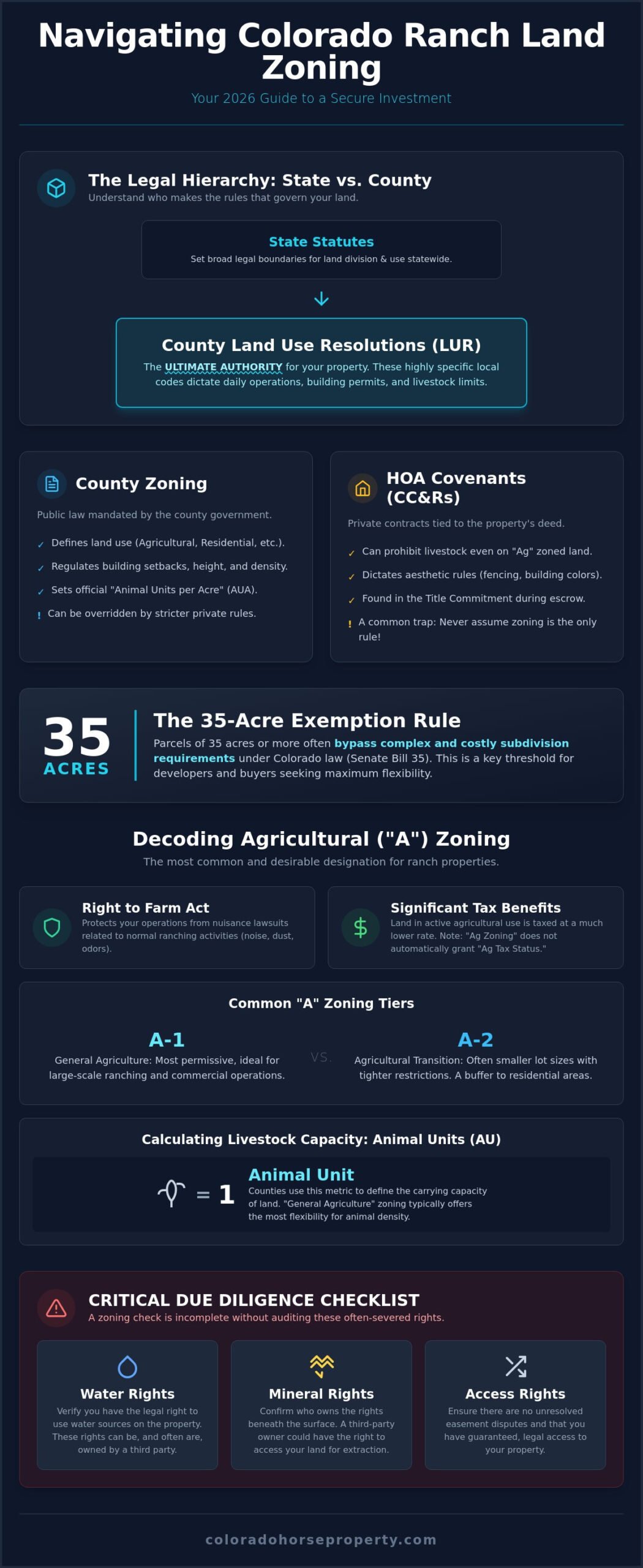
In Colorado, zoning is the primary legal mechanism used to regulate land use, population density, and the types of structures allowed on a property. While the broader history of Zoning in the United States provides a foundation for these laws, Colorado’s rural landscape operates under a specific hierarchy. State-wide statutes set the outer boundaries for land division, but the daily reality for a property owner is dictated by County-specific Land Use Resolutions (LUR). These local codes are the ultimate authority on what you can and cannot do with your acreage.
Mastering Colorado ranch land zoning laws is the most critical step in protecting your property’s long-term value. Zoning isn’t just a set of rules; it’s the framework that determines your Return on Investment (ROI). If you purchase land with the intent to build a commercial equestrian center only to find the zoning is restricted to “Low-Density Residential,” the utility and resale value of that land are immediately compromised. For those eyeing historic properties, you must understand “Legal Non-Conforming Use.” This status allows older ranches to continue operations that don’t meet 2026 codes, as long as those uses were legal when they began and haven’t been discontinued.
The Role of County Land Use Codes
Colorado is a “Home Rule” state. This gives individual counties significant power to create and enforce their own land use standards. These codes are highly specific. They regulate “Animal Units per Acre” (AUA), a metric that defines exactly how many horses or head of cattle you can keep on the property. Beyond livestock, these codes dictate the requirements for building permits. You’ll need to consult the local Land Use Code to find the specific setbacks, height restrictions, and drainage requirements for barns, hay sheds, or indoor riding arenas.
Zoning vs. Covenants (HOAs)
A common trap for buyers is confusing government zoning with private covenants. Zoning is a public law mandated by the county. Covenants, often managed by a Homeowners Association (HOA), are private contracts tied to the deed. It’s possible for a property to be zoned for agricultural use by the county while being strictly prohibited from housing livestock by an HOA. You’ll find these restrictions during the title and escrow process by carefully reviewing the Title Commitment and the CC&Rs (Covenants, Conditions, and Restrictions). Never assume that “Agricultural” zoning overrides the private rules of a subdivision.
Navigating Agricultural Zoning and “Right to Farm” Protections
Colorado’s “Right to Farm” statutes provide a critical safety net for anyone investing in rural acreage. These laws protect established agricultural operations from nuisance lawsuits filed by neighbors who might object to the noise, dust, or odors inherent to ranching. This protection is vital as residential subdivisions continue to expand into traditionally rural areas. When you evaluate a property, you’ll primarily encounter “A” or Agricultural designations. A-1 is typically the most permissive category for ranching, while A-2 often serves as a transition zone with smaller minimum lot sizes and slightly tighter restrictions on commercial activity.
Securing Ag-status is a major financial driver for ranch owners. In Colorado, land dedicated to primary agricultural use is taxed at a significantly lower rate than residential property. It’s a common mistake to assume that zoning and tax status are the same. Just because a parcel is zoned for agriculture under Colorado ranch land zoning laws doesn’t mean it automatically qualifies for the tax break. You must demonstrate active production or grazing to the county assessor. Conversely, residential zoning often places strict caps on livestock that can stifle your plans. Understanding Colorado’s Senate Bill 35 is essential here, as it establishes the 35-acre threshold that often dictates how these rules are applied.
Animal Units and Livestock Restrictions
Counties use “Animal Units” (AU) to calculate the carrying capacity of a piece of land. A single horse is generally considered one AU. For equestrian estates, “General Agriculture” zoning is the gold standard because it offers the most flexibility for animal density and infrastructure. Zoning boards draw a sharp line between domestic pets and livestock. If your land is zoned residential, your horses might be classified as “non-conforming pets,” which severely limits your ability to build additional stalls or expand your herd.
Agritourism and Recreational Zoning
The 2026 market shows a strong trend toward guest ranches, clinics, and agritourism. If you plan to host public events or boarding services, you’ll likely need a Special Use Permit (SUP). This is a discretionary permit that allows activities not normally permitted by right in a specific zone. For a deeper look at designing facilities that meet these regulatory standards, see our Equestrian Real Estate Colorado Guide. Using an AI-powered property search can help you filter for land that already carries the designations necessary for your specific vision.
The 35-Acre Rule and Subdividing Colorado Ranchland
Since 1972, the “35-acre rule” has shaped the Colorado landscape more than almost any other regulation. Formally established by Senate Bill 35, this statute allows landowners to divide large tracts into parcels of 35 acres or more without triggering the intensive, and often expensive, county subdivision review process. For buyers, this is the “magic number” because it streamlines the path to ownership. It bypasses many of the bureaucratic hurdles found in Colorado ranch land zoning laws, making it the standard for rural land development across the state.
Buying into a 35-acre ranch community has distinct advantages. These developments often provide shared road maintenance and established utilities, saving you the headache of starting from scratch. However, you should watch for private covenants. While the county might allow certain agricultural activities, the community’s own rules could be more restrictive. For those with larger holdings, the “Ranchland Process” offers a way to preserve open space through conservation easements. This approach helps maintain the state’s rural character while potentially providing significant tax benefits to the landowner.
How to Subdivide Larger Acreage
If you own a massive tract and wish to divide it into smaller parcels, you’ll generally follow a three-step path. First is the Concept Plan, an informal meeting with county planners to discuss feasibility. Second is the Preliminary Plan, which requires detailed engineering, GIS mapping to identify buildable sites, and environmental impact studies. Finally, the Final Plat is the legal document recorded with the county. Understanding the nuances of Colorado ranch land zoning laws is essential when navigating this transition. Be prepared for costs associated with professional surveying and legal filings, which are necessary to ensure each new lot is a “legal lot” under state standards.
Impact on Water Well Permits
The 35-acre threshold is critical for water security. In most Colorado basins, owning 35 acres or more entitles you to a domestic well permit. Unlike “household-use only” permits found on smaller lots, a domestic permit typically allows you to water livestock and irrigate up to one acre of land. This is a non-negotiable requirement for anyone planning a functional equestrian facility. For a deeper look at how water rights impact land value, review our guide on Colorado Ranches for Sale. Verifying these rights during your due diligence ensures your land remains productive for decades.
Critical Due Diligence: Water, Minerals, and Access Rights
In Colorado, what you see on the surface isn’t always what you own below. Land, water, and mineral rights are frequently “severed,” meaning three separate entities could own different layers of the same property. While Colorado ranch land zoning laws dictate surface use and structure density, they don’t guarantee the resources needed to sustain a working ranch. A zoning check is essentially incomplete without a professional audit of these underlying rights to prevent legal surprises after closing.
The “Split Estate” is a particularly complex issue where a third party owns the minerals beneath your land. In these cases, the mineral owner usually has a legal right to use the surface for extraction activities. This can result in unexpected infrastructure like drilling pads or utility lines on your property. Beyond what’s underground, you must verify both legal and physical access. A deeded easement provides legal access, but if the terrain makes a road impassable during a Front Range winter, your ranch’s utility is severely limited. Rural zoning often depends on these access points for emergency services and building permits.
Verifying Water Rights and Well Permits
Colorado distinguishes between tributary water, which is connected to surface streams, and non-tributary water found in deep aquifers. For any equestrian or agricultural operation, “Adjudicated Water Rights” represent the gold standard because a water court has legally confirmed their priority and use. You should always cross-reference property claims with the Colorado Division of Water Resources database to verify the priority date and decreed use. This is especially critical in 2026 as negotiations over the Colorado River Basin reach a fever pitch, potentially impacting future water availability across the state.
Easements and Public Land Adjacency
Properties bordering BLM or National Forest land offer incredible views and riding access, but they also require careful scrutiny of “Prescriptive Easements.” These occur when the public or neighbors gain a legal right to cross your land through historical, uninterrupted use. Such easements can compromise your privacy and complicate future building plans. To navigate these hurdles effectively, review our Guide to Buying Colorado Land. To simplify your journey and avoid these common pitfalls, use our AI-powered horse property search to find land with verified resource profiles.
Finding Zoning-Compliant Horse Properties with AI Technology
Traditional property searches often fail to account for the granular details of Colorado ranch land zoning laws. A standard filter might show you 40 acres, but it won’t tell you if the county allows a commercial arena or if the water rights are sufficient for twenty horses. This is where modern technology changes the game. Our proprietary AI-powered horse property search analyzes vast amounts of data to identify land that actually aligns with your specific agricultural goals. Instead of manual research, you can filter for properties with existing barns, established arenas, and the necessary water infrastructure already in place.
This technological edge is backed by the 40-year legacy of Mark and Alison Eibner. Leveraging decades of experience in Front Range real estate, we’ve seen how zoning codes have evolved and where the pitfalls lie for unsuspecting buyers. AI allows us to “skip the zoning headache” by narrowing the field to properties that meet legal requirements from day one. It identifies the “General Agriculture” designations and 35-acre parcels that offer the most freedom, ensuring your investment is viable before you ever set foot on the soil.
The Realty Oasis Advantage
Our specialized equestrian division within the Realty Oasis network provides a level of expertise that generalist brokerages simply can’t match. Niche buyer representation is non-negotiable when dealing with rural land. We understand that a ranch closing involves more than just a deed transfer. Our transaction management team is seasoned in handling the complexities of water rights audits, mineral estate disclosures, and title issues unique to Colorado’s rural landscape. This specialized focus ensures that your path to ownership is as smooth as possible.
Ready to Start Your Search?
The 2026 market moves quickly, and properties with the right zoning and infrastructure are in high demand. You can use our AI tool today to filter land by acreage, facility type, and specific zoning features. If you encounter a complex legal question or a “split estate” issue that requires a deeper look, our team is available for a personalized consultation. We’re here to provide the seasoned, no-nonsense advice you need to secure your ranching future. Explore Colorado Ranch Land for Sale and find a property that supports your lifestyle without the legal surprises.
Secure Your Colorado Ranching Legacy
Success in the rural market depends on mastering Colorado ranch land zoning laws to ensure your equestrian or agricultural goals are legally supported from day one. Your due diligence must always extend beyond surface boundaries to include a deep audit of severed water and mineral rights. Whether you’re leveraging the 35-acre rule for guaranteed well permits or navigating “Right to Farm” protections, having the right data is the difference between a high-value investment and a legal surprise.
Don’t let complex county regulations stall your plans. With 40 years of Front Range expertise and specialized buyer representation, we provide the tools you need to buy with confidence. Our team uses specialized AI search technology to filter properties by their actual utility, helping you find land that is already set up for barns, arenas, and livestock. Find Your Perfect Colorado Ranch with Our AI-Powered Search and move one step closer to your goal. Your vision for a sprawling Colorado ranch is achievable when you partner with experts who understand the unique requirements of the land.
Frequently Asked Questions
Can I have horses on any property in Colorado?
No, you cannot keep horses on every property. Local Colorado ranch land zoning laws and private HOA covenants dictate whether livestock is permitted. Even if a property is large, residential zoning might limit you to a specific number of animal units or prohibit them entirely. You must verify both the county designation and the deed restrictions before assuming a parcel is horse-friendly.
What is the “35-acre rule” in Colorado land use?
The 35-acre rule is a state statute that allows landowners to divide property into parcels of 35 acres or larger without going through the rigorous county subdivision review process. This threshold is a primary driver for rural development because it simplifies the path to obtaining a legal building lot. It also plays a significant role in determining your eligibility for specific types of water well permits.
Does agricultural zoning lower my property taxes?
Agricultural zoning doesn’t automatically lower your taxes. While the zoning designation allows for ranching, you must apply for Ag-status with the county assessor by proving the land is used for primary agricultural production, such as grazing or haying. If approved, your property is taxed based on its productive capacity rather than its market value, which can lead to substantial annual savings.
What is a “Special Use Permit” for a Colorado ranch?
A Special Use Permit is a discretionary approval from the county for activities not allowed by right in a specific zone. You’ll likely need this permit if you plan to host public events, run a commercial boarding facility, or operate a guest ranch. These permits often come with specific conditions regarding traffic, noise, and infrastructure that you must maintain to keep the permit active.
How do I check the zoning of a Colorado property before buying?
You can check a property’s zoning by visiting the local county planning department’s website and using their interactive GIS mapping tool. You’ll need the parcel number or address to see the current designation. It’s also wise to review the county’s Land Use Resolution to understand the specific restrictions tied to that zoning code, as rules vary significantly between the Front Range and the Western Slope.
What is the difference between a domestic well and a household-only well?
A domestic well permit allows for in-house use, the watering of livestock, and the irrigation of up to one acre of land. In contrast, a household-only well permit restricts water use strictly to the inside of the home. Most ranch buyers seek properties of 35 acres or more to secure the more permissive domestic well permit, which is essential for any functional equestrian or livestock operation.
Are mineral rights automatically included in a Colorado ranch sale?
Mineral rights are not automatically included in a sale. In Colorado, these rights are often severed from the surface rights and owned by a third party. You must conduct a separate mineral rights search during your due diligence to determine if you’ll own the resources beneath your land. If a split estate exists, the mineral owner may have the legal right to access the surface for extraction.
What does “Right to Farm” mean for my neighbors?
The Right to Farm means your neighbors cannot successfully sue your ranching operation for standard nuisances like noise, dust, or odors, provided you follow established agricultural practices. These laws protect you from legal challenges as residential development moves closer to rural areas. It ensures you can continue traditional ranching activities without interference from those who might not be accustomed to the realities of a working landscape.