
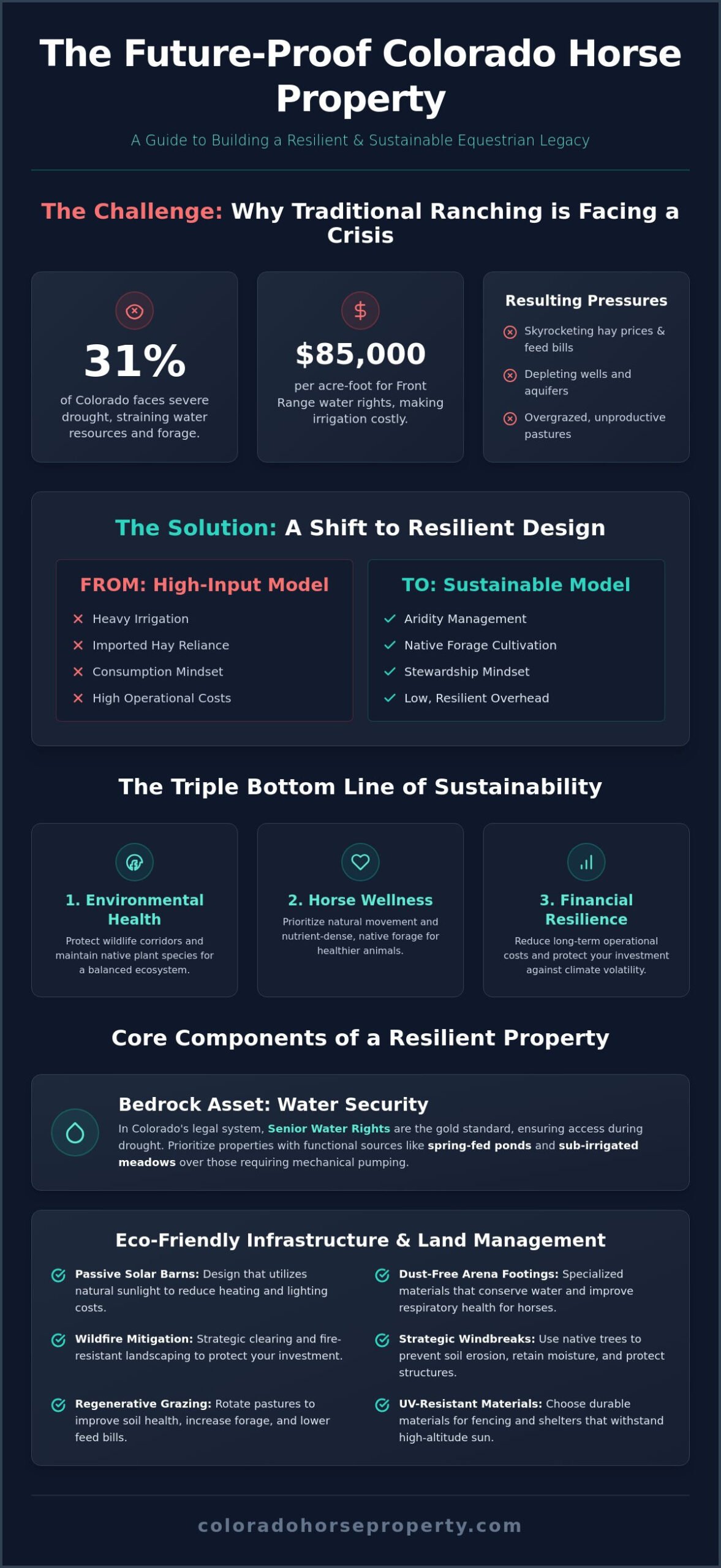
With 31% of Colorado facing severe drought and Front Range water rights trading for as much as $85,000 per acre-foot, the traditional model of high-input ranching is no longer a viable investment. You likely want a legacy property where your horses can thrive without the constant stress of skyrocketing hay prices or depleting wells. It’s difficult to maintain a standard of care when overgrazed pastures lose their vitality and infrastructure costs continue to climb. Finding a sustainable horse property Colorado is no longer just an environmental preference; it’s a financial necessity for the modern equestrian.
We understand that you’re looking for a ranch that works with the land rather than against it. This guide will show you how to identify and acquire eco-friendly estates that balance horse health with the state’s unique environmental demands. We’ll examine the 2026 legal landscape regarding water rights, explore soil restoration techniques that lower your feed bills, and explain how AI-powered search tools help you secure a resilient property that thrives with minimal external inputs.
Key Takeaways
- Understand why resilient ranching in 2026 requires a shift from high-input systems to low-impact designs specifically tailored to Colorado’s arid climate.
- Master the complexities of senior water rights and sub-irrigated meadows to ensure your sustainable horse property Colorado remains productive during drought cycles.
- Discover how passive solar barn designs and dust-free arena footings can significantly reduce your property’s long-term operational costs and environmental footprint.
- Navigate critical zoning regulations and wildfire mitigation strategies that protect your equestrian investment while maintaining the property’s natural aesthetic.
- Learn how to leverage AI-powered search technology to pinpoint estates with specific eco-friendly features and secure expert representation for complex land acquisitions.
Defining Sustainable Horse Properties in Colorado’s 2026 Market
In the 2026 real estate market, a sustainable horse property Colorado is defined by its ability to remain functional with minimal external resources. Traditional ranching often relies on heavy irrigation and imported hay, but today’s buyers prioritize low-impact systems. With rural land valuations up 12.4% since early 2024, sustainability has become a primary driver of property value. Unlike the humid Midwest or East Coast, where “green” might mean lush grass, Colorado sustainability focuses on aridity management. It’s about preserving what little moisture exists and building a resilient ecosystem that survives on its own terms.
Achieving this balance involves applying the core principles of sustainable agriculture to an equestrian context. This means shifting from a mindset of consumption to one of stewardship. Properties that feature regenerative grazing and water-saving infrastructure aren’t just eco-friendly; they’re more profitable to operate. By reducing your reliance on hauled water and $14-per-bale grass hay, you protect your long-term investment against the volatile climate conditions seen in 2026.
To better understand how these elements come together on a local level, watch this helpful video:
The Triple Bottom Line of Equestrian Sustainability
Sustainability in the ranching world isn’t just about the dirt. It involves a “triple bottom line” approach that ensures the property remains viable for decades. First, environmental health focuses on protecting local wildlife corridors and maintaining native plant species. Second, horse wellness is prioritized through natural movement and nutrient-dense, native forage. Finally, financial resilience is key. With 31% of the state in severe drought as of early 2026, reducing operational costs through smart design is the only way to maintain long-term equity. A sustainable horse property Colorado that operates with low overhead is far more attractive to future buyers than a traditional, high-maintenance estate.
Colorado-Specific Climate Challenges
Managing land in the rain shadow of the Rockies presents unique hurdles. While the Front Range deals with rapid urban encroachment and high water costs, the Western Slope faces different water allocation pressures. High-altitude UV rays and constant wind also accelerate the degradation of standard building materials. A truly resilient property uses site-specific designs to mitigate these forces. This might mean using strategic windbreaks to prevent soil erosion or selecting UV-resistant materials for shelters to avoid frequent, costly replacements. Understanding these nuances is what separates a standard ranch from a legacy property built to last.
Water Rights and Soil Health: The Bedrock of Resilient Ranches
Water is the most critical asset for any sustainable horse property Colorado. Without a secure and legally protected supply, even the most advanced infrastructure becomes a liability. In 2026, with 31% of the state in severe drought, the focus has shifted from decorative water features to functional resilience. This means prioritizing land with spring-fed ponds and sub-irrigated meadows that maintain forage quality without the high cost of mechanical pumping. Securing these assets requires a sophisticated understanding of how water moves through the landscape and the legal system.
Navigating Colorado Water Law for Sustainable Use
Securing a resilient ranch requires a deep dive into Colorado water law and the ‘Prior Appropriation’ system. You must distinguish between absolute rights, which are already in use, and conditional rights, which have not yet been put to beneficial use. For sustainable hay production, senior water rights are the gold standard because they ensure delivery even when rivers run low. Many properties also include shares in ditch companies, which provide a reliable allocation of water for a set fee. Sub-irrigated meadows are natural, low-energy hydration systems that use shallow groundwater to keep pastures productive without mechanical pumping.
Soil Regeneration and Pasture Management
Healthy soil acts as a natural reservoir for your ranch. When you practice regenerative grazing on a sustainable horse property Colorado, you rotate horses through smaller paddocks to allow native grasses like Blue Grama or Western Wheatgrass to recover. This prevents ‘sacrifice lots’ from turning into dust bowls and helps build organic matter over time. Composted manure plays a vital role here; it creates a closed-loop nutrient cycle that feeds the soil without the need for synthetic fertilizers. This approach keeps pastures nutrient-dense and reduces your reliance on expensive imported hay.
High-quality soil significantly increases the ‘sponge effect’ of your land. This means the ground absorbs more moisture during heavy snowmelts rather than letting it run off and erode the topsoil. When you’re ready to evaluate the long-term viability of a specific parcel, our AI-powered horse property search can help you filter for these critical environmental features. Building a resilient ranch is a long-term commitment to the land. By focusing on senior water rights and soil vitality, you ensure your property remains a productive sanctuary for your horses, regardless of the climate challenges ahead.
Eco-Friendly Equestrian Infrastructure: Barns, Arenas, and Energy
A sustainable horse property Colorado requires buildings that work as hard as the land itself. While traditional barns often focus on aesthetics, resilient infrastructure prioritizes energy efficiency and resource conservation. Passive solar design is a cornerstone of this approach. By orienting your barn to maximize Colorado’s 300-plus days of annual sunshine, you can naturally heat stalls during the winter while keeping them cool in the summer. High-thermal-mass materials, such as stone or thick concrete, act as a battery by absorbing heat during the day and releasing it slowly at night.
Energy independence is more achievable than ever in 2026. Integrating solar arrays or small-scale wind turbines on ranch acreage allows you to offset operational costs significantly. Water-saving technologies are equally important. Rainwater catchment systems can harvest moisture for landscaping or cleaning, while frost-free automatic waterers provide reliable hydration for livestock without the constant electrical draw of traditional tank heaters. These systems are essential for long-term sustainable land and resource stewardship, ensuring your ranch remains functional during extreme weather cycles.
The Sustainable Barn: Beyond Aesthetics
Building with local or reclaimed materials reduces the carbon footprint and often results in a structure better suited to the regional climate. Natural ventilation is a key design element. Instead of relying on mechanical cooling, strategic window placement and high ceilings encourage airflow. This doesn’t just save on electricity; it drastically improves horse respiratory health by clearing dust and ammonia. Natural lighting through translucent roof panels or clerestory windows further reduces the need for artificial lights during the day.
Sustainable Arenas and Training Facilities
Training facilities must be designed to protect the surrounding ecosystem. Outdoor arenas should be sited to manage drainage effectively, preventing sediment-heavy runoff from entering local watersheds. When selecting footing, look for dust-free, low-maintenance options like polymer-coated sands or recycled materials. These products require significantly less water to stay rideable compared to traditional sand. Strategic placement is also vital. By using natural topography or windbreaks, you can minimize wind erosion, which often strips expensive footing away from exposed Colorado arenas. Investing in these features ensures your sustainable horse property Colorado retains its utility and value for years to come.
Evaluating Land for Long-Term Sustainability and Value
Selecting a sustainable horse property Colorado requires a critical look at the underlying legal and physical structure of the land. Sustainability isn’t just about the features you add; it’s about the inherent qualities of the parcel you buy. Zoning is your first hurdle. Understanding the difference between A-1 and A-2 designations is vital, as these codes dictate livestock density and your ability to build essential equestrian infrastructure. A property that isn’t legally zoned for your long-term vision cannot be truly sustainable.
Topography analysis is equally important for resource management. By using the natural lay of the land, you can create natural windbreaks and manage drainage without heavy earthmoving. Proximity to public land is another massive sustainability advantage. Accessing trails on nearby Colorado land reduces the daily physical impact on your own pastures. This allows your private acreage more time to recover and maintain its nutrient density. When you’re ready to find a parcel that meets these rigorous standards, use our AI-powered horse property search to filter for specific land features.
The Sustainable Property Checklist
Before committing to a purchase, you must vet the land’s hidden assets. A professional soil test is the only way to verify nutrient density and identify compaction issues that could hinder forage growth. You should also vet existing wells for depth, flow rate, and historical reliability. In an arid climate, a well that struggled in 2025 will likely be a liability in 2026. Finally, identify any riparian zones or wetlands on the property. These areas require special conservation but provide invaluable natural water filtration and biodiversity.
Wildfire Resilience as Sustainability
In the Rocky Mountain region, wildfire resilience is a core pillar of property sustainability. You should select fire-resistant native plants for the perimeter of your home and barn to reduce fuel loads. Access roads must be designed to accommodate large emergency vehicles while causing minimal land disturbance. Creating defensible space is the most critical safety feature of a Colorado horse property because it provides a buffer that can slow or stop the spread of fire toward your livestock and infrastructure. This proactive approach protects your investment and ensures the long-term safety of your animals.
Finding Your Sustainable Legacy with Colorado Horse Property
Acquiring a sustainable horse property Colorado shouldn’t rely on guesswork. In the first quarter of 2026, 67% of buyers used AI as their primary research tool to navigate the competitive rural market. We’ve refined this technology to identify the specific resilient features discussed in this guide, from senior water rights to passive solar barn potential. This data-driven approach ensures you find a property that aligns with your ecological goals and financial requirements without wasting time on unsuitable listings.
AI-Powered Search for the Eco-Conscious Buyer
Our proprietary search tools go beyond basic acreage filters. You can specifically target barns with solar potential, verified water rights, and pastures optimized for rotational grazing. This technology saves weeks of physical site visits by identifying “horse-ready” land that meets strict sustainability criteria from the start. We recently used this system to match a buyer with a regenerative ranch in Delta County. The AI flagged the property’s sub-irrigated meadows and existing cross-fencing, allowing the buyer to secure a resilient estate before it was widely marketed.
Your Partners in Sustainable Land Ownership
Success in this niche market requires more than just data. It requires representation that understands the operational realities of ranching. Mark and Alison Eibner bring a 40-year history of experience to your search, providing a level of insight that generalist agents can’t match. This longevity has built a network that often grants us access to off-market equestrian estates with coveted senior water rights. Our specialized focus on equestrian real estate Colorado means we’re equipped to handle the nuances of land valuation and resource management.
We provide a comprehensive service suite that extends from property valuation to post-closing land management referrals. Every deal concludes with title and escrow services designed to handle the complexities of water rights transfers and agricultural easements. Our goal is to make your transition to a sustainable horse property Colorado as seamless as possible. Set up your custom search profile today to begin building your legacy on resilient land.
Securing Your Future in the Colorado High Country
A sustainable horse property Colorado is more than a purchase; it’s a commitment to long-term resilience in an evolving climate. By prioritizing senior water rights, regenerative soil practices, and passive solar infrastructure, you ensure your ranch remains a productive sanctuary for decades. These features aren’t just environmental choices; they’re essential safeguards for your property value in the 2026 market. Understanding the nuances of Colorado water law and agricultural zoning is the difference between a high-maintenance liability and a thriving legacy.
With 40 years of specialized expertise, we help you navigate these complexities with confidence. Our proprietary AI search technology allows you to filter listings for the exact eco-friendly features your horses need to thrive. Whether you’re vetting a well’s reliability or evaluating a parcel’s wildfire defensibility, we provide the seasoned perspective required for success. Start your AI-powered search for sustainable Colorado horse properties today. Building a resilient future starts with finding the right ground. We look forward to helping you secure a property that stands the test of time.
Frequently Asked Questions
Is it possible to have a sustainable horse property on less than 10 acres in Colorado?
Yes, you can manage a sustainable horse property Colorado on smaller acreage by utilizing intensive management practices. This requires a dedicated sacrifice lot to protect your pastures and a strict rotational grazing schedule to prevent soil compaction. Smaller properties often rely more on imported, nutrient-dense hay, but they can still achieve high levels of environmental efficiency through smart infrastructure and manure composting.
Can I use rainwater harvesting for my horses under Colorado law?
Colorado law allows residential homeowners to collect up to 110 gallons of rainwater in two barrels for outdoor use. However, using large-scale catchment systems for livestock or irrigation usually requires a specific water right or court decree. You should check the specific water court rulings for your basin to determine if your collection plans are legally compliant before investing in a large system.
How much does it cost to install a solar-powered well on a ranch?
Installation costs for solar-powered well pumps depend heavily on the depth of the well and the required gallons per minute. While basic pump kits are available for smaller needs, professional installation and battery storage for 24-hour operation increase the total investment. These systems are highly effective for providing reliable water in remote pastures without the need for expensive electrical line extensions.
What are the best native grasses for Colorado horse pastures?
Blue Grama and Western Wheatgrass are among the best native species for Colorado horse pastures. These grasses evolved for the state’s arid climate and provide excellent nutritional value while requiring minimal irrigation. Buffalo Grass is also a strong choice for high-traffic areas due to its extreme drought tolerance and its ability to withstand heavy grazing pressure once established.
What happens if a property has “junior” water rights during a drought?
Owners with junior water rights are the first to be curtailed when water supplies fall below demand. In a drought-prone state, this means your access to ditch water or irrigation can be completely cut off to satisfy senior holders. This is why verifying the seniority and reliability of water rights is a critical step when evaluating a sustainable horse property Colorado.
How can I improve the soil on a property that has been overgrazed for years?
Improving overgrazed soil starts with complete rest and the addition of organic matter to rebuild the nutrient cycle. You can use composted manure to jumpstart biological activity and aerate compacted areas to improve water infiltration. Seeding with native species and implementing a managed grazing plan will help rebuild the topsoil “sponge” that holds moisture during dry spells.
Are there tax incentives for sustainable land management in Colorado?
Colorado offers several financial incentives, including the Agricultural Stewardship Tax Credit for soil health and water efficiency improvements. The next application round for this refundable credit opens in Fall 2026 and provides a maximum annual credit of $300,000. Additionally, the state’s Conservation Easement Tax Credit program has been extended to 2036, offering substantial benefits for protecting open space.
What is the most fire-resistant material for building a horse barn?
Non-combustible materials like steel, masonry, and concrete are the most fire-resistant options for equestrian buildings. Using metal roofing and siding significantly reduces the risk of ignition from wind-blown embers during a wildfire. You should also consider “Class A” fire-rated roofing materials and non-combustible siding to create a more resilient structure that protects your livestock and investment.