
Owning a self-sufficient homestead in the Rockies is more than a scenic dream; it’s a complex infrastructure project that begins long before you break ground. You likely crave the freedom of wide-open spaces, yet the fear of a dry well or a snowed-in winter is a valid concern for any serious buyer. Finding the right off-grid ranches for sale Colorado offers requires looking past the mountain views to the technical realities of the land. We understand that a ranch is only as good as its resources, especially when you’re miles from the nearest utility line.
This guide will show you how to secure reliable water rights and build a resilient power system that supports both your family and your livestock. You’ll learn how to master the complexities of the Colorado market, from the “first in time, first in right” water doctrine to the new 2026 plug-in solar limits. We provide a clear look at county-specific zoning, winter accessibility, and the essential infrastructure required to turn a remote acreage into a functional, sustainable estate.
Key Takeaways
- Learn to size solar power systems for agricultural scale and solve the challenge of powering deep-rock well pumps for reliable livestock hydration.
- Explore the full spectrum of off-grid ranches for sale Colorado, from remote primitive cabins to luxury equestrian estates featuring high-tech independent infrastructure.
- Gain a clear understanding of Colorado’s “Prior Appropriation” water doctrine and how to verify the specific well permits required for your ranching goals.
- Compare the upfront costs of self-sufficient systems against the long-term operational freedom and ROI of a property without monthly utility obligations.
- See how AI-powered search technology and specialized buyer representation streamline the process of finding land with verified off-grid potential.
What Defines an Off-Grid Ranch in Colorado?
A true off-grid ranch in Colorado isn’t just a home without a utility bill; it’s a self-contained ecosystem. While many buyers associate what off-grid living means with simple cabins, the 2026 market for off-grid ranches for sale Colorado includes everything from primitive hunting outposts to multimillion-dollar equestrian estates. These properties function entirely on independent power, water, and waste systems. They require a specialized understanding of land management and resource preservation that grid-tied homes simply don’t demand.
Colorado’s diverse geography dictates your specific off-grid strategy. A ranch on the High Plains might rely heavily on wind turbines and vast solar arrays to capture the constant eastern sun. Conversely, a mountain property in the Rockies requires rigorous planning for heavy snow loads and potential micro-hydro energy from seasonal streams. We’re seeing a surge in “Legacy Properties” this year. These are large-acreage tracts that have remained in families for generations. They often possess superior water rights and established grazing land that modern subdivided parcels lack, making them highly sought after for long-term self-sufficiency.
To better understand the potential of these expansive properties, watch this helpful video:
The Core Pillars of Off-Grid Independence
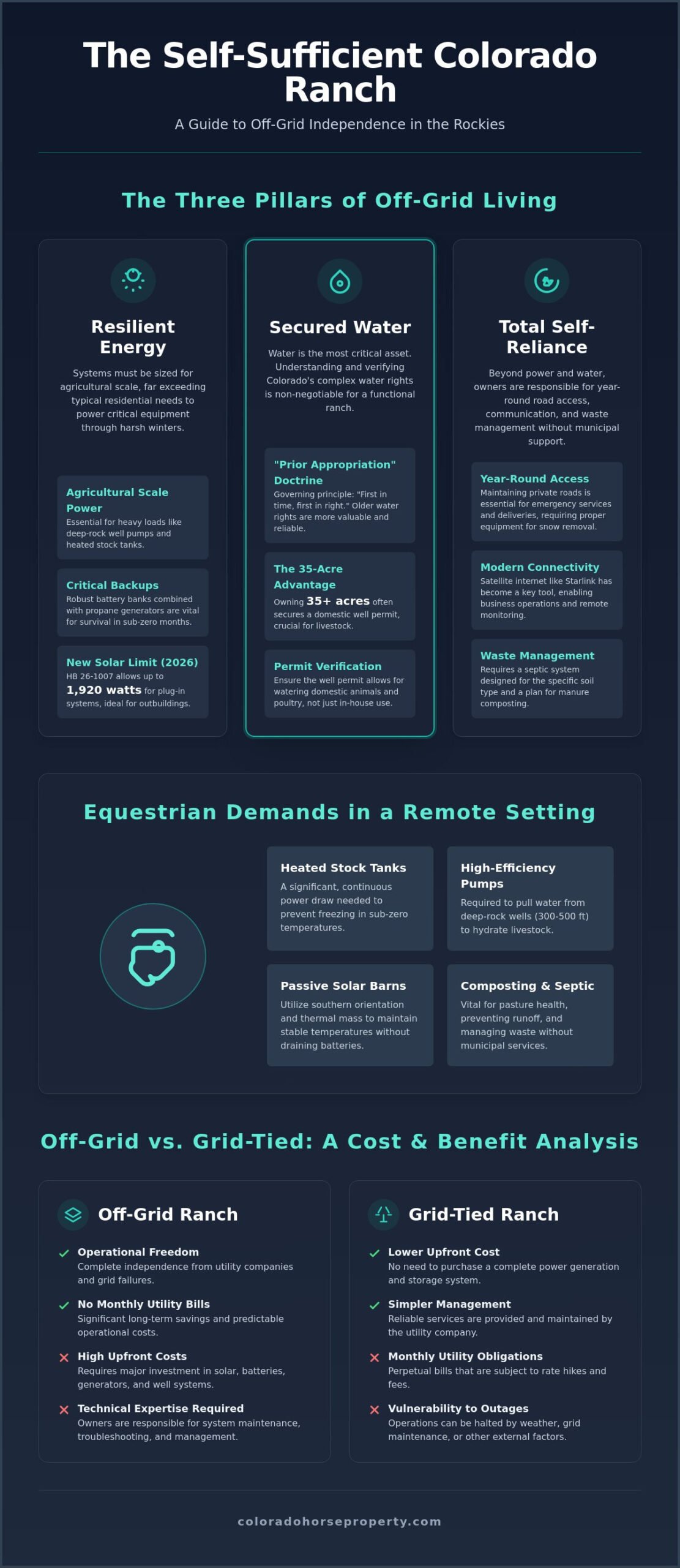
Energy systems in 2026 have become significantly more efficient. With the recent passage of HB 26-1007, ranch owners can now utilize plug-in solar systems up to 1,920 watts. This makes it easier to add power to remote outbuildings or tool sheds. However, primary residences still require robust battery banks and backup generators to survive high-altitude winters. Water remains the most critical pillar. In Colorado, owning 35 acres or more often secures a domestic well permit. This is vital because it allows for watering domestic animals and poultry, a necessity for any working ranch. Maintaining private roads is the final piece of the puzzle. You’ll need the right equipment to ensure year-round access for emergency vehicles or hay deliveries during heavy snow cycles.
Equestrian Needs in a Remote Setting
Managing horses in a remote setting adds specific infrastructure demands. You must calculate the power load for heated stock tanks to prevent freezing during sub-zero nights. High-efficiency pumps are required to pull water from deep-rock wells to keep livestock hydrated. Passive solar barn designs, which use thermal mass and southern orientation, help maintain stable temperatures without draining your battery bank. Waste management is equally vital. Without municipal services, you’ll need a septic system designed for your specific soil type. A dedicated plan for manure composting is also necessary to maintain pasture health and prevent runoff into local watersheds.
Infrastructure: Building the Self-Sufficient Ranch
Building a functional homestead requires more than just installing a few solar panels. When evaluating off-grid ranches for sale Colorado, you must distinguish between a simple residential setup and a working agricultural operation. A standard residential solar array might power your lights and refrigerator, but it often fails when tasked with the heavy surge loads of a deep-rock well pump or the continuous draw of winter stock tank heaters. Sizing your system correctly is the difference between a thriving ranch and a frozen disaster during a Rocky Mountain winter.
The well pump challenge is particularly acute in Colorado’s high-desert and mountain regions. Pushing water from a depth of 300 or 500 feet requires significant energy. Many successful off-grid owners utilize large battery banks combined with propane backup generators to ensure water keeps flowing during the dark, sub-zero months of January and February. For communication, Starlink has effectively eliminated the isolation of remote ranching. This technology allows owners to manage business operations or monitor security cameras across their acreage without relying on terrestrial lines. While the new 2026 plug-in solar limits of 1,920 watts are great for outbuildings, your primary ranch infrastructure will still require a robust, hard-wired system.
Water Systems for Livestock and Irrigation
Understanding your permit is vital for long-term ranch viability. A “household-use-only” permit restricts you to indoor water, while a domestic well permit allows for livestock watering. To reduce the strain on your electrical system, consider implementing gravity-fed watering systems. By pumping water to a high-point cistern during peak sun hours, you can use natural pressure to fill troughs throughout the day. Winter-proofing is non-negotiable in this climate. Water lines must be buried below the frost line, often four feet or deeper, to prevent catastrophic pipe bursts when temperatures plummet.
Sustainable Pasture and Land Management
High-altitude, semi-arid land is fragile and requires careful stewardship. Rotational grazing strategies are essential to prevent overgrazing and maintain the native grasses your horses depend on. You’ll also need a strict fire mitigation plan, which involves creating a 100-foot defensible space around your primary structures. To find properties with the best natural resources, you can use an AI-powered horse property search to identify specific soil qualities and vegetation types before you ever step foot on the land. This technical approach ensures you find off-grid ranches for sale Colorado that can actually support your livestock goals.
Off-Grid vs. Grid-Tied Ranches: A Comparative Analysis
Choosing between grid-tied and off-grid ranches for sale Colorado is a strategic financial decision. On one hand, grid-tied properties offer the convenience of unlimited power without the need for personal oversight. On the other, the independence of an off-grid ranch protects you from rising utility rates and regional grid failures. In 2026, the resale value of well-engineered off-grid estates has reached parity with traditional ranches, as buyers increasingly prioritize self-sufficiency and total privacy.
The psychological shift required for this lifestyle is significant. You move from being a passive consumer to an active manager of your own resources. This independence brings a profound sense of peace, knowing your home and livestock are secure regardless of external circumstances. However, this freedom is balanced by the weight of responsibility. You’re the one who must troubleshoot a frozen pump at midnight or clear a mile-long driveway after a spring blizzard. For many, the pride of a truly sustainable ranch outweighs the labor involved.
The Real Cost of “Free” Energy
While you won’t receive a monthly bill from a utility company, you’re essentially prepaying for decades of energy. You must budget for replacing your battery bank every 10 to 15 years, which remains a significant capital expense even with 2026 technology. Backup generators are also a necessity for long stretches of cloud cover, meaning you’ll have the hidden costs of propane or diesel fuel and regular engine maintenance. Extending utility lines across rugged terrain frequently requires astronomical fees for poles, transformers, and trenching that far exceed the cost of a high-end independent solar array.
Maintenance Responsibilities for Ranch Owners
Independence brings the peace of knowing your systems inside and out, but it also means you’re the first responder when something breaks. You’ll need to monitor inverter performance and water cistern levels daily to ensure your livestock remains hydrated. Living remotely also requires owning heavy equipment like tractors and snowplows to manage your own access roads during Colorado’s unpredictable winters. For a broader look at the market beyond just independent systems, consult our Colorado Ranches for Sale: The 2026 Expert Buyer’s Guide. Understanding these operational demands before you buy ensures you select a property that matches your desired level of involvement.
Evaluating Legalities: Water Rights and Zoning
Purchasing an off-grid ranch in Colorado involves navigating a labyrinth of legalities that don’t exist in urban real estate. You aren’t just buying land and a structure; you’re acquiring a specific set of resource rights. Colorado operates under the doctrine of “prior appropriation,” which follows a “first in time, first in right” system. This means that owning the land doesn’t automatically grant you the right to use the water flowing through it or beneath it. When searching for off-grid ranches for sale Colorado, your first priority must be verifying the seniority and type of water rights attached to the deed.
Well permits are the lifeblood of any self-sufficient operation. Current 2026 regulations state that a parcel of 35 acres or more typically qualifies for a domestic well permit. This permit is essential for equestrian owners because it allows for watering domestic animals and poultry in addition to household use. If you purchase a smaller lot, you might be restricted to a “household-use-only” permit, which prohibits outdoor watering of any kind. The filing fee for a new permit remains $100, but the real value lies in the permit’s classification. Agricultural zoning and conservation easements can also impact your long-term plans, potentially limiting where you can build barns or how many horses the land can support.
Securing Your Water Future
Due diligence is your most powerful tool during the closing process. You must verify that the water rights mentioned in the listing are actually transferable and free of encumbrances. Colorado’s 2026 water conservation updates have placed stricter requirements on new developments, making existing senior rights even more valuable. For a deeper dive into the specifics of land acquisition, see The Ultimate Guide to Buying Colorado Land in 2026. Understanding these nuances prevents you from buying a “dry” ranch that can’t legally sustain your livestock or your lifestyle.
Access and Easements
Remote properties often come with access challenges that require careful title review. You must identify if a parcel is “landlocked” and ensure there’s a recorded legal easement for ingress and egress. Many off-grid ranches for sale Colorado share boundaries with BLM or National Forest land. While this provides incredible trail access, it also means you must respect federal boundaries and understand the regulations regarding grazing or fencing adjacent to public land. Zoning for equestrian facilities like indoor arenas or guest houses varies by county, so always check local building codes before planning your expansion. If you’re ready to find a property with verified legal standing, our buyer representation services provide the expert oversight needed for these complex ranch transactions.
Finding Your Colorado Off-Grid Ranch with AI Expertise
Finding off-grid ranches for sale Colorado requires a blend of old-school boots-on-the-ground experience and cutting-edge technology. Traditional search engines often fail to distinguish between a “remote” property and one with the specific geological and legal attributes needed for true self-sufficiency. You need to know if the southern exposure is sufficient for solar arrays and if the soil can support the grazing requirements of your herd. By using advanced data sets, we strip away the guesswork, allowing you to focus only on parcels that meet the strict criteria of a working ranch.
Realty Oasis and Colorado Horse Property have established themselves as the leaders in ranch transactions by combining deep historical knowledge with modern efficiency. We understand that an off-grid purchase is a life-changing investment. Our goal is to ensure that your transition to self-sufficient living is backed by data and protected by professional oversight. Whether you are looking for a high-altitude retreat or a vast plains estate, the right technology ensures you don’t waste time on properties that lack the necessary water rights or infrastructure potential.
Leveraging Tech for Your Property Search
Our proprietary technology goes beyond simple filters for bedroom counts or square footage. We help you assess solar potential, soil types, and topography using high-resolution satellite imagery. This allows you to evaluate pasture health and water drainage patterns before you ever hook up the trailer for a site visit. You can find CO horse property faster with our AI search tool, which is specifically tuned to the nuances of the Colorado landscape. This technical advantage is crucial when evaluating remote acreage where a single visit can take an entire day.
Partnering with Mark and Alison Eibner
Technology is a powerful tool, but it’s most effective when guided by seasoned experts. Mark and Alison Eibner bring over 40 years of specialized experience to every transaction in the Colorado Front Range. We don’t just find you a listing; we provide a comprehensive ecosystem of support. This includes:
- Expert valuation of off-grid infrastructure and water rights.
- Niche knowledge of county-specific zoning for equestrian facilities.
- Seamless coordination of title and escrow services for complex land deals.
- Direct buyer representation that prioritizes your long-term ranching goals.
Working with a specialist means you have a partner who understands the difference between a domestic well and a household-use permit. We help you navigate the complexities of “prior appropriation” and ensure your investment is legally sound. If you’re ready to move beyond the grid and into the lifestyle you’ve planned, start your AI-powered off-grid ranch search today and secure your piece of the Colorado Rockies.
Secure Your Legacy of Independence in the Rockies
Achieving a self-sufficient lifestyle requires more than a love for the land; it demands a technical mastery of energy systems and a rigorous understanding of Colorado water law. By prioritizing robust infrastructure and verifying senior water rights during your due diligence, you ensure your ranch remains a functional asset for generations. The 2026 market for off-grid ranches for sale Colorado is highly competitive, but those who approach it with a data-driven mindset will find the most resilient properties. A successful transition to remote living depends on balancing your aspirations with the practical realities of resource management.
Our team brings 40+ years of Colorado real estate expertise to your search, utilizing AI-powered niche property filtering to identify land that others might overlook. We offer specialized equestrian and agricultural knowledge to ensure your transaction is managed with the highest level of professional detail. You don’t have to navigate these complexities alone. Browse Current Off-Grid Ranches for Sale in Colorado and start your search for a property that truly sustains you. Your future of freedom in the high country is within reach.
Frequently Asked Questions
Can I get a mortgage for an off-grid ranch in Colorado?
Traditional mortgages are difficult to obtain for off-grid properties because most conventional lenders require a permanent heat source and grid-tied electricity. However, specialized agricultural lenders or owner financing are viable paths for off-grid ranches for sale Colorado. You’ll likely need a higher down payment, often 20% to 30%, to mitigate the lender’s risk on these unique assets. Specialized appraisal is also necessary to determine value without traditional utility comparables.
How much water do I need per day for 5 horses on an off-grid property?
You should budget for at least 50 to 75 gallons of water per day for five horses, depending on the season and activity levels. In Colorado’s semi-arid climate, horses may drink more during dry summer months or when consuming dry hay in winter. Ensure your cistern or well system can handle this daily draw plus your household needs without depleting the well’s recovery rate or straining your solar-powered pump.
What happens to solar power during a Colorado blizzard?
Solar production drops to near zero when panels are covered in snow or during heavy cloud cover. While cold temperatures actually improve panel efficiency, you must have a robust battery bank and a propane or diesel backup generator to maintain power during multi-day storms. Many ranch owners install panels at a steep angle to encourage snow shedding and use long-handled brushes for manual clearing after the wind dies down.
Are composting toilets legal for off-grid ranches in Colorado?
Composting toilets are generally legal in Colorado, but they are regulated at the county level and often require a specific permit. Most counties still require a standard septic system to handle gray water from sinks and showers. Before purchasing land, check with the local health department to ensure your preferred waste management system complies with current sanitation codes. Some counties have stricter regulations regarding “alternative” systems in high-altitude environments.
How do I maintain my private road access during the winter?
You are responsible for all snow removal and grading on a private ranch road. This requires owning heavy equipment, such as a tractor with a blade or a heavy-duty truck with a plow attachment. It’s also vital to ensure your road is wide enough and has a sufficient base to support emergency vehicles or hay delivery trucks during the spring thaw when the ground becomes soft and unstable.
What is the difference between a domestic well and a livestock well?
A domestic well permit, typically granted for parcels of 35 acres or more, allows for in-house use and the watering of domestic animals and poultry. A livestock well is usually a commercial or high-volume permit for large-scale production operations. Understanding these classifications is critical when looking at off-grid ranches for sale Colorado, as a “household-use-only” permit will legally prevent you from watering horses or livestock outdoors, even in small numbers.
Do off-grid ranches have higher or lower property taxes in Colorado?
Off-grid status itself doesn’t lower property taxes, but the lack of utility infrastructure can result in a lower assessed value for the land. The most significant tax savings come from maintaining an “Agricultural” designation. To qualify, you must demonstrate a primary intent to produce a profit from the land through grazing or hay production. This designation significantly reduces the tax rate compared to standard residential land, regardless of your grid status.
Can I install a wind turbine on my Colorado ranch land?
You can install wind turbines on most Colorado ranch land, provided you comply with county height restrictions and noise ordinances. Wind is an excellent secondary power source for off-grid properties, especially on the eastern plains where wind speeds are consistent. Combining solar and wind creates a more resilient hybrid system, ensuring you have power during cloudy, stormy days when wind speeds often increase while solar production fails.