
Imagine finding the perfect 35-acre El Paso County ranch with a functional barn and existing water rights, only to have a traditional lender stall your closing by months because they don’t understand how to value specialized equestrian improvements. It’s a common frustration for Colorado buyers. With conventional mortgage rates sitting at 6.75 percent as of July 2026 and banks imposing strict requirements on agricultural land, the hurdles can feel insurmountable. You’ve worked hard for your lifestyle, and you shouldn’t have to wait on a slow appraisal process while your horses remain in expensive boarding.
Securing an owner financed horse property in Colorado is the strategic solution that puts you back in the saddle. By leveraging seller financing, you can bypass the big bank bureaucracy and secure your equestrian estate with flexible terms that commercial ranch lenders simply cannot match. This guide provides a clear roadmap for the current market. You’ll discover how to navigate the 2026 Colorado contract updates, understand typical 6 percent to 9 percent seller-financed interest rates, and learn the mechanics of using a Promissory Note and Deed of Trust to move onto your property faster.
Key Takeaways
- Understand the mechanics of seller-carry contracts in Colorado and how to use CREC-approved forms to protect your investment.
- Evaluate the strategic benefits of faster closing times and flexible credit requirements against potential risks like due-on-sale clauses.
- Learn to use AI-powered search tools to efficiently find an owner financed horse property Colorado by targeting specific seller-carry keywords.
- Master the vetting process for equestrian land by verifying zoning ordinances and water rights to ensure the property supports your livestock needs.
- Discover how specialized buyer representation can streamline transaction management and help you navigate the unique legal landscape of Colorado ranches.
What is Owner Financed Horse Property in Colorado?
An owner financed horse property Colorado arrangement is a private real estate agreement where the seller serves as the lender. Instead of a buyer securing a traditional mortgage from a bank, the seller “carries” the debt, holding a promissory note that outlines the repayment terms. To get a foundational understanding of the legal mechanics, you can review What is Owner Financed Horse Property in Colorado? through the lens of specialized land transactions. This method has become a strategic tool for equestrian buyers who need to move quickly in a competitive market.
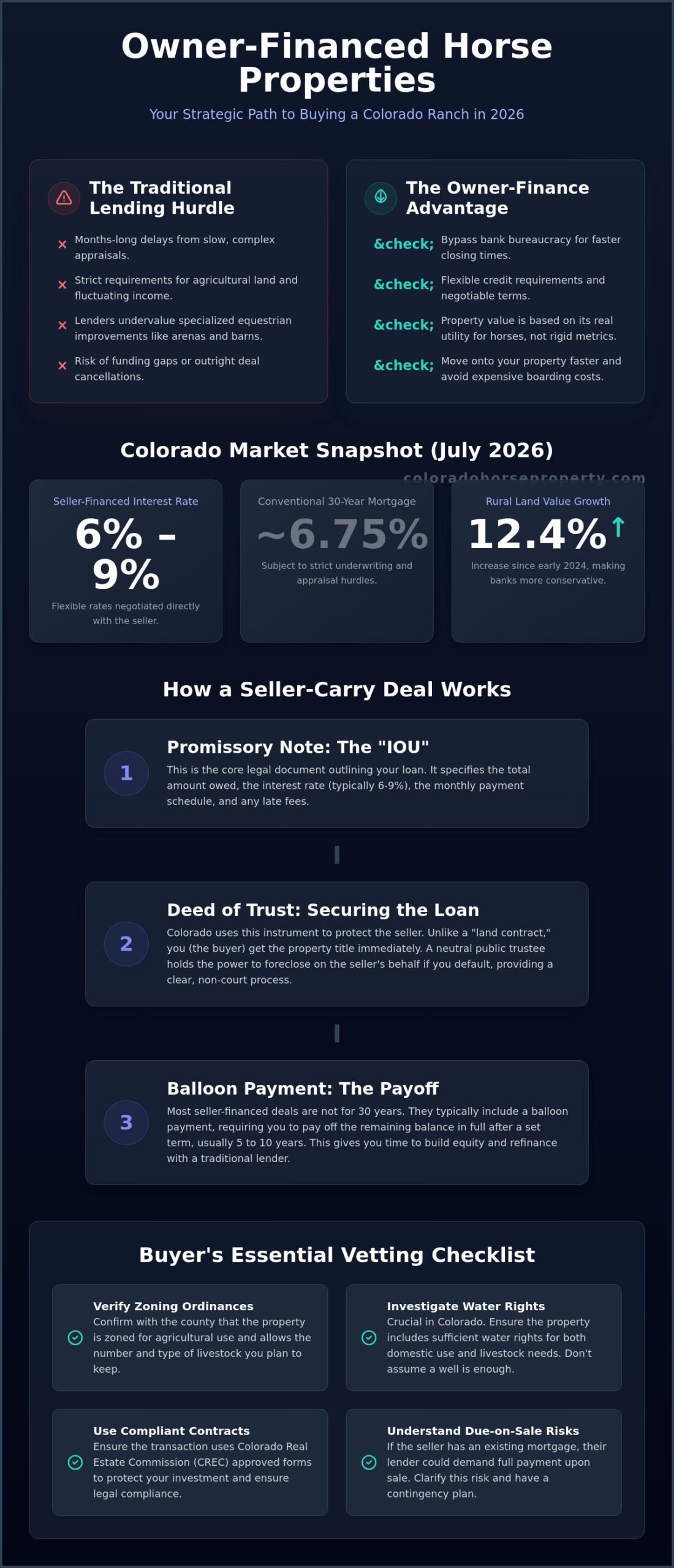
The demand for these arrangements is surging in the 2026 Colorado market. With rural land valuations having risen 12.4 percent since early 2024, traditional banks have become increasingly conservative. Conventional 30-year mortgage rates in Colorado are hovering around 6.75 percent as of July 2026, but the real challenge lies in the appraisal process. Banks often struggle to value unique equestrian improvements, leading to funding gaps that can stall or kill a deal. Seller financing allows both parties to agree on a property’s value based on its utility for horses rather than rigid corporate metrics.
To better understand how these land transactions work on the ground, watch this helpful video:
Sellers often offer these terms for several practical reasons. For many long-term ranch owners, providing an owner financed horse property Colorado deal creates a steady stream of monthly income while spreading out capital gains tax liabilities over several years. It also facilitates a faster sale. In the Front Range, functional horse properties are currently selling in under 24 days. Offering financing makes a property stand out, attracting serious buyers who have significant down payments but prefer to avoid the “big bank” bureaucracy.
The Role of Seller Financing in Equestrian Real Estate
Traditional lenders often view specialized horse improvements like indoor arenas, round pens, and high-end loafing sheds as “over-improvements” that don’t add enough appraised value. This creates a hurdle for buyers who recognize the true worth of a turn-key facility. Choosing an owner financed horse property Colorado bypasses these lending restrictions, allowing the buyer and seller to define value based on infrastructure rather than generic comps. It’s particularly appealing for self-employed trainers or ranchers whose income might fluctuate seasonally, making them appear “risky” to automated bank underwriting systems despite their strong assets.
Key Terms You Will Encounter in a Seller-Carry Deal
Understanding the paperwork for an owner financed horse property Colorado purchase is vital for a secure transaction. You’ll primarily deal with three specific concepts:
- Promissory Note: This is the legal “IOU” that specifies the interest rate, which typically ranges between 6 percent and 9 percent in the 2026 market.
- Deed of Trust: Colorado uses this security instrument to protect the seller’s interest. It allows a public trustee to handle the property if the buyer defaults on payments.
- Balloon Payments: Most seller-carry deals aren’t meant to last 30 years. They often require a full payoff or refinance after 5 to 10 years, giving the buyer time to build equity or wait for interest rates to drop before refinancing with a traditional lender.
The Mechanics of Colorado Seller-Carry Contracts
Colorado operates as a “Deed of Trust” state. This provides a clear legal path for both the buyer and seller. Unlike a land contract where the seller keeps the deed until the final payment, a Deed of Trust allows the buyer to hold the title while a public trustee secures the loan. This distinction is vital for anyone searching for an owner financed horse property Colorado because it offers more robust protections for the buyer’s equity. If the buyer defaults, the foreclosure process is handled through the county’s public trustee rather than a lengthy court battle.
All transactions should use Colorado Real Estate Commission (CREC) approved forms. These documents were updated on January 1, 2026, to include more precise definitions for deadlines and “As-Is” condition clauses. Using standardized forms ensures that inspection rights and default provisions are clearly defined, leaving no room for handshake-deal ambiguity. These forms are designed to protect both the seasoned rancher and the first-time land buyer.
Since there is no federal oversight on private interest rates, these terms are purely negotiable. In the current 2026 market, most seller-carry deals settle between 6 percent and 9 percent. Buyers should weigh these rates against the Pros and Cons: Is Seller Financing Right for Your Ranch? to determine if the flexibility is worth the cost compared to a standard bank loan. Sellers often ask for a down payment of at least 20 percent to mitigate their risk, but this is also a point of negotiation for an owner financed horse property Colorado.
Managing monthly ranch payments shouldn’t be done through a personal check. Using a professional third-party loan servicer is the standard for a high-quality owner financed horse property Colorado. The servicer tracks principal and interest, manages tax and insurance impounds, and provides the 1098 tax reporting required by the IRS. This creates a professional paper trail that is essential when the buyer eventually refinances into a traditional mortgage.
Protecting Your Investment: Title and Escrow
A thorough title search is a non-negotiable step when evaluating horse property for sale in Colorado. You must verify that the seller actually has the legal right to finance the property and that no undisclosed liens exist. Specialized companies like Meridian Title & Escrow often coordinate these closings. They ensure the Deed of Trust is recorded correctly with the county, protecting your ownership rights from day one.
Water Rights and Mineral Rights in Financed Deals
Water is the lifeblood of any equestrian estate. In a seller-carry deal, you must ensure that all water rights transfer with the land. The contract should explicitly address Colorado Division of Water Resources requirements for well permits and ditch rights. A single sentence in the promissory note should define the “tacking” of specific water rights to the security instrument. If you are unsure about these technicalities, our team provides expert transaction management for Colorado horse properties to guide you through the paperwork.
Pros and Cons: Is Seller Financing Right for Your Ranch?
Choosing an owner financed horse property Colorado is often a decision driven by speed and the unique needs of livestock management. While traditional bank loans for agricultural land can take 60 to 90 days to close, a seller-carry deal can often be finalized in under three weeks. This efficiency is a massive lifestyle advantage. It allows you to move your horses onto the property and stop paying boarding fees months earlier than a conventional purchase would allow. You aren’t just buying land; you’re buying back your time and freedom.
Sellers also find value in these arrangements, which can work in your favor during price negotiations. By acting as the lender, the seller can spread out their capital gains tax liability over several years. This tax efficiency often makes them more willing to accept a slightly lower purchase price or provide more flexible terms on the down payment. However, you must ensure the deal is structured legally to avoid predatory terms. It is helpful to understand The Mechanics of Colorado Seller-Carry Contracts and the federal regulations that protect borrowers from high-risk land contracts before you sign a promissory note.
The Financial Benefits for Equestrian Buyers
One of the most overlooked advantages is the elimination of Private Mortgage Insurance (PMI). Standard lenders often require PMI on large acreage buys where the down payment is less than 20 percent, which can add significant costs to your monthly overhead. Seller financing removes this requirement entirely. Additionally, you bypass the secondary mortgage market’s rigid appraisal standards. Banks typically want to see comparable sales within a tight radius, which is difficult for unique ranches with indoor arenas or specialized outbuildings. With an owner financed horse property Colorado, the value is determined by you and the seller, not a distant bank underwriter who has never stepped foot on a ranch.
Risks to Mitigate Before Signing
The primary risk in any seller-carry deal is the “Due-on-Sale” clause. If the seller has an underlying mortgage from a traditional bank, that bank has the right to demand full payment of the loan if the title transfers. You must verify that the property is owned free and clear or that the seller’s lender has approved the arrangement. You also need a firm exit strategy for your balloon payment. Whether you plan to sell other assets or refinance into a traditional loan once rates drop, having a clear plan for your land for sale in Colorado is essential. Finally, remember that default risks are real for an owner financed horse property Colorado. Colorado’s public trustee foreclosure process is efficient, meaning a missed payment could lead to the loss of your equity faster than a judicial foreclosure in other states.
How to Find and Vet Owner-Financed Horse Properties
Finding an owner financed horse property in Colorado requires a more tactical approach than a standard home search. Generic listing sites often rely on outdated “seller-carry” tags, leading to wasted time on properties that no longer offer private financing. To succeed in the 2026 market, where functional properties are selling in under 24 days, you need a process that combines advanced technology with rigorous on-the-ground vetting. You aren’t just looking for a home; you’re looking for a specific legal and agricultural arrangement.
Follow these five steps to secure a viable deal:
- Step 1: Leverage AI-powered search tools to identify specific “seller-carry” or “owner-will-finance” keywords buried in the private broker remarks of the MLS.
- Step 2: Verify zoning ordinances immediately. In Douglas and El Paso counties, a common requirement is 2.5 acres for the first two horses. Boulder County is often more restrictive, and you must confirm the property isn’t limited by even stricter HOA rules.
- Step 3: Conduct a comprehensive “horse-ready” infrastructure inspection. This goes beyond the house to include well production rates, arena footing, and barn electrical systems.
- Step 4: Request a “Chain of Title” early. This confirms the seller has enough equity to finance your purchase without triggering an underlying bank’s due-on-sale clause.
- Step 5: Use a licensed broker to negotiate the down payment and interest rate. In the 2026 market, expect to negotiate within the 6 percent to 9 percent range.
Due Diligence: More Than Just the House
Your inspection must prioritize the safety and health of your livestock. Testing soil quality is essential for both pasture nutrition and the drainage of future riding arenas. If you are evaluating existing horse barns for sale, look for structural integrity, proper ventilation, and zoning compliance for the specific number of stalls. Check perimeter fencing and security to ensure the property is truly horse-ready. A fence that looks good in a photo might be failing at the post, leading to unexpected costs immediately after closing.
The Power of AI in Your Property Search
Manual searching on generic sites often leads to missed opportunities because many sellers don’t check the “owner financing” box even when they’re open to it. Our AI identifies hidden opportunities by scanning listing descriptions for niche financing terms. It also filters for specific equestrian needs like loafing sheds, tack rooms, and hay storage. This precision is vital for an owner financed horse property in Colorado, where the best deals are often found in the fine print. You don’t have time to sift through thousands of irrelevant residential lots. Use our AI-powered horse property search to find specialized listings that match your exact financing and livestock requirements.
Navigating Your Colorado Purchase with Realty Oasis
Buying an owner financed horse property in Colorado isn’t a standard residential transaction. It requires a broker who understands the technical nuances of rural land, private debt, and agricultural utility. Mark and Alison Eibner lead a specialized team that bridges the gap between traditional real estate and niche equestrian needs. They don’t just find listings; they provide the expert buyer representation required to navigate complex seller-carry agreements safely. You need a partner who understands that a ranch is both a financial asset and a lifestyle commitment.
Most real estate aggregators have poor search tools for specific horse features. They often miss the “seller-carry” opportunities hidden in the fine print of broker remarks. Our AI-powered horse property search solves this problem. It scans thousands of data points to identify niche financing deals that generic sites overlook. This technology specifically targets properties with essential infrastructure like loafing sheds, hay storage, and established water rights. You get a curated list of properties that actually meet your livestock requirements and your financing goals.
We provide end-to-end support through our comprehensive transaction management and title and escrow services. This level of coordination is critical when you’re moving away from traditional banking. We manage the flow of the deal to ensure every document, from the promissory note to the Deed of Trust, is legally sound and recorded correctly. This professional oversight gives you the speed of a private transaction with the security of a bank-level closing. We take the guesswork out of the paperwork so you can focus on your horses.
Why Niche Expertise Matters
Generalist agents often overlook the subtle details that make or break a ranch deal. They might miss a restrictive zoning ordinance or fail to verify a well’s production rate. A horse property specialist understands that these details determine the property’s true value. Our 40-year legacy in the Colorado Front Range market gives us a deep understanding of local land-use regulations and regional landscape requirements. We act as your seasoned advocate, protecting your interests during seller-carry negotiations. We ensure the terms are sustainable and that the property is fully prepared for your animals from day one.
Ready to Find Your Colorado Dream Ranch?
The 2026 market moves fast, and the best owner-financed deals rarely stay available for long. Access our exclusive list of equestrian real estate Colorado to explore the latest opportunities across the state. Whether you’re looking for a small hobby farm or a sprawling professional estate, we have the tools to find it. Schedule a consultation with our team to discuss your specific financing needs and property requirements. Your dream of owning a Colorado ranch is within reach. Start your AI-powered horse property search today!
Secure Your Colorado Equestrian Legacy Today
Securing an owner financed horse property in Colorado is more than a financial transaction. It’s a strategic move that bypasses traditional banking delays and puts your horses on the land faster. You now understand how the 2026 market favors buyers who master the mechanics of seller-carry contracts and prioritize rigorous infrastructure vetting. By targeting properties with established water rights and functional improvements, you’re building a foundation for a successful equestrian lifestyle.
Success in this specialized market requires a seasoned partner. We provide 40 years of Colorado real estate expertise, supported by proprietary AI-powered search technology that identifies hidden opportunities. Our team handles every detail through specialized equestrian transaction management, protecting your interests at every turn. It’s time to stop navigating the bureaucracy of big banks and start focusing on your ranch.
Find your owner-financed horse property with our AI search tool and begin your journey. The expansive Colorado landscape is ready for you and your horses.
Frequently Asked Questions
Is owner financing legal for real estate in Colorado?
Yes, owner financing is fully legal in Colorado and is a frequent choice for specialized acreage. The process typically involves a Promissory Note and a Deed of Trust recorded with the county. Sellers must comply with the 2026 Colorado Real Estate Commission contract updates. These regulations ensure that both parties have clear legal standing and defined remedies in case of a default.
How much down payment is typically required for a seller-financed ranch?
Sellers typically require a down payment between 10 percent and 20 percent of the purchase price. Since they are acting as the bank for an owner financed horse property in Colorado, they want enough skin in the game to mitigate their risk. This initial investment also helps cover the seller’s immediate relocation costs or tax obligations. Everything remains negotiable depending on the interest rate and the buyer’s overall financial strength.
What is a balloon payment in a Colorado land contract?
A balloon payment is a final lump sum that pays off the remaining loan balance after a set period. In the 2026 market, many Colorado contracts use a 30-year amortization schedule for monthly payments but require a full payoff in 3 to 5 years. This gives the buyer time to build equity or wait for traditional interest rates to drop before they refinance through a bank.
Can I get owner financing if I have a low credit score?
You can often secure seller financing even with a lower credit score because private sellers have more flexibility than banks. They prioritize your down payment and your experience with livestock over a standard credit report. A larger down payment can often offset credit concerns, providing the seller with enough security to move forward with your owner financed horse property in Colorado without the rigid requirements of the commercial ranch sector.
Who pays the property taxes in an owner-financed deal?
The buyer is legally responsible for property taxes once the title transfers. Most professional transactions use a third-party servicer to manage an escrow account. You pay a portion of the annual tax bill with your monthly mortgage payment. The servicer then pays the county treasurer directly. This protects the seller’s interest by ensuring the property doesn’t face a tax lien foreclosure.
How do water rights work with seller financing in Colorado?
Water rights are handled as a separate asset class in Colorado and must be explicitly transferred in the deed. For financed deals, these rights are usually “tacked” to the promissory note as additional security. This ensures the water rights stay with the land if a foreclosure occurs. You must verify well permits with the Colorado Division of Water Resources before finalizing any private financing agreement.
What happens if the seller still has a mortgage on the horse property?
If the seller has an underlying mortgage, it creates a risk involving the “due-on-sale” clause. Most bank loans allow the lender to demand immediate payment in full if the property is sold. You must ensure the seller’s loan is paid off at closing or that the lender has provided written permission for a “wrap-around” mortgage. A title search is vital to identify these existing liens.
Do I need a lawyer for an owner-financed property purchase in Colorado?
While Colorado brokers can use standard commission-approved forms, consulting a lawyer for private financing is a smart investment. A lawyer can draft custom clauses for unique equestrian improvements or complex water sharing agreements that standard forms might not cover. This ensures your long-term goals are protected and that the contract complies with the latest 2026 legislative updates regarding deceptive housing practices.