
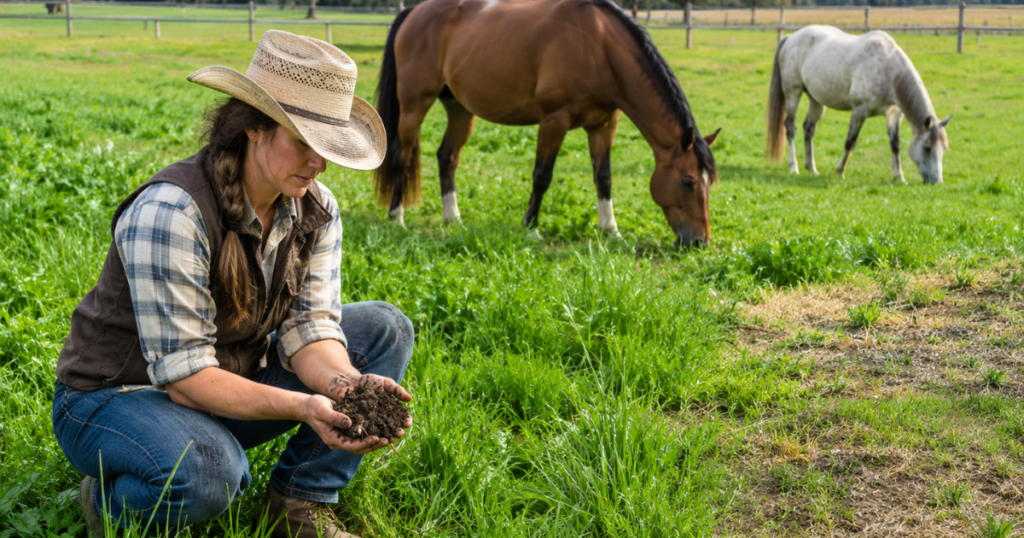
Two horse pastures can look the same from the road in May. By August, one is still green and the other is bare dirt and weeds, with horses nosing through dust for whatever is left. The difference usually starts below the surface.
The short answer: Soil quality matters for horse pastures because the soil decides how much forage your land grows, which minerals end up in that forage, and how well the grass survives grazing and hoof traffic. Healthy soil means more grazing days, lower hay bills, fewer weeds, and less risk of problems like sand colic.
Colorado adds its own challenges. CSU Extension notes that many of the state’s soils are alkaline, with a pH of 7.0 to 8.3, and naturally low in organic matter. Below, we cover what to test, the soil problems that show up most often on Colorado horse property, how to fix them, and why soil belongs on your checklist when you buy or sell.
Soil Quality for Horse Pastures: Why It Matters
Quick Summary: Pasture Soil at a Glance
- Soil sets your carrying capacity: CSU Extension reports that dryland Colorado pasture produces 300 to 2,000 pounds of usable forage per acre a year, while irrigated pasture produces 2,000 to 6,000. Soil health largely decides where your land falls in that range.
- Colorado soils run alkaline and lean: Many test at pH 7.0 to 8.3 with little organic matter, and zinc and iron are the micronutrients most often deficient.
- Selenium cuts both ways: Parts of Colorado have high-selenium soils, and selenium is more available to plants in alkaline soil. Test your forage before adding a selenium supplement.
- Overgrazing is the most common cause of damage: Grass grazed too short loses roots, bare soil invites weeds and erosion, and horses on short, sandy pasture swallow more sand.
What a Soil Test Tells You: Colorado Pasture Checklist
A standard soil test, plus a forage test for selenium, covers the measurements below.
| Test Item | What Colorado Pastures Often Show | Why It Matters for Horses |
|---|---|---|
| pH | Alkaline, often 7.0 to 8.3 | High pH locks up iron and zinc and raises selenium uptake |
| Organic matter | Naturally low | Holds water and nutrients; low levels mean thin, drought-prone grass |
| Salinity | White crusts in low spots on some sites | Salt stunts grass and thins the stand |
| Nitrogen | Varies with manure and fertilizer history | Drives grass growth and yield |
| Phosphorus and potassium | Varies; manure-heavy paddocks can run high | Support roots and stand persistence; excess phosphorus can wash into water |
| Zinc and iron | The micronutrients most often deficient in Colorado | Shortages show up as yellowed, weak grass |
| Selenium (forage test) | High in some areas, adequate or low in others | Too little or too much can both harm horses |
| Texture | Ranges from heavy clay to loose sand | Clay compacts and drains slowly; sand raises sand colic risk |
1. What Makes Pasture Soil Good for Horses?
Good horse pasture soil holds water and nutrients, lets roots and rain in, stays within a pH and salt range grasses tolerate, and is covered by dense, living grass. When those pieces are in place, the pasture recovers from grazing quickly and needs less fertilizer and less hay to back it up.
Organic Matter
Organic matter is the decomposed plant and animal material in soil. It works like a sponge, holding water through dry spells and slowly releasing nitrogen and other nutrients to grass roots. Colorado soils start low, so building and protecting organic matter is one of the most useful things a horse owner can do.
Structure and Drainage
Healthy soil has pore space between particles, which lets water soak in and roots spread. Compacted soil around gates, water tanks, and feeders loses that space. Rain runs off instead of soaking in, grass roots stay shallow, and mud lingers after storms.
Ground Cover
A dense stand of grass shades the soil, slows wind and water erosion, and crowds out weeds. Bare patches lose topsoil and organic matter every time the wind blows, which on the Colorado plains is often.
2. How Does Soil Quality Affect Your Horse's Health?
Soil affects horse health through the forage it grows, the minerals that forage carries, and the ground horses graze and stand on. Poor soil can lead to thin forage, mineral imbalances, more toxic weeds, and a higher risk of sand colic.
Forage Quantity and Quality
Rich soil grows more grass, and that grass carries more of the protein, energy, and minerals horses need. On thin soil, horses spend more time hunting for forage and you spend more on hay to fill the gap.
Selenium: Too Little or Too Much
Horses get most of their selenium from forage, and forage takes it from the soil. University of Georgia Extension lists Colorado among the states with high-selenium (seleniferous) soils, and Kentucky Equine Research notes that plants take up selenium more readily in alkaline soil.
The American Association of Equine Practitioners describes chronic selenium toxicity as hair loss from the mane and tail, cracked hooves, and lameness. Deficiency is a risk too, so the safe move is to test your hay or pasture forage before adding a selenium supplement.
Sand Colic
Horses grazing short grass on sandy soil swallow sand with their forage. Texas A&M AgriLife Extension explains that overgrazed pasture pushes horses to bite closer to the ground, which raises the amount of sand they take in. Keeping grass cover healthy and feeding hay in feeders or on mats both lower the risk.
Weeds and Toxic Plants
CSU Extension notes that overgrazed pastures fill in with broadleaf weeds and shrubs. Some, like locoweed, are dangerous to horses, and hungry horses on bare pasture are more likely to eat plants they would normally avoid.
Hooves and Mud
Compacted, poorly drained soil holds water around gates and feeders. Horses standing in mud for long stretches are more prone to hoof problems, so drainage and a well-built sacrifice area protect both the soil and the horse.
3. How Do You Test Pasture Soil in Colorado?
Send soil samples to a lab that runs tests suited to alkaline soils, such as the CSU Soil, Water and Plant Testing Laboratory at CSU Spur in Denver. The lab says results arrive within 7 to 10 business days and recommends testing once a year.
How to Take a Useful Sample
- Divide your land by use and soil. Sample each pasture, hay field, and paddock separately, and keep low wet spots apart from upland ground.
- Collect several cores from across each area and mix them in a clean bucket, following the lab's current sampling instructions for depth and amount.
- Avoid manure piles, feeders, water tanks, and fence lines, which skew results.
- Ask for a texture test the first time. The lab recommends it for first-time samples because sand, silt, and clay content shapes drainage and nutrient holding.
- Send a forage or hay sample for selenium if you are unsure about levels in your area. The CSU lab offers selenium analysis.
Check the Soil Map First
Before you sample, look up the property on the USDA Web Soil Survey. The free maps show soil types, drainage classes, and erosion risk, which helps you decide where to draw your sampling zones.
Read the Results With Help
The lab report includes recommendations, and your county CSU Extension office can help you read it. Alkaline soils need different nutrient tests than acidic ones, and CSU Extension notes that most home soil test kits are designed for acidic soils.
4. What Are the Most Common Soil Problems on Colorado Horse Property?
The soil problems that show up most on Colorado horse property are high pH, low organic matter, salt buildup, compaction, and erosion on bare ground. Overgrazing makes every one of them worse.
High pH and Micronutrient Shortages
CSU Extension explains that many Colorado soils have a pH of 7.0 to 8.3. At that level, iron is present but in a form some plants can't use, which causes yellowing. CSU also notes that many Colorado soils contain free lime, which makes lowering pH impractical. The better approach is to build organic matter and choose grasses adapted to alkaline ground.
Low Organic Matter
Colorado's dry climate breaks down plant residue slowly and grows less of it, so most soils start with little organic matter. Overgrazing and bare ground drain what little there is.
Salty Soils
CSU Extension describes white salt crusts in low spots as a common sight around the state, because limited rainfall can't leach salts away. Salt-affected areas grow thin, stunted grass and need a soil test before any amendment.
Compaction
Hooves concentrate a horse's weight on a small area. Grazing or riding on wet soil, along with heavy traffic at gates and water tanks, packs the surface and squeezes out pore space.
Erosion on Bare Ground
The Colorado plains are windy, and bare soil blows. Each storm that hits a bare paddock carries away topsoil, which is the layer holding most of the organic matter and nutrients.
5. How Does Grazing Management Protect Your Soil?
Grazing management protects soil by keeping enough leaf and root on the grass that it can regrow and keep the ground covered. In practice that means waiting for grass to grow before turnout, removing horses before the grass is grazed short, and resting each pasture long enough to recover.
Wait for Growth in Spring
CSU Extension recommends keeping animals off pasture in spring until grasses are four to six inches tall. Early grazing on short spring grass weakens roots for the rest of the season.
Take Half, Leave Half
CSU's rule of thumb is to let horses graze about half the available forage and leave the rest. The leaves left behind feed the roots, shade the soil, and keep weeds from moving in.
Rotate and Rest
Divide pasture into smaller sections and move horses between them. CSU's dryland pasture assessment guide notes that Colorado dryland pastures typically need more than 30 days to regrow after grazing.
Use a Sacrifice Area
A sacrifice area, or dry lot, is where horses stay when pastures are wet, resting, or too short to graze. CSU recommends 400 to 500 square feet per horse, located on dry ground where runoff won't reach a well, stream, or other water. It gives up one small area so the rest of the pasture stays healthy.
Stay Off Wet Ground
Keep horses and vehicles off pasture when the soil is saturated. Wet soil compacts far more easily, and hoof prints in mud become ruts and bare spots once it dries.
6. Should You Fertilize, Spread Manure, or Reseed?
Fertilize only what a soil test says is missing, compost manure before you spread it, and reseed only after you've fixed the grazing that thinned the stand. Doing these in the wrong order wastes money and can make weeds worse.
Fertilize by the Test
CSU Extension advises fertilizing pasture only as needed and warns that over-applying nutrients tends to favor invasive weeds over perennial grasses. Grazed pastures need fewer nutrients than hay fields, because much of what horses eat returns as manure.
Turn Manure Into Compost
CSU Extension in Adams County estimates that an average 1,000-pound horse produces about 50 pounds of manure a day, or roughly 9 tons a year. That is a lot of free fertilizer and organic matter if you handle it well.
University of Minnesota Extension notes that good composting kills weed seeds and fly larvae, and it advises against spreading manure on pastures stocked at more than one horse per two acres. Spread finished compost thinly, ideally when horses are rotated off that pasture.
Reseed With Adapted Grasses
When a pasture is too weedy or thin to recover on its own, CSU recommends reseeding with a mix of grasses suited to your soil, water, and goals. Your county Extension office can suggest varieties that tolerate Colorado's alkaline soils and dry summers. Keep horses off new seedings until the plants are well rooted.
Manage Irrigation Water
If you have irrigation rights, use them on a schedule that keeps the root zone moist without leaving standing water. Over-watering on poorly drained ground can raise salts toward the surface.
7. Why Does Soil Quality Matter When You Buy or Sell?
Soil quality decides how many horses a property can carry and how much it costs to keep them, which is a large part of what horse buyers pay for. A property with healthy, productive pasture usually shows better, appraises with fewer questions, and saves the next owner years of rebuilding.
For Buyers: What to Check Before You Commit
- Walk every pasture. Look for bare ground, weeds, salt crusts, ruts, and standing water.
- Ask the seller for past soil tests, fertilizer records, and grazing history.
- Look up the parcel on the USDA Web Soil Survey to see soil types and drainage.
- Confirm any irrigation water rights convey with the property, since water often matters more than soil for forage. See Do Horse Properties Appreciate Like Regular Homes? for how water rights affect value.
- Order your own soil test during the inspection period if the pasture is central to your plans.
For Sellers: Prepare the Pasture Early
Pasture repair takes at least a full growing season, so start a year before you list. Test the soil, rest overgrazed areas, control weeds, and keep horses in a sacrifice area during wet spells. A green, even stand photographs better and backs up the carrying capacity you advertise.
If you're weighing what pasture improvements are worth against their cost, our guide on how to calculate ROI on a working ranch walks through the numbers.
We Know Colorado Horse Land From the Ground Up
A horse property is only as good as the land under it. Judging that land means looking past the house and barn to the pasture, the soil, and the water that keeps it growing.
When Mark Eibner's team represents you, we walk the pastures with you, pull soil survey and water rights records, and help you judge how many horses the land can realistically carry. When you sell, we help you prepare and present your pasture so buyers see its full value.
Contact us today at coloradohorseproperty.com to find premium horse properties Colorado buyers trust.
Browse active Colorado horse ranches for sale or search by location with our Search by County and Search by City tools.
About the Author
Mark Eibner is broker/owner of Realty Oasis and leads Team Eibner with MB Metro Brokers. His team represents buyers and sellers of horse and acreage property across the Denver metro and Colorado Front Range.
Frequently Asked Questions (FAQ) About Soil Quality for Horse Pastures
Why does soil quality matter for horse pastures?
Soil quality decides how much forage a pasture grows, which minerals that forage contains, and how fast grass recovers after grazing. Healthy soil supports more grazing days per acre and lowers hay costs. Poor soil leads to thin grass, weeds, mineral imbalances, and more bare ground, which raises the risk of sand colic.
How often should I test my pasture soil?
The CSU Soil, Water and Plant Testing Laboratory calls once a year good practice. At a minimum, test before you fertilize, before you reseed, and when you buy a property. Sample each pasture separately, and add a texture test the first time.
What soil pH is best for a horse pasture in Colorado?
Most pasture grasses grow well near neutral pH, but many Colorado soils test between 7.0 and 8.3. CSU Extension notes that lowering pH in soils with free lime is impractical, so focus on building organic matter, correcting nutrient shortages a soil test finds, and planting grasses adapted to alkaline soil.
Can poor soil make my horse sick?
It can contribute. Seleniferous soils in parts of Colorado can produce forage high enough in selenium to cause chronic toxicity, while other areas run low. Overgrazed, sandy pasture raises the risk of sand colic, and bare pasture invites toxic weeds. Test your forage and keep grass cover healthy.
Should I spread horse manure on my pasture?
Yes, if you compost it first and spread it based on a soil test. Composting kills weed seeds and fly larvae. University of Minnesota Extension advises against spreading manure on pastures stocked at more than one horse per two acres, and fresh manure should not go on pasture horses are actively grazing.
How do I fix an overgrazed horse pasture?
Move horses to a sacrifice area, rest the pasture until grasses reach four to six inches, and control weeds. Test the soil and correct what it shows. If the stand is too thin to recover, reseed with adapted grasses, then return horses with a rotation that leaves about half the forage after each grazing.
Sources
- University of Georgia Extension: Selenium in soils and forage
- Kentucky Equine Research: Selenium in forage
- American Association of Equine Practitioners: Selenium in the equine diet
- Texas A&M AgriLife Extension: Equine care on sandy pastures
- CSU Soil, Water and Plant Testing Laboratory
- USDA Web Soil Survey
- CSU Extension: Soil pH
- CSU Extension: Saline soils
- CSU Extension: Estimating pasture carrying capacity
- CSU Extension: Pasture condition assessment
- CSU Extension in Adams County: Managing manure and mud
- University of Minnesota Extension: Managing and composting horse manure