
What if the “direct access” mentioned in a real estate listing is actually a legal dead end blocked by a neighbor’s private gate? Many buyers searching for properties near national forest access Colorado assume that bordering federal land automatically guarantees a gateway to the wilderness. However, without a verified deeded easement or a specific Forest Service access point, you might still find yourself loading the trailer just to reach the trail. You deserve a property that delivers on its promise of freedom and expansive space without the headache of boundary disputes.
It’s understandable why you’re prioritizing this niche. With rural land valuations up 12.4 percent since January 2024, securing a “ride-out” lifestyle is as much about investment security as it is about personal passion. This 2026 guide will show you exactly how to interpret USFS regulations and verify permanent access rights before you close the deal. We’ll explore how to identify legitimate boundaries, evaluate water rights under current 2026 regulations, and ensure your connection to millions of acres of trails is legally protected for the long term.
Key Takeaways
- Learn the vital distinction between physical proximity and legal, deeded access to ensure your “ride-out” lifestyle is permanent and protected.
- Discover how to use plat maps and Forest Service records to verify legitimate entry points for properties near national forest access Colorado.
- Identify the infrastructure essentials for mountain acreage, including trailer turn-around space and Wildland-Urban Interface (WUI) safety protocols.
- Compare top-tier regions like Pike and San Isabel National Forests to find the right balance between tech-center proximity and “Old West” affordability.
- See how AI-powered search technology identifies specialized listings with verified wilderness boundaries that standard real estate platforms often miss.
Understanding Properties Near National Forest Access in Colorado
National forest access is defined as the legal and physical ability to enter United States Forest Service (USFS) land directly from your private property line. While many listings claim to be “close” to nature, true access means you don’t need a vehicle or a trailer to reach the trail system. In the 2026 Colorado real estate market, properties that actually adjoin federal land carry a significant price premium over those that are merely nearby. This distinction is critical for equestrian owners who value the “ride-out” lifestyle and for investors looking for long term asset security.
Colorado is home to several massive public land tracts, including the National Forests in Colorado such as the Pike, San Isabel, Arapaho, Roosevelt, and White River. Each forest offers a different terrain and climate, but they all share one common trait: a strictly defined boundary. Owning properties near national forest access Colorado allows you to treat millions of acres as your extended backyard, provided you understand the legalities of the boundary line. Bordering a forest doesn’t grant you the right to clear trees, build structures, or create new unauthorized trails on public land. You are a neighbor to the federal government, and that relationship requires adherence to USFS regulations.
To better understand this concept, watch this helpful video showing a rare large acreage property that borders federal land:
The Distinction Between Proximity and Deeded Access
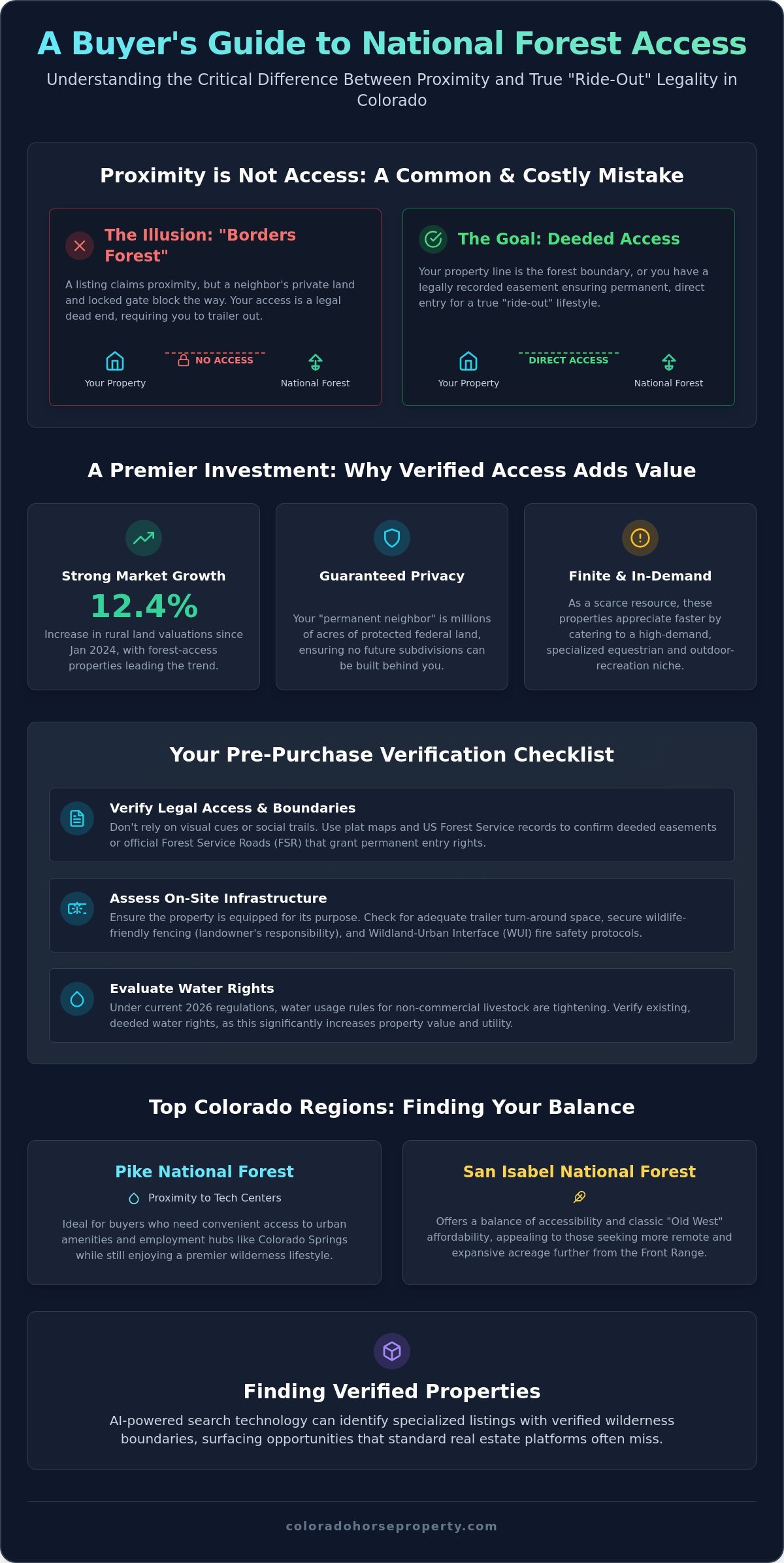
Proximity is often a marketing term. A property might be half a mile from a forest boundary, but if that half mile is owned by a private neighbor with a “No Trespassing” sign, you are effectively miles away. You’ll still be hauling your trailer to a public trailhead. True access often involves a deeded easement or a location where the property line is the forest boundary. Don’t rely on informal social trails. The Forest Service can, and often does, close non-system trails to protect wildlife or prevent erosion. Only a legal gate or a verified easement ensures your ride-out utility remains permanent.
Why National Forest Proximity is a Top Tier Investment
Private land bordering federal boundaries is a finite resource in the Rocky Mountains. As development continues along the Front Range, these border properties become increasingly scarce. One of the greatest benefits is the “permanent neighbor” factor. When you border a National Forest, you’re guaranteed that a high density subdivision won’t appear behind your barn. This privacy, combined with the 12.4 percent rise in rural land valuations seen since early 2024, makes these properties a resilient investment. Historical data shows that horse properties with verified forest access appreciate faster than standard residential lots because they cater to a high demand, specialized niche.
Legal and Regulatory Considerations for Bordering Federal Land
Securing properties near national forest access Colorado requires more than a visual check of the fence line. You must verify that your right to enter the forest is legally recorded. In many cases, a property might adjoin the forest physically, but a steep drainage or protected habitat makes direct entry impossible. This is where reading a plat map becomes essential. Look for dedicated Forest Service Roads (FSR) or historic trail easements. These documents reveal whether your path to the wilderness is a permanent right or a temporary privilege.
The USFS typically doesn’t maintain boundary fences for private livestock. If your horses roam onto federal land, you could face fines for unauthorized grazing. Maintaining a secure, wildlife friendly perimeter is the landowner’s responsibility. The 2026 Colorado land use updates have also intensified the focus on water rights near these boundaries. New regulations like SB25-104 have tightened usage for non-commercial livestock in certain basins, making properties with existing, deeded water rights even more valuable.
Easements and Right-of-Way Realities
There is a major difference between an express easement and a prescriptive one. An express easement is written into your deed. A prescriptive easement is claimed based on years of open use. Don’t rely on the latter. A neighbor’s new gate can legally block your “shortcut” to the forest overnight if you don’t have a deeded right. Working with a specialized title company is the only way to uncover these hidden restrictions. Our team provides expert buyer representation to ensure your trail access is ironclad.
USFS Regulations Every Homeowner Should Know
Encroachment is a zero-tolerance issue for the Forest Service. Even a small tool shed or a garden bed placed inches over the boundary line can result in mandatory removal orders and legal fees. You must also adhere to strict fire mitigation standards. Creating “defensible space” isn’t just a safety recommendation; it’s often a requirement for obtaining property insurance in 2026. If you plan on hosting group rides or commercial outfitting, you’ll need to review specific guidelines for Equestrian Management in National Forests. These permits are separate from your property rights and are managed directly by the local ranger district.
Equestrian Management Near Colorado Public Lands
Managing properties near national forest access Colorado requires a proactive approach to land stewardship. You aren’t just buying a home; you’re operating in the Wildland-Urban Interface (WUI). This zone demands a higher level of livestock safety and fire mitigation. Your property’s layout should account for the terrain, ensuring that your barn and turnout areas aren’t just functional, but also defensible against the risks inherent to mountain living.
Infrastructure needs are more complex on the forest edge. Mountain acreage often lacks the flat expanse of the plains. You must ensure there is adequate trailer parking and turn-around space for your rigs. A standard 3-horse gooseneck requires a significant turning radius to maneuver safely on steep or narrow driveways. Without this space, you’ll find yourself struggling with multi-point turns on soft shoulders, which is both dangerous and hard on your equipment.
Environmental responsibility is another critical factor. The USFS mandates the use of certified weed-free hay to prevent invasive species from spreading into the National Forest. When you ride out from your back gate, your horse can inadvertently carry seeds into protected areas. Storing and using weed-free forage protects the very trails you love. Finding a legitimate horse property for sale in Colorado requires a specific forest-access evaluation. This looks at the physical boundary, the legal easement, and the terrain between your arena and the trailhead.
Trail Access and Terrain Suitability
Evaluate the grade of the slope between your barn and the forest boundary. A 10 percent grade is manageable for most riders, but anything steeper requires conditioned horses and careful footing management. Soil types matter too. Decomposed granite provides excellent drainage but can be abrasive. If your local forest trails are rocky, your horses may require specialized shoeing or boots to prevent stone bruises. Consider seasonal access as well. North-facing trails often hold ice and deep snow through May, while south-facing slopes offer year-round riding opportunities.
Livestock Security and Wildlife Interaction
Living on the forest edge means sharing space with mountain lions, bears, and wolves. Standard horse fencing might keep your animals in, but it won’t necessarily keep predators out. Consider reinforced perimeter fencing and secure stalls for nighttime safety. Manage wildlife attractants by storing grain in bear-proof containers and keeping hay under cover. Remember that bordering a forest doesn’t grant grazing rights. USFS grazing allotments are separate legal entities. Private use of public grass for your livestock is strictly prohibited without a specific permit from the forest ranger district.
Top Colorado Regions for National Forest Horse Properties
Colorado’s geography offers diverse opportunities for buyers seeking properties near national forest access Colorado. Each forest region provides a distinct climate, terrain, and lifestyle. Pike National Forest, covering Douglas and Teller Counties, remains the top choice for Front Range commuters. It allows owners to maintain professional ties in Denver or Colorado Springs while enjoying a “ride-out” lifestyle just minutes from their back door. San Isabel National Forest, particularly in Custer and Fremont Counties, caters to those seeking an “Old West” feel with more affordable acreage. The Sangre de Cristo Mountains provide a dramatic backdrop for ranching communities that have remained largely unchanged for decades.
For those prioritizing high altitude summer retreats, the Arapaho National Forest in Grand County is a premier destination. These properties offer cooler temperatures and lush alpine meadows. On the Western Slope, the White River National Forest in Eagle and Pitkin Counties is the epicenter of luxury equestrian estates. This region features world class trail systems and sophisticated infrastructure, though it comes with a higher entry price. Regardless of the region, the 12.4 percent rise in rural land valuations since early 2024 proves that these forest-adjacent locations are resilient investments.
Front Range vs. Western Slope Access
Choosing between these regions involves balancing convenience with seclusion. Front Range properties offer shorter commute times but face higher competition. In 2026, residential property taxes are assessed at 7.05 percent for schools and 6.8 percent for local governments, so budget for these carrying costs. You’ll find a wider variety of colorado ranches for sale on the Western Slope, where larger tracts of land are still available. These areas offer the total seclusion that many wilderness seekers crave, often located miles from the nearest paved road.
Water Rights and Resource Management by Region
Your proximity to the forest boundary affects more than just your view; it dictates your water security. Wells near federal land are often classified as tributary, meaning they’re legally linked to surface streams and may have stricter usage limits. You should also look for “in-holdings,” which are rare private parcels entirely surrounded by National Forest land. These pockets offer unparalleled privacy but require careful planning for hay delivery and emergency access. Regional hay availability varies significantly, so connect with local equestrian communities to secure reliable forage sources before winter arrives.
Ready to find your own piece of the Colorado wilderness? Use our AI-powered horse property search to filter listings by verified forest access and regional specifications.
Finding Your Wilderness Legacy with Colorado Horse Property
Locating properties near national forest access Colorado requires more than just browsing standard MLS feeds. These specific listings are often miscategorized or lack the detailed boundary data needed to confirm legitimate access. We bridge this gap by combining 40 years of equestrian real estate Colorado expertise with cutting-edge technology. Our team understands that “bordering” is a physical fact, but “access” is a legal right. We specialize in identifying properties where those two elements intersect perfectly, ensuring your investment is as secure as it is beautiful.
The complexity of mountain real estate means that a generalist agent might miss the nuances of USFS boundary regulations or deeded trail easements. We act as your seasoned, no-nonsense experts to navigate these hurdles. By focusing exclusively on this niche, we’ve developed a deep understanding of the unique requirements for land and livestock owners. We don’t just show you a house; we evaluate the entire acreage for its long term utility and lifestyle potential.
AI-Driven Search: The Modern Way to Find Land
Our proprietary AI-powered horse property search is designed to filter for these rare assets with surgical precision. Instead of manually sifting through thousands of irrelevant listings, you can simultaneously filter for “Bordering National Forest” and specific horse facilities like indoor arenas or loafing sheds. We use integrated satellite data to verify physical trail connectivity before you even schedule a showing. This prevents the frustration of visiting a property only to find a cliff or a neighbor’s fence blocking the forest gate. You can also set custom alerts for specific forest zones, ensuring you’re the first to know when new properties near national forest access Colorado hit the market.
Working with a specialized horse real estate for sale expert is non-negotiable when dealing with federal boundaries. The risks of encroachment or easement disputes are too high to leave to a generalist. We provide comprehensive buyer representation that includes a rigorous verification process. We examine plat maps, historical deeds, and USFS records to ensure your trail access is permanent and protected. This level of due diligence is what has made us a niche authority in the Rocky Mountain region.
Expert Representation from Contract to Closing
Our support continues through the entire transaction management phase. We negotiate specific contingencies for mountain-specific needs, such as water well production tests and professional boundary surveys. We also coordinate with title and escrow partners who specialize in agricultural and rural land. This ensures that every legal detail, from grazing rights to mineral interests, is handled correctly. Join the ranks of owners who have successfully secured their colorado land through Realty Oasis. We help you move past the confusion of boundary regulations and into the ride-out lifestyle you’ve worked for.
Securing Your Colorado Wilderness Legacy
Securing a home bordering federal land is the ultimate way to guarantee a permanent connection to the Colorado backcountry. Success in this niche market depends on verifying deeded easements and ensuring the mountain terrain supports your specific livestock and infrastructure needs. A true wilderness legacy isn’t just about the view; it’s about the legal and functional gateway to the trails that only a verified boundary provides.
Navigating the complexities of properties near national forest access Colorado requires the guidance of seasoned experts. Led by industry veterans Mark and Alison Eibner, our team leverages over 40 years of specialized experience to protect your interests. We use proprietary AI search technology to identify listings with verified forest connectivity and equestrian features that standard platforms often miss. We handle the technical details of boundary verification and easement research so you can focus on the lifestyle you’ve earned.
Start Your AI-Powered Search for Colorado Forest Properties and secure your piece of the Rocky Mountains today. Your ride-out lifestyle is within reach.
Frequently Asked Questions
Is it more expensive to buy property bordering a National Forest in Colorado?
Yes, bordering properties generally carry a higher price point due to their extreme scarcity and permanent privacy. In the 2026 market, rural land valuations have risen by 12.4 percent since early 2024, with forest-adjacent parcels leading this growth. Buyers pay a premium for the ride-out lifestyle that eliminates the need for trailers. This direct access is a finite asset that typically appreciates faster than standard residential lots in the same county.
Can I build my own private trail from my property into the National Forest?
No, you cannot legally construct or clear new trails on federal land without specific United States Forest Service authorization. Bordering the forest doesn’t grant you ownership or development rights beyond your private property line. Unauthorized clearing or construction is considered encroachment and can lead to federal fines and mandatory restoration costs. You must use existing system trails or verified access points identified on official Forest Service maps.
Do I need special permits to ride my horse in the National Forest?
Private individuals generally don’t need a permit for recreational horseback riding on most USFS trails. However, you must adhere to specific rules like using weed-free hay and staying on designated system trails. If you plan to host commercial outfitting trips or large organized group rides from your property, the Forest Service requires a Special Use Permit. Always check with your local ranger district for seasonal closures or specific regional restrictions.
What is the “Wildland-Urban Interface” and how does it affect my insurance?
The Wildland-Urban Interface (WUI) is the transition zone between human development and unoccupied wildland. For properties near national forest access Colorado, being in the WUI significantly impacts insurance premiums and availability in 2026. Insurers often require strict fire mitigation, such as 30 to 100 feet of defensible space around structures. Failing to meet these vegetation management standards can lead to policy cancellations or high-risk pool pricing.
How do I verify if a property has a legal easement to reach public land?
You must review the recorded deed and the county plat map to confirm a legal easement. Don’t rely on visual gates or social trails used by previous owners. A legal easement is a written right that stays with the land, whereas informal access can be blocked by a neighbor at any time. We recommend working with specialized title companies to perform a detailed search for any ingress or egress rights before making an offer.
Are there restrictions on grazing my horses on National Forest land?
Yes, your horses cannot graze on National Forest land without a specific grazing allotment permit. Bordering the forest doesn’t allow you to turn your livestock out onto public grass. The USFS manages these allotments strictly to prevent overgrazing and protect native ecosystems. If your horses wander onto federal land, you may be liable for unauthorized use fines. Always ensure your perimeter fencing is secure and well-maintained to prevent trespassing livestock.
What happens if the Forest Service closes the trail access behind my house?
The Forest Service maintains the right to close trails or access points for wildlife protection, fire recovery, or resource management. Unless you have a specific, deeded private easement that guarantees access, your entry depends on the current USFS travel management plan. These plans are updated periodically, and social trails are often the first to be decommissioned. This is why verifying system trail connectivity for properties near national forest access Colorado is vital during your due diligence.
How does bordering a National Forest affect my property taxes in Colorado?
Bordering a forest doesn’t trigger a special tax, but it increases the property’s actual value, which is the basis for your assessment. For the 2026 tax year, Colorado residential property is assessed at 7.05 percent for schools and 6.8 percent for local governments. Because forest-bordering land is highly valued, your total tax bill will likely be higher than a similar home on a standard lot. However, the 10 percent value reduction, up to $70,000, still applies to your assessed value.