
In Colorado, you aren’t just buying land; you’re buying a legal decree to water. The long-term value of any horse property with irrigated pasture for sale CO is directly tied to the seniority of that right. You likely already understand that supplemental hay costs are rising and that a “dry” property is a liability rather than an asset. It’s exhausting to evaluate a beautiful estate while worrying if the water rights will actually hold up when the 2026 Colorado River operating guidelines expire at the end of the year.
This guide will show you how to master the complexities of Colorado water law and irrigation infrastructure. You’ll learn how to identify high-value equestrian estates that sustain your horses year-round and protect your investment. We’ll break down the Prior Appropriation system, explain how to verify senior rights, and detail the maintenance requirements for a truly sustainable legacy ranch.
Key Takeaways
- Learn why the “Prior Appropriation” doctrine makes the seniority of a water right the most critical factor in your land’s long term value.
- Discover how to use AI Powered Search tools to find a horse property with irrigated pasture for sale CO that meets your specific grazing and infrastructure requirements.
- Identify the physical signs of reliable irrigation, including headgates and pipes, to assess the labor and maintenance costs of a potential estate.
- Understand how irrigated acreage increases your land’s carrying capacity, allowing for sustainable year round grazing with less reliance on supplemental hay.
- Master the “7,000 Foot Rule” to evaluate how elevation and local microclimates will impact the length of your growing season in the Rockies.
The Value of Irrigated Pasture for Colorado Horse Properties
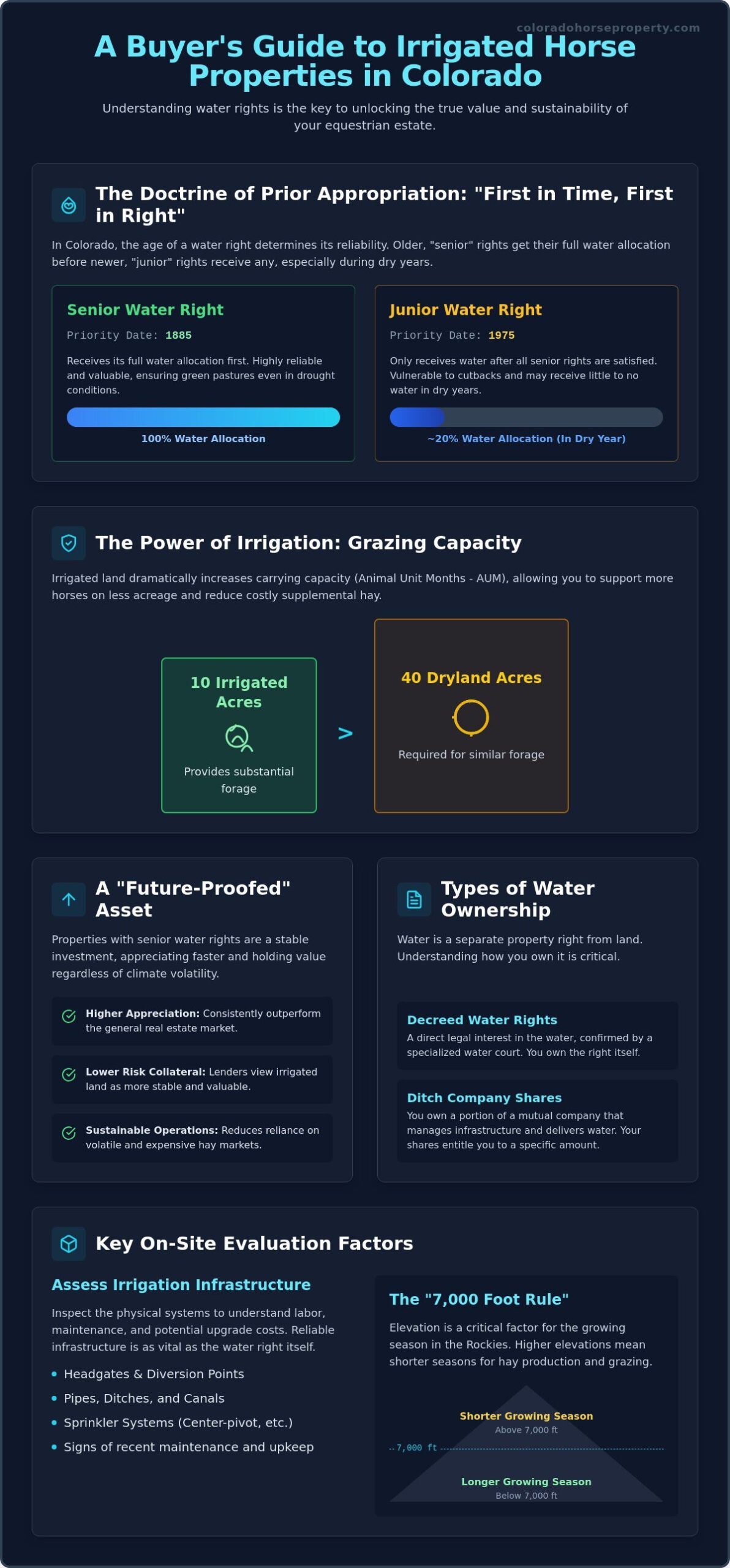
In Colorado’s semi-arid climate, the distinction between a lush field and a dusty lot is almost always a matter of legal paperwork. An irrigated pasture isn’t just a field that receives occasional rain; it’s land with decreed rights to surface or well water specifically for crop and grass growth. When you search for a horse property with irrigated pasture for sale CO, you’re looking for a resource that fundamentally transforms the utility of the acreage. These rights are governed by Colorado’s prior appropriation doctrine, which ensures that those with older rights get their water first during drought years.
To see how these elements come together on a premium estate, watch this walkthrough of a high-value Colorado property:
Beyond the legalities, the practical benefits are immediate. Irrigated land provides superior dust control for arenas and paddocks, which is vital for equine respiratory health. It also acts as a natural fire break and maintains the vibrant aesthetics that define a legacy ranch. In a state where water is the most precious commodity, these properties stand out as functional, sustainable environments for livestock.
Grazing Capacity vs. Dryland Acreage
Stocking densities in Colorado vary wildly based on water access. We measure this through Animal Unit Months (AUM), which represents the amount of forage needed by one horse for one month. In many Front Range zones, 10 irrigated acres can easily provide more forage than 40 acres of dryland range. This efficiency allows you to maintain a larger herd on a smaller physical footprint. It also reduces your reliance on the volatile hay market. With the cost of supplemental hay often spiking during dry years, having the ability to grow your own forage on-site provides a critical buffer for your annual operating budget.
Impact on Property Resale and Appreciation
Water-rich properties consistently outperform the general real estate market in terms of long-term appreciation. Because Colorado has approximately 30 million acres of farmland, and competition for water between municipal and agricultural users is intensifying, land with senior water rights is a “future-proofed” asset. Lenders recognize this stability. They often view irrigated agricultural land as lower-risk collateral because its productive capacity remains high even when regional rainfall fails. Investing in a horse property with irrigated pasture for sale CO isn’t just a lifestyle choice; it’s a strategic move to secure a property that will retain its value regardless of climate volatility.
Navigating Colorado Water Rights: Seniority and Ditch Shares
Understanding the legal structure of water is as important as inspecting the barn or the fencing. In Colorado, water is a separate property right that can be sold independently from the land. This is why a thorough investigation of Colorado water rights is mandatory during your due diligence period. The state operates under the Doctrine of Prior Appropriation. It’s a “first in time, first in right” system. This means the owner with the oldest permit gets their full allocation before anyone with a newer permit receives a single drop.
You’ll encounter two primary types of water ownership. Decreed water rights are direct legal interests confirmed by a specialized water court. Ditch Company shares are different. When you own ditch shares, you own a portion of a mutual company that manages the water delivery infrastructure. You don’t own the water itself; you own the right to have a specific amount delivered to your headgate based on the number of shares you hold. If you’re looking at a horse property with irrigated pasture for sale CO, you must know where your right sits in the priority line. A junior right might be useless in late July if the river levels drop and the state engineer shuts off junior users to satisfy senior calls.
Understanding Senior vs. Junior Rights
Priority dates are everything. A right decreed in 1885 is significantly more valuable than one from 1975. During dry years, junior holders often watch their pastures turn brown while their neighbors stay green. With the 2026 Colorado River operating guidelines set to expire at the end of the year, legal certainty is more important than ever. You must also prove “beneficial use” to maintain your right. If you don’t use your water for an extended period, you risk losing it under the state’s “use it or lose it” policy. To find properties with established water histories, you can use our AI-powered horse property search to filter for specific water assets.
The Role of Ditch Companies
Ditch companies charge annual assessments to cover the costs of ditch riders, maintenance, and administration. You’ll need to review the company’s financial health and bylaws before closing. Delivery is usually handled on a strict rotation. You can’t simply turn on the water whenever you want; you must wait for your scheduled “turn.” It’s also vital to locate the headgate. This is the physical point where the ditch water enters your property. If the headgate is in poor repair or located miles away, your delivery could be unreliable regardless of how many shares you own.
Evaluating Irrigation Infrastructure: From Flood to Sprinklers
Having the legal right to water is only half the battle. You must also evaluate the physical hardware that delivers that water to your horses’ grazing ground. When touring a horse property with irrigated pasture for sale CO, look beyond the barn and the fencing. Inspect the headgates, valves, and distribution pipes. These physical assets determine how much time you’ll spend in the field and how effectively your grass grows. A property might have senior rights, but if the delivery system is crumbling, those rights won’t keep your pastures green.
Colorado’s low humidity means evaporation is a constant threat. Systems that lose water to the air before it reaches the roots are less effective during the peak of summer. You should also assess the power requirements of the property. Pressurized systems like sprinklers require robust electrical service and reliable pump stations. A failed pump in the middle of a July heatwave can ruin a season’s growth in just a few days. Always ask for maintenance records for any pumps or pivots included in the sale.
Flood Irrigation and Ditch Maintenance
Flood irrigation is common on many older Colorado ranches. It’s often favored because it relies on gravity rather than expensive electricity. However, it’s incredibly labor-intensive. You’ll spend your mornings moving gated pipe or adjusting canvas dams to direct the flow across the field. You must also manage tailwater, which is the excess water that runs off the end of the pasture. Without proper drainage, this water pools and creates boggy spots. These areas are not only useless for grazing but can also lead to hoof issues or mosquito breeding grounds. Successful irrigated pasture management requires an annual ritual of cleaning ditches and clearing silt to ensure the water actually reaches your headgate.
Modern Sprinkler Systems: Pivots and Side-Rolls
Modern pressurized systems provide a much more uniform application of water. This leads to consistent forage quality across the entire acreage. Center pivots are the gold standard for efficiency, though they usually require large, circular fields that don’t always fit smaller horse properties. For estates under 40 acres, side-rolls (or wheel lines) are a more practical choice. They are easier to maneuver around outbuildings and smaller paddocks. While upgrading from flood to sprinkler is a significant capital investment, it often pays for itself. You’ll save hours of manual labor and likely see an increase in your land’s carrying capacity. When evaluating a horse property with irrigated pasture for sale CO, a functional sprinkler system represents a massive advantage in both property value and daily lifestyle.
Site Selection: Elevation, Soil, and Seasonal Grazing
Location dictates your management schedule as much as the water rights themselves. When you’re evaluating a horse property with irrigated pasture for sale CO, the elevation of the land is your most restrictive variable. The 7,000-foot rule is a standard benchmark across the Rockies. Properties sitting above this line typically face a significantly shorter growing season, often limited to the window between May and November. Below this elevation, you’ll benefit from more Growing Degree Days, which can allow for multiple hay cuttings or an extra month of high-quality grazing.
Microclimates also play a major role in your property’s productivity. One valley might stay green weeks longer than the next due to wind patterns, solar orientation, or proximity to a river corridor. You must also account for the freeze-thaw cycle. In Colorado, irrigation infrastructure is vulnerable to extreme temperature swings. If the previous owner didn’t properly winterize the pump stations or blow out the lines, you could inherit a system riddled with underground leaks. To begin your search for land that fits your specific elevation and climate needs, explore our listings of Colorado horse properties.
Elevation and Growing Degree Days
The “frost-free” window varies dramatically between counties. In high-altitude areas, you need specific pasture grass varieties like Timothy or certain Orchard grass cultivars that can thrive in shorter windows. These varieties are bred to maximize growth during the intense, high-UV summer days. If you’re looking at property in the high country, your wintering strategy must be more robust. You’ll likely rely on stored hay for six months of the year, even with a senior water right, because the grass simply goes dormant once the ground freezes.
Soil Health and Drainage
Irrigated land requires specialized mineral management. Constant water application can leach nitrogen or lead to phosphorus imbalances over time. You should identify whether the land consists of heavy clay or sandy loam. Clay retains water longer but is highly susceptible to compaction. If horses graze on wet clay, their hooves act like a rototiller, destroying the root structure of the grass. We recommend implementing strict cross-fencing strategies. By rotating horses between smaller paddocks, you protect the soil health and prevent the “pugging” that turns a premium irrigated pasture into a muddy mess. Sandy loam drains better but requires more frequent, shorter irrigation cycles to keep the forage from drying out in Colorado’s thin air.
Finding Your Horse Property with AI-Powered Search
Standard search platforms are designed for zip codes and bedroom counts. They are fundamentally ill-equipped to handle the data required for a successful agricultural purchase. When you’re looking for a horse property with irrigated pasture for sale CO, you’re looking for a specific legal and physical profile that most websites simply can’t index. Our specialized search tools bridge this gap by scanning thousands of data points within listing descriptions that standard platforms ignore. This technology saves you hundreds of hours of manual research by surfacing the technical details that matter most to horse owners.
Leveraging Specialty Search Tools
Most general real estate sites don’t have a specific checkbox for “Senior Water Rights” or “Ditch Company Assessments.” Our Colorado Horse Property AI search identifies these assets by analyzing the language used by listing agents and cross-referencing public records. You can set highly specific alerts for new inventory that features the exact infrastructure you need. This includes searching for properties with:
- Decreed surface water rights with specific priority dates.
- Mutual ditch company shares and established delivery schedules.
- Functional irrigation hardware like pivots, side-rolls, or gated pipe.
- Dedicated equestrian improvements such as indoor arenas or specialized footing.
Expert Representation for Ranch Buyers
Once the AI identifies a potential estate, the technical evaluation begins. Agricultural transactions involve complex contracts that differ significantly from residential sales. Alison and Mark Eibner bring decades of specialized experience to these negotiations. They understand how to read a water decree and how to coordinate with ditch riders to verify actual delivery capacity. Through Realty Oasis, they provide comprehensive transaction management. This includes specialized title and escrow services tailored for land that includes water assets and agricultural easements. They ensure that the water you think you’re buying is the water that actually reaches the headgate.
Securing a legacy property in Colorado’s competitive 2026 market requires a partner who understands both the law and the land. You can learn more about our specific process by reading about Expert Buyer Representation for Your Colorado Property. Don’t wait until the peak of summer to begin your search. The most valuable properties often hit the market just before the irrigation season begins. The next step is to move beyond the screen. Schedule a tour to inspect the physical infrastructure and start the water right verification process before the seasonal window closes.
Secure Your Colorado Equestrian Legacy
Securing a high-value ranch in the Rockies is a long-term investment in both lifestyle and resource security. You now understand that a successful purchase requires more than just a beautiful view. It demands a deep dive into the seniority of water decrees, a physical audit of irrigation hardware, and a clear awareness of how elevation impacts your grazing season. Verifying these technical details before you close is the only way to protect yourself from buying a property that cannot support your herd during dry cycles.
Our team brings over 40 years of experience in Colorado real estate to your search. As a specialized division of Realty Oasis, we use proprietary AI-powered niche search technology to identify the specific water assets and infrastructure that general platforms often miss. We don’t just find listings; we help you navigate the complexities of agricultural contracts and water law to ensure your investment is sound.
Search Colorado Horse Properties with Irrigated Pasture Now to find a horse property with irrigated pasture for sale CO that sustains your horses year-round. Your dream of a sustainable, green ranch in the West is within reach when you have the right data and expert representation behind you.
Frequently Asked Questions
How do I know if a horse property’s water rights are senior or junior?
You determine seniority by checking the priority date listed on the water decree or ditch certificate. In Colorado’s “first in time, first in right” system, a senior right is one with an older appropriation date, often dating back to the late 1800s. You should verify these records through the Colorado Division of Water Resources (DWR) or a water attorney. Senior holders receive their full allocation before junior holders receive any water during a call.
What is a ditch share and how much does it cost annually?
A ditch share represents a portion of ownership in a mutual ditch company that manages water delivery infrastructure. Owners pay annual assessments to cover the salary of ditch riders, maintenance, and administrative costs. While fees vary significantly between companies, they are mandatory for continued water delivery. You should review the specific company’s bylaws and financial health during your inspection period to understand the exact annual obligation for that property.
Can I use domestic well water to irrigate a large horse pasture in Colorado?
No, a standard household-use-only well permit does not allow for large-scale pasture irrigation. These permits typically restrict water usage to indoor domestic purposes and sometimes a small garden or watering of domestic animals. To irrigate a significant horse property with irrigated pasture for sale CO, you need a decreed irrigation right or a specific “domestic and livestock” well permit that explicitly allows for acreage irrigation.
How many acres of irrigated pasture do I need per horse in CO?
You generally need one to two acres of well-managed irrigated pasture per horse to provide adequate forage. This estimate varies based on your specific elevation, soil quality, and grazing management practices. Irrigated land supports much higher stocking densities than dryland, where you might need 30 to 40 acres per animal. Proper cross-fencing and rest periods are essential to maintain the grass health and prevent overgrazing on these productive acres.
What is the difference between flood irrigation and a sprinkler system for horses?
Flood irrigation uses gravity to flow water across the land through ditches or gated pipes, while sprinkler systems use pressurized pumps to deliver water via pivots or wheel lines. Flood is less expensive to operate but much more labor-intensive and can lead to boggy spots. Sprinklers provide more uniform grass growth and better water efficiency. For horse owners, sprinklers are often preferred because they reduce the risk of mud and hoof-related issues.
Do I need a special lawyer to buy an irrigated horse property in Colorado?
Yes, hiring a specialized water attorney is highly recommended to verify the validity and seniority of water rights. Standard real estate attorneys may not have the expertise required to navigate Colorado’s complex water court system or investigate ditch company histories. A water attorney will perform a “water right title search” to ensure the seller actually owns the rights they are claiming and that those rights haven’t been abandoned through non-use.
What happens to my irrigated pasture during a drought ‘call’ on the river?
During a river call, the state engineer orders junior water rights holders to stop diverting water so that senior holders can receive their full decreed amount. If your property holds junior rights, your irrigation could be shut off entirely during the hottest part of the summer. This is why understanding the priority date is vital when evaluating a horse property with irrigated pasture for sale CO, as senior rights offer the only reliable protection during drought.
Are there tax benefits to owning irrigated agricultural land in Colorado?
Yes, land classified as “agricultural” by the county assessor is taxed at a lower assessment rate than residential or commercial land. For the 2026 tax year, agricultural property in Colorado is assessed at 25% of its actual value. This actual value is determined by the land’s productive capacity, capitalized at a statutory rate of 13%, rather than its market value. This classification can result in significant annual property tax savings for ranch owners.