
Buying a ten-acre lot in the mountains doesn’t mean you’ve bought a functional ranch. In fact, if your well permit is restricted to household-use only, your horses can’t legally drink a drop of that water. Finding the right foothills horse property for sale near Denver requires looking past the panoramic views to the technical data that makes an equestrian estate viable. You’ve likely spent hours searching for acreage only to realize the terrain is too steep for a round pen or the local zoning code is far more restrictive than you expected.
We understand that a successful purchase depends on more than just a beautiful barn. This guide provides the expertise you need to navigate complex terrain, specialized zoning laws, and the 2026 market trends currently shaping the region. You’ll learn how to verify water adjudications, manage Jefferson County’s animal unit requirements, and secure a property that offers direct trail access. We will explore everything from the current 6.5% jumbo loan rates to the specific land use regulations that will protect your investment and your lifestyle.
Key Takeaways
- Identify the specific geographic zones across Jefferson, Boulder, and Douglas counties that offer the best balance of mountain access and equestrian utility.
- Learn why the “Usable Acreage” rule is vital when searching for a foothills horse property for sale near Denver to ensure your land supports arenas and barns.
- Compare top-tier communities like Golden and Evergreen to find the specific trail access and high-altitude infrastructure that suits your riding style.
- Understand how 2026 market trends and remote work demands are impacting the availability and long-term value of turnkey mountain-edge ranches.
- Gain insight into the logistical requirements of high-elevation property management, including well permit adjudication and county-specific animal unit regulations.
Defining Foothills Horse Property for Sale Near Denver
The foothills represent the narrow, rugged band where the High Plains meet the Rocky Mountain Front Range. For equestrians, this isn’t just a change in scenery; it’s a fundamental shift in land management and lifestyle. When looking for a foothills horse property for sale near Denver, you’re primarily evaluating land within Jefferson, Boulder, Douglas, and Clear Creek counties. These areas provide a distinct buffer between urban density and high-altitude wilderness, offering a mountain experience without sacrificing city convenience.
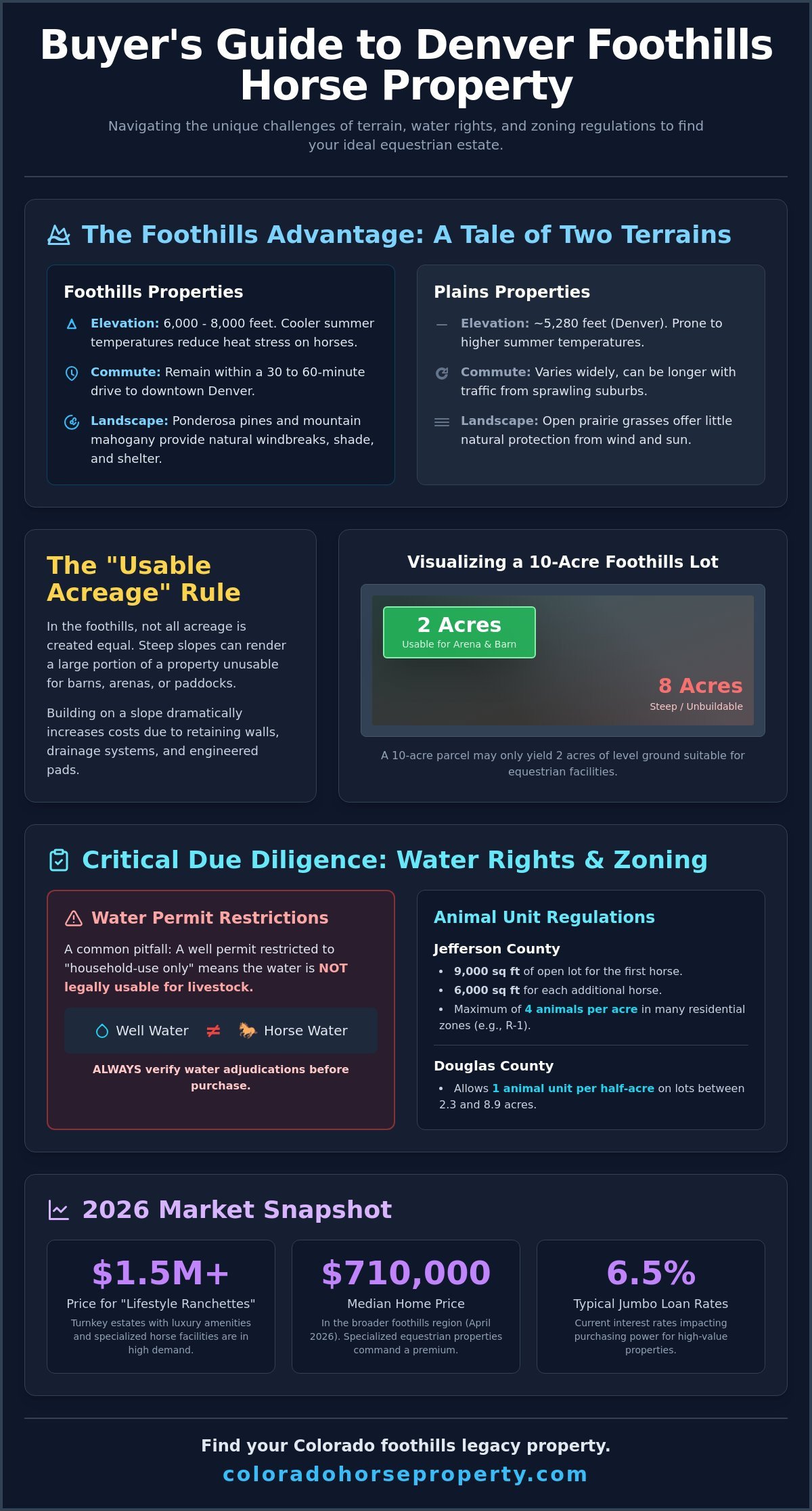
As of mid-2026, market data shows a significant shift toward “lifestyle ranchettes” priced at $1.5M and above. These properties typically feature smaller, high-quality acreage that prioritizes luxury amenities and proximity to the city over large-scale agricultural production. Buyers are increasingly seeking turnkey estates that offer sophisticated living spaces alongside specialized horse facilities. While the median home price in the broader foothills region reached $710,000 in April 2026, the specialized equestrian market often commands a premium due to the scarcity of flat, usable land for arenas and barns.
To better understand the layout and potential of these mountain estates, watch this helpful video showing a successful equestrian transaction in the region:
The “Front Range” vs. The Foothills
Elevation is the primary differentiator in this market. While Denver sits at 5,280 feet, foothills properties generally range from 6,000 to 8,000 feet. This altitude provides cooler summer temperatures, which helps reduce heat stress on horses during heavy training sessions. You’ll notice the landscape change from prairie grasses to thick stands of ponderosa pine and mountain mahogany. This vegetation provides natural windbreaks and shade that you won’t find on the plains. Despite the rugged feel and vertical gain, most of these properties remain within a 30 to 60 minute commute of downtown Denver, making them ideal for professionals who ride daily.
Why Horse Owners Choose the Foothills
The main draw for many buyers is the immediate access to world-class riding. Many properties border Jefferson County Open Space or offer easy connections to The Colorado Trail. This allows riders to travel for miles without crossing major roads or trailering their horses. The topography also offers natural shelter that flat plains lack. Ridges and timbered draws protect livestock from the harsh winds common on the Front Range. Beyond the practical utility, these mountain-edge estates offer a level of privacy and prestige that’s difficult to find in suburban developments. You aren’t just buying a barn; you’re securing a gateway to the Rockies.
Essential Equestrian Features: Navigating Terrain and Zoning
Evaluating a foothills horse property for sale near Denver requires a total shift in how you calculate land value. On the plains, ten acres is usually ten acres of flat, usable ground. In the foothills, you might discover that only two of those acres are level enough for a riding arena or a barn pad. This “Usable Acreage” rule is the first hurdle for mountain buyers. Building on a slope significantly increases your site preparation costs. You aren’t just paying for the arena surface; you’re paying for massive retaining walls, complex drainage systems, and engineered pads to prevent erosion during the spring thaw.
Zoning laws in counties like Jefferson and Douglas are equally technical and vary by specific district. Jefferson County utilizes an animal unit system that requires 9,000 square feet of open lot area for the first horse and 6,000 square feet for each subsequent animal. In residential zones like R-1, the maximum is four animals per acre. Conversely, Douglas County allows one animal unit per half-acre on lots between 2.3 and 8.9 acres. Familiarizing yourself with Colorado equestrian protection laws can help you navigate these local restrictions and ensure your facility remains compliant as regional land use policies evolve.
By 2026, fire mitigation has become a non-negotiable infrastructure requirement for mountain ranches. Proper defensible space isn’t just about the primary residence; it must extend to your barns, hay storage, and equipment sheds. Using non-combustible materials for fencing and maintaining a 100-foot manure pile setback from property lines helps reduce risk and satisfies county health regulations. These details often determine the long-term viability of an equestrian estate.
Water Rights and Well Productivity
Well productivity is the lifeblood of any mountain ranch. You must verify that the property has a domestic or stock well permit rather than a household-use only permit. A household-use permit legally forbids you from watering livestock. With the governor activating Phase 2 of the Colorado Drought Response Plan in March 2026, water security is paramount. Buyers should look for augmentation plans that protect their water rights during “water calls” when junior rights holders are restricted. We can help you identify properties with secured water rights before you enter the due diligence phase.
Infrastructure for the Mountain Climate
The mountain climate demands heavy-duty construction standards. You need to verify that horse barns for sale meet local snow load requirements, which are significantly higher than those in the Denver metro area. Heated auto-waterers are essential to prevent frozen pipes during sub-zero stretches. Additionally, designing paddocks with a 2% to 4% grade ensures proper drainage during the spring “mud season,” keeping your horses on dry, stable ground while the snowpack melts.
Top Foothills Communities: Where to Find Your Equestrian Estate
Finding the right foothills horse property for sale near Denver depends entirely on your riding discipline and lifestyle needs. The northern communities like Golden offer immediate trail access; southern areas like Larkspur provide more traditional rolling pasture land. As of April 2026, single-family pending sales in the foothills region increased by 15.6% year-over-year. This surge shows that demand for these niche communities remains high even as buyers become more selective about property utility and water rights.
Golden and West Arvada
Golden and West Arvada are the premier choices for equestrians who need to balance a professional career in the city with mountain riding. This area provides unparalleled proximity to White Ranch Park and North Table Mountain, two of the most popular multi-use trail systems in the Front Range. While you’ll often find smaller parcels here compared to the deep foothills, the property value is exceptionally stable. You can explore our equestrian real estate Colorado guide to see how these urban-edge properties compare to more remote mountain tracts. The trade-off is often price-per-acre, as the convenience of being near the city core and elite trailheads commands a significant premium.
Evergreen and Conifer
For those seeking high-altitude luxury and a deep connection to the regional landscape, Evergreen and Conifer are the standard. Established neighborhoods like Soda Creek and Bear Mountain feature heavily timbered lots, privacy, and active equestrian clubs. Living at 7,000 feet or higher means sharing your property with resident elk herds and navigating shorter grazing seasons. You’ll need to plan for hay delivery logistics carefully. Steep, winding mountain roads can be difficult for large semi-trucks; many residents coordinate split-load deliveries with neighbors to manage winter stockpiles. These communities also benefit from Colorado equestrian zoning laws, which help maintain the rural character and protect horse-friendly land use from urban encroachment.
Morrison and Conifer offer a more rugged alternative for buyers who want larger acreage without the Golden price tag. The terrain is often steeper, requiring more creative barn placement, but the privacy is unmatched. Further south, the Larkspur and Sedalia corridor offers a traditional “Horse Country” feel. This area is characterized by rolling hills and more open pastures, making it ideal for those who prefer the look of a classic ranch but want the backdrop of the Rocky Mountain peaks. No matter which community you choose, the key is verifying that the specific lot supports the animal units you intend to keep.
The 2026 Market: Buying Strategies for Denver’s Mountain-Edge Ranches
The market for foothills horse property for sale near Denver is defined by scarcity and long-term ownership. Unlike suburban residential markets where homeowners move every seven to ten years, mountain-edge ranches are often legacy properties held for decades. This creates a low-inventory environment where buyers must act decisively when a functional estate hits the market. Rural land valuations in Colorado have increased by 12.4% since January 2024, reflecting the sustained demand for acreage near urban centers. Even as the broader Denver metro market shifts toward a more balanced state with an average of 53 days on market, well-priced equestrian properties in the foothills continue to sell steadily.
Remote work has fundamentally changed the “commutable” radius. Buyers are now willing to live deeper in the foothills of Jefferson or Douglas County because they only need to travel to Denver twice a week. This shift has placed a premium on properties with reliable high-speed internet and paved access. To navigate this competitive landscape, smart buyers use horse property for sale in colorado data to identify listings that may be overlooked due to outdated interiors but possess superior water rights or flat arena sites. These technical advantages often provide better long-term value than a “turnkey” home on unusable land.
Negotiation in this niche requires looking at infrastructure rather than just aesthetics. A perimeter fence that needs replacement can cost tens of thousands of dollars in rocky mountain soil. Use these technical details as levers during the inspection phase. If you are ready to start your search with expert representation, you can view our latest listings and speak with a specialized agent today.
The Inspection Period: Beyond the Home
Standard home inspections don’t cover the complexities of a mountain ranch. You must test the soil in potential arena sites to determine if the footing will require expensive amendments or drainage work. In heavily wooded areas, old fence lines are notoriously inaccurate. Verifying property boundaries through a fresh survey is critical to ensure your paddocks don’t encroach on neighboring National Forest or private land. Finally, evaluate outbuildings for “horse safety,” checking for sharp edges, proper ventilation, and structural integrity under heavy snow loads.
Financing Foothills Acreage
Financing these properties is more complex than a standard suburban mortgage. As of July 2026, 30-year fixed jumbo loan interest rates are approximately 6.5% for loans exceeding the conforming limit of $832,750. If the property is classified as a “hobby farm” or has significant agricultural acreage, you may need to look toward specialized agricultural land loans. The role of title and escrow is also heightened in colorado land transactions. You must ensure all mineral rights, grazing easements, and water adjudications are clearly documented before closing to protect your investment.
Finding Your Legacy: Expert Representation and AI-Powered Search
A generalist real estate agent is often a liability when buying a foothills horse property for sale near Denver. Most residential agents focus on bedroom counts and kitchen finishes, but they lack the technical knowledge to evaluate a mountain well permit or a county’s animal unit system. When you’re investing in an equestrian estate, you need a partner who understands the difference between a household-use only well and a domestic permit that legally allows for livestock watering. Missing these details during the due diligence period can result in a property that’s unusable for your horses.
Colorado Horse Property brings 40 years of Front Range expertise to your search. Led by Mark and Alison Eibner, our team operates as specialized authorities who live the lifestyle we represent. We understand the unique requirements of land and livestock owners because we share your community. Our approach is leadership-forward and personal, ensuring you have a seasoned expert managing the complex logistics of a mountain land transaction. We provide more than just a listing service; we offer a supportive partnership built on decades of localized data and professional history.
AI-Powered Search for the Modern Buyer
Generic search platforms often fail to filter for the specific infrastructure horse owners require. Our proprietary AI-powered search fills this gap by identifying properties with functional hay storage, loafing sheds, and specific barn types. We match your needs to the right topography, ensuring you only view lots that can support your desired arena size. By setting up real-time alerts for a foothills horse property for sale near Denver, you gain an immediate advantage in a low-inventory market where turnkey ranches sell quickly. This technology allows you to filter by barn type, arena size, and water right status with granular precision.
Ready to Start Your Search?
The first step toward securing your legacy is a specialized consultation. We help you define your “must-haves,” such as direct trail access to Jefferson County Open Space, versus your “nice-to-haves.” Our deep equestrian network also provides access to off-market listings that never reach public platforms. This insider knowledge is vital in the 2026 market, where many of the best mountain-edge ranches trade privately between community members. We guide you from the initial search through title and escrow, ensuring every detail of the transaction is managed with professional rigor.
Search foothills horse properties for sale near Denver now!
Secure Your Foothills Equestrian Legacy
Finding a foothills horse property for sale near Denver requires a technical approach to land utility and water rights. Success in this specialized market involves more than just finding beautiful acreage; it requires verifying well permits and understanding the specific animal unit regulations of Jefferson and Douglas counties. By prioritizing usable terrain and direct trail access, you ensure your mountain estate remains a functional and sustainable asset for years to come. The right property isn’t just a home, it’s the foundation for your equestrian lifestyle.
Colorado Horse Property provides the specialized representation needed to navigate these technical complexities with confidence. Led by industry veterans Mark and Alison Eibner, our team leverages over 40 years of specialized Colorado real estate experience to protect your interests. We utilize a proprietary AI-driven search tool designed specifically for equestrians, allowing you to filter for infrastructure like hay storage and arena suitability that other platforms often overlook. Whether you’re seeking a turnkey estate in Evergreen or a rugged ranch in Conifer, we have the tools to find it.
Find Your Dream Foothills Horse Property with Our AI Search Tool
Your ideal mountain-edge ranch is waiting along the Front Range. We’re ready to help you turn that vision into a reality with expert guidance and a deep understanding of the land. Let’s start building your equestrian future today.
Frequently Asked Questions
How many horses can I keep on a 5-acre property in Jefferson County?
You can keep up to 20 horses on a five-acre lot in residential zones like R-1, provided you meet the specific space requirements. Jefferson County uses an “Animal Unit” system that requires 9,000 square feet of open lot area for the first horse and 6,000 square feet for each additional animal. However, the county also enforces a maximum density of four animals per acre, which is the primary limiting factor for most owners.
Do I need a special permit to build a riding arena in the foothills?
Yes, most foothills counties require a formal review and a building permit for any riding arena, especially if it involves structural components or significant grading. Regulations in areas like Boulder County include “presumptive size analysis” that might limit the footprint of your outbuildings based on neighboring properties. You’ll also need to submit a drainage plan to ensure that runoff from the arena doesn’t cause erosion on lower slopes.
What is the average price for a horse property near Denver in 2026?
The median price for a home in the Evergreen foothills was $710,000 in April 2026, but specialized equestrian estates often command much higher prices. A functional foothills horse property for sale near Denver with a barn, arena, and usable acreage typically starts at $1.5M. Prices vary significantly based on the quality of water rights and the amount of level, buildable ground available for livestock facilities.
Is well water safe for horses, or do I need a filtration system?
Well water is generally safe for livestock, but you must verify that your specific well permit allows for stock watering. In Colorado, a “household-use only” permit legally forbids you from watering horses. It’s standard practice to test for high mineral content or heavy metals common in mountain aquifers. If tests show high levels of iron or manganese, a basic filtration system can help prevent long-term health issues for your animals.
How do I manage manure on a mountain property with limited flat space?
Manure management on sloped terrain requires strict adherence to setback rules and regular removal schedules. Jefferson County regulations require manure piles to be at least 100 feet from the front property line to manage odors and runoff. Many owners on smaller mountain lots use covered, concrete-padded bins or professional hauling services to prevent waste from leaching into local watersheds during the spring snowmelt.
Are there specific fire insurance requirements for equestrian properties in the foothills?
Insurers in 2026 often require a documented fire mitigation plan before they will issue a policy for a mountain ranch. This includes maintaining defensible space not just around the home, but also around barns and hay storage areas. You may be required to use non-combustible fencing materials and ensure that large emergency vehicles have a wide, stable turnaround area near your livestock facilities to qualify for better rates.
Which foothills area has the best access to public riding trails?
Golden and Evergreen are widely considered the top choices for riders seeking immediate access to public trail systems. Golden properties frequently border White Ranch Park or North Table Mountain, offering miles of multi-use paths without the need for a trailer. In the higher foothills, communities in Evergreen and Conifer provide the best connections to the Colorado Trail, which is a major draw for long-distance trail riders.
What should I look for in a foothills barn to ensure it survives heavy snow?
You must verify that any barn is engineered to meet the specific snow load requirements of the local county, which are much higher than those in the Denver metro area. Look for steep-pitched metal roofs with snow guards to prevent dangerous “snow slides” and reinforced roof trusses. Proper eave ventilation is also critical to prevent ice damming and ensure your horses have clean air when they are stalled during winter storms.