
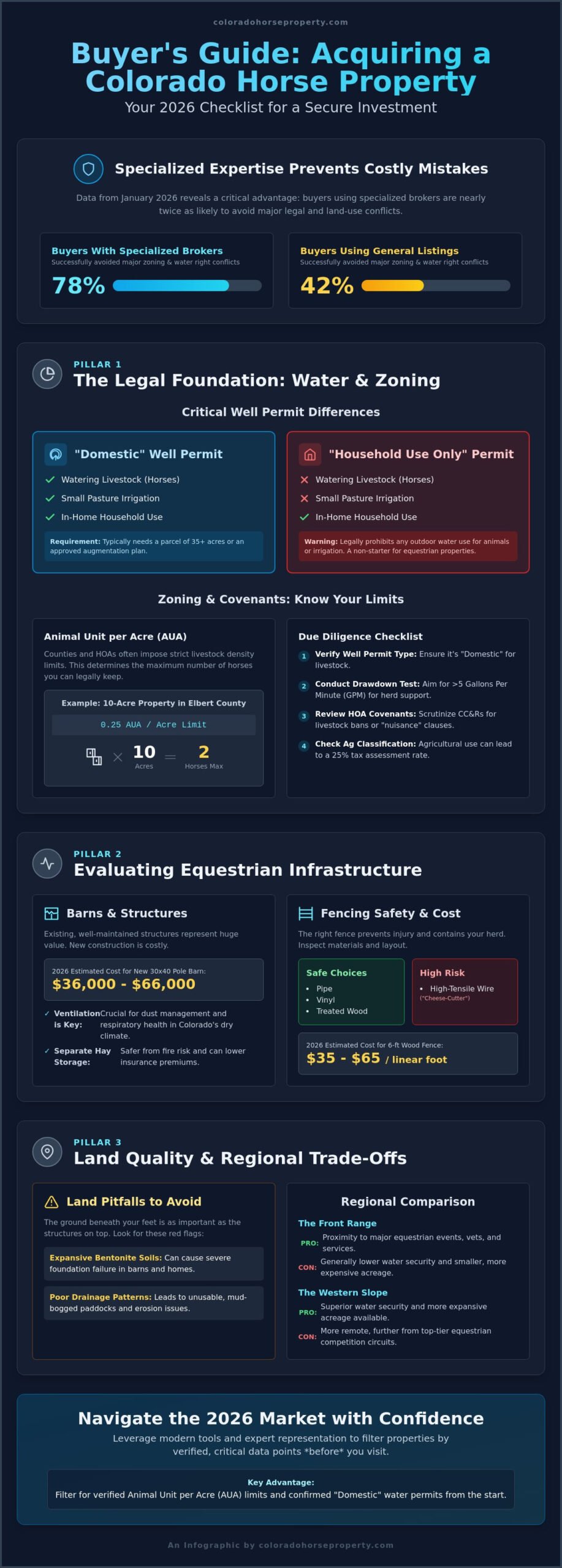
Data from January 2026 shows that 78% of buyers who worked with specialized brokers avoided major zoning conflicts, while only 42% of those using general listings were as lucky. This gap highlights why understanding what to look for when buying a horse property in Colorado involves much more than finding a scenic view and a sturdy barn. You’re not just buying a home. You’re acquiring a complex set of legal rights and geological conditions that dictate whether your lifestyle is sustainable or a financial drain.
It’s natural to feel anxious about Colorado’s intricate water laws or whether a specific parcel can actually support your livestock. We believe your equestrian dream should be built on a foundation of legal security and land quality. This guide provides the expert clarity you need to navigate the 2026 market with total confidence. We’ll examine the latest updates on “Domestic” well permits, the implications of HB26-1340 for land use, and the specific soil considerations that ensure your property remains a functional, high-value asset for years to come.
Key Takeaways
- Identify the critical difference between “Domestic” and “Household Use Only” well permits to ensure your livestock has a legal, long-term water source.
- Learn to spot expansive bentonite soils and poor drainage patterns that can lead to foundation failure and unusable, mud-bogged paddocks.
- Understand what to look for when buying a horse property in Colorado by evaluating infrastructure designed for high altitudes, such as specialized barn ventilation and year-round arena footing.
- Compare the regional trade-offs between the Front Range’s proximity to equestrian events and the Western Slope’s superior water security and expansive acreage.
- Leverage AI-powered search tools and expert buyer representation to filter for verified Animal Unit per Acre (AUA) limits before you ever step foot on the land.
The Legal Foundation: Zoning and Colorado Water Rights
Securing a property for your horses requires more than just a functional barn; it demands a rigorous audit of the land’s legal bones. One of the most critical factors in what to look for when buying a horse property in Colorado is the status of the water rights. In our semi-arid climate, land without a verified water source is essentially just dirt. The Colorado Division of Water Resources oversees every drop, and you must understand the difference between adjudicated rights and exempt permits. Under the prior-appropriation doctrine, which defines Colorado water rights, being “first in time” is “first in right.”
A “Household Use Only” permit is a non-starter for equestrian buyers. This specific permit legally prohibits you from watering a single horse or irrigating even a small patch of pasture. You need a “Domestic” permit to keep your animals hydrated. Generally, a parcel must be at least 35 acres to qualify for an exempt domestic well permit that allows for livestock watering. If the property is smaller, you’ll need to verify if it’s part of a court-approved augmentation plan that allows for outdoor use.
To better understand the nuances of land selection in specific regions, watch this helpful video regarding mountain property considerations:
Navigating Well Permits for Livestock
Verify the permit type during your initial search. Domestic permits allow for watering poultry and livestock, while commercial permits are necessary if you’re running a professional boarding stable. Recent updates to Colorado well water rules (2 CCR 402-2), effective January 1, 2026, have increased the scrutiny on these applications. Always conduct a drawdown test during due diligence to confirm the Gallons Per Minute (GPM) production. A well might exist, but if it produces less than 5 GPM, you’ll struggle to maintain a large herd. Permit fees for new wells in 2026 typically range from $500 to $2,000, not including drilling costs.
Zoning and Covenant Restrictions
County zoning sets the baseline for what to look for when buying a horse property in Colorado, but Homeowners Associations (HOAs) often have the final word. Review the Covenants, Conditions, and Restrictions (CC&Rs) for hidden livestock bans or “nuisance” clauses. In 2026, Douglas and Elbert Counties maintain strict livestock density limits based on Animal Units per Acre (AUA). One horse usually equals one AUA. If a 10-acre property has a limit of 0.25 AUA per acre, you’re legally capped at two horses regardless of how many stalls the barn has. Ensure the property is classified for agricultural use to benefit from the 25% tax assessment rate for improved agricultural land.
Evaluating Equestrian Infrastructure: Barns, Arenas, and Fencing
After securing your water rights, the next step in what to look for when buying a horse property in Colorado is the quality of the built environment. Infrastructure in the Rockies faces extreme temperature swings and high-altitude UV exposure. A 30×40 pole barn in Colorado currently costs between $36,000 and $66,000, so existing, well-maintained structures represent significant immediate value. Ventilation is vital; Colorado’s dry climate means dust management is a health priority for equine lungs. Avoid properties that store large quantities of hay directly above stalls in fire-prone regions. Separate hay sheds are safer and often help lower your insurance premiums.
Fencing requires a no-nonsense inspection. High-tensile wire is common but widely discouraged by equestrian specialists due to the risk of “cheese-cutter” injuries. Look for pipe, vinyl, or treated wood. In 2026, a 6-foot wood privacy fence costs between $35 and $65 per linear foot. While checking the perimeter, consider how the layout supports Managing established horse pastures to ensure your turnout areas remain productive rather than overgrazed. If you’re struggling to find properties with the right layout, you can use an AI-powered horse property search to filter listings by specific barn and fencing configurations.
The Ideal Horse Barn Configuration
Stalls should be at least 12×12 for average-sized horses. Rubber mats over a level crushed-rock base are superior to packed clay, which eventually develops deep holes. Wash racks must feature frost-free hydrants and sloped drainage to prevent winter ice buildup. A climate-controlled tack room is a necessity to preserve leather equipment and prevent liquid medications from freezing during sub-zero winter nights.
Arena and Round Pen Essentials
A 1% to 2% slope is mandatory for outdoor arenas to prevent spring snowmelt from creating unusable bogs or “ice rinks.” The sub-base is the most critical component. Without a 4 to 6-inch compacted base, your expensive footing will eventually mix with the native soil, leading to uneven spots and potential soft-tissue injuries. While indoor arenas offer 365-day utility, they require specific engineering to handle heavy Colorado snow loads.
Land Quality and Topography: Soil, Drainage, and Forage
The ground beneath your horses’ hooves is just as vital as the roof over their heads. When determining what to look for when buying a horse property in Colorado, you must look past the green grass to the chemical and physical makeup of the soil. Colorado is notorious for expansive soils, specifically bentonite, which can exert thousands of pounds of pressure on foundations as it swells with moisture. While a general home inspector might miss the signs, an equestrian specialist knows that cracked barn floors or sticking arena gates are often symptoms of deep-seated geological issues. You aren’t just buying acreage; you’re buying a geological profile that either supports or sabotages your infrastructure.
Topography also dictates property utility. While flat land is easier for building, a gentle 2% to 5% slope is actually preferable for natural drainage. Avoid parcels with steep, rocky inclines that increase the risk of tendon strain or make it impossible to move a hay trailer during a winter storm. High-altitude properties also require a health check. Horses need time to acclimate to elevations above 7,000 feet, where oxygen levels and forage quality drop significantly. If the land doesn’t drain well, you’ll spend your spring dealing with thrush and mud fever rather than riding.
Soil Testing and Foundation Stability
Professional soil testing is mandatory before you break ground on a new indoor arena or stable. These tests identify the depth of the bedrock and the plasticity of the clay. Bentonite is a highly absorbent volcanic clay that expands significantly when wet, and mitigating its effects in 2026 typically requires structural engineering solutions like drilled piers or specialized foundation vents. Beyond stability, consider dust management. In our dry summers, high-silt soils create respiratory hazards. You’ll need to budget for soil stabilizers or specialized footing additives to keep your training environment safe for equine lungs.
Pasture Management and Grazing Capacity
Colorado’s semi-arid climate means forage is a finite resource. You can’t graze horses here the same way you would in the Midwest. Carrying capacity in the Front Range often requires 10 to 35 acres per horse if you rely solely on natural forage without supplemental hay. During your walkthrough, identify noxious weeds that thrive in disturbed Colorado soil. Locoweed and Russian Knapweed are toxic and highly invasive. They often take over overgrazed pastures, making rotational grazing a necessity. This strategy involves dividing your land into smaller paddocks to allow the fragile topsoil and native grasses time to recover. What to look for when buying a horse property in Colorado includes checking for these specific plant species before you sign a contract.
Regional Variations: Front Range vs. Western Slope
Colorado’s diverse geography means that what to look for when buying a horse property in Colorado depends entirely on the region you choose. The state isn’t a single market; it’s a collection of micro-climates and legal jurisdictions. On the Front Range, you’ll find high demand and proximity to major equestrian events, but you’ll also face stricter zoning and higher prices. Conversely, the Western Slope offers expansive acreage and more traditional irrigation rights, though it requires a commitment to a more remote lifestyle. Understanding these regional trade-offs is essential for a successful long-term investment.
For those looking at the High Country, snow load requirements and short grazing seasons are the primary hurdles. Barns in mountain regions must be engineered for heavy winter accumulation, and you’ll likely need to budget for year-round hay supplementation. Regardless of the region, proximity to public lands remains a top priority for trail riders. Properties that border National Forest or BLM land command a premium because they offer direct access to Colorado’s extensive trail systems without the need for a trailer.
The Front Range Equestrian Corridor
The corridor stretching through Parker, Elizabeth, and Castle Rock remains the heart of the state’s equestrian community. If you prioritize proximity to the Colorado Horse Park and elite veterinary clinics, this region is your primary target. In 2026, functional horse properties in this area are moving fast, averaging under 24 days on the market. Buyers here must be decisive and focused on zoning compliance, as high demand has led to increased scrutiny over animal unit limits. For a deeper dive into current listings in this area, see our Horse Property for Sale in Colorado: The Ultimate 2026 Buyer’s Guide.
Western Slope and Rural Ranches
Grand Junction and Montrose appeal to riders seeking a more temperate climate and year-round riding opportunities. This region often provides better access to larger irrigation rights, which is vital for maintaining productive pastures. However, buyers must navigate new legislation like HB26-1340, which requires land revegetation when changing water uses in Water Division 2. These properties often offer 35 to 100+ acres, providing the privacy and “off-grid” potential that many 2026 buyers crave. Learn more about these larger parcels in our Colorado Ranches for Sale: The 2026 Expert Buyer’s Guide.
Ready to find the perfect location for your herd? Find your ideal regional property using our specialized search tools.
Navigating the 2026 Market with AI and Expertise
The 2026 real estate climate moves at a pace that leaves generalist agents behind. When you’re determining what to look for when buying a horse property in Colorado, the volume of data regarding zoning, water rights, and soil quality can be overwhelming. Standard residential platforms often fail to distinguish between a “large lot” and a legally compliant equestrian estate. This is where AI-powered horse property search technology bridges the gap, allowing you to filter through thousands of listings to find land that actually meets your livestock requirements. You don’t have to waste time on properties that look beautiful but lack the legal “Domestic” well permits discussed earlier.
Expert buyer representation is your most valuable asset during contract negotiations. In Colorado, professional representation is typically free for buyers, as the seller pays the commission in most transactions. This means you gain the expertise of a seasoned specialist who understands why 78% of buyers using niche brokers avoid zoning conflicts. Your specialist manages the entire lifecycle of the deal, from initial search to transaction management and the final exchange of keys. They ensure that every contingency, from soil tests to well production reports, is satisfied before you commit your capital.
Leveraging AI for Precision Property Identification
Our platform utilizes AI to analyze more than just square footage and bedroom counts. You can filter for critical equestrian features like indoor arenas, specific water shares, or the presence of existing loafing sheds. This precision saves dozens of hours by automatically excluding properties hampered by restrictive HOA covenants that might otherwise look perfect on paper. By utilizing historical data and current market trends, the system also helps predict market value, ensuring your offer is competitive in a market where functional properties often sell in under 24 days.
Closing the Deal: Title, Escrow, and Beyond
The transition from “under contract” to “closed” requires meticulous transaction management. A clean title in Colorado must be scrutinized for both mineral and water rights, which are often severed from the surface land. We coordinate closely with specialized partners like Meridian Title & Escrow to handle these complex closings. They understand the nuances of agricultural transfers and the specific legal requirements of Water Division 2. This collaborative approach ensures your investment is legally protected and that all water rights are properly deeded during the title and escrow process.
Find your perfect Colorado horse property with our AI search tool today!
Secure Your Colorado Equestrian Legacy
Securing a property for your herd in the Rockies requires a precise balance of legal due diligence and physical land assessment. You’ve learned that “Domestic” well permits are non-negotiable for livestock and that local zoning limits dictate your herd’s size long before you build a stall. Identifying expansive bentonite soils and assessing drainage patterns ensures your infrastructure remains a lasting asset rather than a foundation repair nightmare. Understanding what to look for when buying a horse property in Colorado is the difference between a thriving ranch and a costly legal liability.
With 40 years of experience serving the Colorado Front Range, industry veterans Mark and Alison Eibner understand the specific requirements of horse owners. Our team uses proprietary AI search technology to filter for equestrian-specific features that general listings often ignore. We handle the complexities of transaction management and title services so you can focus on the lifestyle you’ve worked to build. Your ideal acreage is within reach when you have the right data and expert representation on your side.
Start Your AI-Powered Colorado Horse Property Search today to find a property that supports your goals and protects your investment. The expansive space and freedom of the Colorado landscape are waiting for you.
Frequently Asked Questions
How many acres do I need for two horses in Colorado?
You typically need between 10 and 35 acres per horse if you plan to rely on natural forage in Colorado’s semi-arid climate. However, county zoning often dictates a specific Animal Unit per Acre (AUA) limit regardless of forage quality. In counties like Douglas or Elbert, you might only be allowed two horses on a 10-acre parcel depending on the specific AUA designation for that land.
What is the difference between a domestic well and a household-use well?
A domestic well permit allows for watering livestock and small-scale irrigation, while a household-use-only permit restricts water use to inside the primary residence. Securing a domestic permit usually requires a parcel of at least 35 acres. This distinction is one of the most critical factors in what to look for when buying a horse property in Colorado, as a household-only permit is a dealbreaker for most owners.
Do I need a special inspection for an equestrian property?
Yes, you should hire specialized inspectors to evaluate well production rates, soil stability, and barn structural integrity. Standard home inspectors often miss expansive bentonite soils or inadequate ventilation in stables. A drawdown test is also necessary to verify the Gallons Per Minute (GPM) of the well to ensure it can support your herd’s daily water needs throughout the year.
How do I verify if a property has water rights in Colorado?
You must verify water rights through the Colorado Division of Water Resources and review the property’s deed for severed rights. It’s common for mineral and water rights to be sold separately from the surface land in Colorado. Working with a specialized title company helps ensure that any adjudicated water rights or ditch shares are properly transferred during the closing process.
Are there specific property taxes for horse properties in Colorado?
Properties classified as agricultural or improved agricultural land benefit from a 25% tax assessment rate in 2026. To qualify, you must prove the land is used for a primary purpose like grazing or hay production. If the property loses this classification, your tax burden could increase significantly, making it vital to verify the current tax status and any requirements for maintaining that status during due diligence.
Can I build a barn on any land zoned as residential in Colorado?
No, residential zoning does not automatically grant the right to build agricultural structures or house livestock. You must check the specific county zoning codes and any Homeowners Association (HOA) covenants. Many residential areas have strict “nuisance” clauses or size limits for outbuildings that can prevent you from constructing a functional barn or arena even if the acreage seems sufficient.
What are the most common mistakes when buying horse property?
The most common mistakes include overlooking restrictive water permits and ignoring the presence of expansive bentonite soils. Many buyers also fail to calculate the true carrying capacity of the land, leading to overgrazed pastures and high supplemental hay costs. Understanding what to look for when buying a horse property in Colorado requires looking past the aesthetic appeal to the legal and geological constraints of the parcel.
How does the Colorado climate affect barn construction?
Colorado’s climate requires barns to be engineered for heavy snow loads and equipped with frost-free hydrants to prevent frozen pipes. High-altitude UV exposure can degrade certain roofing materials faster, and dry air makes dust-mitigating ventilation essential for equine respiratory health. You should also consider separate hay storage to reduce fire risks during the dry summer months when wildfire danger is highest.