
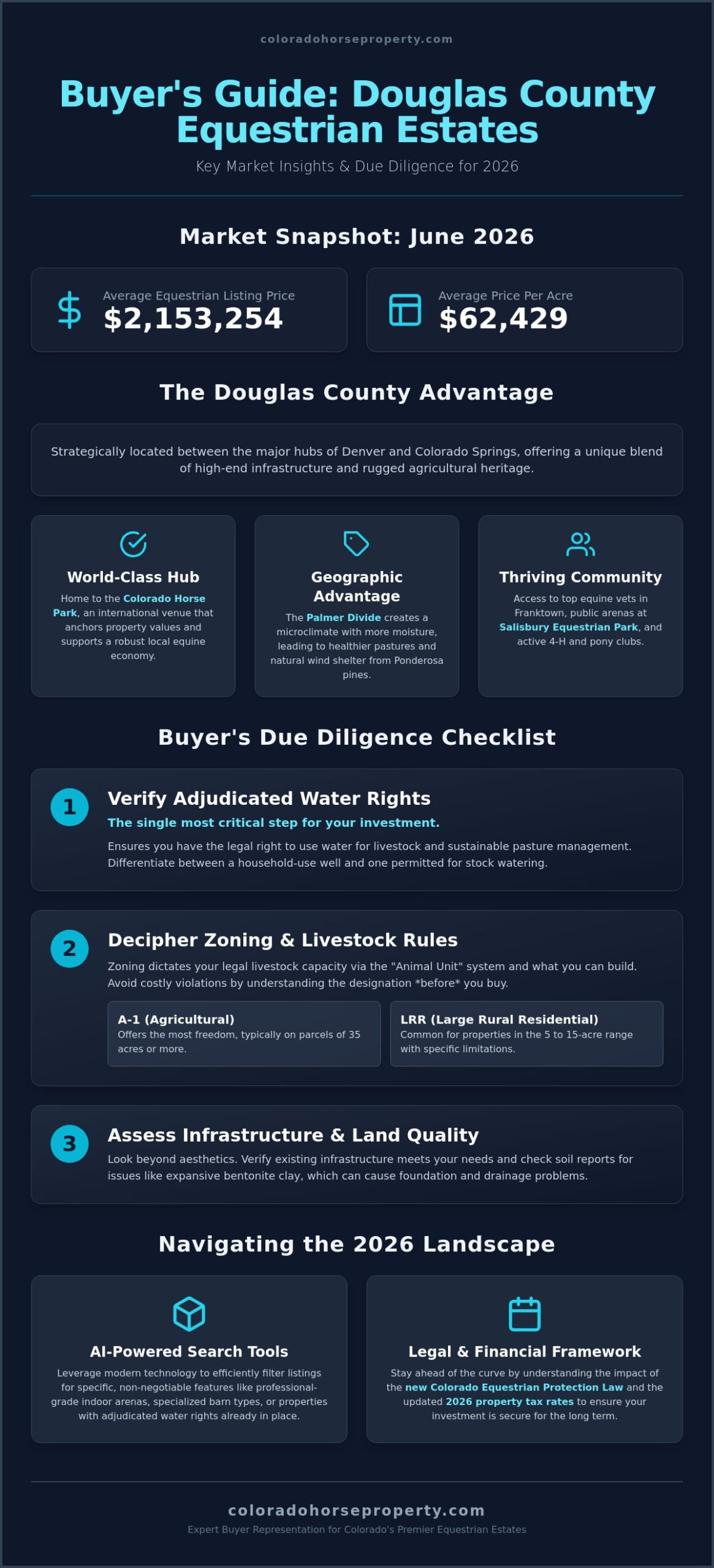
With the average equestrian listing price in Douglas County reaching $2,153,254 as of June 2026, finding the right acreage is a high-stakes investment. You aren’t just looking for a home; you’re searching for a functional asset that balances livestock density rules with complex water rights. If you’re currently scouting for a horse property for sale Douglas County CO, you’ve likely realized that generic listing sites don’t account for the nuances of A-1 zoning or the difference between a household-use well and a stock-permitted one.
We understand the pressure of competing for quality land in hubs like Parker and Franktown. This guide provides the expert local perspective you need to find a turnkey estate without the guesswork. You’ll learn how to use AI-powered search tools to filter for professional-grade arenas and specific infrastructure. We also break down the critical 2026 property tax rates and the new Colorado Equestrian Protection Law to ensure your investment stays secure. Our goal is to help you move past the uncertainty of livestock regulations and into a property that supports your lifestyle and your horses.
Key Takeaways
- Understand the “Animal Unit” system to accurately calculate the legal livestock capacity of A-1 and LRR zoned parcels before you buy.
- Identify the geographic advantages of the Palmer Divide and how proximity to the Colorado Horse Park impacts the long-term investment value of your estate.
- Learn why verifying adjudicated water rights is the most critical step when evaluating a horse property for sale Douglas County CO to ensure sustainable pasture management.
- Leverage AI-powered search tools to efficiently filter listings by specific equestrian infrastructure, such as professional-grade indoor arenas and specialized barn types.
- Navigate the 2026 market with seasoned buyer representation that covers the entire transaction lifecycle, including title services and specialized due diligence.
Why Douglas County is Colorado’s Premier Destination for Equestrian Estates
Douglas County isn’t just a suburban extension of the Front Range. For those searching for a horse property for sale Douglas County CO, it represents a unique intersection of high-end infrastructure and rugged agricultural heritage. Situated perfectly between the professional hubs of Denver and Colorado Springs, Douglas County, Colorado offers a lifestyle where you can work in the city and return home to a private ranch with views of the Rockies. In 2026, the market remains a bastion of stability because of its limited acreage availability and high demand for lifestyle-oriented properties.
To better understand the layout and quality of estates available in this region, watch this short overview of local equestrian listings:
The presence of the Colorado Horse Park in Parker serves as a massive value driver for the entire county. It’s a world-class venue that draws international competitors, supporting a robust local economy dedicated to the horse industry. Owning land near this hub ensures your property value is anchored by permanent infrastructure. In 2026, the market remains stable; while overall inventory has grown to over 2,000 homes across the county, the specific demand for acreage remains high. With an average price per acre of approximately $62,429 for equestrian land, these properties represent a significant but durable investment in the corridor.
The Palmer Divide: A Microclimate for Horse Health
The geography here is defined by the Palmer Divide, an elevated ridge that creates a distinct microclimate. This area often receives more moisture than the surrounding plains, leading to healthier, more resilient pastures for grazing. The rolling terrain, dotted with Ponderosa pines, provides excellent natural shelter from the wind. If you want to understand how these geographical factors compare to other regions, check out our ultimate guide to buying Colorado land in 2026. The combination of elevation and drainage makes this land some of the best in the state for maintaining sound, healthy horses.
Community and Infrastructure for the Modern Rider
A great horse property is only as good as the support system around it. Douglas County excels in this area. Franktown is home to some of the state’s most respected specialized equine veterinarians, ensuring emergency care is never far away. Residents also enjoy access to Salisbury Equestrian Park, which offers public arenas and trail connections. For families, the active 4-H and pony club chapters foster a deep-rooted community culture that prioritizes animal husbandry and competitive excellence. Finding a horse property for sale Douglas County CO means joining a community that truly understands the needs of livestock owners.
Essential Features for Horse Properties: Zoning, Water, and Infrastructure
Finding a horse property for sale Douglas County CO requires looking past the aesthetic of a barn or a fenced pasture. Many buyers assume that if a property has equestrian features, it’s legally ready for horses. This isn’t always the case. You must verify the specific zoning designation, as it dictates everything from your animal density to the types of structures you can build. While A-1 (Agricultural) zoning offers the most freedom for 35-acre parcels, many properties in the 5 to 15-acre range fall under LRR (Large Residential Rural) or RR (Rural Residential) classifications. Understanding Douglas County’s rules and regulations is the first step in avoiding costly zoning violations.
Soil composition is another factor often overlooked until it’s too late. Certain parts of the county contain bentonite, an expansive clay that can wreak havoc on barn foundations and arena footings. Testing the soil before closing can save you thousands in future repairs. If you’re feeling overwhelmed by these technical requirements, we can help you find a property with the right infrastructure already in place.
Decoding Douglas County Animal Units
Douglas County uses an “Animal Unit” system to regulate livestock density. For parcels between 2.3 and 8.9 acres in Estate Residential or Rural Residential zones, the maximum density is one animal unit per half-acre. If you’re looking at a 5-acre lot, you’re generally limited to 10 animal units. In Douglas County, zoning typically allows for one animal unit per 35,000 square feet in specific LRR zones. If your goals exceed these limits, you might need to apply for a Special Use permit, though these are never guaranteed. On larger A-1 lots of 35 acres or more, there’s no limit on the number of horses owned by the landowner, making these the gold standard for serious riders.
Water Rights and Well Permits
Water is the most critical asset in any Colorado land transaction. As of January 1, 2026, new well construction rules require permits to be physically posted at the site during any work. All new non-exempt well permits now carry a strict two-year expiration date, so timing your infrastructure builds is more critical than ever. It’s vital to distinguish between “in-house use only” wells and those with adjudicated stock use rights. A household-use well legally prohibits you from watering horses or irrigating pastures. If you’re planning a larger facility, you must verify augmentation plans to ensure you have the legal right to replace the water you pump. For a deeper look at how these rights impact property worth, consult our horse real estate for sale market guide.
Exploring Douglas County’s Equestrian Hubs: Parker, Franktown, and Castle Rock
Douglas County offers a diverse range of environments for horse owners, from manicured luxury subdivisions to rugged mountain ranches. Choosing the right location for a horse property for sale Douglas County CO depends heavily on your riding discipline and your need for city access. While some areas prioritize proximity to competition venues, others offer the isolation required for large-scale breeding or hay production. Understanding the distinct personality of each hub is essential before you begin your search.
Castle Rock and Sedalia provide a more rugged, mountain-style ranching experience. These areas are characterized by dramatic rock formations and scrub oak, offering a landscape that feels authentically Western. While the terrain can be steeper, it provides natural windbreaks and incredible privacy. Buyers here often look for properties that balance aesthetic beauty with functional trail access, as the proximity to Pike National Forest is a significant draw for endurance and trail riders.
Parker and the Colorado Horse Park Influence
Parker is the undisputed center of the county’s competitive riding scene. High-end communities like Spirit Ridge and Pinery Southwest cater to owners who want luxury living paired with professional-grade facilities. Many of these properties are just minutes from E-470, making them ideal for professionals who commute to the Denver Tech Center but want their horses in the backyard. Because land prices are premium here, many buyers focus on estates with existing horse barns for sale to avoid the rising costs and permitting delays of new construction. The influence of the Horse Park ensures that infrastructure in Parker is often top-tier, featuring heated stalls and indoor arenas.
Franktown and Larkspur: Acreage and Autonomy
Franktown is often called the “Equestrian Capital” of the county for good reason. Unlike the more developed parts of Parker, Franktown offers larger, flatter parcels that are perfect for hay production and extensive turnout. The soil here is often more forgiving for pasture health, and the community is deeply rooted in agricultural traditions. If you’re looking for a property with a true rural feel without sacrificing high-speed internet or paved access, Franktown is the primary target. It’s a place where you’ll find multi-generational ranches alongside modern training facilities.
Moving south toward Larkspur, the landscape shifts again to high-country aesthetics with heavy timber and significant elevation changes. These parcels provide unmatched privacy and a sense of freedom, though they require more intensive land management. Fire mitigation is a critical priority in these wooded areas, especially in the Sedalia foothills where Ponderosa pines are dense. Additionally, as you move into these more remote terrains, verifying your well’s legality becomes paramount. Resources from the Colorado State University Extension can help you understand how mountain water rights differ from those in the valley. Whether you prefer the rugged cliffs of Castle Rock or the lush valleys of Franktown, each area requires a specific due diligence approach.
Navigating the 2026 Market: AI Search Tools and Expert Due Diligence
The 2026 market moves fast. With a median of only 15 days to pending, buyers looking for a horse property for sale Douglas County CO cannot afford to waste time on manual searches. Standard real estate sites often use a generic “horse” checkbox that includes properties with unusable hillsides or restrictive HOAs. Success in this competitive landscape requires advanced technology to filter for functional infrastructure before you ever schedule a showing. You need to verify trailer access, barn utility, and land health with precision to secure a viable estate.
The Power of AI in Equestrian Real Estate
Our proprietary AI search tool changes how you evaluate listings. Instead of relying on vague descriptions, the system analyzes listing photos to identify specific high-value features. It can recognize tack rooms, wash stalls, and rubber-matted flooring without a human having to tag them. This technology saves hours of scrolling by matching you only with properties that meet your technical requirements. For a deeper understanding of how to leverage these tools, consult our equestrian real estate Colorado buyer guide. This proactive approach ensures you’re first in line for properties that actually support your riding discipline.
The Equine Property Audit: Beyond the Home Inspection
A standard home inspection doesn’t cover the most critical parts of a ranch. We recommend a specialized audit that focuses on the safety and functionality of the acreage. This includes checking fence integrity for loose wires and scanning pastures for toxic weeds like Locoweed, which can be devastating to livestock health. You also need to assess arena drainage and the depth of the footing to ensure it’s suitable for your horses’ joints. A dedicated equine property audit in 2026 should always include a professional assessment of manure management systems and pasture rotation capacity. This step prevents environmental issues and ensures compliance with local health department standards.
Due diligence also requires a hard look at legal access. You must verify that easements are wide enough for large trailers and that road maintenance agreements are in writing. Historical land use is equally important; check for previous chemical applications or environmental factors that could impact soil health. Analyzing these details before you place an offer protects your investment and your animals. If you’re ready to see how specialized technology can streamline your hunt, start your AI-powered property search today and find the infrastructure your horses deserve.
Securing Your Legacy: Expert Buyer Representation with Colorado Horse Property
General real estate agents often struggle with the technicalities of a horse property for sale Douglas County CO. They might miss the significance of a specific stall dimension or fail to ask the right questions about hay storage capacity. Working with a specialized team ensures that these critical details are handled by someone who shares your lifestyle. With over 40 years of local experience, Mark and Alison Eibner provide a level of niche authority that generic listing platforms simply can’t match. Their tenure in the Front Range market means they’ve seen every zoning shift and water law update since the 1980s, giving you a distinct advantage in a competitive market.
A Partnership Built on Expertise
Mark and Alison Eibner aren’t just brokers; they’re active participants in the equestrian community. This background allows them to speak “horse talk” fluently, translating your specific needs into actionable search parameters. Whether you need an indoor arena with specific footing or a barn layout that facilitates easy stall cleaning, they understand the functional requirements of daily horse care. Their deep-rooted network also grants you access to off-market equestrian listings that never hit the public MLS. This is a vital advantage in a market where quality acreage moves in just 15 days. For a broader look at the state-wide market, see our horse property for sale in colorado guide. Having a peer as your representative means your priorities are understood before the first showing.
Seamless Transactions from Barn to Boardroom
The complexity of a ranch transaction doesn’t end when your offer is accepted. Douglas County land deals often involve intricate title issues, from historic grazing easements to complex mineral rights that can impact your future building plans. Our partnership with Meridian Title & Escrow ensures that your property’s title is scrutinized by experts who understand rural land law. This specialized oversight is part of our full-cycle transaction management. We handle the heavy lifting of the contract-to-close process, providing a streamlined experience that is especially beneficial for out-of-state buyers who can’t be on-site for every inspection or meeting.
We provide more than just a functional search tool; we offer a supportive partnership designed to help you achieve a specific lifestyle goal. From the initial AI-powered search to the final signature at the closing table, our team at Realty Oasis manages every detail with professional precision. You don’t have to navigate the 2026 zoning hurdles or water right verifications alone. If you’re ready to secure your piece of the Colorado landscape, contact us for a personal consultation. Let’s find the property that will serve as the foundation for your equestrian legacy and provide the freedom you’ve been searching for.
Build Your Equestrian Future in Douglas County
Securing a horse property for sale Douglas County CO in 2026 requires more than just a passion for the lifestyle. It demands a technical understanding of animal unit densities and the legal nuances of Denver Basin water rights. As the market moves toward a 15 day median for pending sales, your ability to filter for high value infrastructure like indoor arenas and specialized hay storage becomes your greatest competitive advantage. You’ve seen how the geography of the Palmer Divide and the professional hubs of Franktown offer distinct benefits for your horses’ health and your investment’s stability.
Success depends on having the right tools and a seasoned team by your side. Led by Mark and Alison Eibner, our team brings 40 years of local experience to every transaction. We provide specialized AI powered search technology to identify equestrian features instantly, alongside full service transaction and title support to manage the complexities of ranch land titles. Don’t let the fast paced market discourage you from finding the perfect acreage. Find your dream Douglas County horse property with our AI Search Tool and start the next chapter of your equestrian journey today. We look forward to helping you find a home where your horses can thrive.
Frequently Asked Questions
How many horses can I have on 5 acres in Douglas County?
You can typically keep up to 10 animal units on a 5-acre parcel under the current Douglas County density regulations. For Estate Residential and Rural Residential lots between 2.3 and 8.9 acres, the county allows one animal unit per half-acre. It’s vital to check your specific homeowners association covenants, as they can be more restrictive than the county’s general zoning rules.
Does Douglas County require a permit for a private riding arena?
Yes, any indoor riding arena requires a building permit, and outdoor arenas often require a grading permit if significant earth is moved. The county reviews these plans to ensure proper drainage and adherence to set-back requirements from property lines. While private-use arenas face fewer hurdles than commercial ones, you must still obtain site plan approval before starting construction.
What are the most popular equestrian subdivisions in Parker, CO?
Spirit Ridge and Pinery Southwest are among the most popular equestrian subdivisions for buyers seeking a horse property for sale Douglas County CO. These communities offer luxury estates with professional-grade infrastructure and are located within minutes of the Colorado Horse Park. They’re highly sought after for their commutable distance to Denver and their established horse-friendly cultures.
How do water rights work for horse properties in the Denver Basin?
Water rights are adjudicated based on the specific aquifer and the type of well permit attached to the land. A standard household-use only well doesn’t legally allow you to water livestock or irrigate pastures. You must verify that your property has a domestic or stock-permitted well to ensure your horses have a legal and sustainable water source.
Are there specific fencing requirements for horses in Douglas County?
The county doesn’t mandate a specific fencing material, but the structure must be adequate to contain your livestock and comply with zoning set-backs. Most high-end equestrian estates utilize three-rail wood or PVC for safety and durability. With the 2025 “Pass Wide and Slow” rule now in effect, secure perimeter fencing is more important than ever for safety near public roads.
Can I run a commercial boarding stable on my private property in Franktown?
Commercial boarding is allowed by right for up to four horses on A-1 agricultural lots of 35 acres or more. If your property is smaller or you plan to board more horses, you’ll likely need to go through an administrative review or apply for a Special Use permit. In Large Residential Rural zones, only two boarded horses are permitted by right.
What is the average price per acre for horse property in Douglas County in 2026?
The average price per acre for equestrian land in Douglas County is approximately $62,429 as of June 2026. This price reflects the high demand for usable acreage in the Front Range corridor. When looking for a horse property for sale Douglas County CO, remember that prices fluctuate based on existing infrastructure like indoor arenas and adjudicated water rights.
Is hay production viable on Douglas County horse properties?
Hay production is viable on larger parcels, especially in the flatter areas of Franktown and eastern Parker. The Palmer Divide microclimate often provides the necessary moisture levels to support healthy grass growth throughout the summer. However, you’ll need a well permit that allows for irrigation and enough flat acreage to accommodate modern harvesting equipment efficiently.