
Owning a ranch should mean total autonomy, yet many buyers realize too late that an HOA board has more say over their barn size than they do. If you’re looking for a horse property with indoor arena for sale Colorado, you’re likely seeking a sanctuary where your trailers are welcome and your horse count isn’t capped by a suburban committee. It’s frustrating to pay high fees for amenities that offer zero value to a working equestrian. You want the space to ride, train, and manage your livestock without a neighbor’s oversight.
We understand that true freedom comes from owning land that answers only to county zoning, not restrictive covenants. This 2026 guide is designed to help you navigate the latest complexities of Colorado land ownership, including the new January 1, 2026, water well construction rules and significant property tax valuation shifts. We’ll preview the top counties for non-HOA land, from Douglas to Elbert, and show you how to verify Domestic well permits so your horses always have water. You’ll learn exactly how to find a property that matches your vision of equestrian independence while staying ahead of local land use codes.
Key Takeaways
- Understand the critical difference between private restrictive covenants and county zoning to ensure you maintain the freedom to build custom barns without board approval.
- Use our AI-Powered Horse Property Search to efficiently find a horse property with indoor arena for sale Colorado while automatically filtering out HOA-restricted listings.
- Identify high-value regions like Weld, Elbert, and Douglas Counties that offer a balance of A-1 agricultural zoning and proximity to equestrian infrastructure.
- Learn to perform essential due diligence, including verifying legal access and testing soil quality to confirm the land can support your intended livestock density.
- Navigate the “No HOA” landscape with an expert understanding of county-level land use codes that still govern manure management and animal unit limits.
What is a Non-HOA Horse Property and Why Does it Matter?
A non-HOA property is land that operates without a private governing board or a set of restrictive covenants. In most residential developments, these boards dictate everything from the color of your front door to how many days a guest can park on the street. When you look at the legal framework for Understanding Homeowner Associations, it’s clear these structures are designed for high-density uniformity. For an equestrian, that uniformity is often the biggest obstacle to running a functional ranch. True freedom means your only regulators are the county and the state, not a group of neighbors with a shared bank account and a list of aesthetic grievances.
Searching for a horse property with indoor arena for sale Colorado is usually driven by a desire for autonomy. Beyond the emotional appeal of independence, the financial benefits are significant. You won’t face monthly or annual dues that fund suburban amenities like community pools or tennis courts. Instead, your capital stays in your pocket or goes directly toward your land’s productive capacity. You also gain operational control over livestock counts and equipment storage, allowing you to manage your property according to professional agricultural standards rather than suburban preferences.
To better understand this concept, watch this helpful video:
The Freedom to Build Your Equestrian Vision
Modern HOAs often enforce strict architectural guidelines that clash with the needs of a working horse property. You might need a specialized roof pitch for ventilation or a specific metal siding for durability, only to have a committee reject it because it doesn’t match the “neighborhood character.” On non-HOA land, you follow county building codes. This allows you to build the barn you actually need. You can park your horse trailers, tractors, and hay rounds where they are most accessible, rather than hiding them behind expensive, board-mandated screening.
Avoiding the Covenant Trap
It’s a common mistake to assume that the absence of a monthly bill means a property is unrestricted. Some Colorado parcels carry “deed restrictions” or “protective covenants” that were recorded decades ago. Even if there is no active board, these rules can be legally enforced by any neighbor in the subdivision. A dormant HOA is a sleeping giant that can be revived at any time. We always advise our clients to prioritize the title commitment over the listing description. The legal documents are the only place where your true property rights are documented.
Zoning vs. HOAs: Understanding Colorado Land Use Codes
Leaving an HOA behind doesn’t grant total lawlessness. It simply shifts the jurisdiction from a private board to the local county government. While you escape architectural committees, you remain subject to county land use codes. These regulations govern everything from how many horses you can keep to where you pile manure. Understanding Colorado equestrian zoning protections is essential for anyone looking for a horse property with indoor arena for sale Colorado, as these laws provide the legal baseline for your operation.
Most equestrian land falls under A-1 (Agricultural) or RR (Rural Residential) designations. A-1 is generally the gold standard for freedom. In many counties, A-1 zoning allows for larger livestock counts and more flexibility with outbuildings. Rural Residential zoning is more common for smaller hobby farms. It often comes with tighter restrictions on “Animal Units” (AU). One horse typically equals one AU. If you’re planning on housing a barn manager, you must also verify the legality of Accessory Dwelling Units (ADUs). Some counties allow a second residence for employees by right, while others require a lengthy administrative review. To see how these rules apply to current listings, you can use our AI-powered horse property search to filter by specific zoning requirements.
Decoding County-Specific Horse Limits
Horse limits vary wildly between neighbors. In Douglas County, Estate Residential (ER) parcels between 2.3 and 8.9 acres are limited to one horse per half-acre. However, on A-1 lots of 35 acres or more, there is no limit on the number of horses you can own for personal use. Commercial boarding is a different story. On those same 35 acre lots, you can board up to four horses by right. Exceeding that number usually requires a Special Use Permit. You must also account for setbacks. For instance, Douglas County requires manure piles to be set back at least 100 feet from any lot line or well.
The Critical Role of Water Rights and Well Permits
Water is the most valuable asset on any Colorado ranch. As of January 1, 2026, updated well construction rules (2 CCR 402-2) are in effect. These rules make it vital to verify your permit type before closing. A “Household Use Only” permit is a dealbreaker. It legally prohibits you from watering livestock or irrigating a paddock. You need a “Domestic” well permit to provide water for your horses. For larger operations, you might even need specific stock water rights. Never rely on a seller’s word. Always check the state’s eForm reporting system to confirm the well’s production and legal allowed uses.
Top Colorado Counties for Non-HOA Equestrian Living
Finding the right horse property with indoor arena for sale Colorado requires looking beyond the house and barn. You must evaluate the county’s history of supporting agriculture. Some regions are naturally more hospitable to livestock owners than others. Pueblo and Fremont Counties offer a more temperate climate and longer growing seasons. This can significantly reduce winter hay costs for owners with large herds. On the Western Slope, Mesa and Montrose Counties provide incredible high-altitude ranching opportunities. These areas avoid the restrictive resort-town building codes found in nearby mountain peaks, allowing for functional, large-scale equestrian facilities without unnecessary aesthetic oversight.
When you’re comparing different parcels, it’s helpful to consult the Colorado State University Extension guide to equine management to understand how different regional soil types and climates impact your land’s carrying capacity. While Douglas County is known for luxury equestrian estates, it also maintains strict zoning for smaller parcels. For example, Estate Residential (ER) lots under 9 acres are limited to one horse per half-acre. However, once you reach the 35-acre threshold in A-1 zoned areas, those limits often disappear for personal use horses. This makes Douglas a premier choice for those who want a high-end lifestyle paired with serious training capabilities.
Weld County: The Agricultural Powerhouse
Weld County is the undisputed leader for agricultural freedom. It’s common to find 35-acre or 160-acre parcels here that have never been touched by an HOA. This makes it a top destination for serious cattle and horse operations. The county infrastructure is built for trailers. You’re never far from major hubs like Island Grove Regional Park in Greeley. This accessibility is vital for competitors who haul to events frequently. Weld’s commitment to right-to-farm laws ensures that your equestrian operation is protected from the encroachment of suburban complaints.
Elbert County: The Pine-Covered Escape
Elbert County serves as a sanctuary for those who need to stay near Denver but want rural privacy. Areas like Elizabeth and Kiowa are famous for ranchettes and luxury estates that prioritize equestrian utility. One major benefit of this region is the sandy soil. It offers natural drainage that is superior to the heavy clay found closer to the city. This is a game-changer for maintaining outdoor paddocks and arena footing. When researching equestrian real estate Colorado, Elbert stands out for its balance of aesthetics and function. It’s a place where you can find a horse property with indoor arena for sale Colorado that offers both a professional training environment and a quiet, wooded retreat.
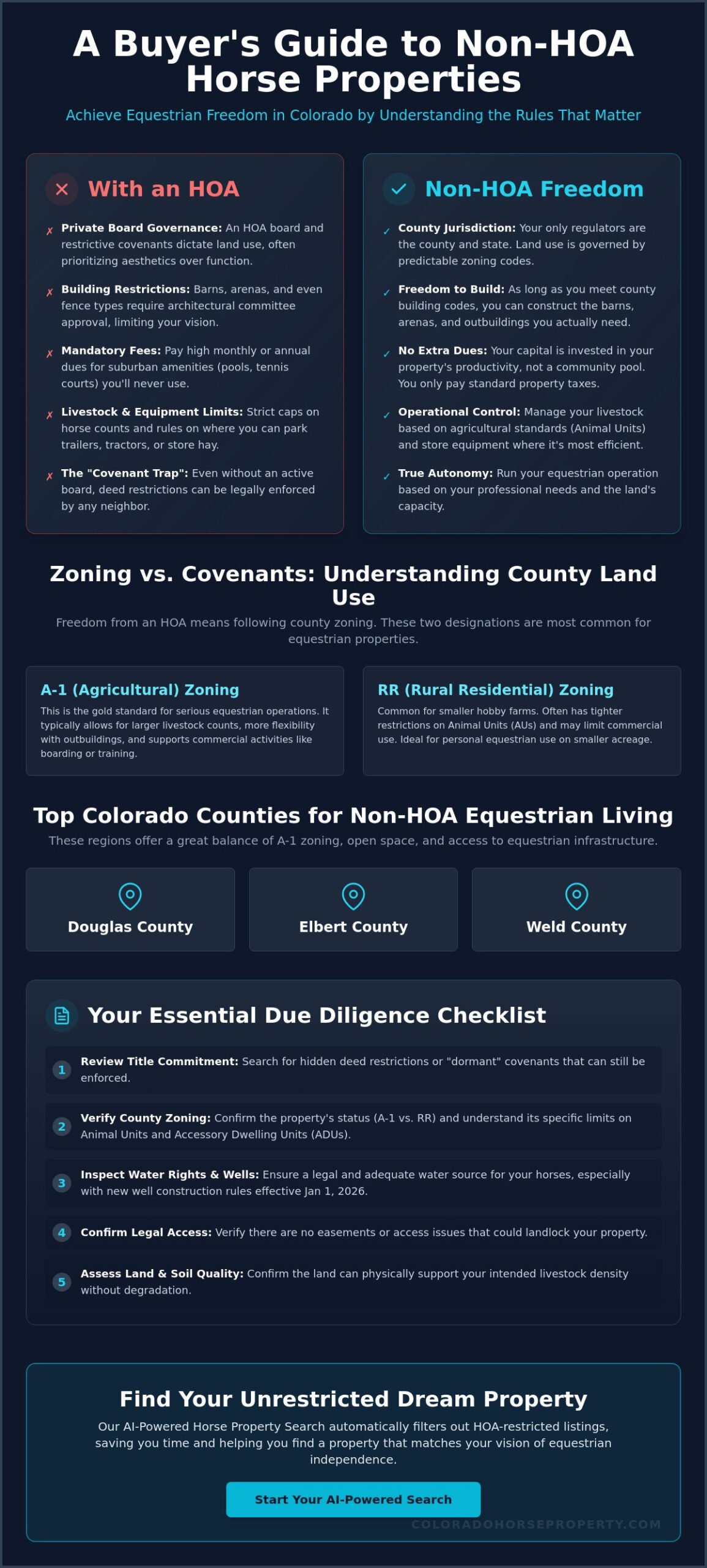
Due Diligence Checklist for HOA-Free Horse Property
Purchasing a horse property with indoor arena for sale Colorado without an HOA requires a shift in mindset. You are now the sole steward of your property rights and responsibilities. While you escape the oversight of a board, you also lose the collective management of shared infrastructure. This makes a rigorous due diligence period non-negotiable. You must look beyond the aesthetics of the farmhouse and the size of the stalls to evaluate the legal and physical integrity of the land itself. A mistake during this phase can result in restricted access, legal disputes with neighbors, or infrastructure that cannot support your equestrian goals.
Your first priority is a thorough review of the Title Commitment. Pay close attention to the Schedule B-2 exceptions. These are the specific items the title insurance will not cover. This section often contains “hidden” restrictions, such as old deed covenants or grazing rights held by third parties, that act exactly like an HOA even if no board exists. We also recommend testing the soil and forage quality early in the process. This confirms the land can actually support the livestock density you planned for in your animal unit calculations. If you are ready to start your search with a team that understands these technical hurdles, you can explore our specialized equestrian real estate listings today.
- Verify legal access: Never rely on a handshake deal for driveway access. Ensure all easements are recorded and transferable to you as the new owner.
- Structural barn inspections: Hire a professional familiar with agricultural buildings. An “as-is” indoor arena may have hidden drainage issues or structural fatigue that a standard home inspector will miss.
- Consult a specialized agent: Land-use trends in Colorado change quickly. An expert can tell you if a neighboring parcel is slated for high-density development that could impact your rural autonomy.
Easements and Access Rights
Utility easements are common on rural land, but they can be a dealbreaker if they bisect the area where you intend to build your arena. You must also evaluate private road maintenance agreements. In non-HOA areas, road upkeep is often a shared cost between neighbors. If there is no formal agreement in place, you could be left footing the bill for snow removal and grading. Additionally, check for bridge weight limits on the approach to the property. A bridge rated for standard cars might not support a fully loaded four-horse trailer or a hay delivery semi-truck.
Infrastructure and Utility Assessment
Standard residential power service is often insufficient for a professional-grade equestrian facility. Heated automatic waterers, high-output arena lighting, and wash rack heaters pull significant amperage. You must verify if the current transformer can handle an increased load. Similarly, if you plan to add a bathroom to your barn, you must confirm the septic system has the capacity for the additional fixtures. Finally, always order a new survey. Fence lines on non-HOA land are notoriously inaccurate. Knowing the exact boundary prevents future disputes when you begin cross-fencing or installing permanent paddock structures.
Finding Your Unrestricted Colorado Dream with AI Search
Searching for a horse property with indoor arena for sale Colorado often feels like a full-time job. Generic real estate platforms aren’t built for equestrians. They’ll show you a “horse property” that turns out to be a five-acre lot in a subdivision with strict limits on barn size or trailer parking. Our proprietary AI-Powered Horse Property Search changes this. We’ve designed our technology to filter out HOA-restricted listings automatically. This ensures every result aligns with your need for operational freedom and professional-grade infrastructure.
We focus on the assets that matter to your daily routine. You can target specific infrastructure like loafing sheds, multi-stall barns, and existing cross-fencing. This level of granularity is essential for managing the long-term legacy of ranches for sale colorado. We understand that a property isn’t just a house; it’s a specialized facility. It requires precise technical specifications to function properly, and our tools prioritize those needs over generic residential data.
The Advantage of AI-Powered Property Matching
Our system moves beyond basic keyword tags. It analyzes listing data to identify true equestrian utility. You can set custom parameters for specific acreage sizes and, crucially, verified water rights. Instead of manually checking every well permit, you receive real-time alerts for new non-HOA listings that meet your exact standards. Whether you need a horse property with indoor arena for sale Colorado or a sprawling working ranch, our system identifies the infrastructure you need. This is especially helpful in high-demand counties like Weld or Douglas, where the best unrestricted land moves quickly. You’ll see the right property before the general market even knows it’s available.
Expert Representation for Complex Land Deals
Finding the land is only half the battle. Closing an equestrian deal involves negotiating the transfer of agricultural equipment and complex water rights. This is where the 40 years of local experience provided by Mark and Alison Eibner becomes your greatest asset. We’ve navigated decades of shifting Colorado land-use trends. We know how to spot a bad deal before you sign a contract. Our team understands the nuances of transaction management for rural properties, ensuring that title and escrow services are handled with an eye for agricultural detail.
Specialized knowledge of horse property for sale in colorado prevents expensive mistakes. Whether it’s interpreting a complicated title commitment or verifying a domestic well’s production, we act as your seasoned partners. We don’t just facilitate transactions; we help you secure a lifestyle of freedom. If you’re ready to stop scrolling and start touring, Find Your Unrestricted Colorado Horse Property Now.
Secure Your Equestrian Legacy in Colorado
Achieving true independence on your land requires more than just avoiding a monthly fee. It’s about understanding the intersection of county zoning, the 2026 water well regulations, and the technical requirements of a working ranch. We’ve covered why non-HOA status is vital for those who need custom barns and unrestricted trailer parking, and how to perform the due diligence necessary to protect your investment. Finding a horse property with indoor arena for sale Colorado is the beginning of a long-term commitment to your lifestyle and your livestock.
Our team brings 40 years of Colorado real estate experience to every transaction. We use specialized AI-powered equestrian search tools to filter out the noise and focus on properties with verified water rights and agricultural utility. We understand the nuances of agricultural zoning because we’re peers to the community we serve. Don’t leave your property rights to chance when you can work with a seasoned expert who knows the terrain.
Find Your Unrestricted Colorado Horse Property Now. We’re ready to help you turn your equestrian vision into a permanent reality.
Frequently Asked Questions
Can I have horses on a property if there is no HOA?
Yes, you can have horses on a non-HOA property as long as the county zoning allows for livestock. While the absence of an HOA removes private restrictive covenants, you are still subject to local land use codes. You must verify the specific zoning designation, such as A-1 or Rural Residential, to determine the legal animal unit limits for that parcel.
What is the minimum acreage for a horse property in Colorado?
There is no single state-wide minimum acreage requirement. Limits are determined by individual counties and their specific animal unit (AU) calculations. For example, some counties allow horses on as little as 2.3 acres, while others require more space to meet setback requirements for a horse property with indoor arena for sale Colorado. Always check the county’s density rules before purchasing.
How do I find out if a property has an HOA?
The only certain way to identify an HOA is by reviewing the Title Commitment and Schedule B-2 exceptions. Listing descriptions and marketing materials are often inaccurate or incomplete. You should look for recorded declarations or protective covenants in the county clerk and recorder’s office. A specialized agent can help you interpret these legal documents to ensure the land is truly unrestricted.
Is a non-HOA property always better for horses?
A non-HOA property is better for owners who prioritize autonomy and custom infrastructure. It allows you to build barns and park trailers without seeking board approval. However, you lose access to shared amenities like community bridle trails or collective road maintenance. For professional trainers and serious competitors, the freedom to manage livestock without neighborhood oversight usually outweighs the loss of shared perks.
What are the risks of buying property with no HOA?
The primary risks involve neighboring land use and infrastructure maintenance. Without an HOA, you have little control over what a neighbor builds on their land, which could impact your privacy or views. You are also solely responsible for your portion of private road upkeep and snow removal. It’s vital to ensure there is a formal road maintenance agreement in place with other landowners.
How do water rights work for Colorado horse properties?
Water rights are governed by state-issued well permits that dictate how you can use your water. As of the 2026 updated regulations, it’s critical to confirm your permit is “Domestic” or “Stock” use. A “Household Use Only” permit is a dealbreaker because it legally prohibits you from watering horses or irrigating paddocks. You must verify the permit type through the Colorado Division of Water Resources.
Can an HOA be formed after I buy a non-HOA property?
An HOA cannot be forced upon you if your property deed is currently unrestricted. Forming a new HOA requires the unanimous voluntary consent of all affected landowners. However, you should be aware of dormant covenants. If old restrictions were recorded decades ago but never enforced, a neighborhood group could potentially vote to revive the association and begin enforcing those existing rules.
What is the difference between a ranch and a horse property?
The difference is primarily defined by scale and agricultural intent. A horse property is typically a smaller ranchette designed for equestrian training, boarding, or hobby riding. A ranch usually refers to a much larger operation involved in cattle grazing or commercial hay production. When looking for a horse property with indoor arena for sale Colorado, focus on the quality of the outbuildings and arena footing rather than just total acreage.