
What if your most profitable asset wasn’t a digital portfolio, but a 35-acre parcel with senior water rights and a functional 10-stall barn? Many equestrian enthusiasts and savvy investors ask, is buying a horse property a good investment in a market as unique as Colorado’s? It’s natural to feel concerned about high maintenance costs or the complex web of zoning and water rights that can impact your bottom line. You want a home for your horses that also builds long-term wealth, not a money pit that drains your savings.
We’ve helped clients master these rural landscapes for nearly four decades. This 2026 guide provides the clear financial framework you need to calculate real ROI while securing your lifestyle and dreams. You’ll discover how to leverage tax benefits like 1031 exchanges and why the Colorado market remains a resilient choice for land ownership. We’ll examine the specific data points that separate a hobby farm from a high-performing asset, giving you the confidence to move forward with your next acreage acquisition.
Key Takeaways
- Understand why equestrian real estate is emerging as a stable tangible asset class that can outperform volatile equity markets in 2026.
- Evaluate the financial drivers—including passive income streams and long-term land appreciation—to determine if buying a horse property is a good investment for your portfolio.
- Learn why Colorado’s Front Range remains a premier investment destination and how critical factors like water rights impact your property’s future value.
- Identify strategies to mitigate high maintenance costs and navigate the unique liquidity challenges of selling niche equestrian estates for a premium.
- Discover how modern AI tools and data analytics are uncovering “hidden gem” properties in the direct path of regional progress.
Is Buying a Horse Property a Good Investment? The 2026 Perspective
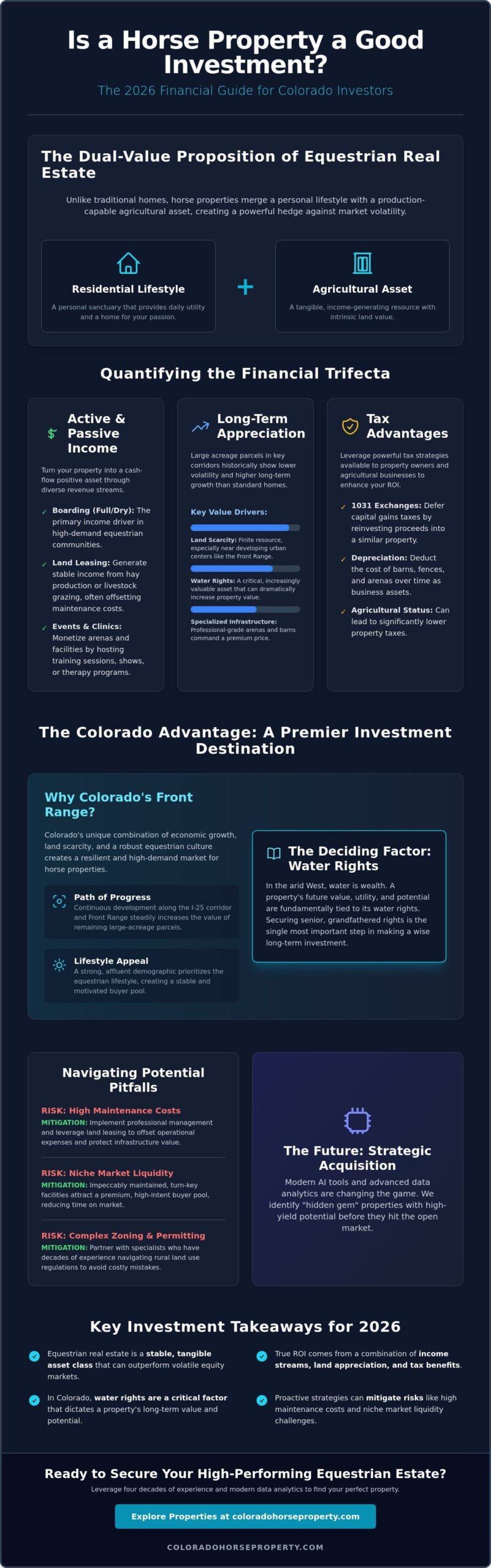
Horse property represents a unique specialty real estate class. It merges residential living with agricultural utility, creating a dual-purpose asset. In 2026, investors are pivoting toward tangible assets as a hedge against equity market volatility. While stocks and digital assets fluctuate, land remains a finite resource. When asking if buying a horse property is a good investment, you must look at the specific market dynamics of niche acreage. These properties often hold their value because they cater to a dedicated demographic that prioritizes lifestyle and land ownership over traditional suburban convenience.
To better understand this concept, watch this helpful video:
The Dual Nature of Equestrian Real Estate
Equestrian real estate offers a “Residential + Agricultural” value proposition. You aren’t just buying a home; you’re acquiring a production-capable asset. In Colorado, land scarcity in prime corridors like the Front Range or the I-25 belt drives long-term appreciation. Development continues to eat away at available rural land, making existing horse properties more valuable each year. Specialized improvements like professional-grade arenas, heated barns, and cross-fenced pastures attract a high-intent, premium buyer pool. These buyers often search for years to find the right setup, which creates a resilient price floor for well-maintained facilities.
Historical Performance vs. Traditional Real Estate
Historical data from the last decade shows that large-acreage parcels experience lower volatility than standard residential subdivisions. During economic shifts, the economic impact of the horse industry remains robust, fueled by a demographic with high disposable income. Suburban homes are often commoditized, but every horse property is unique. This uniqueness protects your equity. While a standard home might appreciate based on local school ratings, a horse property appreciates based on water rights, soil quality, and zoning permissions.
The intersection of financial ROI and “Lifestyle ROI” is where this investment truly shines. You’re saving on boarding fees while building equity in a physical asset you use daily. In 2026, the scarcity premium for horse properties represents the additional market value paid for land that possesses grandfathered water rights and existing equine infrastructure that is no longer easily permitted. Buying a horse property is a good investment because it secures a diminishing resource while providing a functional space for your passion.
Quantifying Financial Benefits: Income, Appreciation, and Tax Incentives
Investors often ask: is buying a horse property a good investment? The answer lies in the dual nature of the asset. It’s both a land play and a specialized business hub. Properties with 10 or more acres typically see higher long-term appreciation compared to standard residential lots because large, contiguous parcels are finite. Infrastructure like indoor arenas and professional-grade stables aren’t just for show. They add to the property cost basis, which can reduce your tax liability when you eventually sell. Professional management plays a key role here. A well-run facility ensures the infrastructure stays in top condition, protecting your initial capital while driving monthly cash flow.
Passive and Active Revenue Streams
Boarding is the primary income driver for most equine estates. Full board, which includes feed and stall cleaning, commands a higher price point but carries higher labor costs. Dry board, where the owner provides care, offers a lower but more stable margin. You can also lease land for hay production or cattle grazing. This preserves the land’s health and secures agricultural status. Hosting clinics, events, or equine therapy sessions can turn a private estate into a high-yield business. Success depends on local demand and the quality of your facilities.
- Boarding: High-demand areas can see waitlists for specialized care.
- Land Leasing: Leasing for hay or grazing can offset maintenance costs.
- Business Models: Equine therapy and clinics leverage specialized infrastructure for hourly or daily fees.
Strategic Tax Advantages for Investors
Tax incentives make these properties attractive for high-net-worth individuals. An agricultural tax classification, often called greenbelt status, can reduce property tax bills by 50% to 90% in many Colorado counties. You’ll need to demonstrate legitimate agricultural use, such as haying or breeding, to qualify. Understanding Colorado water rights is essential here, as your ability to irrigate directly impacts your ag status and total property value.
Investors can use a 1031 Exchange to defer capital gains taxes when upgrading to a larger ranch or estate. This keeps your equity working for you rather than losing a chunk to the IRS. Conservation easements offer another path. By legally protecting your land from future development, you may receive substantial state tax credits and federal deductions. These tools transform a lifestyle choice into a sophisticated financial strategy. If you’re ready to start your search, you can find your next Colorado horse property with our specialized tools. It’s a proven way to build wealth while enjoying the rural landscape.
The Colorado Factor: Water Rights and Regional Appreciation
Colorado isn’t just a scenic backdrop; it’s a strategic choice for equine land ownership. By 2026, the state population has continued its steady climb, putting immense pressure on available rural land near urban centers. When asking is buying a horse property a good investment, you have to look at the scarcity of usable acreage. The Colorado lifestyle acts as a permanent driver for property demand. People move here for the mountains and the space, which keeps horse properties insulated from many broader market corrections.
Understanding Colorado Water Rights and ROI
Water is the gold of the West. In Colorado, land without water is simply dirt. Resale value in 2026 hinges almost entirely on the security of a property’s water source. You’ll encounter three main types of water access:
- Adjudicated Rights: These are court-decreed rights with a specific priority date. They are the most secure and valuable.
- Well Permits: Most domestic horse properties rely on wells. In 2026, the “household use only” versus “domestic” (which allows for livestock) distinction is a deal-breaker for ROI.
- Ditch Shares: These represent a portion of a larger water company’s flow, essential for irrigating hay fields or pastures.
If you’re evaluating Water Rights in Colorado alongside existing infrastructure, you’re looking at a property with a much higher ceiling for appreciation. Without secure water, your long-term investment is at significant risk.
Front Range vs. Western Slope: Where to Invest?
The Front Range corridor remains the primary engine for appreciation. Douglas, Elbert, and Boulder counties are the top investment hubs for 2026. These areas offer proximity to major show circuits and high-paying jobs in Denver and Colorado Springs. In these counties, 10 to 35 acre parcels are in extremely short supply, leading to rapid equity growth. If you’re wondering is buying a horse property a good investment for a shorter five-year flip, the Front Range is the logical choice.
The Western Slope offers a different investment profile. This region focuses on larger parcels and a long-term hold strategy. It appeals to buyers seeking “off-grid” capabilities or massive acreage for private trail systems. While appreciation might be slower than the suburban-adjacent Front Range, the lower entry price per acre and the sheer size of the land provide a different kind of financial stability.
Climate factors now dictate land value more than ever. Properties with reliable wells and proactive fire mitigation are currently fetching 15 percent premiums over neglected counterparts. Buyers aren’t just looking for a barn; they’re looking for a sustainable ecosystem that can withstand the changing Western climate.
Mitigating Risks: Maintenance, Liquidity, and Zoning Pitfalls
Owning an equestrian estate is a significant financial commitment that goes far beyond the initial mortgage payment. High carry costs are the first reality check for any buyer. Perimeter fencing requires repair or replacement every 10 to 15 years; barns demand regular roof inspections and stall maintenance. These aren’t just chores; they are capital expenditures that directly impact your net return. When asking is buying a horse property a good investment, you must account for a maintenance budget that typically runs 1% to 3% of the property value annually.
Maintaining the main home is just as crucial for overall ROI as the barn; for those looking to modernize their residence, Cabinet refinishing Denver offers a professional solution to increase interior appeal and property value.
Liquidity is another factor to weigh. These are niche assets. According to market data from the last decade, equestrian properties often stay on the market 30% longer than standard residential homes. The buyer pool is smaller, which means you can’t always exit the investment quickly. However, the scarcity of high-quality, horse-ready acreage in Colorado often results in a higher final sale price for those who can afford to wait for the right buyer.
Zoning and Land Use Restrictions
Don’t assume you can keep five horses just because you have five acres. Many counties use “animal unit” formulas to determine density. One horse might equal one unit, but specific rural-residential zones might limit you to two units per 35 acres. It’s also vital to verify “grandfathered” uses. If a previous owner operated a commercial boarding stable, that permit might not automatically transfer to you. Always check for utility or conservation easements. A buried gas line or a protected wetland can instantly kill your plans for a new indoor arena or barn expansion.
Infrastructure Depreciation vs. Maintenance
Specialized improvements depreciate differently than the primary residence. A $250,000 professional dressage arena is a massive asset to a specific buyer, but it might add very little value to a buyer looking for a hobby farm. Over-improving for one specific discipline often hurts liquidity. For facility standards that maintain their value across different equine activities, see our Equestrian Real Estate Colorado Guide. Stick to versatile, high-quality builds to ensure your investment remains attractive to the widest possible market.
- Verify water rights and well production levels for livestock.
- Review soil samples to ensure proper drainage and forage quality.
- Inspect all existing fencing for safety and boundary accuracy.
- Confirm current zoning and review the county’s 10-year master plan for the area.
- Assess the “highest and best use” to ensure you aren’t paying development prices for agricultural land.
Ready to evaluate a specific parcel for its long-term potential? Search our current Colorado listings to see how land use and infrastructure impact market pricing today.
Strategic Acquisition: Using AI to Identify High-Yield Estates
Success in the 2026 market requires more than just a love for the outdoors. To determine if is buying a horse property a good investment for your specific portfolio, you need to look at data. Modern technology now identifies “hidden gems” that traditional searches miss. Investors use predictive modeling to find areas in the “path of progress,” where urban sprawl meets rural charm, driving up land value over time. Identifying these zones before they become mainstream is the key to capturing maximum equity growth.
Leveraging AI for Niche Property Search
The AI-Powered Horse Property Search tool changes the game for buyers. Instead of scrolling through thousands of irrelevant listings, the tool filters for specific ROI-driving features like senior water rights, specialized barn specs, and usable pasture acreage. You can compare price-per-acre data across different Colorado counties in real-time. This level of granularity ensures you aren’t just buying a home; you’re acquiring a strategic asset with measurable growth potential. It’s about finding the intersection of utility and appreciation.
The Importance of Decades of Expertise
Technology identifies the opportunity, but humans close the deal. Mark and Alison Eibner bring nearly four decades of specialized experience to every transaction. This history is vital when navigating the complexities of Colorado ag-rights and zoning laws. A “founder-forward” approach means you get direct access to their deep knowledge of the local landscape. They understand that a contract involving water shares or off-grid infrastructure requires a level of scrutiny that generalist realtors can’t provide. You can explore the latest Horse Property for Sale in Colorado to see how this expertise translates into high-quality listings.
The 2026 investment thesis is clear. Land remains the core asset while horses provide the lifestyle fulfillment. When you ask yourself is buying a horse property a good investment, consider the long-term appreciation of Colorado’s limited rural acreage. By combining cutting-edge AI tools with the seasoned guidance of experts who live the lifestyle, you secure a future that is both financially sound and personally rewarding. Land is finite; your opportunity to own a piece of it shouldn’t be left to chance. Consider these factors as you build your legacy:
- Water Security: Properties with established rights hold value better during climate shifts.
- Zoning Flexibility: Land that allows for additional structures or business use offers multiple exit strategies.
- Infrastructure Quality: High-end barns and arenas reduce immediate capital expenditure, boosting your initial ROI.
Ultimately, the marriage of data and experience allows you to move with confidence. You’re not just purchasing a ranch; you’re securing a tangible asset that serves your passion and your bottom line simultaneously.
Secure Your Equestrian Legacy and Financial Future
Owning a ranch in 2026 requires more than just a passion for the trail; it demands a strategic look at land utility and market shifts. You’ve seen how regional appreciation and complex water rights dictate the long-term value of these estates. When you factor in potential tax incentives and the rising demand for rural space, the question of whether is buying a horse property a good investment becomes clear for those who prioritize both lifestyle and capital growth. Success in this market hinges on navigating agricultural zoning and securing senior water rights that protect your land’s viability for decades to come.
Our team brings nearly 40 years of specialized Colorado real estate experience to your search. We use proprietary AI technology to filter listings for specific equestrian features like indoor arenas and fenced pastures, ensuring you don’t waste time on unsuitable parcels. We understand the technicalities of Colorado’s water laws and zoning restrictions that can make or break an acquisition. Your dream of owning a functional, high-yield estate is within reach when you have the right data and expertise on your side.
Start your AI-powered search for the perfect Colorado horse property today. Your ideal lifestyle and a solid financial future are waiting in the Colorado foothills.
Frequently Asked Questions
Is horse property more expensive to maintain than a regular home?
Maintenance on a horse property is typically 2% to 4% of the property value annually, which is significantly higher than the 1% standard for residential homes. You’ll face unique costs for fence repairs, barn roof maintenance, and pasture seeding. The University of Minnesota Extension notes that basic pasture management alone requires $100 to $200 per acre each year for fertilizer and weed control. These expenses are essential to protect your investment and ensure the land remains functional for equine use.
How many acres do I need for a property to be a viable investment?
You generally need a minimum of 35 acres in Colorado to secure an automatic domestic well permit under Senate Bill 35. While smaller 5-acre parcels are popular for personal use, the 35-acre threshold often makes the property a more viable long-term investment due to water security. Zoning laws in counties like Weld or Larimer frequently require at least 2 acres per horse. Larger acreage provides the flexibility needed for future development or maintaining an agricultural tax status.
Can I get a mortgage for a horse property as an investment?
You can get a mortgage for a horse property, but traditional lenders often limit land value to 30% of the total appraisal. If the land or outbuildings make up a larger portion of the price, you’ll likely need a specialized agricultural lender. These institutions often require a 25% down payment. Determining if buying a horse property is a good investment depends on your ability to secure these specific financing terms early in the process.
What is the “agricultural exemption” and how does it affect my ROI?
The agricultural exemption is a tax status that values land based on its productive capacity rather than its market price. In Colorado, this classification can lower your property tax bill by 50% to 80% compared to standard residential rates. To qualify, you must prove the land is used for a primary purpose like hay production or grazing. This tax savings directly improves your annual cash flow and overall ROI by keeping carrying costs low.
Do horse properties appreciate faster than standard residential homes?
Horse properties often appreciate at rates similar to residential homes, but they benefit from increasing scarcity in the market. The 2023 USDA Land Values report indicated a 6.7% rise in pasture land value across the United States. Because developers continue to subdivide large tracts, intact equestrian estates become rarer every year. This scarcity suggests that buying a horse property is a good investment for those seeking long-term capital gains in growing rural corridors.
What are the biggest red flags when inspecting an equestrian estate for investment?
The biggest red flags are poor soil drainage and unpermitted outbuildings. Inspect the stalls for “bottom rot” in the wood and check the arena for uneven footing that indicates a failing sub-base. A 2024 study on rural infrastructure found that replacing a damaged arena base can cost upwards of $30,000. Always verify that every barn and shed has a recorded permit with the county to avoid future legal liabilities and expensive tear-down orders.
How do water rights affect the resale value of a Colorado ranch?
Water rights are the single most important factor for resale value in the Colorado market. A ranch with adjudicated water rights or a high-priority well permit can sell for 30% more than a neighboring property without them. Without secured water, your ability to irrigate pastures or support livestock is severely limited. This makes water documentation the first thing a savvy buyer looks for during the due diligence period to protect their investment.
Is it better to buy a turnkey property or build my own equestrian facilities?
Buying a turnkey property is usually more cost-effective than building new facilities in the current market. Construction costs for professional barns now range from $80 to $150 per square foot, and permitting can take over 12 months. When you buy an existing estate, you’re getting infrastructure at a depreciated cost. This allows you to start living your lifestyle and dreams immediately while avoiding the inflation risks and delays associated with new construction.