
Could a ranch’s airstrip look suitable in a listing but be a poor fit for the way you fly? Colorado ranches with private airstrips can offer direct access to remote country, but a runway mention alone won’t tell you whether it suits your aircraft, travel patterns, or comfort with local conditions. Elevation and terrain make a property-specific review especially important.
The appeal is clear: aviation access alongside acreage, ranch infrastructure, and room for a rural lifestyle. The challenge is weighing those features without letting the airstrip overshadow the rest of the property. Start with what you need from the strip, then compare how each ranch supports your intended use. This guide covers aircraft fit, runway and hangar details, access, ranch infrastructure, and due diligence for records, land use, and site conditions. Use one checklist across properties, keep unknowns separate from verified facts, and assess each strip against your aircraft and plans before moving forward.
Key Takeaways
- Evaluate an airstrip in context: its fit with your aircraft, travel patterns, and ranch plans matters more than its presence in a listing.
- Separate advertised runway details from information that needs property-specific verification, including approach, access, and operating conditions.
- Compare Colorado ranches with private airstrips using consistent criteria for aviation utility, hangar space, ranch infrastructure, and verification status.
- Organize due diligence around records, land-use context, access, infrastructure condition, and ongoing responsibilities.
- Define aviation and ranch priorities before searching, then use specialized property criteria to narrow listings and guide buyer representation.
What Makes Colorado Ranches With Private Airstrips Different?
A private ranch airstrip is an on-property runway intended to provide private aviation access. With public airport access, you fly to an airport available to public users and continue to the ranch by ground. This distinction describes the access arrangement, not a blanket statement about who may land or under what conditions. An airpark is a related but distinct concept, generally combining residential property and aviation facilities; see What is an Airpark?
A Colorado airport approach can illustrate why terrain belongs in an aviation discussion, but an airport video cannot establish the suitability of a ranch runway. This landing at Telluride offers regional context, not a substitute for evaluating a specific parcel.
What does a private airstrip on a ranch usually involve?
Assess the airstrip as a group of features, not a single checkbox. The runway has a surface, dimensions, and condition. The approach area affects how an aircraft reaches it. Ground access connects the strip to the home, hangar, or ranch roads. A hangar may be present, absent, or configured in a way that doesn’t meet your needs. These details vary by property, so don’t assume one listing’s infrastructure is standard across the market.
Listing language is a starting point for questions, not proof of operational suitability. “Private runway” doesn’t tell you whether the runway characteristics align with your aircraft or intended use. Record each advertised feature separately, then distinguish listing claims from information supported by records or an independent, property-specific assessment.
Why Colorado’s setting belongs in the first review
Colorado isn’t one uniform flying environment. A parcel’s elevation, surrounding terrain, and exposure to local weather conditions all belong in the initial review. A runway’s apparent length or clear space in a listing photo can’t show how the specific site works for your aircraft and approach needs.
Listings in Gateway and Walsenburg are examples of locations buyers may encounter, not a basis for generalizing about conditions across the state. Compare the actual site and its setting with your aircraft, flight patterns, and ranch plans. This helps distinguish a compelling headline feature from infrastructure that supports your intended use.
How to Assess a Colorado Ranch Airstrip for Your Aircraft
Assess each strip against the aircraft you intend to fly, then compare properties using the same checklist. Listing materials can provide useful starting information, but they don’t establish how a runway performs for your aircraft or under the conditions you expect to encounter. Keep advertised details separate from those that need independent, property-specific verification.
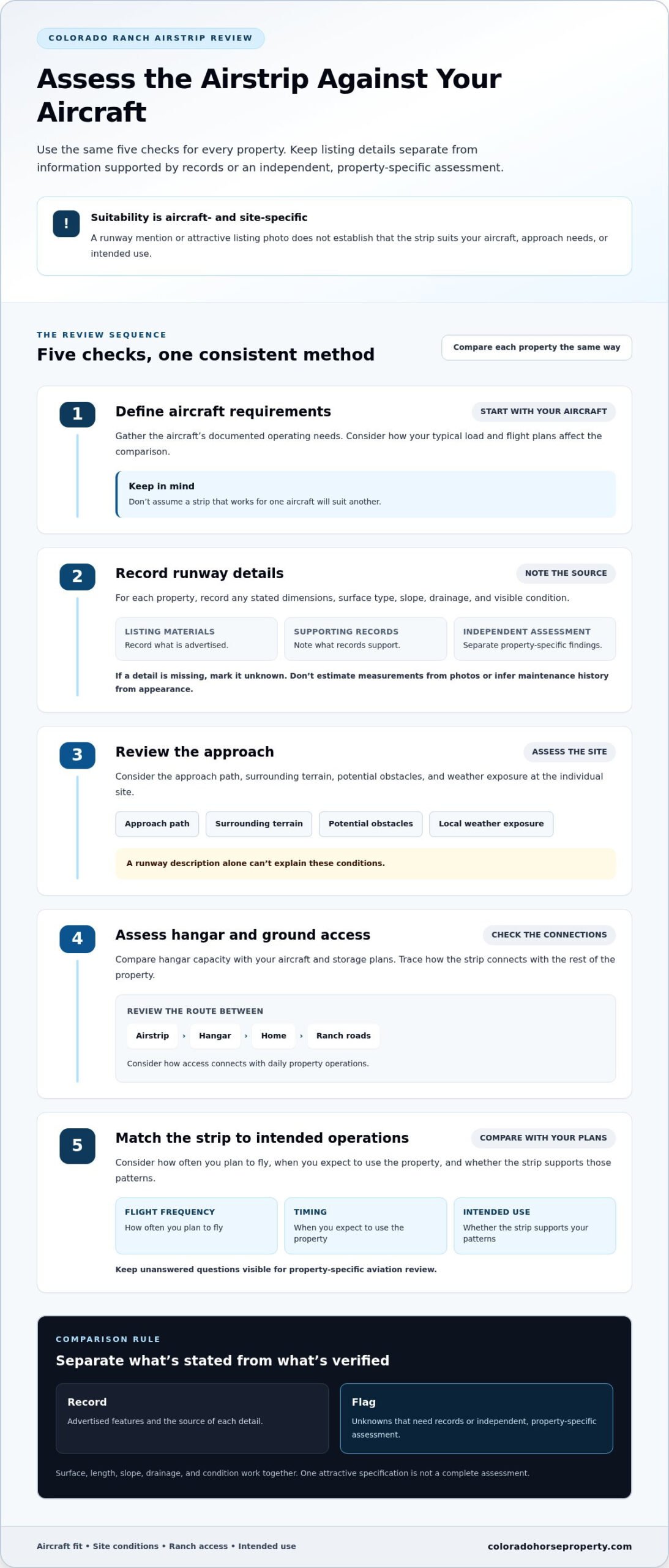
Runway suitability depends on the aircraft’s documented specifications and verified conditions at the site. Use this sequence to organize your review and identify gaps:
- Define aircraft requirements. Gather the aircraft’s documented operating needs and consider how your typical load and flight plans affect the comparison. Don’t assume a strip that works for one aircraft will suit another.
- Record runway details. Note any stated dimensions, surface type, slope, drainage, and visible condition. Label the source of each detail, such as listing materials, supporting records, or an independent assessment.
- Review the approach. Consider the approach path, surrounding terrain, potential obstacles, and weather exposure at the individual site. A runway description alone can’t explain these conditions.
- Assess hangar and ground access. Compare hangar capacity with your aircraft and storage plans. Trace the route between the strip, hangar, home, and ranch roads, including how it connects with daily property operations.
- Match the strip to intended operations. Consider how often you plan to fly, when you expect to use the property, and whether the strip supports those patterns. Record unanswered questions for property-specific aviation review.
Which runway details should a buyer compare?
Create one row per property and enter only stated or verified information. Mark unknown details as unknown rather than filling gaps with visual estimates. Surface, length, and slope can affect aircraft compatibility; drainage and maintenance condition can influence how the strip performs over time. These factors work together, so one attractive specification isn’t a complete assessment.
Compare recorded details with the intended aircraft’s documented operating needs. If a listing omits dimensions, gives only a broad surface description, or says little about runway condition, flag the gap. Don’t estimate measurements from photos or infer maintenance history from a well-kept appearance.
How do approach, hangar, and access affect everyday use?
Review the site as a connected system. Consider the approach alongside nearby terrain, potential obstacles, and local weather exposure. Judge hangar capacity in relation to your aircraft and storage plans. Ground access matters too: the strip may be less practical for your routine if the route to the residence, equipment, or ranch operations is inconvenient.
A consistent checklist helps you compare Colorado ranches with private airstrips without letting headline features outweigh practical fit. A specialized Colorado ranch property search can help organize aviation criteria alongside acreage, barns, water, and other property priorities.
Compare Airstrip Ranches by Aviation Utility and Ranch Function
A consistent comparison keeps a runway’s appeal from eclipsing the rest of the property. Before reviewing listings, rank your aviation requirements and ranch priorities separately. Then assess each property against both lists. Colorado ranches with private airstrips can differ substantially in how their aviation features support a buyer’s plans, even when listings use similar language.
Use a comparison sheet to record what is stated, what is verified, and what remains unknown. “Not stated” is more useful than an assumption based on photos or acreage.
| Criteria | Compare across properties | Priority can vary by use |
|---|---|---|
| Aircraft fit | Match documented aircraft needs to verified site conditions. | Central for every buyer, especially frequent flyers. |
| Runway information | Record stated dimensions, surface, condition, and other available details. | Occasional users may accept less convenience; regular travel makes dependable fit a greater priority. |
| Hangar | Compare capacity, condition, and access with storage plans. | May be optional for occasional visits, more useful for frequent use or aircraft storage. |
| Access | Review approach context and the route from runway to home and ranch roads. | Regular travelers may value a simpler routine; ranch operations may need practical links to work areas. |
| Ranch infrastructure | Assess residence, barns, pasture, water, and acreage as distinct features. | Weight each according to intended land use, not as a proxy for runway suitability. |
| Verification status | Label each item as listing-stated, independently verified, or unresolved. | Resolve important unknowns before relying on a feature in your decision. |
Which features are essential and which are preferences?
Set your must-haves before touring. Rank aircraft compatibility, access, storage, and how often you expect to fly. Separately identify the ranch functions the property needs to support, such as suitable pasture, barns, water, or a residence that works for your household. Then list preferences, including additional recreational facilities. A larger parcel or longer amenity list doesn’t automatically mean a better aviation fit.
How should aviation and ranch priorities be balanced?
Consider the whole operating picture. A property may offer a runway worth evaluating but lack a barn or pasture arrangement central to your plans. Another may align with your ranch needs while requiring closer review of its aviation details. Compare those trade-offs without allowing any single feature to decide the purchase. Keep acreage, water rights, barns, pasture, and residence as separate criteria, and assess water rights and land-use considerations on their own terms.
For broader land evaluation, consult a Colorado land buying guide alongside your aviation comparison. The goal is a property that works as a complete ranch and fits your intended flying, not a headline feature that overshadows either.
Colorado Airstrip Ranch Due Diligence: Records, Use, and Site Conditions
For Colorado ranches with private airstrips, due diligence means testing listing descriptions against the property’s records, actual condition, and intended use. Organize the review so aviation questions don’t crowd out title, access, and ranch considerations. FAA and Colorado aviation information can help frame research, but requirements and permissions must be checked for the specific property and current circumstances.
What records and permissions need property-specific review?
Build a file around the airstrip and the land beneath and around it. Separate documents already available from questions still to resolve. Use this checklist to keep the review organized:
- Aviation information: Gather available records describing the runway and its use. Treat FAA and Colorado aviation sources as research references, then verify which current requirements apply to the property.
- Land-use context: Identify the county jurisdiction and review relevant land-use information for the parcel and airstrip. Don’t assume a listing description settles which uses are allowed.
- Title and access: Review title documents, recorded access, and easements connected to reaching and using the strip. Determine how routes cross the property and whether access involves other land.
- Permissions and operating limits: Document available permissions or stated restrictions, and identify what remains unresolved. No single record should be treated as proof of unrestricted operations.
- Ongoing responsibilities: Find available information about maintenance, access arrangements, and responsibility for shared or on-site features. Record open questions rather than relying on assumptions.
This record-based approach helps distinguish a documented feature from an expectation. It also keeps county, title, access, and aviation questions visible for qualified, property-specific review rather than leaving them until the end of the process.
What physical conditions deserve a closer look?
Review the strip and its surroundings on site. Note the runway surface, drainage, visible wear, boundaries, and connection to ranch roads. Compare observed conditions with available maintenance information. Look beyond the runway itself: nearby obstructions, terrain, and weather exposure can affect the specific site, so don’t generalize from another Colorado property or region.
Keep the broader land review alongside aviation due diligence. Access routes, water considerations, and land use can affect how the ranch functions, independently of the runway. A Colorado land due-diligence framework helps keep these questions in view as you evaluate the full property.
Because these purchases combine aviation features with land, infrastructure, and title considerations, specialist buyer representation can help organize the search and keep property-specific questions moving through the transaction. Explore buyer representation for Colorado ranch properties as you assess your next steps.
Find and Evaluate Colorado Ranches With Private Airstrips
A focused search turns a specialized property goal into criteria you can compare. Define your aviation needs, set ranch priorities separately, compare listings using the same framework, and then move into property-specific due diligence. This sequence keeps a prominent runway feature in perspective alongside the land, buildings, access, and intended use.
How to turn aviation needs into searchable property criteria
Write a short search brief before reviewing listings. Keep flight and ranch criteria in separate groups so a strong match in one area doesn’t obscure a mismatch in another.
- Define aviation priorities. Note your aircraft, documented operating needs, preferred runway information, hangar or storage needs, likely travel patterns, and location considerations.
- Set ranch requirements. List acreage, water, barns, pasture, residence, and other property features based on how you plan to use the land.
- Compare listings consistently. Record what each listing states, what remains unknown, and which features are essential versus preferred.
- Advance to due diligence. For properties worth pursuing, organize the records, site conditions, access, and land-use questions that need property-specific review.
AI-powered horse-property search can help organize specialized criteria and surface relevant property features, including acreage, barns, and water. Treat search results as a way to structure discovery, not as confirmation that a runway fits your aircraft or intended operations. The next step is reviewing each property’s actual details.
What specialist buyer representation adds to the process
A complex ranch purchase brings aviation considerations together with land, improvements, access, title, and transaction details. Buyer representation can support the process from initial search through property evaluation and transaction coordination. Mark and Alison Eibner lead the business, and Realty Oasis has served the Colorado Front Range for approximately 40 years.
As you narrow the field, keep unresolved property-specific questions visible and work through them as part of the purchase process. An organized search helps you make an informed decision that reflects both your aviation plans and the way you intend to use the ranch.
Explore Colorado ranch and horse-property search to organize your property criteria and buyer representation needs.
Make Your Next Property Search More Intentional
The right ranch should support the life you want to build, not just look compelling in a listing. Before taking the next step, decide which trade-offs you’re comfortable making and which would change how you use the property. That clarity helps focus your search on Colorado ranches with private airstrips that align with your priorities, rather than features that may not matter in daily life.
Give yourself room to compare thoughtfully. A property search is more productive when your goals are clear and listing details can be explored in context. You don’t need to have every decision settled before you begin. Start with the essentials, refine your criteria as you learn, and use buyer representation to move from a shortlist toward a well-considered purchase.
Explore Colorado ranch and horse-property search to take the next step toward finding a property that fits your plans. A focused search can turn your priorities into a practical path forward.
Frequently Asked Questions
Can any aircraft use a private ranch airstrip?
No. Compatibility depends on the aircraft’s operating requirements and the specific runway and approach conditions, not simply on the fact that the strip is private. Compare the property’s verified details with the aircraft’s documentation, including the configuration and load you expect to fly. A runway suitable for one aircraft may not suit another. A listing’s general description can’t replace an aircraft-specific evaluation by the pilot.
What should I check before buying a Colorado ranch with an airstrip?
Look beyond the runway description and assess whether the property’s aviation feature fits your planned use. For Colorado ranches with private airstrips, compare listing claims with records, note when condition information was gathered, and determine whether seasonal changes could affect your intended schedule. Review the ranch independently too: assess whether its access, residence, water, and working improvements fit your plans rather than assuming the airstrip defines the property’s overall value.
Does a private airstrip mean a ranch is approved for all flight operations?
No. The word “private” doesn’t establish that every pilot, aircraft, guest, or type of operation can use the strip. Restrictions or approval procedures may apply at an individual property. For example, the Crested Butte Airpark requires prior approval, proof of insurance, and pilot testing for guest landings. Treat that as a property-specific example, not a rule for every ranch.
How do I compare grass and paved ranch airstrips?
Compare the actual condition and characteristics of each strip, not just the surface label. A grass runway and a paved runway can differ in maintenance needs, drainage, and how they match your aircraft’s documented operating requirements. Review available information about upkeep and observed condition, then consider how those details relate to your planned use. Neither surface type is automatically the better choice for every aircraft or property.
Can an airstrip-equipped ranch also work for horses or livestock?
Yes, a ranch may combine aviation access with horse or livestock use, but the layout matters. Consider whether fencing, gates, pasture rotation, and routes between barns and working areas fit the way you manage animals. Think through how aircraft movements and ranch activity could share space, and identify where separation or scheduling may be needed. Evaluate animal facilities and land use on their own merits; an airstrip doesn’t establish that the ranch is livestock-ready.
What does a hangar add to a ranch with a private airstrip?
A hangar can provide enclosed aircraft storage, but its practical value depends on the building and your plans. Compare interior dimensions, door clearance, access, and the space needed to move or service your aircraft. Consider whether the route between the hangar and runway works for your routine. A hangar is a separate property feature, not proof that the runway suits your aircraft or that your storage needs are met.
Are private airstrip ranches found in different parts of Colorado?
Listings can appear in different parts of the state. Gateway and Walsenburg are examples of locations represented in reviewed listings, but they don’t describe the full search area or establish what is currently available. As you look across Colorado, compare each parcel on its own merits, including how its location fits your travel plans and ranch priorities. Keep the same evaluation criteria as you move between regions and listings.