
What if that stunning five-acre parcel with a panoramic Front Range view is actually a legal liability because of a single missing sentence in a water decree? In the 2026 market, the beauty of the land matters far less than the legal rights attached to it. You understand that your horses need more than just a fenced pasture; they need secure water, proper zoning, and functional infrastructure that won’t result in a code violation next year.
We’ve spent 40 years helping buyers master the complexities of how to buy horse property in Colorado, and we’ve seen how quickly a dream can stall without the right expertise. This guide provides a clear roadmap to manage today’s competitive landscape with confidence. You’ll learn how to secure properties with adjudicated water rights, understand the true cost of ownership, and find functional barns using our proprietary AI-powered search technology. We’ll walk through the essential steps of evaluating equestrian zoning and animal units so your investment remains protected for the long haul.
Key Takeaways
- Define the legal requirements for equestrian real estate and understand how 2026 market trends influence property values across the Front Range.
- Learn how to buy horse property in Colorado by prioritizing adjudicated water rights and verifying local zoning laws regarding animal units.
- Evaluate existing infrastructure like barns and arenas for structural integrity, drainage, and footing suitability before committing to a purchase.
- Leverage proprietary AI-powered search tools to automatically filter for specific equestrian features that traditional real estate sites often miss.
- Navigate the complexities of agricultural addendums and title coordination to ensure a secure transaction for multi-parcel properties.
The Landscape of Colorado Equestrian Real Estate in 2026
Colorado’s appeal for horse owners hasn’t faded, but the 2026 market demands a technical approach. Buyers are moving away from general-purpose ranches toward highly specialized equestrian estates. These properties prioritize specific drainage for arenas and proximity to trail systems over simple grazing acreage. Understanding how to buy horse property in Colorado starts with recognizing that “equestrian” is now a legal and functional classification, not just a lifestyle description.
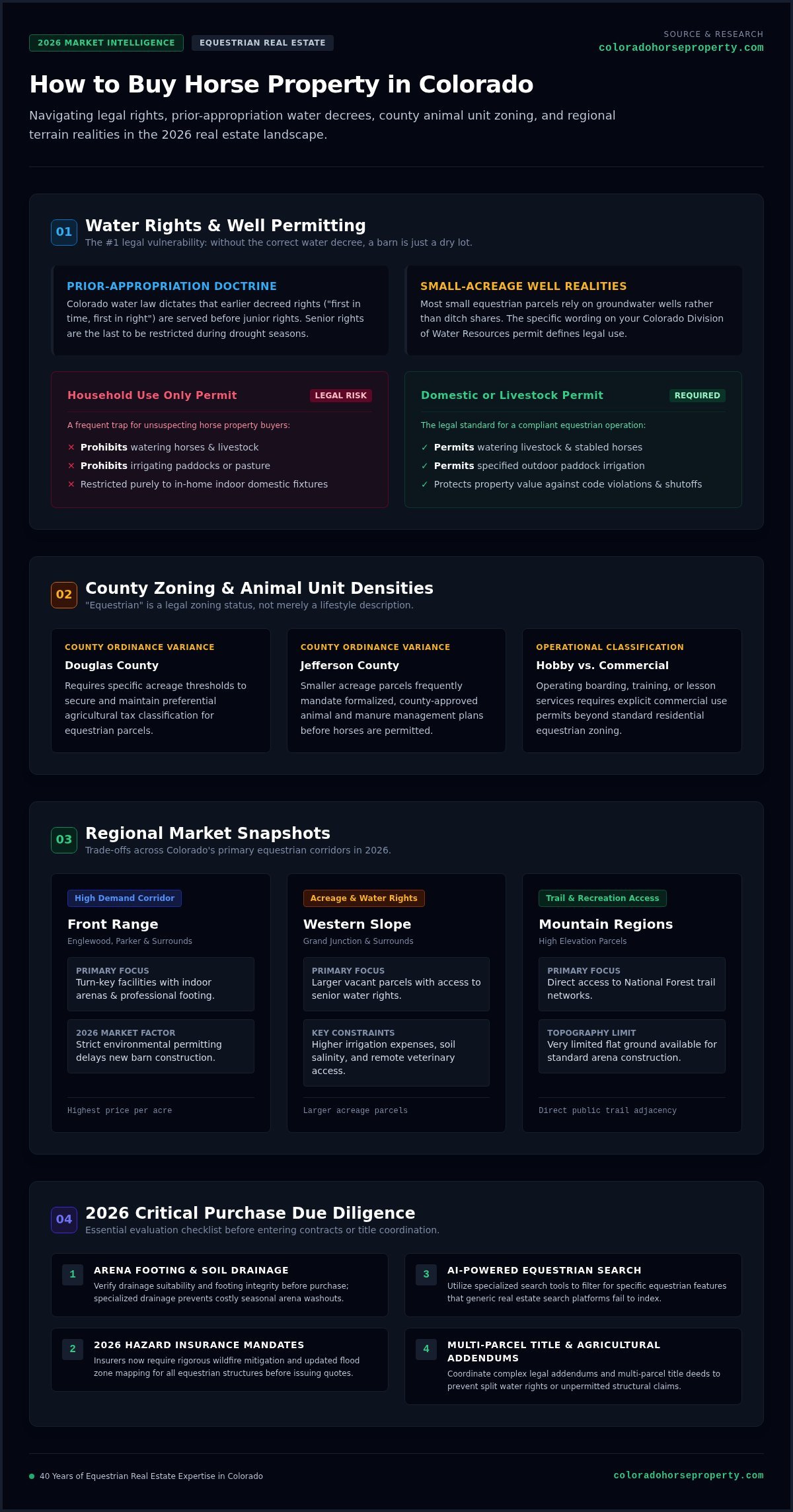
Success in this market requires a firm grasp of the prior-appropriation water rights doctrine. This legal framework determines who gets water first during dry seasons, which is a critical factor for maintaining pastures and livestock. Without a clear water decree, even the most beautiful barn is essentially a dry lot. You’ll need to verify that your potential property has the legal right to use well water for horses, as domestic-only permits don’t cover livestock needs.
To better understand the financial and legal realities of this investment, watch this helpful video:
Understanding the ‘Colorado Horse Property’ Definition
A “legal” horse property is defined by county-level zoning ordinances that dictate “animal units” per acre. In Douglas County, you might need a specific acreage to maintain agricultural tax status, while smaller parcels in Jefferson County may allow horses only with approved management plans. An equestrian house in Colorado is a residential dwelling situated on land specifically zoned to allow the permanent stabling and care of horses according to local animal unit densities. The distinction between a hobby farm and a professional facility often hinges on whether the land has a commercial use permit for boarding or training services.
Regional Market Snapshots: From Englewood to Grand Junction
The Front Range, including areas like Englewood and Parker, remains the highest-demand corridor. Here, you’ll find premium prices and a focus on properties with existing infrastructure, as building new barns can be delayed by 2026’s strict environmental permits. Conversely, the Western Slope near Grand Junction offers more vacant acreage, but buyers must account for higher irrigation costs and soil salinity. When learning how to buy horse property in Colorado, you must also factor in regional hazards. 2026 insurance policies now require rigorous wildfire mitigation and updated flood zone mapping for all equestrian structures before they’ll issue a quote.
- Front Range: High competition for “turn-key” facilities with indoor arenas and professional footing.
- Western Slope: Greater availability of larger parcels with senior water rights but more remote veterinary access.
- Mountain Regions: Limited flat ground for arenas; focus on properties with direct access to National Forest trails.
Navigating Colorado-Specific Legalities: Water Rights and Zoning
Legal due diligence is the most critical phase when you’re learning how to buy horse property in Colorado. Unlike standard residential transactions, equestrian deals often hinge on “invisible” assets like water decrees and zoning variances. If you purchase a property without verifying these details, you could find yourself owning a beautiful home where it is technically illegal to keep even a single horse. The 2026 market has seen stricter enforcement of groundwater regulations, making it vital to understand exactly what your deed includes.
The distinction between senior and junior water rights is a primary concern. Senior rights are those established earliest and are the last to be shut off during a drought. Most small-acreage horse properties rely on wells rather than ditch shares. You must consult the Colorado Division of Water Resources well permitting guidelines to identify your permit type. A “Household Use Only” permit is a common trap; it strictly prohibits watering livestock or irrigating a small paddock. For a functional horse property, you generally need a “Domestic” or “Livestock” permit that explicitly allows for the watering of animals.
The Buyer’s Guide to Colorado Water Law
Verifying water claims requires more than just reading a listing. You need to investigate the role of local ditch companies if the land includes irrigation rights. These companies have their own bylaws and assessment fees that impact your total cost of ownership. Before closing, your due diligence should include a professional water well inspection and a review of the state’s database to ensure the well’s production matches the needs of your herd. Our specialized AI-powered search can help you filter listings specifically for properties with confirmed livestock-eligible permits.
Zoning and Land Use Regulations
Zoning determines “animal units,” which is the legal limit on how many horses you can keep per acre. While Douglas County might allow one horse per half-acre in specific zones, other Front Range counties require a minimum of 35 acres to avoid intensive use permits. You must also account for:
- Variances: Special permissions required for building large indoor arenas or high-occupancy barns.
- Conservation Easements: Legal agreements that may permanently restrict where you can build new infrastructure.
- HOA Covenants: Private rules in equestrian communities that might dictate the color of your fencing or the hours you can use a shared arena.
Understanding how to buy horse property in Colorado means looking past the pasture and into the county records. Checking for existing easements or set-back requirements now prevents expensive legal battles later. Always ensure that any existing barns or shelters were built with the proper permits, as unpermitted structures can complicate your insurance and future resale value.
Evaluating Equestrian Infrastructure: Barns, Arenas, and Pasture
When learning how to buy horse property in Colorado, you’ll quickly realize that infrastructure determines the true value of the land. A beautiful home is a secondary consideration if the barn is poorly ventilated or the arena footing is unsafe for your horses. We’ve spent 40 years evaluating these facilities, and we know that “equestrian ready” means different things to different sellers. Your goal is to find a property where the bones of the operation are solid, allowing you to focus on riding rather than expensive structural repairs.
Barn and Stable Essentials
Colorado’s climate features extreme temperature swings; a well-designed barn must have superior ventilation to prevent respiratory issues during winter when buildings are closed up. You should look for “freeze-proof” hydrants and insulated plumbing to ensure your horses have access to water during a deep freeze. Electrical systems must be encased in conduit to prevent rodents from creating fire hazards. A functional layout includes a centrally located tack room, a wash rack with proper drainage, and hay storage that’s accessible but safely separated from the stalls to mitigate fire risks.
The Professional Riding Arena
Evaluating an arena requires looking beneath the surface. Snowmelt is a major factor in the Rockies, so the base layer must have a slight grade for drainage to prevent pooling. Footing should be discipline-specific; what works for a reiner won’t support a grand prix jumper. Indoor arenas offer year-round utility but come with higher property taxes and maintenance costs. Outdoor arenas are more common but require careful site selection to avoid wind-scoured areas or low spots where water collects. Our AI-powered horse property search allows you to filter specifically for these infrastructure assets, saving you hours of manual vetting.
Pasture management at high altitudes is a specialized skill. Colorado’s arid environment means the grazing capacity is much lower than in the Midwest. You’ll likely need to implement rotational grazing or sacrifice paddocks to maintain soil health. For research-backed guidance on carrying capacity and dryland grazing, consult the CSU Extension small acreage management resources. Fencing choice is equally vital for this landscape:
- Pipe Fencing: Durable and visible, though it requires more upfront investment.
- Specialized Non-Climb Wire: Excellent for keeping predators out and horses in, especially when paired with a top rail.
- High-Tensile Vinyl: Provides a traditional look but must be rated for extreme cold to prevent becoming brittle.
Understanding how to buy horse property in Colorado means looking past the pasture and into the technical specifications of the improvements. Checking for existing permits on barns and arenas now prevents expensive legal battles or insurance denials later.
Mastering the Search: Using AI to Find Your Colorado Dream Ranch
Finding the right property in a competitive market requires more than just scrolling through general listings. Most generalist portals use broad keyword filters that surface homes with a “horse” themed painting just as often as a functional ten-stall barn. When you’re learning how to buy horse property in Colorado, you need tools that understand the specific needs of livestock owners. Our proprietary AI-powered search technology bridges the gap between raw data and equestrian utility.
This technology analyzes property features automatically. It identifies the presence of arenas, round pens, and outbuildings without relying on a listing agent’s often-incomplete description. It allows you to filter for “must-haves” like specific arena dimensions or senior water rights decrees. By moving beyond the standard MLS, we help you access off-market and pocket listings that never hit the public portals. This proactive approach is essential in 2026, where the best land is often traded within specialized networks before a sign ever hits the dirt.
The Evolution of Equestrian Real Estate Tech
The Realty Oasis platform represents a shift in how we categorize land. We use satellite data and AI to assess pasture health and grazing capacity from above, providing a preliminary look at soil quality before you even schedule a showing. This hyper-specialized search is designed for high-intent buyers who don’t want to waste time on properties that lack basic equestrian zoning. You can Find CO Horse Property Faster with Our AI Search Tool by focusing on data that generalist sites ignore.
Setting Your Search Parameters
Defining your “radius of search” is a balancing act between lifestyle and location. Many buyers start with a wide net around major hubs like Denver or Grand Junction, then narrow down based on facility quality. It’s easy to fall in love with a renovated kitchen, but you can’t easily move a professional-grade indoor arena. Prioritize the land and infrastructure first. You can always update a house, but you can’t manufacture more acreage or change a county zoning code. To see how these tools can streamline your journey, start your specialized AI-powered horse property search today.
To maximize your success, follow these five steps for a high-intent search:
- Establish your search radius: Determine your maximum commute to veterinary services and supply stores.
- Prioritize infrastructure: Filter for barn type and arena size before house specifications.
- Verify legal status: Set parameters for adjudicated water rights and specific animal unit zoning.
- Use AI imagery: Inspect pasture layout and fencing condition through high-resolution satellite views.
- Access the network: Connect with specialists who hold off-market listings in your target county.
Understanding how to buy horse property in Colorado involves leveraging technology to see what others miss. By focusing on the technical requirements of your horses from the start, you ensure the property remains a functional asset for years to come.
Securing the Transaction: Why Expert Representation Matters
Buying a home in a suburban cul-de-sac is a relatively simple process. Buying a working ranch is a technical and legal undertaking that requires a specific set of skills. You’re not just purchasing a residence; you’re acquiring water decrees, zoning permissions, and specialized infrastructure. Generalist agents often miss critical red flags, such as unpermitted structures or wells that don’t allow for livestock use. Mastering how to buy horse property in Colorado requires an advocate who understands the difference between a decorative fence and a functional one.
Contractual complexity is the norm in 2026. Equestrian contracts often involve detailed agricultural addendums that cover everything from manure management plans to the transfer of grazing leases. Our team’s 40 years of Front Range experience ensures that every parcel, whether it’s a single five-acre lot or a multi-parcel estate, is correctly identified and cleared through title and escrow. We manage the specialized transaction details so you can focus on the lifestyle you’re building.
The Due Diligence Period for Ranches
The inspection period for a horse property is far more intensive than a standard home walk-through. You’ll need to conduct environmental assessments and soil testing, particularly in areas slated for arena construction. Soil quality impacts everything from drainage to the health of your pasture. You must also verify boundary lines and access easements. It’s common for rural properties to have “handshake” agreements for trail access that don’t hold up in a legal transaction. If the sale includes agricultural equipment, like tractors or harrows, these must be itemized and inspected for structural integrity before the deadline passes.
Closing Your Equestrian Dream
The final transition involves more than just handing over keys. You must ensure the legal transfer of water rights and livestock permits through the proper state agencies. A mistake here can leave you with land you can’t legally use for your horses. Partnering with a brokerage that understands your lifestyle ensures these details aren’t overlooked. You deserve Expert Buyer Representation for Your Colorado Property to manage your transaction from the initial AI-powered search to the final signature at the closing table. Our specialized focus means we don’t just find you a house; we secure the foundation for your equestrian future.
Securing Your Equestrian Future in the Rockies
Success in the 2026 market requires a shift from viewing acreage as just land to seeing it as a complex legal and functional asset. You now understand that the secret of how to buy horse property in Colorado lies in the technical details; adjudicated water rights, county-specific zoning, and infrastructure built to withstand the unique Colorado climate. By prioritizing these factors over cosmetic home features, you ensure your investment remains a sanctuary for your horses and a secure legacy for your family. The right land provides more than just a view; it provides the freedom to pursue your passion without legal or logistical hurdles.
Mark and Alison Eibner bring 40 years of specialized Front Range experience to your search, providing the seasoned expertise needed to navigate these technical transactions. Our proprietary AI search technology allows you to filter for specific needs like indoor arenas and livestock-eligible wells with precision that generalist sites simply cannot match. We’re ready to help you turn your vision into a reality with a property that meets every requirement of the equestrian lifestyle.
Start Your AI-Powered Colorado Horse Property Search Today and take the first step toward finding a property that truly supports your equestrian goals. The perfect Colorado ranch is waiting for you.
Frequently Asked Questions
How many acres do I need for two horses in Colorado?
You typically need between 2 and 5 acres to support two horses, though this varies significantly by county. Each Colorado county defines “animal units” differently. For instance, Douglas County might allow more horses per acre than Jefferson County. You must verify the specific zoning for your parcel to ensure you don’t violate local density laws. In the 2026 market, code enforcement is stricter; having a clear understanding of your land’s legal capacity is essential.
What is the difference between adjudicated and non-adjudicated water rights?
Adjudicated water rights have been confirmed by a Colorado water court, giving them a specific priority date and decreed volume. Non-adjudicated rights are merely claims that haven’t been legally validated. When learning how to buy horse property in Colorado, prioritize adjudicated rights. These provide the legal protection you need to ensure your horses have water during drought cycles. Without a decree, your access to water could be shut off by senior rights holders during dry seasons.
Can I build a barn on any property zoned as residential in Colorado?
You cannot assume a residential zoning allows for a barn. While a property may be zoned for a home, it must also have an agricultural or equestrian overlay to permit livestock and large outbuildings. Many residential areas have strict “set-back” rules that dictate how far a barn must be from property lines or neighboring wells. Always verify the specific use-by-right or conditional use permits for any structure before you sign a purchase contract.
Do I need a special permit to have a domestic well for my horses?
A standard “Household Use Only” well permit does not allow you to water horses. You specifically need a “Domestic” or “Livestock” permit from the state. These permits allow for the watering of domestic animals and sometimes limited irrigation of paddocks. If the property only has a household permit, you may need to apply for a change of use, which is not guaranteed in 2026’s tighter regulatory environment. Always verify well production during your inspection.
What are the hidden costs of buying a Colorado ranch?
Beyond the mortgage, you’ll face costs like ditch company assessments, arena footing replenishment, and specialized agricultural insurance. In 2026, wildfire mitigation costs have also risen, often requiring specific landscaping to maintain coverage. Don’t overlook the electrical costs of heating water tanks in winter or the expense of professional manure management. These operational costs can add thousands to your annual budget, making it vital to calculate the total cost of ownership before closing the deal.
How does the 2026 Colorado market affect horse property valuations?
Valuations in 2026 are heavily influenced by “turn-key” readiness and water security. Properties with existing, permitted arenas and senior water rights are seeing higher valuations because of the rising costs of new construction. Buyers are willing to pay a premium for land that already has functional equestrian infrastructure. Conversely, vacant land without a proven water source or clear zoning for livestock has seen a cooling in demand as buyers avoid the risk of permit denials.
Is it better to buy a property with an existing arena or build my own?
Buying a property with an existing arena is generally the more efficient choice in the current market. Constructing a new arena involves complex drainage engineering, environmental permits, and high material costs for quality footing. The permitting process alone can take over a year in some Front Range counties. Finding a property where the arena is already functional allows you to begin training immediately and avoids the financial uncertainty of a long-term, expensive construction project.
What should I look for in a Colorado horse property inspection?
Your inspection should focus on the technical health of the equestrian assets. Test the well’s gallons-per-minute flow and the water quality for livestock safety. Inspect the barn’s electrical system for conduit protection and check the ventilation for proper airflow. For arenas, verify the depth and type of footing, as well as the effectiveness of the drainage system after snowmelt. These technical details are the most important part of how to buy horse property in Colorado.