
In Colorado, you don’t buy water; you buy a place in line. This reality defines the state’s “first in time, first in right” legal framework, where owning land doesn’t automatically guarantee you can use the stream running through it. If you’re searching for a property with irrigation ditch rights for sale Colorado, you already know a lush pasture is only as good as the priority date attached to its water. It’s natural to feel uneasy about the difference between senior and junior rights or the rising costs of ditch company assessments.
We understand that securing a reliable equestrian property requires more than just a scenic view. It requires verified access to water that actually arrives at your headgate. This 2026 guide provides the expertise you need to master Colorado water law and protect your agricultural investment. We will explore current C-BT unit market valuations, explain the April 1 statutory maintenance deadlines, and show you how to use AI-powered search tools to filter for properties with secure, high-priority water rights.
Key Takeaways
- Understand the critical legal distinction between deeded water rights and mutual ditch company shares to ensure your ownership is properly recorded.
- Learn how to evaluate priority dates when viewing a property with irrigation ditch rights for sale Colorado, ensuring your land stays productive during dry seasons.
- Identify the essential physical infrastructure, such as headgates and lateral lines, that must be in place to deliver water from the ditch to your pasture.
- Master the five-step due diligence process, including professional water abstracts, to protect your investment from historical abandonment claims.
- Discover how AI-powered search technology can instantly filter listings to find equestrian estates with verified and high-value water features.
Understanding Irrigation Ditch Rights in Colorado
In Colorado’s semi-arid climate, water is the lifeblood of any functional equestrian estate. Ditch rights represent the legal authority to divert water from a specific natural source, such as a river or creek, through a man-made channel to your land. Unlike riparian rights found in eastern states, where owning the bank gives you access to the water, Colorado follows the doctrine of prior appropriation. This means your right to water is a separate property interest that must be specifically identified. When you evaluate a property with irrigation ditch rights for sale Colorado, you aren’t just buying land; you’re securing a legal place in a very long line. These rights are essential for maintaining sustainable horse pastures that can survive a hot July without turning into a dust bowl. Agriculture accounts for approximately 80% to 85% of diverted water consumption in the state, making these rights highly competitive and valuable assets.
The Mutual Ditch Company Model
Most Colorado landowners access water through a mutual ditch company. In this corporate structure, you don’t own the water itself. Instead, you own shares of stock in a private corporation that holds the water decree. This is a critical distinction to understand during your search for a property with irrigation ditch rights for sale Colorado. A Ditch Rider manages the daily logistics, opening and closing headgates based on a strict delivery schedule. As a shareholder, you’re responsible for annual assessments. These fees cover infrastructure repairs, legal costs, and the Ditch Rider’s salary. By state law (C.R.S. § 37-84-119), these companies must have ditches ready to receive water by April 1 each year, ensuring the system is functional for the growing season.
Adjudicated Rights vs. Shares
The Colorado Water Court system formalizes usage through decrees. An adjudicated right provides a recorded history of beneficial use, which offers far more legal certainty than unrecorded historical claims. A key factor in your security is the point of diversion. This is the exact location where water is legally allowed to leave the stream. If a property relies on a distant headgate, you must understand the carriage loss ratios. Some water inevitably evaporates or seeps into the ground before reaching your pasture. Working with specialists who understand these nuances ensures you don’t buy a paper right that fails to deliver actual wet water to your horses.
Seniority and Priority Dates: The Value of Your Water
The Colorado Doctrine is simple: first in time, first in right. This system ranks water users by the date their water was first put to beneficial use. In 2026, as interstate negotiations over the Colorado River Basin intensify following the expiration of the 2007 Interim Guidelines, understanding these dates is more vital than ever. When you look at a property with irrigation ditch rights for sale Colorado, the priority date determines where you stand in the hierarchy. A senior right from 1870 is a gold-standard asset. It means you get your full allocation before a neighbor with an 1885 right sees a single drop.
Senior vs. Junior Water Rights Comparison
The distinction between senior and junior rights creates two very different ownership experiences. Senior rights offer reliability during severe drought cycles and provide significant property value premiums. Because these rights are rarely shut off, they offer long term stability for agricultural operations. Junior rights, often decreed in the early 20th century, carry a much higher risk. While the initial purchase price of the land might be lower, these users are the first to be “called out” when river levels drop.
Imagine a dry July on the Front Range. If a senior user downstream places a “call” on the river, the State Engineer will order junior headgates closed. Your lush horse pasture could dry up in weeks, forcing you to purchase expensive supplemental hay. This volatility is why we recommend using an AI-powered horse property search to specifically target land with established senior priorities. Seniority directly correlates to resale value; a property with guaranteed water is always in higher demand than one that goes dry every five years.
The Role of the Colorado Division of Water Resources
The State Engineer and the Division of Water Resources (DWR) act as the referees of the river. They monitor stream flows and ensure every gallon is distributed according to the law. In basins like the South Platte or Arkansas, this administration is constant. When water levels drop, the DWR enforces the call system, shutting down upstream junior diversions to satisfy downstream senior decrees. The State Engineer serves as the executive head of the Division of Water Resources, responsible for the daily administration and distribution of water according to the priority system. If you buy a property with irrigation ditch rights for sale Colorado without checking the DWR call history, you’re gambling with your land’s productivity.
Evaluating Ditch Companies and Physical Infrastructure
A water decree is only as reliable as the channel that carries it. When you walk a property with irrigation ditch rights for sale Colorado, your inspection must include the physical infrastructure that bridges the gap between the river and your pasture. Legal rights provide the authority to use water, but headgates, weirs, and lateral lines provide the ability. If these structures are dilapidated, your senior water might never reach your horses. You also need to account for statutory ditch easements. Under Colorado law, specifically C.R.S. § 37-86-103, ditch owners hold a dominant right-of-way. They can enter your property to clean, repair, or even pipe the ditch without your permission. You cannot build fences, sheds, or permanent crossings that obstruct this access.
Physical Inspection Checklist for Buyers
Start your evaluation at the headgate. This is the control point where water is diverted into your system. If the gate is rusted or the concrete is crumbling, you’re looking at immediate repair costs. Next, trace the lateral lines that distribute water across your acreage. Look for leaky sections where water seeps into the ground before reaching its destination. This waste reduces your effective yield. Finally, check the tailwater area. Proper drainage is essential; without a clear path for excess water to exit, you’ll end up with boggy pastures that are unusable for livestock and prone to mosquito breeding.
Navigating Ditch Company Bylaws
Ownership in a mutual ditch company is governed by private bylaws and articles of incorporation. These documents are just as important as the deed. They dictate your water turns, which is the specific window of time you’re allowed to divert water. Missing your turn often means waiting until the next cycle. You must also check for restrictions on water use. Some companies strictly limit water to agricultural production. If you plan to use your shares for arena dust control or filling a decorative pond, the board may have the power to block those activities. Reviewing these rules before closing prevents costly surprises regarding your daily operations. When searching for a property with irrigation ditch rights for sale Colorado, always request a copy of the company’s current assessment schedule to understand your long term maintenance liabilities.
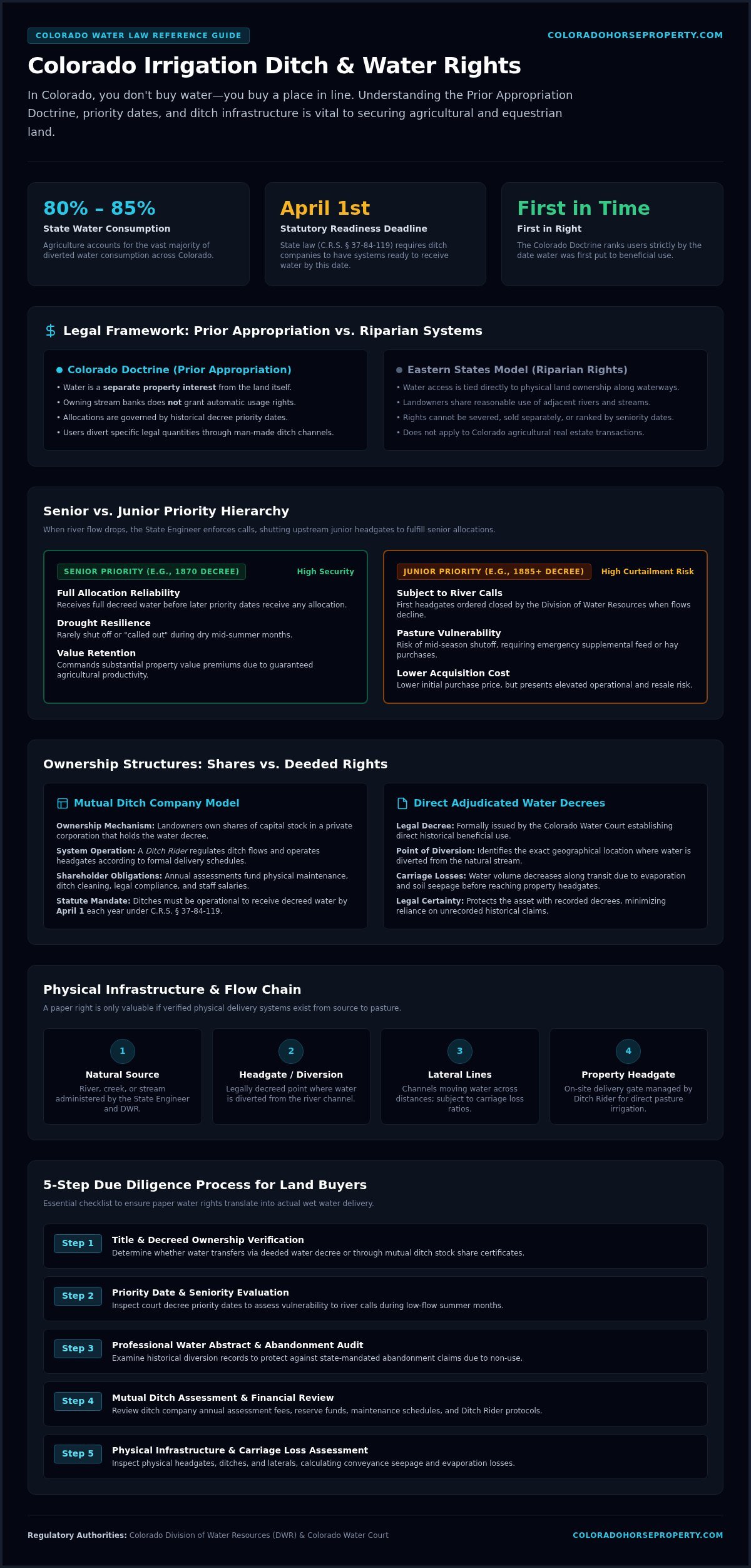
Due Diligence: 5 Essential Steps Before Buying
Securing a property with irrigation ditch rights for sale Colorado involves a level of scrutiny that goes far beyond a standard home inspection. You’re purchasing a complex legal interest that is often the most valuable part of the real estate. To protect this investment, you must verify the entire chain of ownership and the physical reliability of the water delivery system. Failure to perform these steps can result in buying “dry” land at “wet” prices. Effective October 1, 2026, e-filing fees for water court documents will rise to $18, making it even more important to gather your documentation efficiently during the due diligence period.
The Water Rights Abstract
Standard title insurance policies typically exclude water rights from coverage. This leaves a significant gap in your protection. You should hire a specialized water abstractor to trace the decree from its original adjudication to the present day. They look for “breaks” in the chain, such as past owners who may have sold the water shares separately from the land. This process ensures the seller actually has the legal authority to transfer the rights to you. For a broader look at the market, see The Ultimate Guide to Buying Colorado Land in 2026.
Beneficial Use and Abandonment Risks
Colorado law operates on a “use it or lose it” principle. If a water right isn’t put to beneficial use for 10 or more consecutive years, it creates a rebuttable statutory presumption of abandonment. While the last decennial abandonment list was finalized in 2022, the next cycle begins in 2030. You must verify that the previous owner consistently irrigated the land. Ask for hay receipts, photos of active irrigation, or DWR diversion records to prove the right is active. Without this proof, you risk a “futile call” or losing the right entirely in water court.
To finalize your due diligence, follow these additional steps:
- Analyze DWR Records: Use the Colorado Decision Support Systems (CDSS) to audit historical diversion amounts and “call” records for your specific structure ID (WDID).
- Audit Ditch Company Health: Review the company’s financial statements and check for pending litigation that could lead to massive special assessments.
- Consult a Water Attorney: For high-value ranch transactions, a specialized attorney can navigate complex augmentation plans or change-of-use decrees.
If you’re ready to find a secure investment, search our verified listings to see every property with irrigation ditch rights for sale Colorado currently on the market.
Find Your Ideal Colorado Property with Verified Water Rights
Locating a property with irrigation ditch rights for sale Colorado requires a strategic approach that combines technical data with local expertise. The complexities of water law, priority dates, and ditch company standing mean you cannot rely on broad real estate platforms to provide the granular details necessary for a secure investment. We provide the specialized tools and representation required to identify land that meets both your equestrian needs and legal requirements. Our process removes the guesswork, allowing you to focus on the utility and potential of the land rather than the fear of buying “dry” property.
Leveraging AI in Your Property Search
Traditional search methods often overlook the specific details of water decrees. Our AI-Powered Horse Property Search filters through massive datasets to identify high-priority water rights before they reach the general market. By using these data-driven tools, you can isolate listings based on “Senior Rights” or “Ditch Access” within the Realty Oasis ecosystem. This technology allows you to see the real value of a parcel beyond its surface acreage. It’s the fastest way to verify that a property has the infrastructure to support your livestock year-round. For a deeper look at the acquisition process, read our Equestrian Real Estate Colorado: A Complete Buyer’s Guide.
Expert Representation for Complex Land Deals
Generalist agents often lack the specialized knowledge to spot discrepancies in water abstracts or ditch company bylaws. Mark and Alison Eibner bring 40 years of Front Range real estate experience to every transaction. They understand the intersection of agricultural utility and Colorado land law. Our team provides comprehensive buyer representation and transaction management, ensuring every detail of the water transfer is handled correctly. We also maintain strategic partnerships with title and escrow experts who specialize in complex agricultural closings. This coordination ensures your deed and stock certificates are properly recorded and transferred, protecting your investment for the long term.
If you’re ready to secure a reliable equestrian estate, the next step is setting up a custom search tailored to your specific irrigation requirements. You can Search Colorado Horse Property with Irrigation Rights Now to view currently verified listings. Don’t leave your water security to chance. Use a system and a team designed for the unique demands of Colorado land ownership.
Secure Your Agricultural Future in Colorado
Owning a property with irrigation ditch rights for sale Colorado is about more than just land; it’s about securing the water that makes that land productive. We’ve explored why priority dates are the bedrock of property value and why the physical condition of headgates is just as critical as the legal decree. Protecting your investment requires a specialized approach, from conducting professional water abstracts to verifying historical beneficial use records. These steps ensure your horse property maintains its utility and value for decades to come.
With 40 years of specialized Colorado brokerage experience, we provide the seasoned expertise needed to navigate these technical requirements. Our exclusive AI search for equestrian features allows you to filter specifically for irrigated acreage, while our expert coordination with Meridian Title & Escrow ensures your agricultural transfers are handled with precision. Don’t leave your water security to chance in an increasingly competitive market.
Start Your AI-Powered Search for Irrigated Colorado Properties and find a landscape that truly supports your lifestyle. Your dream of a lush, sustainable horse property is within reach when you have the right data and experts on your side.
Frequently Asked Questions
What is the difference between water rights and ditch rights in Colorado?
Water rights are the broad legal authority to use a specific volume of water, while ditch rights refer to the specific right to transport that water through a man-made channel. In Colorado, these ditch rights are frequently held as shares in a mutual ditch company rather than a deeded interest in the land itself. When looking at a property with irrigation ditch rights for sale Colorado, you must verify if you’re receiving a stock certificate or a deeded water right.
How do I know if the water rights on a property are senior or junior?
You determine the status of water rights by reviewing the priority date established in the original court decree. Senior rights have older dates, often from the late 1800s, giving them first access during dry seasons. Junior rights have more recent dates and are the first to be curtailed during a shortage. You should consult the Colorado Division of Water Resources (DWR) HydroBase records to verify the exact standing of any water decree before closing.
Can I lose my ditch rights if I don’t use them for several years?
Yes, you can lose your rights through a legal process called abandonment. Colorado law operates on a “use it or lose it” principle, where ten or more consecutive years of non-use creates a rebuttable presumption of abandonment. The State Engineer publishes an abandonment list every decade to remove inactive rights from the system. Maintaining consistent beneficial use is the only way to protect the long term value of your agricultural investment and ensure your water remains secure.
Do I own the land underneath the irrigation ditch on my property?
Typically, you own the fee title to the land underneath the ditch, but the ditch company holds a dominant easement. This statutory right-of-way, codified under C.R.S. § 37-86-103, allows the company to enter your property for maintenance, cleaning, and repairs. You aren’t allowed to build structures, plant trees, or install fences that interfere with their access. The ditch company also has the right to pipe or line the channel to improve water efficiency.
Are annual ditch company assessments expensive?
Annual ditch company assessments vary significantly based on the infrastructure needs and debt of the specific company. Small rural ditches might charge between $4.50 and $15.00 per share, while formal irrigation districts often set rates between $30.00 and $60.00 per acre-foot. These fees cover the salary of the Ditch Rider and essential repairs. You should always request the last three years of assessment history when evaluating a property with irrigation ditch rights for sale Colorado.
Can I use irrigation ditch water for my horses to drink?
Whether you can use ditch water for livestock drinking depends entirely on the specific language of the water decree. Most ditch rights are decreed strictly for “irrigation” use, which doesn’t legally include “stock water” or domestic consumption. While horses often drink from open ditches, you should verify if the property has a separate well permit or municipal tap to ensure a legal and reliable source of drinking water during the non-irrigation season.
What is a “Water Rights Abstract” and why do I need one?
A Water Rights Abstract is a specialized report that traces the historical chain of title for a water right from its original adjudication to the present owner. Standard title insurance policies almost always exclude water rights, meaning you have no protection against ownership disputes without this document. A professional abstractor identifies breaks in the chain, such as past owners who sold water shares separately, ensuring the seller has the legal authority to transfer the water.
How does the Colorado “Call” system affect my ability to irrigate?
The Colorado “Call” system is the administrative tool used to enforce the priority of senior water rights. When a senior user downstream isn’t receiving their full decreed amount, they place a call with the State Engineer. The Division of Water Resources then orders all junior users upstream to stop diverting water until the senior right is satisfied. If you hold junior rights, this system can shut off your irrigation supply entirely during the hottest weeks of summer.