
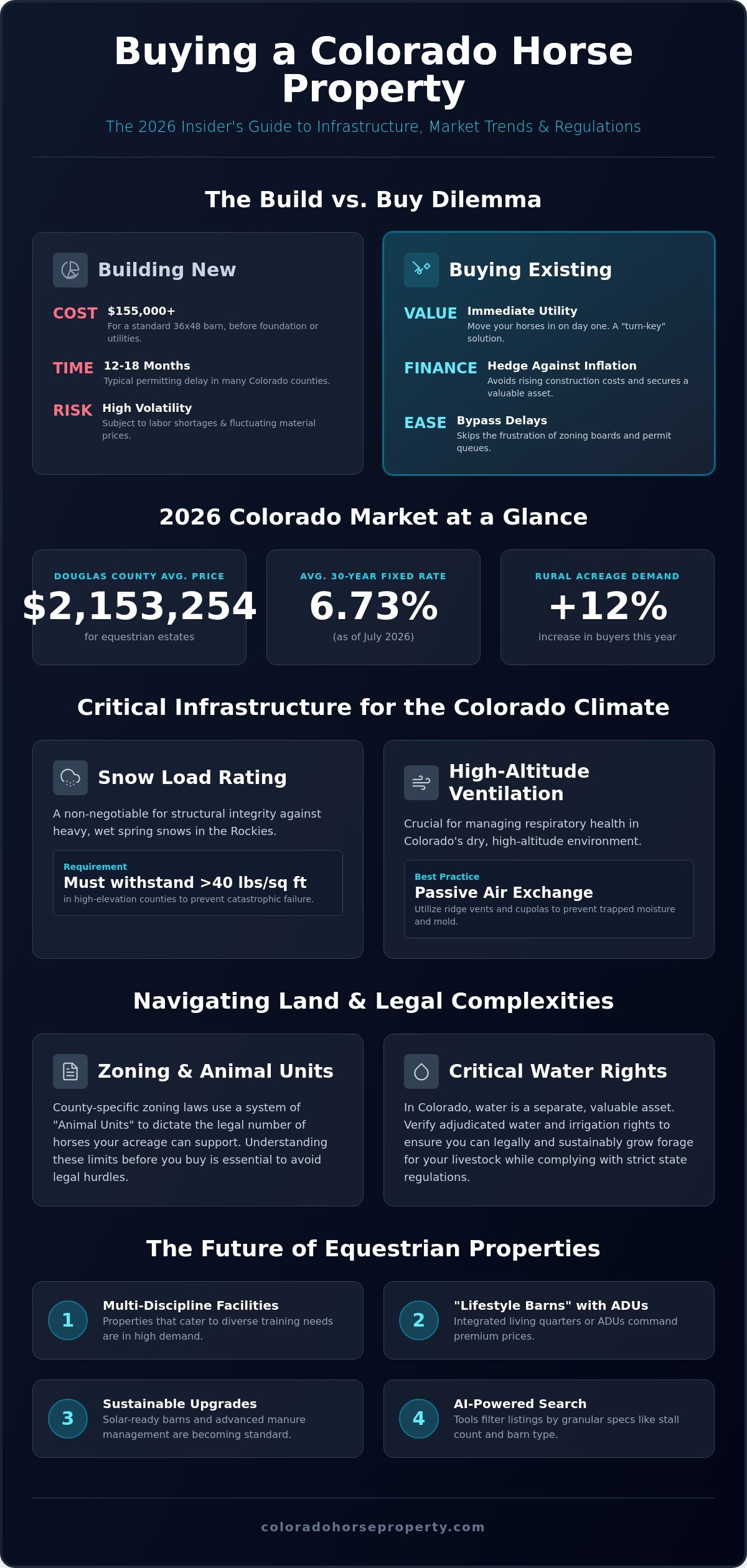
Did you know that building a standard 36×48 barn in Colorado now costs approximately $155,000 before you even pour a foundation or connect utilities? In a market where construction expenses and water quality fees are climbing, finding a Colorado horse property with barn for sale that is truly “turn-key” is more than a convenience; it’s a critical financial strategy. You likely want a home where your horses can move in on day one, but you’re also wary of hidden zoning limits and the complex web of Colorado water rights.
We understand that your goal is to find a functional, safe environment for your livestock without the stress of unexpected legal hurdles. This guide provides the expert insights you need to evaluate equestrian infrastructure and utilize AI-powered search tools to find your ideal match. You’ll learn how to identify high-quality barn features, understand the latest 2026 property tax assessments, and efficiently filter listings by stall count to ensure your new land is ready for work from the moment you close.
Key Takeaways
- Evaluate the financial advantages of purchasing an existing Colorado horse property with barn for sale to avoid the rising costs and delays of 2026 construction.
- Identify non-negotiable infrastructure features for the Rocky Mountain climate, such as specialized snow load ratings and high-altitude ventilation systems.
- Navigate complex zoning laws by understanding how “Animal Units” dictate the legal horse capacity of your specific acreage across different counties.
- Assess adjudicated water rights and irrigation needs to ensure your land provides sustainable forage while meeting Colorado’s strict usage regulations.
- Streamline your search using AI-powered tools that filter listings by granular specifications like stall count, barn type, and existing stabling infrastructure.
Navigating the 2026 Market for Colorado Horse Property with a Barn
The 2026 Colorado market is defined by a flight to quality. With average 30-year fixed mortgage rates sitting at 6.73% as of July 2026, buyers are prioritizing assets that offer immediate utility. Finding a Colorado horse property with barn for sale allows you to bypass the logistical nightmares of modern construction. While raw land might seem cheaper initially, the reality of current labor shortages and material costs often makes existing infrastructure the smarter financial play. You aren’t just buying a building; you’re buying a hedge against inflation.
Location remains a primary driver of value. Along the Front Range, particularly in Douglas County, the average listing price for equestrian estates has reached $2,153,254. Meanwhile, the Western Slope offers more expansive acreage but often requires more scrutiny regarding water rights. There’s been a 12% increase in buyers seeking rural acreage over suburban properties this year. Whether you’re a seasoned equestrian or looking for general horse information to start your journey, understanding these regional nuances is vital. A functional barn is a cornerstone of horse real estate for sale, as it directly influences the property’s total appraised value and marketability.
To see how modern barn designs are integrating living spaces, watch this property tour:
The Value of Existing Infrastructure
Building a new 36×48 barn in 2026 costs roughly $155,000, and that doesn’t include the foundation or utility hookups. Beyond the cost, you must account for the 12 to 18 month permitting delay common in many Colorado counties. In areas like Boulder or Larimer, the wait for a building permit for an agricultural structure can easily stretch past a year. “Legacy” barns are often situated on the most level, well-drained portions of a parcel. Buying a property that already has these structures in place saves you from the frustration of navigating zoning boards and fluctuating lumber prices.
Market Trends for Equestrian Estates
We’re seeing a massive shift toward multi-discipline facilities that cater to diverse training needs. Properties featuring “lifestyle barns” with integrated Accessory Dwelling Units (ADUs) or high-end living quarters are commanding premium prices. Additionally, sustainability is no longer optional. Solar-ready barns and advanced manure management systems are becoming standard requirements for high-tier buyers who want to reduce long-term operational costs. Finding a Colorado horse property with barn for sale that already includes these eco-friendly upgrades can provide an immediate return on investment through lower utility bills and reduced environmental impact.
Essential Barn Features for the Colorado Climate
Searching for a Colorado horse property with barn for sale requires a focus on engineering that goes beyond basic aesthetics. In the Rockies, structural integrity is measured by snow load ratings. A roof in high-elevation counties must often withstand over 40 pounds of pressure per square foot to handle heavy, wet spring snow. If a barn isn’t specifically rated for these local conditions, you risk catastrophic structural failure during a standard winter storm. Always verify the engineering specs of any existing outbuildings before you commit to a purchase.
Ventilation is the next critical factor. Colorado’s high altitude and dry air can exacerbate respiratory issues in livestock if the environment isn’t managed correctly. You need a system that facilitates constant air exchange without creating freezing drafts. Passive ventilation, such as ridge vents and cupolas, is highly effective in this climate. Don’t make the mistake of sealing a barn too tightly in the winter. Trapped moisture leads to condensation and mold, which are far more dangerous to a horse’s health than the cold. When building a horse barn or inspecting a potential property, prioritize fire-resistant materials like metal siding and roofing. This is especially vital in wildland-urban interface zones where ember resistance can be the difference between losing or saving your facility during a wildfire.
Internal Layout and Horse Safety
Stall dimensions should reflect the needs of your specific horses. While 12×12 is the industry standard, larger breeds or foaling mares benefit from 12×16 spaces. Flooring is another non-negotiable detail. In Colorado, the standard setup is heavy-duty rubber mats placed over a well-compacted base of crushed stone or “breeze.” This provides essential insulation from the frozen ground while allowing for necessary drainage. Additionally, ensure the tack room has dedicated climate control. Colorado’s extreme temperature swings can quickly crack expensive leather saddles and degrade liquid supplements or medications.
Hay Storage and Logistics
Fire safety often dictates the best layout for hay storage. While traditional lofts offer convenience, many modern owners prefer separate hay sheds to keep highly combustible fuel away from the animals. Proper hay ventilation involves stacking bales with strategic air gaps to allow heat to dissipate, preventing the internal core from reaching temperatures that cause spontaneous combustion. Logistics are just as important. Ensure the property layout allows for a 53-foot hay delivery truck to navigate the driveway and turn around even when the ground is covered in several inches of snow. To find listings that already feature these sophisticated infrastructure upgrades, you can use our AI-powered search tools to filter by specific barn types and amenities.
Colorado Zoning and Land Use: The Legal Side of Horse Property
Securing a Colorado horse property with barn for sale involves more than a structural inspection; it requires a deep dive into the county’s development code. Many buyers assume that “rural” zoning automatically permits an unlimited number of animals, but Colorado counties use a specific “Animal Unit” (AU) calculation to dictate capacity. These regulations prevent overgrazing and protect local soil health. If you purchase a five-acre parcel thinking it can support ten horses, you might find that local ordinances limit you to only two or three. Understanding these legal constraints before closing is the only way to protect your investment and your lifestyle.
Zoning classifications generally fall into three categories: Agricultural (A), Rural Residential (RR), and Planned Unit Development (PUD). Agricultural zoning is often the most desirable for horse owners because it typically offers the most flexibility for livestock numbers and outbuilding construction. It also qualifies the land for the 25% agricultural property tax assessment rate, a significant savings compared to the residential rates of roughly 7%. However, as suburban sprawl reaches further into the plains and foothills, the Colorado Right to Farm Act has become a vital shield. This law protects established agricultural operations from nuisance lawsuits filed by new neighbors regarding noise, odors, or dust, provided the farm was there first and follows standard management practices.
Before you plan an expansion, check for easements and setbacks. These are legal “no-build” zones that can prevent you from placing a barn or arena too close to a property line or a utility corridor. In many Colorado counties, a barn must be set back at least 50 to 100 feet from the primary residence or neighboring boundaries. Ignoring these lines can lead to mandatory demolition orders or title issues that make a future resale impossible.
Permitting for Barns and Arenas
Converting an existing equipment shed into a functional stable requires more than just adding stalls. Building departments often reclassify the structure’s occupancy type, which triggers new requirements for fire safety and drainage. When evaluating horse barns for sale, ask if the current stalls were permitted. Unpermitted work can complicate your insurance coverage and lead to fines. Additionally, if the property is part of a Homeowners Association (HOA), their private covenants may be even more restrictive than county laws, potentially banning specific barn materials or limiting the height of your hay loft.
Environmental and Manure Management
In 2026, environmental oversight is stricter than ever. Colorado’s Department of Public Health and Environment monitors runoff to protect local watersheds from nitrogen contamination. Property owners must have a clear plan for manure storage and disposal that prevents waste from entering nearby creeks or aquifers. In El Paso County, one horse is legally defined as one Animal Unit, and the zoning code typically requires a minimum of five acres to keep more than four units in most rural residential districts. Failing to manage waste properly can result in significant fines and increased water quality fees, which have already seen a 17.5% increase as of July 2026.
Acreage, Pasture, and Critical Water Rights
When evaluating a Colorado horse property with barn for sale, the acreage surrounding the structure is just as vital as the stalls themselves. You must understand the “carrying capacity” of the land, which refers to how many animals the soil can support without becoming a dust bowl. In Colorado’s arid climate, non-irrigated native grass often requires 2.5 to 5 acres per horse to maintain sustainable forage. If you’re looking at land for sale in Colorado for a 4-horse barn, a parcel of 10 to 15 acres is usually the minimum required to provide adequate turnout and grazing rotations.
Fencing is another immediate concern. In the Rockies, “no-climb” wire fencing with a sturdy wood-post top rail is the preferred choice for safety and durability. This setup prevents horses from getting legs caught in the wire and remains highly visible during heavy snow. It also resists the high-wind gusts common on the plains far better than vinyl or lightweight tape. Investing in high-quality fencing from the start protects your livestock and reduces long-term maintenance costs.
Decoding Colorado Water Rights
Water is the most legally complex part of a rural real estate transaction. You must verify the specific type of well permit attached to the deed. A “Household Use Only” permit is strictly limited and generally forbids watering any livestock. Conversely, a “Domestic” permit typically allows for the watering of non-commercial animals and some garden irrigation. If the property mentions ditch rights, you’re buying shares in an irrigation company that allows you to divert water for pasture maintenance. The “Water Decree” is the most important document in your due diligence; it’s a court-certified record proving the priority and legality of your water usage. Without a confirmed water source, your pasture value can vanish during a drought cycle.
Soil Quality and Land Topography
Topography dictates your daily workload. Low-lying areas that trap moisture lead to “mud fever” and various hoof ailments, so you must prioritize well-drained soil. When inspecting a Colorado horse property with barn for sale, look for a gentle slope that naturally directs runoff away from the barn and arena sites. You should also be able to identify toxic native plants like locoweed or Russian knapweed, which can thrive in overgrazed or disturbed Colorado soil. Finally, consider the cost of site prep. Building a professional arena on a significant slope can add tens of thousands of dollars to your budget in excavation and retaining wall costs.
To find properties with adjudicated water rights and premium acreage, use our AI-powered horse property search to filter by specific land features and irrigation status.
Finding Your Dream Property with AI-Powered Search
Traditional real estate platforms often fail to distinguish between a basic storage shed and a high-performance equestrian facility. When you’re searching for a Colorado horse property with barn for sale, you can’t afford to waste time on listings that don’t meet your technical requirements. Our AI-powered search tool at Realty Oasis is designed specifically for this niche market. It goes beyond simple keywords to identify the structural and legal nuances that define a successful ranch purchase in 2026. This technology allows you to focus on properties that align with your specific livestock needs from the very first click.
The AI Search Advantage
Most search engines won’t tell you the difference between a center-aisle barn and a shed-row configuration. Our platform changes that. You can filter properties by granular data points like the number of stalls, the square footage of an indoor arena, or specific construction styles such as steel-frame or pole-barn buildings. Crucially, the system can automatically flag listings with “Domestic” water permits or adjudicated ditch rights. This level of precision saves you hours of manual listing review and ensures you only visit properties that are legally and physically capable of supporting your horses. In a market where high-quality “A-Class” properties move quickly, this speed is a significant competitive advantage.
Expert Transaction Management
A successful closing requires a team that understands the complexities of agricultural law and rural infrastructure. With 40 years of specialized experience, we provide a perspective that generalist agents can’t match. This tenure is vital when assessing the long-term utility of horse property for sale in Colorado. We don’t just look at the residential home; we evaluate the viability of the pastures, the condition of the stabling, and the history of the water rights. Our goal is to ensure your investment is protected by identifying potential issues before they become expensive liabilities.
Our transaction management services ensure that every detail, from water rights transfers to environmental runoff compliance, is handled with precision. We work closely with Meridian Title & Escrow, a firm that understands the unique requirements of ranch closings. This partnership includes coordinating specialized inspections for both the residence and the equestrian facilities to ensure no hidden structural defects exist. To start your specialized search and leverage our 2026 market insights, contact Mark and Alison Eibner today. We’re here to help you navigate the complexities of the Colorado horse property with barn for sale market and find a property that truly supports your lifestyle goals.
Secure Your Colorado Equestrian Future
Finding a Colorado horse property with barn for sale in 2026 requires balancing lifestyle goals with technical due diligence. You’ve seen that climate-specific infrastructure, like high-altitude ventilation and snow-rated roofing, is essential for the safety of your livestock. Beyond the structures, verifying water decrees and county zoning ensures your property remains legally compliant and functional for the long term. These elements form the foundation of a sound investment in the Rocky Mountain region.
Our team brings 40 years of local real estate experience to every transaction. We combine proprietary AI search technology with a specialized network of title and escrow partners to streamline your journey from browsing to closing. This expert-led approach helps you identify “turn-key” assets while avoiding the pitfalls of building from scratch in a high-cost market. We understand the unique requirements of land and livestock owners because we share your passion for the rural lifestyle.
Start your AI-powered search for Colorado horse properties with barns here to find a facility that meets your exact specifications. Your dream of wide-open spaces and professional-grade stabling is within reach. We’re ready to help you make it a reality.
Frequently Asked Questions
How many horses can I have on 5 acres in Colorado?
The number of horses permitted on 5 acres depends on your specific county’s Animal Unit (AU) zoning and the land’s carrying capacity. For instance, El Paso County generally allows one horse per acre in certain rural districts, but you must verify if your parcel is zoned Agricultural or Rural Residential. Overstocking can lead to soil degradation and code enforcement penalties if the land can’t support the livestock density.
What is the difference between a pole barn and a steel-framed barn for horses?
Pole barns utilize wooden posts buried in the ground and are generally faster and less expensive to construct. Steel-framed barns offer superior fire resistance and can support much heavier snow loads, which is a vital consideration when evaluating a Colorado horse property with barn for sale in high-elevation regions. Steel structures also require less maintenance over a long lifespan and aren’t susceptible to rot or wood-boring insects.
Does a horse barn need a specific permit in Colorado?
Yes, almost all horse barns in Colorado require a building permit to ensure they meet local structural, electrical, and fire safety codes. Even if a structure is classified as agricultural, it must comply with county-specific snow load requirements and setbacks from property lines. Unpermitted barns can cause significant title issues during a real estate transaction and may lead to insurance claim denials.
How do I check the water rights on a horse property before buying?
You can verify water rights by reviewing the well permit through the Colorado Division of Water Resources and examining the property’s Water Decree. It’s essential to confirm the permit specifically allows for livestock use rather than just “household only” consumption. Ditch shares and irrigation rights should be verified through the specific ditch company’s records to ensure they’re legally transferred at closing.
What are the most horse-friendly counties in Colorado?
Douglas, El Paso, Weld, and Larimer are widely considered the most horse-friendly counties due to their established equestrian infrastructure and favorable zoning. These areas offer extensive trail systems, public arenas, and a high concentration of specialized veterinary services. When looking for a Colorado horse property with barn for sale, these counties often provide the most robust resale value for equestrian estates.
Is it better to have an indoor or outdoor arena in Colorado?
An indoor arena is the superior choice for year-round training in Colorado because it provides a controlled environment during extreme wind and heavy snow. Outdoor arenas are more affordable to install but are often unusable during the spring mud season or winter storms. Many professional facilities utilize a combination of both to accommodate different weather conditions and specialized training needs throughout the year.
Can I build a second barn on a property that already has one?
You can usually build a second barn if your property has sufficient “building coverage” allowance and meets the required setbacks from existing structures. County codes often limit the total square footage of all outbuildings based on the parcel’s acreage. You must check with the local planning department to ensure a second structure won’t violate “accessory building” limits or density restrictions.
What should I look for in a barn inspection?
A barn inspection should focus on structural stability, electrical safety, and specialized stabling features. Look for signs of wood rot, rodent damage to wiring, and proper drainage around the foundation to prevent ice heaving in the winter. You should also test the water pressure at the wash rack and ensure the ventilation systems are functioning correctly to maintain air quality and prevent respiratory issues.