
Being close to Barr Lake State Park doesn’t automatically put a riding trail at your barn gate. Finding horse property with access to Barr Lake State Park means checking how you’ll reach the park, whether the route is practical, and whether the land and facilities fit your horses.
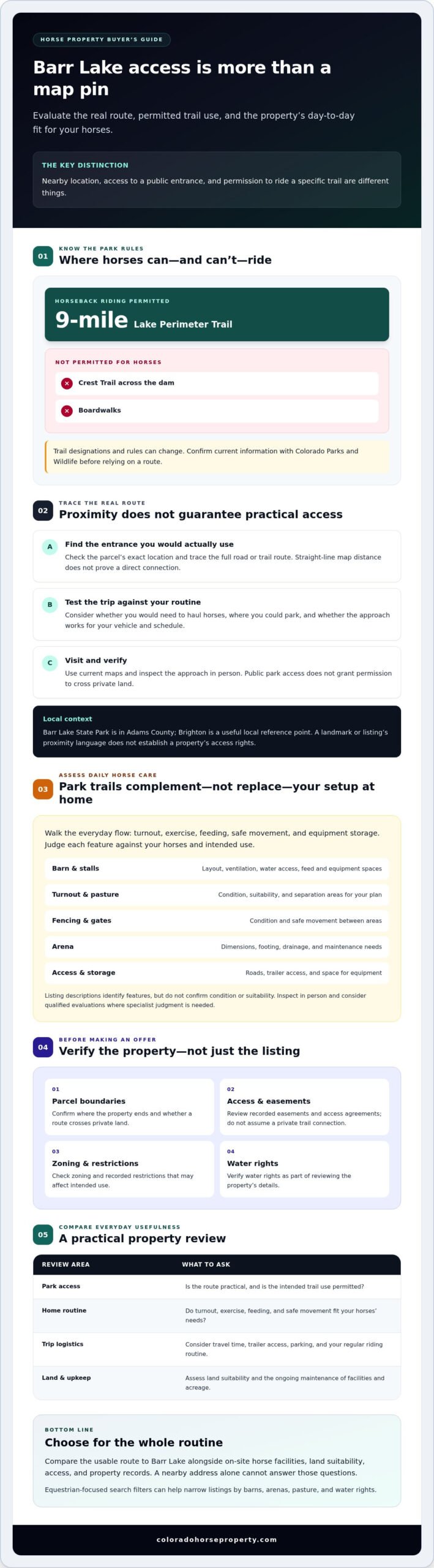
Nearby acreage may make trail rides easier, but map distance alone can be misleading. Barr Lake permits horseback riding on its 9-mile Lake Perimeter Trail, but not on the Crest Trail across the dam or on boardwalks. A property may still require a separate drive, and parcel boundaries and legal access matter. Confirm current rules with Colorado Parks and Wildlife before you buy.
This guide explains how to assess park proximity alongside barns, pasture, fencing, zoning, and water rights. You’ll also learn what to verify about access routes and public-use rules, so you can compare properties by everyday usefulness, not just location. Specialized search tools can help narrow options by equestrian features, while buyer representation can support your review of property details and transaction requirements.
Key Takeaways
- Assess horse property with access to Barr Lake State Park by checking real-world routes and permitted use, not location alone.
- Match barns, fencing, turnout, arenas, and storage to your horses’ daily needs and riding routine.
- Compare properties using practical factors such as trailer access, travel time, land suitability, and ongoing upkeep.
- Before making an offer, verify parcel boundaries, zoning, easements, water rights, and recorded restrictions.
- Use equestrian-focused search filters to narrow listings by features such as barns, arenas, pasture, and water rights.
What Does Horse Property with Access to Barr Lake State Park Mean for Buyers?
“Park access” can mean a property is nearby, you can reach a public park entrance, or horses are permitted on a specific park trail. Those are different things. A horse property with access to Barr Lake State Park should be evaluated by the route from the parcel to a usable entrance and whether your intended park activity is allowed.
Barr Lake is in Adams County, with Brighton serving as a useful local reference point. Check the parcel’s exact location and the route you’d actually take rather than relying on a listing’s proximity language. The Barr Lake State Park overview provides general context about the landmark, but it can’t establish a particular property’s access rights.
For a visual overview of the park, watch this guided tour. It can help you get oriented, but confirm riding routes separately.
How close is a horse property to Barr Lake State Park?
Compare the parcel with the park entrance you’d use, then trace the full route. Consider whether you’d need to haul horses by trailer, where you could park, and whether the route works for your vehicle and routine. A straight-line map distance doesn’t guarantee a direct road or trail connection. Check current maps and visit in person to assess the approach and access conditions.
Does park access mean horseback riding is allowed?
No. Public entry, equestrian permission, and private-land rights are separate questions. Current park information identifies horseback riding on the 9-mile Lake Perimeter Trail. Horses aren’t permitted on the Crest Trail across the dam or on boardwalks. Confirm current trail designations and rules with Colorado Parks and Wildlife before relying on them. Park rules also don’t give you permission to ride across private land.
For the parcel itself, verify boundaries and any recorded easements or access agreements. A nearby property may offer convenient public-road access to the park without a private trail connection. Evaluate park recreation separately from on-site horse facilities, which must meet your needs for turnout, riding, and daily care.
What Makes Horse Property Near Barr Lake Work for Everyday Riding?
Park trails can add off-property riding options, but they can’t replace the land and facilities you rely on every day. A workable setup should support your horses’ routine at home, including turnout, exercise, feeding, and safe movement between areas. Evaluate those needs separately from the route to Barr Lake.
Buyer’s checklist: Inspect the barn, stalls, ventilation, water access, arena footing and drainage, fencing, gates, pasture, access roads, and storage against your horses’ needs and intended use.
Which horse facilities should buyers evaluate?
Walk the daily route from barn to turnout and riding areas. Check whether gates and lanes allow safe movement, whether fencing is intact and suited to your horses, and whether pasture condition and separation areas fit your management plan. In the barn, assess stall layout, ventilation, water access, and the condition of spaces used for feed and equipment.
An arena deserves more than a quick look. Consider whether its dimensions, footing, and drainage suit your discipline, along with the maintenance it may require. Listing descriptions can identify features, but they don’t confirm condition or suitability. Inspect the property in person, and consider qualified evaluations for concerns that need a specialist’s judgment.
Land management matters, too. Colorado State University Extension offers guidance on managing a small acreage horse property, including practical considerations such as pasture and feed. Use that guidance to assess whether the acreage supports your intended horse-keeping routine, not just whether a barn is present.
How should buyers compare park riding with on-property use?
Map a typical day: where horses get turnout, how they exercise when you don’t visit the park, and how feeding and equipment storage fit into the layout. Then consider trailer access. A nearby trail may still involve loading, driving, and parking, so decide whether that process fits your regular routine.
Before relying on a route to park trails, verify that it’s legal, practical for your trailer, and currently usable. A map or listing claim alone doesn’t establish private access. Keep the property’s own riding and turnout capacity at the center of your comparison.
For buyers comparing existing barns and equestrian features, Colorado Horse Property’s horse property search can help narrow listings by horse-related criteria. Use filters to shortlist options, then verify each facility’s condition and fit during your property review.
How to Compare Horse Properties Near Barr Lake State Park
A useful comparison looks beyond asking price and map distance. A property that appears close to Barr Lake may involve a less practical route, while another farther away may better suit your travel and horse-keeping needs. Apply the same criteria to every listing, then verify details at the parcel level.
| Factor | What to compare | What to verify |
|---|---|---|
| Location | Route to the park, feed suppliers, services, and your regular destinations. | Current road conditions, seasonal access, and whether the route works for your trailer. |
| Park access | Practical travel to an entrance, parking options, and the steps needed to reach a usable trail. | Current permitted use, legal routes, and any claimed private access. |
| Horse facilities | Existing barns, arenas, fencing, and other features against your actual horse-care routine. | Condition, suitability, and any work needed after purchase. |
| Land and water | Pasture layout, usable areas, and how the land supports your intended use. | Parcel boundaries, zoning, permitted uses, water rights, and well details. |
| Upkeep | Expected effort to maintain land, facilities, and access areas. | Property-specific maintenance needs and restrictions. |
Which location factors matter around Brighton and Barr Lake?
Brighton and Adams County are useful search-area reference points, not a guarantee that a suitable listing is available in either location. Plot each property’s route to the park and to the places you visit regularly. A map helps compare options, but drive the route if possible. Check whether road surfaces, turns, gates, and parking areas work for your vehicle and trailer, and consider access during the seasons when you expect to ride.
How do buyers weigh acreage, water, and horse facilities?
There’s no universal acreage or facility combination for every horse owner. Consider how the land is configured, the number and needs of your horses, and your intended use. A qualified local assessment can help you evaluate whether pasture and usable space fit those plans. Compare listings by function, not acreage alone.
Treat water as a separate due-diligence item. Don’t assume a well or other water source can legally support livestock or irrigation just because it’s present or currently in use. Verify water rights, well details, and permitted land uses for the specific parcel with appropriate professionals. A Colorado land buyer’s guide can help frame broader due diligence, but parcel records and professional review are essential.
For buyers seeking horse property with access to Barr Lake State Park, the strongest comparison weighs verified access alongside land suitability, facilities, and upkeep. No single feature should outweigh unresolved questions about the parcel.
What Should You Verify Before Buying Near Barr Lake?
A listing can describe a property as horse-ready or close to the park, but those phrases don’t confirm legal access, permitted land use, or facility condition. Treat due diligence as a set of separate checks. Keep written notes on what you’ve confirmed and what still needs an answer.
How can buyers verify park access and local requirements?
- Confirm the parcel location, access routes, and current park rules. Check the parcel against current maps, identify the route to the park entrance, and confirm current equestrian trail access directly with Colorado Parks and Wildlife. Don’t rely on a listing description or assume a nearby route is open to horses.
- Verify boundaries and legal access. Review parcel records, road access, easements, and recorded restrictions with qualified real estate or title professionals. A visible path or gate doesn’t establish a legal right to use it.
- Check zoning and permitted uses. Contact Adams County or the relevant local jurisdiction to confirm the requirements for the specific parcel, including whether your intended horse use is allowed. Rules can depend on the property’s location and designation.
- Investigate water rights and systems. Confirm what any well or other water source is legally permitted to supply. Don’t assume that current use proves water is available for horses, irrigation, or future plans.
What should a horse-property inspection cover?
Arrange appropriate inspections of the structures and infrastructure you’ll rely on. Ask qualified local professionals to assess barns, arenas, utilities, water systems, fencing, gates, and drainage. Look for issues that affect safe daily use, such as damaged fencing, poor drainage around work areas, or repairs needed to make a structure suitable for your plans. A general walkthrough is useful, but it isn’t a substitute for specialist evaluation.
Keep an open-items list as you review reports and property documents. Record who will verify each item, what evidence is needed, and when you need an answer. If the well’s permitted uses, an access easement, or a facility’s condition remains unclear, seek clarification before assuming how you’ll be able to use the property.
Remember: Park access, land-use permission, and horse-facility suitability are separate matters. Verify each one for the specific parcel before choosing a horse property with access to Barr Lake State Park.
Use equestrian-focused search tools to compare listings by features such as barns, arenas, pasture, and water rights, then verify those details during your purchase review. Explore horse property listings to begin narrowing your options.
Find Horse Property Near Barr Lake with Specialized Buyer Support
Choosing the right acreage means weighing more than a pin on a map. Confirm how you’ll reach Barr Lake and which park uses are permitted, then compare the property’s facilities, land, water, and upkeep with your plans. Keep those checks distinct: a listing filter can identify promising features, but it can’t confirm legal access or replace parcel-specific due diligence.
Colorado Horse Property’s AI-powered search helps buyers narrow Colorado listings by equestrian features, including barns, arenas, water rights, and pasture. Start with the features that matter most to your routine, then compare relevant options side by side. Use search results as a shortlist, not as confirmation that a facility is in suitable condition or a water right supports your intended use.
How can specialized search narrow the Barr Lake-area options?
Broad location terms alone may surface properties that don’t meet your horse-keeping needs. Filtering by equestrian features can focus your search on listings with the facilities or land characteristics you want to investigate. For each option, confirm the parcel’s location, routes to the park, and the details behind every advertised feature. Verify current park rules separately with Colorado Parks and Wildlife.
A useful shortlist makes tradeoffs visible. One property may have a barn but limited pasture; another may offer more land but require a longer drive to a park entrance. Compare each option against your priorities rather than treating any single filter as a complete measure of fit.
What happens when you work with a horse-property brokerage?
Buyer representation can support the process of comparing listings and reviewing property details relevant to your goals. Transaction management can help keep purchase steps organized, while title and escrow services support the closing process. These services don’t replace your own due diligence or the need for qualified professionals to assess zoning, water, structures, and legal access.
Colorado Horse Property is operated by Realty Oasis and led by Mark and Alison Eibner. Its equestrian-focused approach is relevant to buyers who want to evaluate horse facilities and land alongside location. As you consider a horse property with access to Barr Lake State Park, use specialized search to identify options, then verify each parcel’s access, permitted uses, and condition before moving forward.
Explore Colorado Horse Property’s specialized search and buyer representation as you compare acreage and equestrian features for your needs.
Choose Your Barr Lake-Area Property with Confidence
The best horse property with access to Barr Lake State Park is more than a nearby parcel. It should match your daily horse-care needs, offer suitable land and facilities, and have access and permitted uses you’ve verified. Check park rules, private property rights, and property condition separately before making a decision.
Colorado Horse Property’s AI-powered search can help filter listings by equestrian features such as barns, arenas, water rights, and pasture. Specialized Colorado equestrian real estate buyer representation can also support you as you compare options and coordinate the transaction.
Start narrowing your options with Colorado horse-property search. Careful searching and parcel-specific verification can help you find a property that fits your horses and the life you want to build.
Frequently Asked Questions
Can you ride horses at Barr Lake State Park?
Yes. Horseback riding is permitted on the 9-mile Lake Perimeter Trail. Horses aren’t allowed on the Crest Trail, the road across the top of the dam, or on boardwalks. Check with Colorado Parks and Wildlife for current trail designations and rules before planning a ride. Confirm park entry requirements, too. Public access to the park and permission to ride a specific trail are related but separate details.
Are there horse properties for sale near Barr Lake State Park?
Horse properties may be listed in the Brighton and Adams County area, but availability changes and shouldn’t be assumed. Search active listings for equestrian features, then confirm each property’s location, facilities, and status with the listing professional. A listing described as “near Barr Lake” doesn’t necessarily offer direct park access or a suitable horse setup. Compare the property’s practical routes and facilities with your needs before deciding whether it fits.
How close does a property need to be to have access to Barr Lake?
There’s no single distance that guarantees practical access. A nearby parcel may still require a drive to a public entrance, while a farther property may have a more convenient route for your vehicle and trailer. Check current maps, identify the entrance and roads you’d use, and visit the route in person. Verify any claimed private trail connection separately, including whether there’s a documented legal right to use it.
What should I look for in a horse property near Barr Lake?
Look for facilities and land that support your daily routine, not just proximity to the park. For a horse property with access to Barr Lake State Park, assess barn condition, stalls, water access, fencing, gates, pasture layout, arena suitability, and trailer access. Consider how horses move between areas and what upkeep the property requires. Confirm zoning, permitted uses, boundaries, and water details for the specific parcel before relying on listing descriptions.
Does buying near Barr Lake State Park give me access to its trails?
No. Buying nearby doesn’t automatically grant trail access, private passage across other land, or permission to ride on every park trail. Public park rules determine where horses may be ridden within the park, while parcel boundaries, easements, and recorded agreements affect access outside it. Check current equestrian rules with Colorado Parks and Wildlife, and have any claimed private access or easement verified through appropriate property records and qualified professionals.
What zoning and water-right details should horse-property buyers verify in Adams County?
Confirm the parcel’s jurisdiction, zoning, permitted horse use, and any limits that apply to your plans. For unincorporated Adams County, review the county’s Development Standards and Regulations and verify requirements with the county. Water rights don’t automatically transfer with a property. Check what rights convey and what any well is legally allowed to supply, including livestock use. The Colorado Division of Water Resources handles well permitting; consult qualified professionals about parcel-specific questions.
How can I find Colorado horse property with barns, pasture, or an arena?
Use an equestrian-focused search that lets you filter listings by features such as barns, arenas, water rights, and pasture. Colorado Horse Property offers AI-powered search to help narrow options by those criteria. Treat filters as a starting point, not proof that a feature is suitable or in good condition. Review listing details, confirm availability, and verify the property’s facilities, land use, water, and access before moving forward.