
What if the creek, ditch, or well that drew you to a Colorado property can’t support the way you plan to use it? A visible water source or a claim in a listing isn’t proof of usable legal rights. That’s why finding a realtor who truly understands water rights means looking beyond acreage and asking how water claims will be checked before your deadlines pass. If you’re planning for a home, irrigation, or livestock, it’s reasonable to want clear answers early.
The right agent can help surface water questions, organize property information, and coordinate with title professionals and qualified Colorado water-rights experts. This article explains how to assess an agent’s rural transaction experience, what to ask about wells, ditch shares, streams, ponds, and municipal connections, and which records or professional reviews may help clarify the details. You’ll learn how to compare documented rights with your intended use, so you can make an informed decision instead of relying on a promising description alone.
Key Takeaways
- Water can affect whether a Colorado property fits your household, irrigation, or livestock plans. Compare each claim with your intended use.
- When finding a realtor who truly understands water rights, ask about relevant rural-property transactions, document review, and coordination with qualified specialists.
- Compare the advertised water source with available records, stated uses, and unanswered questions before drawing conclusions.
- Raise water-rights concerns early, confirm applicable contract deadlines, and track requested documents and follow-up in a diligence log.
- Use a specialized search tool to identify properties for review, not as proof that water rights are valid or sufficient.
Why finding a realtor who truly understands water rights matters in Colorado
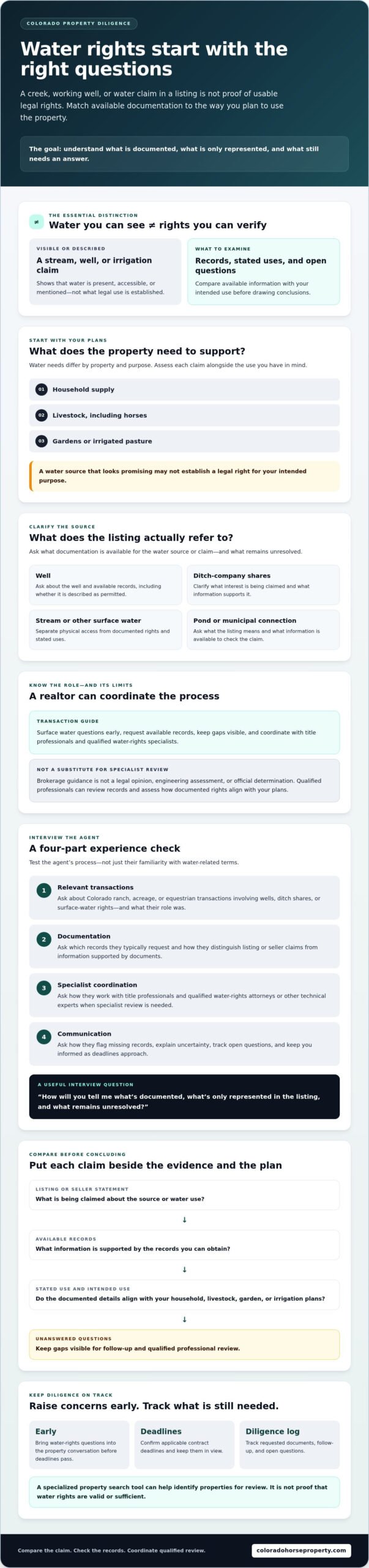
Water can shape a Colorado property’s usefulness and fit for your plans. A creek beside the pasture, a well near the house, or a listing that mentions irrigation may look promising, but none of those details alone confirms what water rights exist or how water may be used. If you’re planning for a household, horses or other livestock, gardens, or irrigated pasture, assess water claims alongside access, fencing, and acreage.
Finding a realtor who truly understands water rights means choosing a transaction guide who knows which questions to raise and how to coordinate verification. The agent doesn’t replace legal or technical review. Instead, they can bring water-related claims into the property conversation early, request available records, and track what still needs an answer. For a high-level overview of the agency involved in Colorado water-rights administration and well permits, see the Colorado Division of Water Resources.
For a general introduction to water rights, watch this video:
What does a water-rights-informed realtor actually do?
An experienced rural-property agent flags water claims during property discovery and due diligence. They can ask what documentation is available, clarify whether a listing refers to a well, surface-water right, ditch-company interest, or another source, and keep open questions visible as the transaction progresses. Ask how they’ll communicate gaps and coordinate with title professionals and qualified water-rights specialists.
That role has limits. A realtor can organize the transaction and help identify questions, but shouldn’t present brokerage guidance as a legal opinion, engineering assessment, or official determination. Have qualified professionals review the records and assess whether the documented rights align with your plans.
Why water deserves early attention in a Colorado property search
Water needs depend on the property and your intended use. Household supply, livestock, pasture irrigation, and gardens may raise different questions about the source, documented use, and practical availability. A late discovery can leave less time to evaluate a concern before a contract deadline or negotiate with a clear understanding of what’s included.
Physical water access is not the same as documented water rights. A visible stream or working well tells you water is present or accessible. It doesn’t, by itself, establish the legal right to use it for your intended purpose.
How to verify a Colorado realtor’s water-rights experience
Use the interview to test the agent’s process, not just their familiarity with water-related terms. Ask for examples of Colorado ranch, acreage, or equestrian transactions involving wells, ditch shares, or surface-water rights. You don’t need confidential client details. You do need to understand the kinds of properties the agent has handled and how water questions were addressed.
A useful four-step screen:
- Relevant transactions: Ask which Colorado property types and water sources the agent has encountered, and what their role was in those transactions.
- Documentation: Ask what records they typically request and how they distinguish a seller’s or listing’s claims from information supported by documents.
- Specialist coordination: Ask how they work with title professionals and qualified water-rights attorneys or other technical experts when questions need specialist review.
- Communication: Ask how they flag missing records, explain uncertainty, track open questions, and keep you informed as deadlines approach.
Questions to ask before signing a buyer representation agreement
Be specific: “Have you represented buyers for Colorado properties involving a permitted well, ditch-company shares, or decreed surface-water rights?” Then ask, “How will you tell me what’s documented, what’s only represented in the listing, and what remains unresolved?” A capable agent should be comfortable explaining their process and limits, not promising that a particular water supply will meet your needs.
You can also ask whom they would involve if records raise legal or technical questions. Colorado water rights operate within a distinct legal framework. The state’s overview of Colorado’s Prior Appropriation System can help you gauge whether an agent recognizes that water claims may need specialist review. The agent should coordinate with qualified professionals rather than offer a legal interpretation or engineering conclusion themselves.
Experience signals that matter more than broad claims
Look for clear, relevant examples and a repeatable diligence process. An agent might explain how they identified an incomplete water file, requested additional records, and referred the unresolved issue to an appropriate professional, without disclosing client information. That’s more useful than a broad claim of “water expertise.”
Check credentials and experience claims independently. A license or other designation may support an agent’s general qualifications, but it doesn’t guarantee water-rights expertise or a favorable conclusion about a property. Where appropriate, request references or review public testimonials as indicators of service, not as proof that a specific right is valid or sufficient. For a starting point in your search, explore Colorado horse-property resources, then apply the same questions to any agent you consider.
Finding a realtor who truly understands water rights comes down to evidence of relevant Colorado experience, a transparent process, and appropriate specialist coordination. Pay attention to how the agent handles what they don’t know. Clear limits and timely referrals are strengths.
What Colorado water-rights records and property details should you compare?
Start with the property’s specific water claims, then compare them with available records and the uses you have in mind. Acreage, a flowing stream, or a pond doesn’t establish what water rights exist or which uses they may allow. When finding a realtor who truly understands water rights, look for someone who helps separate listing language from documented details and flags questions for further review.
Use a comparison table to organize each claim. Records from the Colorado Division of Water Resources and water-court records may be useful research avenues. Confirm how to access the relevant records, then ask a qualified professional to interpret them.
| Claimed source | Available documentation | Stated use | Questions outstanding | Reviewer |
|---|---|---|---|---|
| Well | Available well permit and related records | Use described in records or listing | Do the records apply to this property and planned use? | Qualified water professional or attorney, as appropriate |
| Surface-water right or stream | Available water-right and water-court records | Use and property details shown in records | What rights or permissions are documented? | Qualified water-rights attorney |
| Ditch-company interest | Share documentation and transfer-related records | Use represented by the seller or listing | What interest is included, and how is its transfer documented? | Title professional and qualified water-rights specialist |
| Stored water, if applicable | Available documents identifying the claimed interest | Use represented for the property | What terms or conditions need confirmation? | Qualified water-rights specialist |
How wells, ditches, streams, and ponds raise different questions
For a well, request available permits and related records, then have a qualified professional assess whether they apply to the property and intended use. For a ditch interest, clarify what shares are represented and request documentation showing the interest and any transfer details. A stream or pond is a physical feature, not proof of a right to divert or use water. Verify the specific rights or permissions claimed rather than relying on appearance or access alone.
Match documented water details to the property’s intended use
Write down your plans before reviewing the records: household supply, livestock, pasture, gardens, or other irrigation. Compare each intended use with the documentation, and note conditions, missing information, and uncertainties for specialist review. Keep the agent’s summary separate from conclusions made by counsel, engineers, water officials, or title professionals. This makes it easier to see what is supported, what remains a question, and who should answer it.
How to manage water-rights due diligence before Colorado closing
Raise water questions early, before contract deadlines limit the time available to gather records and review concerns. Ask your agent and counsel to identify the applicable dates and explain what the signed documents require. Contract rights, deadlines, and remedies depend on the specific agreement and professional advice, so don’t assume a general timeline applies to your purchase.
A written diligence log keeps the process visible. For each water claim, record the document requested, who is responsible for reviewing it, the response received, and any unresolved concern. This helps your agent coordinate transaction steps while title and escrow professionals, attorneys, and technical specialists address issues within their expertise.
A practical sequence for reviewing water information
Begin with the listing and seller-provided materials. Separate stated claims from supporting records, then note what’s missing. For example, if irrigation is advertised but the documents don’t identify the claimed right or its use, add that gap to the log instead of treating the listing language as confirmation.
- Gather: Request available records and documents related to each claimed water source or interest.
- Route questions: Direct property-specific record questions to the appropriate agency, title professional, or water-rights specialist.
- Track responses: Note what each reviewer confirms, what needs follow-up, and what remains uncertain.
- Check timing: Review open issues with your agent and counsel in time to understand your options under the signed contract.
Finding a realtor who truly understands water rights includes choosing an agent who can keep this work organized without presenting a listing claim or preliminary summary as a final determination.
When to bring in a Colorado water-rights specialist
Ask qualified counsel to review unclear decrees, priority, permitted use, transfer questions, well status, or competing claims. Seek technical review when you need an expert assessment of source reliability, infrastructure, or whether the water supply aligns with your intended plans. Brokerage helps coordinate the transaction. Legal and technical conclusions belong with the appropriate professionals.
Keep the decision process grounded in documented information and clearly identified gaps. For additional context on planning a Colorado equestrian-property purchase, explore Colorado horse-property buyer resources. To review property options and buyer representation resources, visit Colorado Horse Property.
Choose a Colorado property realtor who can coordinate water-rights diligence
The right representative brings relevant Colorado property experience, clear communication about their limits, organized transaction management, and coordination with qualified professionals. That combination helps you assess whether a ranch or equestrian property fits your plans without confusing a promising listing with a confirmed water-rights conclusion.
For buyers focused on acreage, barns, and equestrian use, a rural-property specialist can connect search criteria with practical questions about the property. Ask how the agent will track water-related claims, what information they can help obtain, and when they recommend involving title professionals, counsel, or technical specialists. Finding a realtor who truly understands water rights doesn’t mean finding someone who can guarantee an outcome. It means choosing a transaction guide who knows when a claim needs independent review.
What specialized buyer representation can add
Colorado Horse Property specializes in equestrian properties, ranches, and acreage. Its AI-powered property search can help surface listings tagged with water-rights criteria, making it a discovery tool for narrowing options. A search filter isn’t proof that a right exists, transfers with the property, or supports a particular use. Verify every material water representation through appropriate records and qualified review.
Buyer representation can also connect property discovery with transaction management and title and escrow coordination. These services help organize the purchase process, but they don’t replace legal interpretation, engineering analysis, or determinations by relevant water authorities. Ask how the brokerage will communicate outstanding questions and coordinate with the right professionals for each issue.
Start your search with water questions on the table
Before your first conversation, outline your intended uses and search priorities. Include your preferred location, property type, and known water concerns. Be specific about plans for household needs, horses or other livestock, pasture, or irrigation. A clear brief helps an agent search for suitable properties and identify water questions early, before a listing shapes your expectations.
As you review potential properties, ask how water-related listing information is represented and what supporting records are available. Treat filters and listing descriptions as starting points, then confirm the details independently. Keep a short list of unresolved questions so you can discuss next steps with the appropriate professionals.
To discuss your property goals, water questions, and the professional support a transaction may require, discuss your Colorado horse-property search. Ask how water-related listing details are handled and how the search process can help identify properties for closer review.
Start your Colorado property search with water questions in view
Water claims deserve the same careful review as acreage, access, and improvements. A capable agent helps surface questions early, distinguish listing statements from supporting records, and coordinate review with title professionals and qualified water-rights specialists. Confirm what rights and uses are documented, how they align with your plans, and which concerns need answers before contract deadlines.
Finding a realtor who truly understands water rights means looking for relevant Colorado property experience, organized communication, and clear limits. Colorado Horse Property specializes in equestrian properties, ranches, and acreage. Its AI-powered property search can help identify listings with water-rights criteria, but search results are a starting point, not verification. Buyer representation includes transaction management and title and escrow coordination, while legal and technical conclusions require appropriate professional review.
Bring your intended uses, preferred location, property type, and known water concerns to the first conversation. Discuss your Colorado horse-property search and ask how water-related listing details are handled. With a clear plan and the right professional support, you can move toward a property that better fits the life and work you have in mind.
Frequently Asked Questions
How do I find a realtor who understands water rights in Colorado?
Look for evidence of relevant Colorado ranch, acreage, or equestrian transactions when finding a realtor who truly understands water rights. Ask how they handled wells, ditch-company interests, or surface-water claims, and how they tracked missing records and contract deadlines. A strong agent explains their limits and coordinates with qualified water-rights professionals when legal or technical questions arise. Check experience and credentials independently, since no designation alone confirms water-rights expertise.
Can a Colorado realtor verify that a property has usable water rights?
A realtor can help identify water-related claims, request available documents, and coordinate review, but shouldn’t be the final authority on whether rights are valid, transferable, or sufficient for your plans. Listing language and an agent’s summary aren’t substitutes for records or specialist advice. Ask a qualified Colorado water-rights attorney or technical professional to assess relevant documents, and involve title professionals to clarify transaction and title matters.
What questions should I ask a realtor about water rights?
Ask what Colorado property types and water sources they’ve encountered in transactions, such as permitted wells, ditch shares, or surface-water rights. Find out what documentation they’ll request, how they distinguish listing claims from records, and how they communicate missing information. Ask which qualified legal or technical professionals they coordinate with when questions arise. Also confirm how they’ll track open issues and applicable contract deadlines with you.
Do water rights transfer automatically when you buy land in Colorado?
Don’t assume they do. In Colorado, most water rights are treated as a separate form of real property and aren’t automatically included in a land sale. The specific rights intended to transfer should be identified in the transaction documents, then reviewed alongside relevant records. Ask your agent and title professional what the purchase documents say, and seek advice from a qualified Colorado water-rights attorney about the legal effect of the transaction.
How can I check water rights on a Colorado property?
Start by requesting the seller’s available water documents and identifying each claimed source, such as a well, surface-water right, or ditch-company interest. Research avenues may include Colorado Division of Water Resources records and water-court records. Compare those materials with the property’s stated uses and your plans, then ask a qualified specialist to interpret any gaps or conditions. Confirm the relevant records and access process for the specific property.
What happens if a property has a well but no confirmed water-rights information?
A well’s presence alone doesn’t establish its permit status, authorized use, or whether it fits your plans. Request available well permits and related records, and note what information is missing. Have a qualified water-rights professional or attorney assess the records and help identify follow-up questions. Raise the issue with your agent and counsel early, because your options and decision deadlines depend on the signed purchase documents.
Should I hire a water-rights attorney when buying a Colorado ranch?
Consider consulting a Colorado water-rights attorney when the property’s rights, permitted uses, priority, transfer, or well status are unclear, or when your intended use depends on a specific water claim. An attorney can provide legal interpretation that a realtor can’t. Technical questions about infrastructure or water supply may also call for a qualified technical professional. Coordinate reviews early with your agent and counsel so you understand open issues before relevant contract deadlines.