
A high-producing water well on a beautiful Colorado acreage means absolutely nothing if the state permit restricts your water use to the kitchen sink. For equestrian buyers, the distinction between a standard household-use permit and an augmented well permit is the difference between a thriving ranch and a legal nightmare. Finding actual homes for sale with augmented well permits CO requires looking past generic real estate filters that bundle all water sources together.
You already know that managing livestock requires guaranteed resources, yet Colorado water law remains highly confusing when separating actual well production from legal rights. It’s exhausting to filter through generic listing sites that hide critical permit details. This 2026 guide will show you how augmented well permits secure your equestrian lifestyle, protect your property resale value, and provide absolute legal certainty for livestock watering. Discover how to identify these rare Colorado properties with expert precision and streamline your land search.
Key Takeaways
- Understand the critical legal distinction between “Household Use Only” permits and augmented permits to ensure you can legally water livestock on your property.
- Learn how court-approved Augmentation Plans function as a “water bank,” protecting your equestrian lifestyle from senior water calls in over-appropriated basins.
- Discover the specific due diligence steps for using the DWR Map Viewer and Well Permit Search portal to verify a property’s water rights before you make an offer.
- Identify high-value homes for sale with augmented well permits CO by utilizing specialized AI-powered search tools that filter for technical permit data generic sites often miss.
- Evaluate how different permit types directly impact property resale value and long-term land utility in the evolving 2026 Colorado real estate market.
Understanding Augmented Well Permits for Colorado Horse Properties
Colorado operates on a strict water rights system. An augmented well permit is a specialized legal structure tied directly to a court-approved Augmentation Plan. Unlike standard wells that only draw water, an augmented permit requires a mechanism to replace the water depleted from the local stream system. This legal framework allows you to bypass the strict priority calls of senior water rights holders. When browsing homes for sale with augmented well permits CO, you are looking at properties that have secured these vital replacement mechanisms to allow for legal outdoor water use.
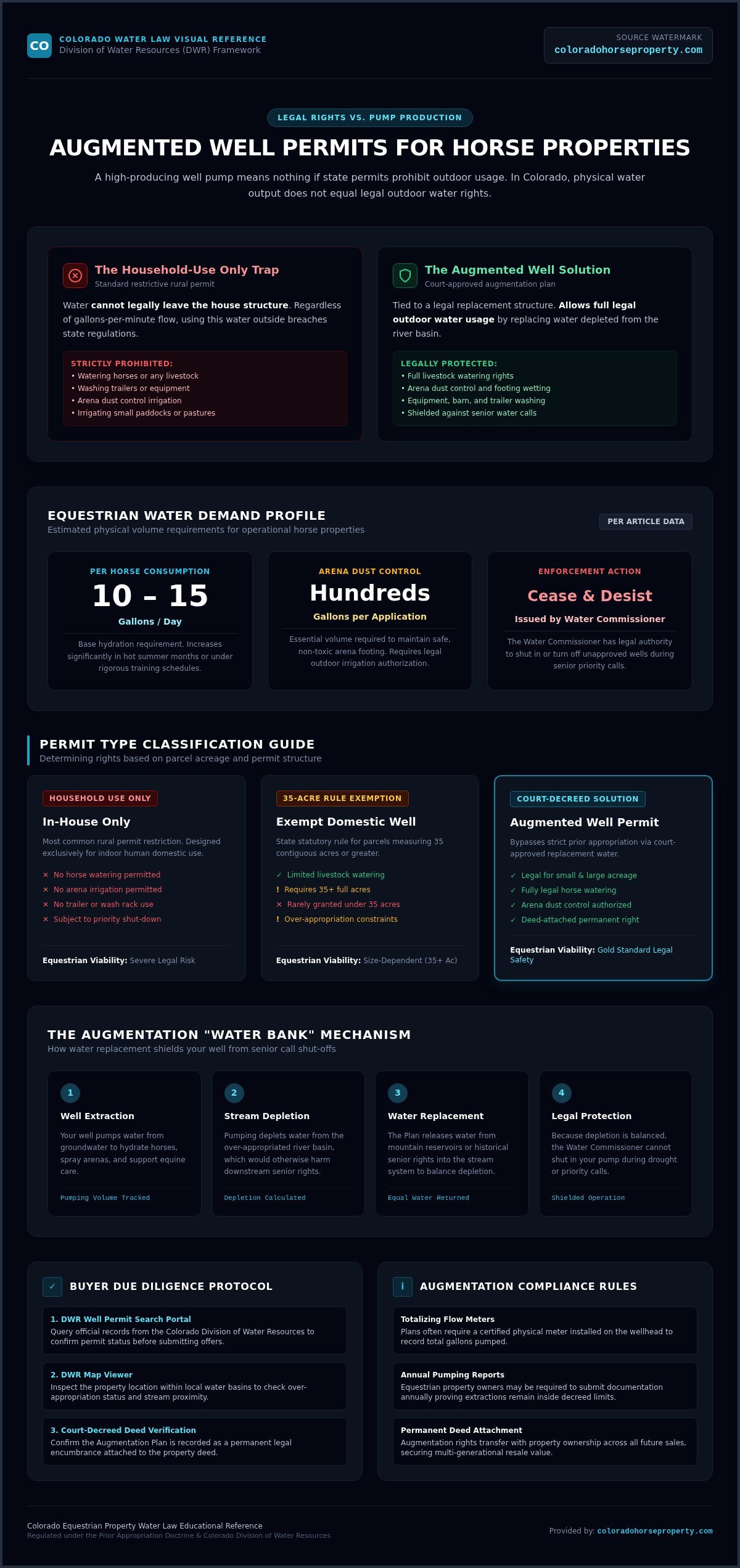
Many buyers fall in love with a rural acreage only to discover it holds a “Household Use Only” permit. This restrictive classification is the primary obstacle for horse owners. Under this permit type, water cannot legally leave the house structure. You cannot water a horse, wash a trailer, or irrigate a small paddock. Doing so violates state law, regardless of how much physical water your well pump can produce. Augmented permits solve this constraint by explicitly allowing outdoor uses like livestock watering and arena dust control.
The Difference Between Domestic and Augmented Permits
In Colorado, the 35-acre rule dictates many well allocations. Properties with 35 acres or more often qualify for an “Exempt” domestic well, which typically allows for limited livestock watering. However, if your equestrian property is under 35 acres, obtaining a standard domestic permit is rarely an option in over-appropriated basins. An augmented permit serves as a legal workaround for strict water priority rules established by the traditional prior appropriation doctrine. It provides a reliable pathway for smaller acreages to secure full outdoor water utility legally.
Why Horse Owners Specifically Need Augmentation
Equestrian operations demand a reliable, legally protected water supply. A single horse typically consumes 10 to 15 gallons of water per day, and this number increases during hot summer months or heavy training schedules. Operating without the correct permit puts your entire lifestyle at risk. If you don’t have the proper authorization, the local Water Commissioner can issue a “Cease and Desist” order if they catch you watering livestock on an unapproved permit.
Beyond animal hydration, dust control for a riding arena requires hundreds of gallons of water to maintain safe footing. An augmented well permit legally protects your right to irrigate your arena and keep your horses hydrated. When evaluating homes for sale with augmented well permits CO, you are investing in the exact legal framework required to run your horse property without state interference.
The Mechanics of Colorado Augmentation Plans
An augmentation plan functions as a sophisticated water bank. For every gallon your well pulls from the ground, the plan ensures a corresponding amount of replacement water returns to the stream system. This replacement water often comes from senior water rights or shares in a reservoir, managed under the strict oversight of the Colorado Division of Water Resources. When you look for homes for sale with augmented well permits CO, you aren’t just buying land; you’re buying a court-decreed right that is permanently attached to the property deed. This “Plan for Augmentation” is a legal encumbrance that stays with the property through every future sale.
The sources for this replacement water are diverse. Some plans utilize historic irrigation rights that have been changed in water court for augmentation use. Others rely on water stored in high-mountain reservoirs that is released during dry periods to offset pumping depletions. This complex back-end system is what allows a modern equestrian property to exist in an over-appropriated river basin without infringing on the rights of downstream farmers who have held water claims since the 1800s.
The Role of the Water Commissioner
The Water Commissioner is the boots-on-the-ground official who manages local priority. During drought years, the Commissioner has the duty to “shut in” or turn off wells that lack senior priority or a valid augmentation plan. An augmented permit acts as a shield for your lifestyle. It allows your pump to keep running even when senior calls would otherwise force a shutdown. Some plans require you to install a totalizing flow meter and submit annual pumping reports to prove you are staying within your legal limits. If you want to verify these technical details quickly, using an AI-powered horse property search can save you hours of manual research.
Annual Fees and Augmentation Associations
Most individual homeowners don’t own their own reservoir shares. Instead, they belong to an Augmentation Association or a community plan managed by an HOA. You’ll typically pay an annual fee to these organizations. These funds cover the cost of purchasing replacement water, legal fees for maintaining the court decree, and administrative reporting. It’s also vital to check if a property sits within a “designated basin.” These areas, mostly on the Eastern Plains, are managed under different rules by the Colorado Ground Water Commission. Identifying homes for sale with augmented well permits CO requires knowing which administrative body governs the water under your feet.
Comparing Colorado Well Permit Types for Buyers
Evaluating homes for sale with augmented well permits CO requires a clear understanding of how different permit classifications dictate your daily life. Buyers often assume that a functional well pump automatically grants the right to water horses or wash trailers. This is a significant misconception. In the 2026 real estate market, the type of permit attached to a property is as important as the house itself. Augmented permits have become the gold standard for smaller equestrian estates because they provide the only legal pathway for outdoor water use on parcels under 35 acres.
The resale value of a property is tied directly to its water security. A property with a restrictive permit may sit on the market longer or sell for less because it cannot legally support livestock. Conversely, an augmented permit ensures that your investment is protected against future water calls. Understanding The Mechanics of Colorado Augmentation Plans is essential for any buyer looking to avoid the legal pitfalls that come with over-appropriated river basins.
Household Use Only (The Restriction)
The “In-House Use Only” permit is a common trap for first-time ranch buyers. These permits are strictly limited to water use inside the primary residence. They explicitly prohibit outdoor watering, gardens, and livestock. If you are caught watering a horse on a household-only permit, you face serious legal consequences, including cease-and-desist orders and potential fines. These permits are frequently found in newer subdivisions where water rights were severed or were never available for outdoor allocation. While the pump might be capable of producing 15 gallons per minute, your legal right is zero once the water leaves the house.
Domestic/Exempt (The 35-Acre Standard)
For properties that meet the 35-acre threshold, “Exempt” domestic wells are the traditional standard. These permits typically allow for the watering of livestock and the irrigation of up to one acre of lawn and garden. However, they are generally limited to serving a single-family dwelling. If you plan to build a secondary ADU or a large guest house, a standard domestic permit may not be sufficient. For a comprehensive breakdown of these rules, see our article on Water Rights in Colorado: What Every Buyer Must Know.
With roughly 285,000 registered wells in Colorado as of January 2026, the state is increasingly vigilant about monitoring usage. As the population relying on private wells grows, having the correct permit isn’t just a luxury; it’s a fundamental requirement for maintaining an equestrian lifestyle. When searching for homes for sale with augmented well permits CO, always verify that the permit allows for the specific number of livestock you intend to keep.
Due Diligence: Verifying an Augmented Well Permit
Verifying a well permit is the most technical phase of your due diligence. When you find homes for sale with augmented well permits CO, you must move beyond the marketing description to confirm the legal reality of the water supply. A seller’s claim that a property is “horse-ready” doesn’t always align with the state’s official records. To ensure your purchase is fully protected, use our AI-powered search tool to find properties with verified augmented status and start your search with confidence.
Follow these specific steps to validate a permit before your inspection objection deadline:
- Step 1: Locate the Well Permit Number in the property listing or seller disclosures. It’s typically a six-digit number followed by a suffix like “-F” or “-A”.
- Step 2: Access the Colorado Division of Water Resources (DWR) Map Viewer and Well Permit Search portal to pull the original documents.
- Step 3: Review the “Conditions of Approval” on the permit. This section explicitly states what you can and cannot do with the water.
- Step 4: Confirm the specific augmentation plan name and the source of the “replacement water.” You need to know which association or reservoir is backing your usage.
- Step 5: Hire a water attorney or a broker specializing in technical land rights to review the court decree.
Red Flags in Permit Documents
Identifying problems early saves you from a high-stakes legal battle later. Look for expired permits or an “unapproved” status in the state database. As of August 6, 2025, all valid non-exempt permits have a two-year expiration date from issuance, so check the dates carefully. If the document doesn’t explicitly mention “livestock” or “augmentation,” the well is likely restricted. Watch for discrepancies between the physical well location and the GPS coordinates on the permit; a well drilled in the wrong spot can lead to a total loss of water rights.
The Importance of a Well Test
It’s vital to understand the difference between “Legal Water” and “Physical Water.” A perfect augmented permit gives you the legal right to water your horses, but it doesn’t guarantee the aquifer will provide enough flow. As of January 1, 2026, any well constructed for beneficial use must have a “Well Construction and Yield Estimate Report” filed. During your inspection, schedule a four-hour flow test. This longer test is necessary for equestrian properties to ensure the well can sustain the daily demands of livestock and arena maintenance without dropping in production.
How to Find Colorado Homes with Augmented Permits
Finding homes for sale with augmented well permits CO is notoriously difficult on traditional real estate platforms. Standard public listing portals are designed for high-volume, suburban residential transactions. They lack the technical infrastructure to filter for specific well permit types or court-decreed augmentation plans. For an equestrian buyer, this limitation means wasting hours clicking through hundreds of generic listings only to find that a property is legally restricted to indoor water use. You need a search process that respects the technical reality of Colorado water law from the very beginning.
Specialized brokerages fill this critical gap. When you’re searching for land that can legally support horses, you need a platform that understands the difference between a domestic and an augmented permit. Our team leverages proprietary technology to parse thousands of data points that generic sites ignore. This ensures you only see properties that meet your specific livestock and land management requirements without the manual filtering headache.
AI-Powered Search for Equestrian Water Rights
Our proprietary search tool identifies keywords like “augmented” or “augmentation plan” within the deep metadata of property records. This technology allows you to Find Colorado Horse Property Faster with Our AI Search Tool by stripping away non-compliant listings. Instead of guessing about a property’s water status, you receive a curated list of properties that have already cleared the first hurdle of legal water security. This efficiency is essential in a competitive market where water-secure land sells quickly.
Expert Representation by Mark and Alison Eibner
Finding a property with the right data is only the first step. Navigating a technical real estate transaction requires seasoned judgment. Mark and Alison Eibner bring 40 years of Front Range experience to every deal. We don’t just find the property. We evaluate the underlying water decrees to ensure they align with your long-term goals and the specific needs of your animals.
The Eibner team’s expertise extends directly to the closing table. We coordinate with title companies and the Colorado Division of Water Resources to ensure that well permits and augmentation rights transfer correctly to your name. In 2026, where state records hold hundreds of thousands of entries, having a specialized advocate is the only way to guarantee your property’s legal standing. Don’t leave your equestrian dream to chance. You can Search augmented well properties now and secure your future on the land with absolute certainty.
Secure Your Equestrian Future with Technical Precision
Securing a property where you can legally water horses and maintain a riding arena requires more than a standard real estate search. The legal distinction between a restrictive household-use permit and an augmented decree is the foundation of a viable horse property. Without a court-approved augmentation plan, you risk legal shut-ins and diminished property values. Identifying the right homes for sale with augmented well permits CO requires looking past the surface and verifying the technical decrees that govern the land.
Our team provides the expert buyer representation you need to navigate these high-stakes transactions. With 40 years of specialized Colorado experience and our proprietary AI-driven technical search filters, we bridge the gap between complex water rights and your lifestyle goals. We don’t just find listings; we protect your investment by ensuring every permit is verified and every right transfers correctly at closing. It’s time to stop filtering through generic sites and start searching with professional certainty.
Start Your AI-Powered Search for Horse Properties with Augmented Wells today. You’ve worked hard for this lifestyle, and we’re here to ensure your water rights are as solid as your commitment to your horses.
Frequently Asked Questions
What is the difference between an augmented well and a domestic well in Colorado?
An augmented well is legally tied to a court-approved plan that replaces water depleted from the stream system. This allows for outdoor use on smaller parcels. A domestic well is usually an “exempt” permit granted to properties of 35 acres or more, allowing for limited irrigation and livestock watering without a replacement plan. When searching for homes for sale with augmented well permits CO, you’re looking for properties that secured these rights through a water bank.
Can I water horses on a “Household Use Only” well permit?
You cannot legally water horses on a “Household Use Only” permit. These permits restrict water use strictly to the interior of the primary residence. Using this water for troughs, pastures, or arena dust control is a violation of Colorado water law. If a property under 35 acres lacks an augmentation plan, you’ll likely be restricted to this indoor-only classification, which makes legitimate equestrian operations impossible without a legal permit change.
How much does it cost to get an augmented well permit in Colorado?
The state filing fee for a “Plan for Augmentation” application is $469.00 as of January 2025. However, this is only the administrative cost. The actual price of securing an augmented well involves purchasing water shares and paying legal fees, which typically ranges from $10,000 to $50,000. For many buyers, joining an existing augmentation association is a more affordable path than filing a private decree in water court for a new development.
Do augmented well permits expire?
Yes, augmented well permits do expire. As of August 6, 2025, all valid non-exempt and large-capacity well permits are issued with a two-year expiration date. If the well isn’t constructed and the water isn’t put to beneficial use within that timeframe, the permit lapses. Buyers should always check the “Well Construction and Yield Estimate Report” filed after January 1, 2026, to ensure the physical infrastructure matches the current legal permit status.
How do I find the permit number for a well on a property I want to buy?
You can locate a permit number by searching the Colorado Division of Water Resources (DWR) “Well Permit Search” portal or using their online Map Viewer. Most specialized listings for homes for sale with augmented well permits CO will include this number in the disclosures. If it isn’t listed, you can search by the property’s physical address or GPS coordinates. Our AI-powered search tool simplifies this by identifying these technical permit numbers automatically for every listing.
What happens if I water my horses without an augmented permit?
If you water horses without a proper augmented permit, you risk receiving a “Cease and Desist” order from the local Water Commissioner. The state can fine you for illegal water diversions and force you to stop all outdoor usage immediately. This not only puts your animals at risk but also significantly devalues your property. Without the correct legal permit, you have no defense against senior water calls during drought cycles.
Can I convert a household-only permit into an augmented permit?
You can convert a household-only permit, but it’s a complex legal process. It usually requires filing an application in Water Court to change the use of the well, which involves proving you have replacement water to offset depletions. Most homeowners find it more practical to join a local augmentation association or water district that already has a court-decreed plan in place. This process can be costly and requires expert legal or brokerage guidance.
Is an augmented well permit the same as a water right?
A well permit and a water right are distinct legal entities. A permit is a document issued by the State Engineer that grants you the authority to construct a well and withdraw water. A water right is a property right, often decreed by a water court, that defines your priority and the amount of water you own. An augmented permit is the mechanism that allows you to exercise your water right even when you have junior priority.