
A beautiful ten-acre lot in El Paso County is a liability if the soil is packed with bentonite or the well permit doesn’t allow for livestock watering. It’s frustrating to filter through horse property for sale Colorado Springs only to find listings that lack basic infrastructure or sit on land where you can’t legally build an arena. You need more than just acreage; you’re looking for a functional environment that supports your animals and protects your investment. We understand the desire for expansive space and the necessity of technical due diligence in our unique high-desert landscape.
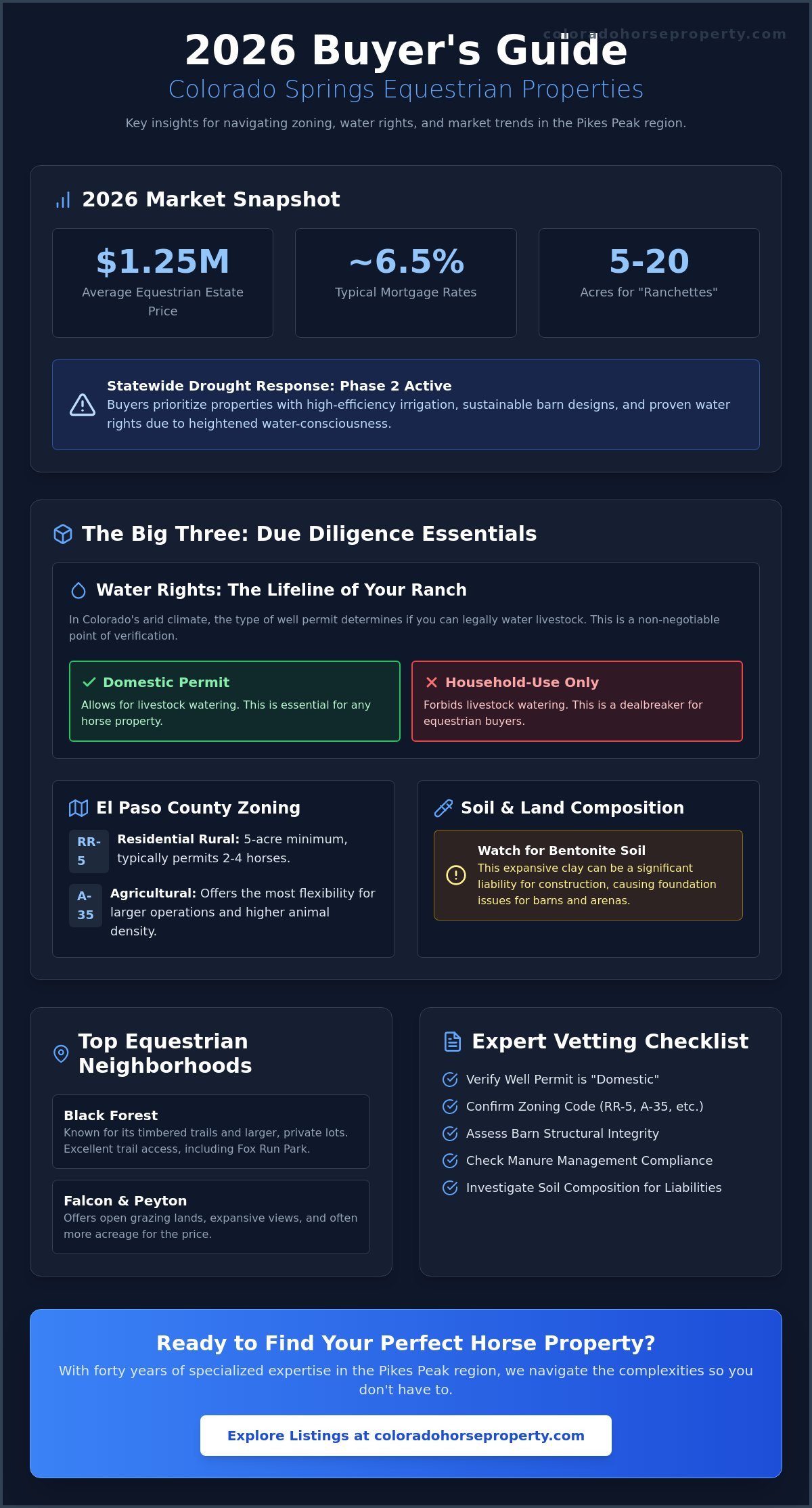
This 2026 guide provides the expert insights you need to secure a property with viable water rights, proper zoning, and the infrastructure required for equestrian success. We’ll break down the specific challenges of the state’s Phase 2 Drought Response Plan activated in March 2026 and identify neighborhoods with the best trail access, such as Fox Run Park and Black Forest. You’ll learn how to navigate El Paso County’s RR-5 zoning, evaluate current mortgage rates near 6.5 percent, and work with specialists who understand the difference between a residential backyard and a true equestrian facility.
Key Takeaways
- Learn to distinguish between Domestic and Household Only well permits to guarantee your livestock has a legal, sustainable water source.
- Understand how El Paso County zoning codes like RR-5 and A-35 impact your search for horse property for sale Colorado Springs.
- Discover which neighborhoods offer the best value, from the timbered trails of Black Forest to the open grazing lands of Falcon and Peyton.
- Gain a professional checklist for vetting existing infrastructure, including barn structural integrity and manure management compliance.
- Benefit from forty years of specialized expertise in the Pikes Peak region to navigate complex land management and title requirements.
The 2026 Market for Horse Property for Sale in Colorado Springs
Finding horse property for sale Colorado Springs involves a significant distinction between raw land and established equestrian estates. In June 2026, the market shows a clear preference for properties that offer immediate utility. Raw land requires extensive permitting and infrastructure development. A functional horse property includes secure fencing, hay storage, and reliable water access. With an average listing price of $1,255,881 for equestrian estates in the region, buyers are increasingly looking for “ranchettes” between five and twenty acres. These smaller hobby farms offer the lifestyle of a large ranch without the massive overhead of managing hundreds of acres.
Investing in equestrian real estate Colorado remains a sound long-term strategy. The limited availability of land with senior water rights and favorable zoning makes these assets highly resilient. Understanding the geography of the Pikes Peak region is foundational for any buyer. The variation in soil types and elevation directly impacts how you’ll manage your pastures and maintain your barn. We see a steady influx of buyers relocating from higher-density states who are drawn to the freedom and expansive space our region provides.
Why Colorado Springs is an Equestrian Hub
The Pikes Peak region is built on horse culture. Proximity to the Norris Penrose Event Center provides easy access to national-level shows and rodeos. Our climate offers nearly 300 days of sunshine. This allows for year-round riding even in the winter months. Whether you’re involved in local 4-H clubs or looking for professional training stables, the community is supportive and deeply rooted in livestock traditions. This social infrastructure is just as important as the physical barns and arenas when choosing a location.
Evolving Buyer Expectations in 2026
Current trends show a massive shift toward water-conscious management. Following the activation of Phase 2 of the Colorado Drought Response Plan in March 2026, buyers now prioritize properties with high-efficiency irrigation and sustainable barn designs. There’s also a growing demand for indoor arenas to combat the wind and sun. Turn-key estates that already feature these amenities command a premium. They allow buyers to bypass the high costs of new construction and the complexities of 2026 building codes.
Zoning, Water, and Soil: The Big Three of Colorado Land
Buying land in the Pikes Peak region requires a technical eye. You can’t assume that five acres automatically permits horses or that the ground is stable enough for a heavy barn. Zoning, water rights, and soil composition dictate the true utility and value of any horse property for sale Colorado Springs. Without verifying these “Big Three,” a dream ranch can quickly become a legal and financial burden.
Decoding El Paso County Horse Zoning
El Paso County utilizes an “Animal Unit” system to determine livestock capacity. This system balances animal density with land preservation to prevent overgrazing. The RR-5 (Residential Rural) zone requires a five-acre minimum lot size and typically permits two to four horses depending on specific parcel health. For those seeking higher density or smaller lots, the RR-2.5 zone offers different constraints. Conversely, the A-35 (Agricultural) classification provides the most flexibility for larger operations. Understanding the El Paso County agricultural classification is also vital for tax purposes. If your goals include a commercial boarding or training facility, you’ll likely need to apply for a Special Use permit through the county planning department.
Water Rights: The Lifeline of Your Ranch
Water is the most critical asset in our arid climate. You must verify well permits before closing on horse property for sale in colorado. A “Household Use Only” permit is often a dealbreaker for equestrians because it forbids watering livestock. You need a “Domestic” permit to legally provide for your animals. Some properties operate under Augmentation Plans, where a third party replaces the water you pump from the ground to protect senior water rights holders. Always ask about the depth of the well and the presence of cistern systems. If you’re unsure about a listing’s water status, our specialized buyer representation can help you pull the necessary state records.
Soil quality is another factor that often goes overlooked until a barn foundation starts shifting. Our region contains pockets of expansive bentonite clay. This soil swells when wet and shrinks when dry, which can crack concrete and ruin expensive arena footing. Proper drainage is non-negotiable for any arena build to prevent “muck holes” during the spring melt. Finally, don’t forget to check for private covenants. Even if the county allows horses, an HOA might restrict your choice of fencing or the location of your manure pile. We recommend looking for properties with existing non-climb wire or pipe fencing to save on immediate infrastructure costs.
Top Neighborhoods for Horse Properties in the Pikes Peak Region
Selecting the right location for your horse property for sale Colorado Springs requires balancing terrain preferences with trail access and budget. The Pikes Peak region offers a diverse landscape. You’ll find everything from dense Ponderosa Pine forests to expansive, flat grasslands. Each area has unique benefits for livestock management and recreational riding. Before committing to a specific parcel, consult the El Paso County Planning & Community Development office to verify specific land-use regulations for that neighborhood. Understanding these local nuances is the first step toward a successful purchase.
Black Forest: Trees, Trails, and Tradition
Black Forest is the premier destination for equestrians who value privacy and natural wind protection. The dense canopy of Ponderosa Pines creates a sheltered environment for both horses and riders. Many colorado land owners in this area enjoy direct access to the Fox Run Park trail system. This connectivity is a major draw for those who prefer long trail rides over arena work. Five-acre parcels dominate this sub-market. This size aligns perfectly with RR-5 zoning requirements. While the timbered terrain is beautiful, it requires active forest management to mitigate fire risks and maintain healthy grazing pockets. It’s a traditional hub where horse culture is deeply embedded in the community.
The Eastern Plains: Falcon, Peyton, and Calhan
If your priority is a large outdoor arena or expansive grazing, look toward the Eastern Plains. Neighborhoods like Falcon and Peyton offer flat, usable acreage that is significantly easier to develop than the hilly terrain found further west. You often get more dirt for your dollar here. This makes it an ideal choice for buyers seeking ten to thirty-five-acre lots. The open landscape provides unobstructed views of the Front Range. However, the lack of natural cover means you’ll need to invest in wind management strategies. Many owners plant rows of hardy trees or install windbreak fencing to protect their livestock from the frequent plains winds. These areas are excellent for performance horse owners who need level ground for training.
Monument and Larkspur: High-End Estates
Monument and Larkspur cater to the luxury equestrian market. These neighborhoods sit along the I-25 corridor. They provide a convenient commute to both Denver and Colorado Springs. Properties here often feature professional-grade infrastructure, including heated barns and indoor arenas. The terrain is a mix of rolling hills and scrub oak. This provides a scenic backdrop for high-end estates. Demand in this sector remains high. Turn-key properties in these northern zones often sell quickly due to their proximity to major equestrian event centers and metropolitan amenities. You’ll find a sophisticated blend of rural living and modern convenience in these sought-after locations.
How to Vet a Potential Horse Property Like an Expert
A standard home inspection rarely covers the technical nuances of a working ranch. When evaluating horse property for sale Colorado Springs, you must shift your focus from the residential dwelling to the specialized infrastructure. A beautiful kitchen doesn’t compensate for a barn with poor drainage or a paddock that floods every spring. You’re looking for functional utility that protects your animals, your equipment, and your time. Professional vetting ensures the land can actually support your specific livestock goals.
The Equestrian Infrastructure Checklist
Start with a deep dive into the existing outbuildings. Structural integrity is paramount. Look for signs of shifting foundations in the barn or rot in wooden support beams. The layout should prioritize animal health and owner convenience. Consider the following factors during your walkthrough:
- Stall Specifications: Ensure stalls are at least 12×12 feet with high ceilings and proper cross-ventilation to prevent respiratory issues.
- Tack and Feed Rooms: These areas must be dry, rodent-proof, and large enough to store your gear and daily supplements.
- Fencing Quality: Check for horse-safe non-climb wire or pipe fencing. Standard cattle wire or barbed wire is a safety hazard for horses and often requires immediate, expensive replacement.
- Hay Storage: Evaluate the capacity for seasonal storage. The storage area must be accessible for large delivery trucks or “squeeze” lifts. If a semi-truck can’t reach your hay shed, your annual feed costs will increase due to smaller delivery fees.
The Arena Test and Environmental Compliance
Don’t assume a flat field is a ready-made arena. You must test the ground for sub-surface rock and soil stability. In the Pikes Peak region, shallow granite deposits can turn a simple grading project into a massive excavation expense. You also need to plan for manure management. El Paso County has specific guidelines for waste disposal to protect local groundwater. Ensure the property has a designated, compliant area for composting or storage. This prevents future legal issues and maintains a healthy environment for your herd. Proper drainage away from the barn and arena is non-negotiable to avoid “muck holes” during the spring melt.
Leveraging AI in Your Property Search
Generic real estate platforms often fail to distinguish between a garden shed and a legitimate livestock facility. Our proprietary AI-Powered Horse Property Search identifies horse barns for sale that generic sites frequently miss. We use advanced algorithms to filter listings by pasture type, specific water rights, and the presence of specialized footing in arenas. This technology provides real-time alerts for niche listings that match your exact livestock needs. You can bypass irrelevant residential results and focus only on properties with the infrastructure you require. Activate your AI-powered search account to see the latest equestrian listings in the Colorado Springs market.
Partnering with Colorado Horse Property for Your Search
Navigating a ranch transaction requires more than a standard real estate license. It demands a deep understanding of the land’s history, legal encumbrances, and physical potential. The legacy of Mark and Alison Eibner is built on forty years of specialized expertise in the Pikes Peak region. We’ve seen every market shift and regulatory change since the 1980s. This longevity provides our clients with a distinct advantage when evaluating horse property for sale Colorado Springs. Our affiliation with Realty Oasis further strengthens this position. It allows us to provide a full ecosystem of support, from the initial search to the final closing.
Expert buyer representation is essential for complex land sales. Unlike a suburban home purchase, a ranch deal involves intricate title reviews and specific escrow requirements. We manage every detail of the transaction. This includes coordinating with water attorneys, verifying septic records, and ensuring that all land-use permits are in order. Our goal is to protect your investment and ensure that the property you buy today remains a functional asset for decades. We handle the technical paperwork so you can focus on the vision for your new facility.
Why a Specialized Brokerage Matters
Generalist residential agents often miss the subtle red flags that can ruin a livestock operation. They might overlook a restrictive covenant that forbids loafing sheds or fail to recognize a failing well pump. We’ve built a robust network of local partners to assist our clients. This includes trusted well testers, barn builders, and soil engineers who understand the unique challenges of the Front Range. We are deeply committed to providing the most accurate data and insights for the horse real estate for sale market in Colorado. This specialization ensures you aren’t just buying a house, but a viable environment for your animals.
Start Your Colorado Springs Journey Today
The best equestrian estates often move quickly, sometimes before they even hit the public market. Our deep roots in the local community give us access to off-market listings and upcoming opportunities. We invite you to begin your search with a personalized consultation. We’ll discuss your specific requirements for acreage, infrastructure, and trail access. By partnering with a team that understands the nuances of horse property for sale Colorado Springs, you gain a peer who shares your passion for the equestrian lifestyle. Search Colorado Springs Horse Properties Now to explore current listings and find the perfect foundation for your dream ranch.
Securing Your Equestrian Future in the Pikes Peak Region
Finding the right horse property for sale Colorado Springs requires a balance of passion and technical due diligence. You now understand that a successful purchase depends on verifying Domestic well permits, navigating RR-5 zoning, and selecting a neighborhood that fits your specific riding discipline. Whether you’re drawn to the sheltered trails of Black Forest or the expansive training grounds of Falcon, the right foundation is available if you know where to look. Technical details like soil composition and manure management are just as important as the number of stalls in the barn.
Our team is here to simplify this complex process for you. With over 40 years of Colorado real estate experience and specialized expertise in regional water rights, we provide the niche authority you need. We use proprietary AI-powered equestrian search tools to identify listings that meet your exact infrastructure requirements. Browse Verified Colorado Springs Horse Properties today to start your next chapter. Your dream of owning a functional, sustainable ranch is within reach, and we look forward to helping you achieve it.
Frequently Asked Questions
How many horses can I have per acre in Colorado Springs?
El Paso County utilizes an Animal Unit system rather than a strict per-acre count. Generally, one horse equals one animal unit, and the number allowed depends on your specific zoning and the health of the land. For example, a property in the RR-5 zone typically supports two to four horses on five acres. You must ensure the land can sustain grazing without overtaxing the soil or violating county density regulations.
What is the difference between a domestic well and a household-only well?
A domestic well permit allows for livestock watering and limited outdoor irrigation, making it essential for any horse property for sale Colorado Springs. In contrast, a household-only permit strictly limits water use to inside the residential dwelling. If a property only has a household-use permit, you cannot legally use well water for your horses. This distinction is a critical factor in determining the land’s utility and long-term value.
Are there specific HOAs in Colorado Springs that are horse-friendly?
Yes, several developments like Wildwood Village and parts of Black Forest are specifically designed with equestrian residents in mind. These communities often feature dedicated trail easements and communal riding areas for homeowners. However, you must carefully review the specific Covenants, Conditions, and Restrictions (CC&Rs). Some HOAs may allow horses but place strict limits on the size of your barn or the type of fencing you can install.
What should I look for in a horse barn inspection?
Focus on structural integrity, electrical safety, and ventilation. Check that all wiring is encased in conduit to prevent fire hazards from rodents or dust. Inspect the stalls for proper drainage and ensure the ceilings are high enough for safe movement. You should also evaluate the hay loft’s weight capacity and confirm that the barn’s layout allows for easy manure removal and efficient daily feeding routines.
How do water rights affect the value of a horse property?
Water rights are a primary driver of property value in Colorado’s high-desert climate. A parcel with senior water rights or a robust domestic well permit is significantly more valuable than one with restricted usage. With the state’s 2026 drought response plans in effect, secured water access is no longer just a convenience; it’s a necessity for protecting your livestock investment and ensuring the property remains marketable in the future.
Which areas in Colorado Springs have the best access to public riding trails?
Black Forest and the Monument region offer the most direct connectivity to established systems like Fox Run Park. These areas feature wooded trails that provide natural wind protection during the winter months. While the eastern plains offer more open acreage, riders in those areas often need to trailer their horses to reach public trailheads. Identifying a horse property for sale Colorado Springs with direct trail access can significantly enhance your daily riding experience.
Is bentonite soil a dealbreaker for building an arena?
Bentonite is not a dealbreaker, but it does require a specialized construction budget. This expansive clay swells and shrinks with moisture, which can ruin a standard arena foundation. If your soil test reveals bentonite, you’ll need to invest in a professional drainage system and a thicker sub-base to keep the footing stable. It is better to address this during the vetting process rather than fixing a shifting arena later.
Do I need a special permit to run a boarding business on my property?
Yes, running a commercial boarding operation typically requires a Special Use permit from the county planning department. While keeping your own horses is usually allowed “by right” in agricultural and rural residential zones, accepting payment for boarding or training changes the property’s legal status. You must verify that both the county zoning and your private neighborhood covenants allow for commercial activity before starting your business.