
What if your multi-million dollar mountain view disappeared behind a neighbor’s new barn or a high-density subdivision? In Colorado, a vista is only as secure as the zoning and topography surrounding it. You’ve likely spent years dreaming of owning ranches with views of Pikes Peak, but the reality of the 2026 market involves more than just finding the right acreage. It requires a deep dive into Douglas, El Paso, and Teller County regulations to ensure “America’s Mountain” stays in your window.
We understand that you aren’t just buying land; you’re investing in a specific lifestyle that demands both aesthetic beauty and functional utility. This guide provides the technical expertise you need to navigate the new House Bill 26-1340 water regulations and the dual assessment tax rates for the 2026 tax year. You will learn which specific regions offer the most reliable sightlines, how to manage high-altitude infrastructure, and why specialized buyer representation is essential for the niche equestrian market.
Key Takeaways
- Identify the distinct visual advantages of Teller County’s “High Country” angles versus the expansive prairie vistas found in El Paso County.
- Learn to evaluate building envelopes and ridge-line topography to ensure your mountain view remains unobstructed by future neighboring developments.
- Navigate the technical differences between domestic and agricultural well permits to secure reliable water access from regional aquifers.
- Discover how AI-powered search tools can identify specific topographical features that standard MLS listings often overlook when filtering for ranches with views of Pikes Peak.
- Understand the historical and cultural factors that position a protected Pikes Peak vista as a permanent, high-value asset class in Colorado real estate.
The Allure of the Front Range: Why Ranches with Views of Pikes Peak Command a Premium
A view of the mountain is more than a scenic perk; it’s a primary driver of property valuation in the 2026 Colorado market. While standard mountain vistas are common, ranches with views of Pikes Peak command a significant premium due to the mountain’s status as a cultural and geographic icon. For over a century, Pikes Peak has served as the definitive landmark for Colorado ranching families, representing the gateway to the West. Today, that historical prestige translates into tangible market value. The sight of the summit provides a sense of orientation and expansive freedom that defines the high-desert lifestyle.
To better understand how these views integrate with luxury ranch design, watch this helpful video:
Unobstructed sightlines are increasingly rare as development continues along the Front Range. Owning a ranch where the peak remains visible from the main residence or training arena is a strategic move. It ensures the property retains its status as a legacy asset. Buyers aren’t just looking for a home; they’re looking for a connection to the rugged landscape that defines the region. Finding a parcel where the view isn’t compromised by future neighbors requires careful topographical analysis and a deep understanding of local land use trends.
The Economic Value of a Mountain Vista
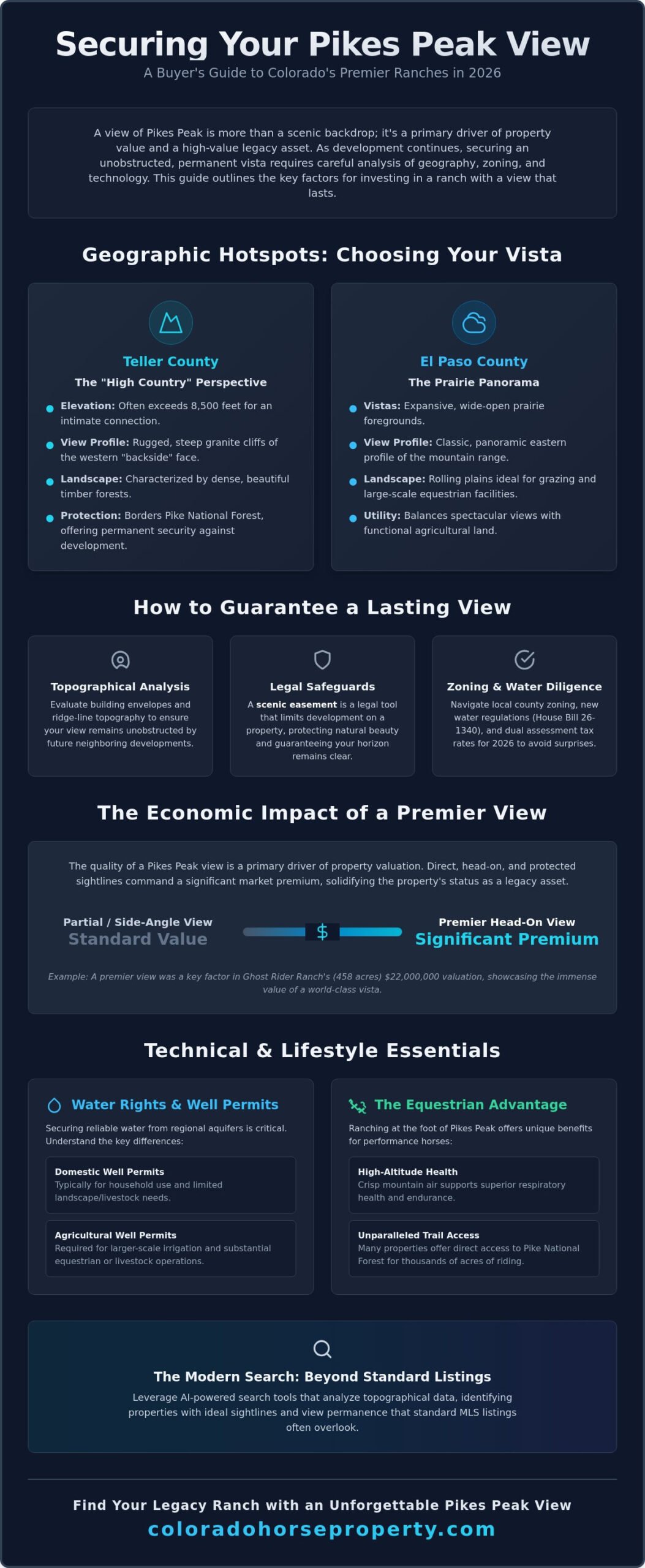
The resale value of an equestrian estate often hinges on the quality of its peak view. Properties with a direct, head-on look at the summit typically outperform those with side-angle or partial mountain views. For example, June 2026 market data shows Ghost Rider Ranch in Douglas County listed at $22,000,000 for 458 acres, while Pikes View Ranch holds a $3,250,000 valuation for 478 acres. A scenic easement is a legal agreement that limits development on a property to protect its natural beauty and the views enjoyed by surrounding landowners. These legal protections add security for investors who want to guarantee their horizon remains clear of rooftops.
Equestrian Lifestyle at the Foot of the Peak
The physical benefits of high-altitude ranching are well-documented among professional horse owners. The crisp air found at the foot of the mountain supports respiratory health and endurance in performance horses. Many of these properties offer direct access to Pike National Forest, providing thousands of acres of trail riding opportunities that extend far beyond your property lines. When searching for horse property for sale in colorado, prioritize parcels that balance these recreational benefits with necessary infrastructure. The combination of private acreage and public land access creates a training environment that standard residential lots can’t match.
Geographic Hotspots: Where to Find the Best Pikes Peak Views
The visual profile of Pikes Peak shifts significantly as you move across the Front Range. Selecting the right location for your ranch depends on whether you prefer a dramatic, close-up mountain face or a wide, panoramic vista that spans the horizon. Identifying ranches with views of Pikes Peak requires an understanding of how county lines intersect with the region’s unique topography. Each geographic pocket offers a different balance of elevation, climate, and agricultural utility.
Teller County: Woodland Park and Divide
Properties in Teller County offer what locals call the “High Country” perspective. At elevations often exceeding 8,500 feet, these ranches provide a rugged, intimate connection to the western face of the mountain. This “backside” view is characterized by steep granite cliffs and dense timber, offering a stark contrast to the traditional eastern profile seen from the city. Because much of the county borders the Pike National Forest, these parcels often enjoy permanent protection against neighboring development. When evaluating colorado ranches for sale in this area, pay close attention to Teller County’s A-1 zoning. On parcels of 35 acres or more, current 2026 regulations permit up to three single-family dwellings, making it an ideal choice for multi-generational legacy estates.
El Paso County: Black Forest and Peyton
If you prefer an expansive, “Rolling Plains” view, El Paso County is the primary destination. Ranches in the Black Forest or Peyton areas offer a prairie-to-peak vista where the mountain rises abruptly from the flatlands. This region is particularly popular for larger equestrian operations because the terrain is generally more manageable for fencing and pasture rotation than the steep slopes of Teller County. You’ll find a mix of A-35 agricultural zoning and RR-5 residential rural tracts, allowing for varied scales of livestock management. These properties benefit from being close to Colorado Springs equestrian amenities while maintaining the quiet of the open range. It’s often helpful to use specialized search tools to filter these listings by specific acreage and sightline orientation.
Douglas and Fremont Counties offer specialized alternatives for buyers with specific climate or luxury needs. Douglas County, particularly around Larkspur, features high-end estates where the northern face of the peak is framed by scrub oak and red rock formations. These properties often command the highest price points in the region. Fremont County provides a southern perspective with a significantly milder winter climate. This is a strategic choice for ranch owners who want ranches with views of Pikes Peak but need to minimize the heavy snow loads and extreme cold found at higher elevations. Each of these hotspots presents a different set of trade-offs between visual drama and year-round operational ease.
Evaluating Ranch Land for View Permanence and Utility
Securing ranches with views of Pikes Peak requires a technical assessment that goes beyond a simple walk-through. You need to analyze the topography to determine if a ridge-top build provides the best vantage point or if it exposes your home and livestock to excessive wind. While a valley floor offers natural protection, it can easily obscure the mountain behind rising terrain or neighboring structures. Building envelopes, the specific area on a plat where construction is permitted, must be carefully oriented to maximize window placement without compromising privacy.
The long-term health of that vista also depends on regional land management. For instance, the Pikes Peak Vegetation Management and Restoration Project works to reduce wildfire risks and improve forest resilience, which directly impacts the scenic quality of your property’s backdrop. Understanding these public land initiatives helps you predict how the surrounding landscape will evolve over the next decade. If the forest on a neighboring ridge is thinned, your view might actually improve, but it also increases the visibility of any future structures built there.
Protecting Your Sightlines
Don’t assume a clear view today remains clear tomorrow. Research the zoning of every adjacent parcel to identify potential future developments that could block your horizon. Conservation easements are powerful tools here; they legally restrict development on neighboring land to preserve the open character of the region. A professional topographical survey verifies the specific height limitations and setbacks required to maintain an unobstructed status from your primary build site.
When looking at existing horse barns for sale, evaluate their current placement relative to the main house. A poorly situated barn can sever the visual connection between your living room and the peak. If you’re building from scratch, you have the advantage of plotting the barn’s footprint to act as a windbreak while keeping the primary sightline open.
Infrastructure Placement
Strategic placement of arenas and stables is essential for functional ranching. You want your training facilities close enough for convenience but positioned so they don’t dominate the landscape. Balance is the goal. For example, placing a hay shed on the leeward side of a hill can provide wind protection for your herd while keeping the structure out of your main “view shed.”
Natural landscaping should frame the peak rather than hide it. Use native scrub oak or ponderosa pines to create depth in the foreground. This technique draws the eye toward the summit while providing privacy from the road. By integrating these technical considerations, you ensure your investment in ranches with views of Pikes Peak remains both beautiful and operationally efficient.
Technical Essentials for Pikes Peak Region Ranches
Buying ranches with views of Pikes Peak involves more than evaluating the horizon; you must understand the technical constraints of the land itself. The region’s soil is famously granite-rich, particularly in Teller and western El Paso counties. This decomposed granite provides excellent drainage for horse paddocks, but it can make excavating for foundations or septic systems more expensive. Additionally, managing access and egress requires a plan for high-snowfall months. Ranches at higher elevations in Divide or Woodland Park often require heavy-duty equipment to keep private roads passable during spring storms.
Colorado Water Law 101
Water is the most critical technical factor in any Colorado land transaction. Colorado operates on the doctrine of “prior appropriation,” meaning senior water rights take precedence during shortages. Adjudicated water rights have been confirmed by a water court, providing a level of security that non-adjudicated rights lack. When researching land for sale in colorado, you’ll find that a standard domestic and livestock well permit (typically available on parcels of 35 acres or more) generally supports the watering of non-commercial livestock and up to one acre of garden or lawn. For smaller parcels, well permits may be restricted to “in-house use only,” which prohibits outdoor troughs or wash racks. The new House Bill 26-1340, signed in June 2026, also adds strict revegetation requirements for those transferring agricultural water rights to municipal use, a move designed to protect the local ecosystem.
Zoning for Equestrian Use
Zoning regulations vary significantly between Front Range counties. In El Paso County, the A-35 (Agricultural) zone requires a 35-acre minimum and is designed to preserve ranching culture, while A-5 allows for limited residential use on smaller 5-acre tracts. If you’re planning a large-scale riding arena, you must navigate specific building codes regarding snow load ratings and wind resistance. Be cautious of “Ranchette” communities; while they offer ranches with views of Pikes Peak, they often come with HOA or covenant restrictions that limit the number of “animal units” per acre. To ensure your property qualifies for the significantly lower agricultural property tax rates, you must prove the land is used for profit. Personal “pleasure horses” usually don’t qualify, so many owners lease their pastures to neighbors for cattle grazing to maintain their ag status. Before you sign a contract, consult with a specialized buyer representative to verify that the local zoning matches your long-term ranching goals.
Finding Your Legacy: How to Search for Pikes Peak Ranches
Standard MLS tools fall short when you’re looking for specific topographical assets. A typical search engine doesn’t account for the angle of a ridge or the height of a neighbor’s future arena. Finding ranches with views of Pikes Peak requires a specialized approach that integrates visual data with traditional property specifications. You need a system that understands how a 35-acre parcel in El Paso County differs from a 5-acre tract in Douglas County regarding both utility and sightline permanence. Transitioning from a dream to a closed ranches for sale colorado transaction demands a platform built for the unique requirements of the rural market.
AI-Powered Horse Property Search
The Colorado Horse Property platform uses an AI-Powered Horse Property Search to identify “view-heavy” parcels that others overlook. This technology analyzes elevation data and building envelopes to ensure the mountain is actually visible from your primary training area or residence. Instead of clicking through hundreds of irrelevant photos, you can filter for barns, indoor arenas, and senior water rights simultaneously. Modern real estate has evolved; the “view” is no longer just a descriptive adjective. It’s a searchable data point that our system cross-references with soil quality and zoning density. This allows you to find ranches with views of Pikes Peak that meet your livestock needs without compromising on the iconic Colorado horizon.
Expert Representation with Realty Oasis
Technology provides the data, but seasoned experts provide the strategy. Mark and Alison Eibner offer over 40 years of local experience in the Pikes Peak region. They understand that a ranch purchase is a complex transaction involving more than just a price negotiation. Their team handles every aspect of the deal, including Buyer Representation and comprehensive Transaction Management. They also coordinate Title and Escrow services to ensure that every easement and water right is clearly documented before you reach the closing table. This leadership-forward approach takes the guesswork out of high-stakes land acquisitions. You aren’t just hiring a broker; you’re partnering with a peer who understands the agricultural and equestrian lifestyle from the ground up.
Don’t leave your mountain vista to chance. Use a system and a team that specializes in the technical realities of the Front Range. Start your AI-powered search for Pikes Peak views today and secure your piece of the Colorado landscape.
Secure Your Legacy Under America’s Mountain
Securing a long-term investment in the Front Range requires balancing the emotional appeal of the landscape with the technical realities of Colorado land use. You’ve seen how geographic hotspots like Teller and El Paso counties offer distinct perspectives, and why topographical analysis is the only way to guarantee your sightlines remain permanent. Identifying ranches with views of Pikes Peak that support a functional equestrian lifestyle is a complex process, but it’s one that yields immense rewards for your family and your livestock.
We provide the specialized tools and 40 years of Front Range real estate expertise needed to navigate this competitive market. Our division of Realty Oasis utilizes proprietary AI-powered search technology to filter for the specific water rights, soil types, and building envelopes that general listings often miss. We’re here to guide you through every step of the transaction, from the first search to the final title coordination. Find your dream ranch with Pikes Peak views using our AI search tool. Your vision of a permanent, unobstructed horizon is within reach when you have the right data and the right partners by your side.
Frequently Asked Questions
Do ranches with Pikes Peak views cost more than other mountain properties?
Yes, properties with clear sightlines of Pikes Peak typically command a significant premium compared to standard mountain vistas. This price gap reflects the mountain’s status as a regional icon and the scarcity of unobstructed private land. Buyers often view these parcels as legacy assets that hold their value better during market fluctuations. The specific orientation and closeness to the peak are the primary factors that determine the exact price increase.
What counties have the best views of Pikes Peak for ranch owners?
Teller and El Paso counties offer the most diverse selection of ranches with views of Pikes Peak. Teller County provides dramatic, high-altitude angles of the western face; El Paso County is famous for expansive, “rolling plains” vistas. Douglas County also features high-end estates with distant, framed views of the northern face. Each county has unique zoning laws that impact how much acreage you can acquire for your equestrian operations.
Can I have horses on a property in the Pikes Peak National Forest area?
You can keep horses on private land adjacent to the National Forest, provided the county zoning allows for livestock. Most agricultural zones like A-35 in El Paso County or A-1 in Teller County are designed for this purpose. These properties are highly sought after because they offer direct access to public trail systems. Always verify the specific animal unit densities permitted by your county to ensure your herd size complies with local regulations.
How do I ensure my view of Pikes Peak won’t be blocked by future construction?
Protecting your vista requires a combination of topographical analysis and legal research. Building on a ridge or elevated slope is the most effective way to stay above potential future structures on neighboring lots. You should also look for properties protected by conservation easements or those bordering National Forest land. A professional survey can identify building envelopes that maximize your sightlines while accounting for the height restrictions of adjacent parcels.
What kind of water rights do I need for a 35-acre ranch in Teller County?
For a 35-acre parcel, you typically qualify for a domestic and livestock well permit. This allows for household use, watering non-commercial livestock, and limited irrigation. It’s important to understand the difference between adjudicated and non-adjudicated rights in Colorado’s “prior appropriation” system. Recent 2026 legislation has increased the focus on land restoration when water is transferred; consulting a water rights expert during your due diligence is essential for long-term security.
Is it difficult to maintain a ranch at the higher elevations near Pikes Peak?
High-altitude ranching presents unique challenges, particularly regarding winter road maintenance and snow loads on structures. Ranches at elevations above 8,500 feet experience longer winters and shorter growing seasons for hay. The granite-rich soil offers excellent drainage for paddocks, but it can be difficult for certain types of forage. You’ll need reliable equipment for snow removal and well-insulated shelters to protect your horses from extreme temperature drops during peak winter months.
How much acreage do I actually need for a horse ranch with a view?
While you can find 5-acre “ranchettes” with stunning vistas, 35 acres is the standard for full agricultural benefits and flexible well permits. Smaller parcels often face stricter limits on the number of horses allowed and how you can use your water. Larger acreage also provides a “buffer zone” that helps protect your ranches with views of Pikes Peak from encroaching development. Your specific goals for grazing and training facilities will ultimately dictate your land requirements.
What is the best time of year to view properties to see the true “peak vista”?
Late spring and early fall offer the clearest atmospheric conditions for evaluating a property’s sightlines. During these months, you can see the full definition of the mountain’s granite faces without the heavy haze that sometimes occurs in mid-summer. Viewing in winter is also valuable for seeing how snow accumulates on access roads and pastures. A year-round perspective is ideal, but the shoulder seasons provide the best balance of accessibility and visual clarity.