
Owning a horse in the Colorado Rockies is a complex exercise in resource management and legal compliance rather than just a scenic lifestyle choice. You probably dream of finding the perfect Florissant CO equestrian homes with Pikes Peak views, but the technical reality of Teller County zoning and high-altitude livestock care can feel like a steep climb. It’s common to worry about whether a property has the senior water rights necessary to sustain your horses or if the soil can handle 2026 grazing requirements. We understand that a beautiful barn is useless if the land lacks the legal utility to support your animals year-round.
This guide provides the essential data you need to secure a functional, move-in-ready estate that protects your investment. You’ll learn how to evaluate land utility at 8,000 feet, understand the nuances of local water law, and use proprietary AI search tools to filter for properties with existing infrastructure like barns and arenas. We’ve compiled decades of regional expertise to help you transition from a dreamer to a prepared mountain landowner. We will cover everything from soil management to the specific zoning codes that dictate your lifestyle in Teller County.
Key Takeaways
- Learn why insulated barns and heated tack rooms are non-negotiable infrastructure requirements for managing horses through Florissant’s high-altitude winters.
- Understand the critical legal difference between domestic and household-use-only wells to ensure your property has the water rights necessary to support livestock.
- Discover how to use AI-powered search technology to efficiently filter for Florissant CO equestrian homes that meet your specific requirements for acreage and outbuildings.
- Identify the best local recreational opportunities, including direct trail access to Mueller State Park and the Florissant Fossil Beds National Monument.
- Navigate the complexities of 2026 Teller County zoning laws with specialized buyer representation to protect your investment and lifestyle goals.
Why Florissant CO Equestrian Homes are Highly Coveted in 2026
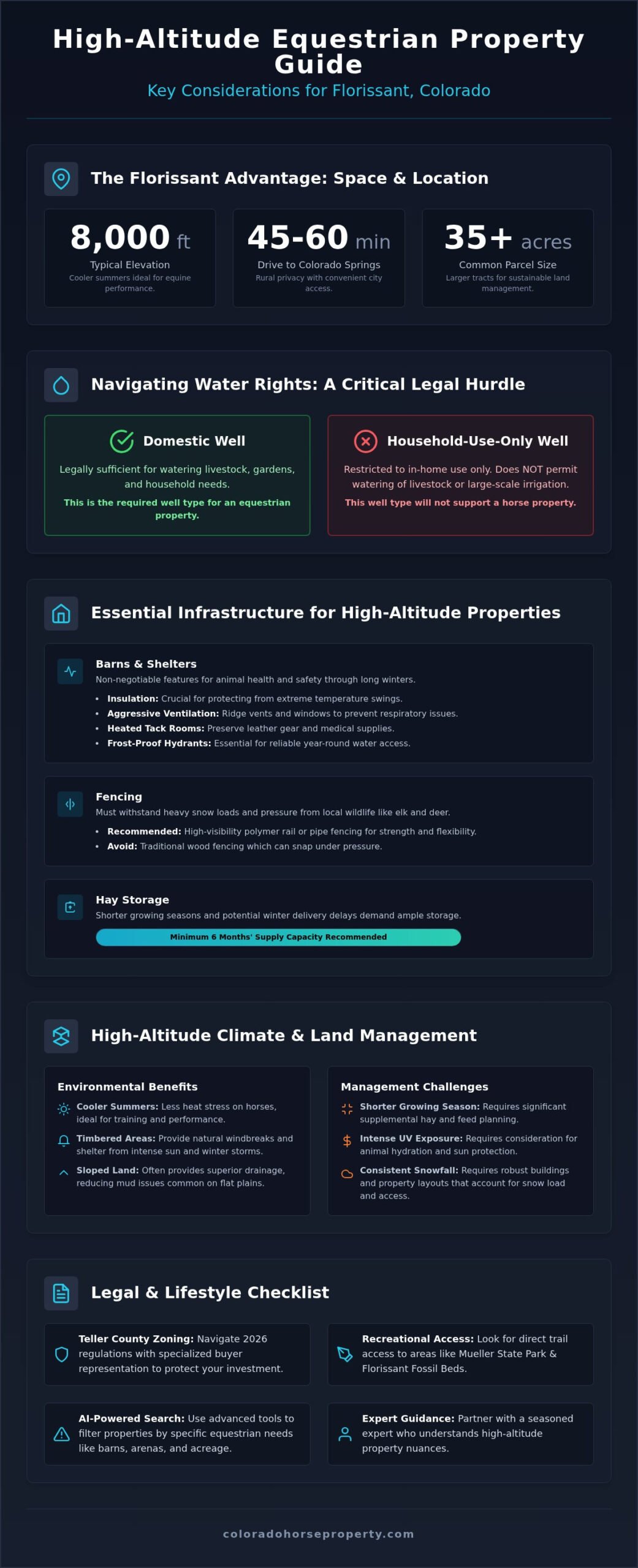
Florissant has emerged as a premier destination for mountain living in 2026, offering a unique blend of high-altitude utility and expansive space. At an elevation of over 8,000 feet, this region provides a distinct advantage over the increasingly congested Front Range. While buyers near Denver or Colorado Springs often find themselves limited to five or ten acre parcels, Florissant CO equestrian homes typically offer the larger acreage necessary for sustainable land management and true privacy. This shift toward Teller County is driven by a desire for functional rural estates that remain within a 45 to 60 minute drive of major hubs like Colorado Springs and Falcon.
The 2026 market outlook for Teller County mountain estates remains strong. Demand is fueled by a growing demographic of horse owners who prioritize trail access and climate over urban proximity. These buyers recognize that the value of mountain property isn’t just in the square footage of the house, but in the quality of the land and its ability to support a specialized lifestyle. Securing a property here requires a seasoned expert who understands how elevation affects everything from well production to property taxes.
The Florissant Landscape: Pine Forests and Open Meadows
The terrain in Florissant is a diverse mix of dense timbered stands and lush sub-alpine meadows. For horse owners, this variety is highly functional. Timbered areas provide natural windbreaks and shelter from the elements, while open meadows offer the primary grazing ground. Successful land management in the Rockies depends on understanding how terrain affects pasture rotation. Sloped land can be more difficult to fence but often provides better drainage, preventing the mud issues common in lower-elevation plains. Many of these estates also feature iconic Pikes Peak views, adding significant long-term value to the real estate investment.
Climate Considerations for Teller County Horse Owners
Operating a horse property at 8,000 feet requires specific preparation for the environment. The growing season is notably shorter than in the valley, meaning supplemental hay storage is a critical infrastructure component. The high-altitude sun is intense, requiring owners to consider UV protection and hydration for their livestock. However, the benefits are clear. Florissant’s cooler summers are ideal for equine performance, as horses don’t have to contend with the oppressive heat found at lower elevations. Winter expectations include consistent snowfall, but the dry climate means snow often clears quickly from south-facing slopes. Choosing a property with natural wind protection can significantly reduce the cost of winter heating and animal care.
Essential Infrastructure for High-Altitude Horse Properties
High-altitude horse ownership requires infrastructure that prioritizes durability and thermal regulation. In the Florissant environment, standard agricultural buildings often fail to meet the needs of equine health during the long winter months. An insulated barn is a baseline requirement rather than a luxury. This infrastructure protects your livestock from extreme temperature swings and prevents water systems from freezing. Heated tack rooms are equally vital, as they preserve leather equipment and ensure that veterinary supplies remain at stable temperatures.
Barn Design for Mountain Living
Effective barn design at 8,000 feet balances insulation with aggressive ventilation. Tight buildings trap ammonia and moisture, which can lead to chronic respiratory issues in horses. Using ridge vents and strategically placed windows allows for constant air exchange without creating drafts. Flooring choices must also account for the high-moisture spring thaw. Many owners prefer rubber mats over a deep, well-drained gravel base to prevent stall floors from becoming uneven or saturated. Since winter sunsets arrive early in the mountains, high-output LED lighting and frost-proof hydrants are essential for safe evening chores.
Fencing in Teller County must withstand more than just livestock. Local wildlife, including large elk herds and mule deer, often move through these properties. Traditional wood fencing can snap under heavy snow loads or wildlife pressure. High-visibility polymer rail or pipe fencing provides the necessary strength and flexibility. Additionally, because winter road conditions can sometimes delay deliveries, Florissant CO equestrian homes should have hay storage capacity for at least six months of feed. This prevents the stress of sourcing hay during peak winter storms when access might be limited.
Managing Pastures and Arenas at 8,000 Feet
The soil composition in Florissant is typically rocky and well-draining, which is excellent for preventing mud but challenging for arena footing. Standard sand can become dusty in the thin, dry air or freeze into a solid block during a cold snap. Incorporating moisture-retaining additives or specialized wood fibers can keep the surface pliable. For properties without a full barn, run-in shelters are a practical alternative. These structures must be oriented to block the prevailing westerly winds and should be anchored to withstand high-altitude gusts. Finding a property with these improvements already in place can significantly reduce your initial capital outlay. You can use our AI-powered search to filter for listings that include these specific infrastructure upgrades.
Navigating Water Rights and Land Use in Florissant
Water rights represent the most complex hurdle in securing equestrian real estate Colorado. In the Florissant area, assuming that every property with a well allows for livestock is a costly mistake. Colorado water law is based on the doctrine of prior appropriation. This means the legality of your water use depends on the specific permit attached to the land. For owners of Florissant CO equestrian homes, a Domestic well permit is the gold standard. It typically allows for the watering of domestic animals and livestock, whereas a Household-use-only permit restricts water usage strictly to inside the home.
Zoning regulations in Teller County also dictate the feasibility of your equine operations. As of 2026, zoning codes continue to emphasize livestock density to prevent overgrazing and soil erosion at high altitudes. While the general rule of thumb often suggests one horse per acre, local topography and vegetation density can alter these requirements. Buyers must also consider conservation easements. These legal agreements can protect the scenic beauty of the Rockies but might also prohibit the construction of additional barns or arenas in the future.
Understanding Your Well Permit
Verifying a well’s production in gallons per minute (GPM) is a standard part of due diligence. However, a high flow rate doesn’t guarantee long-term reliability. We recommend a four-hour drawdown test to ensure the aquifer can sustain both household needs and several thirsty horses. If a property lacks sufficient natural rights, you might need an augmentation plan. This legal mechanism allows you to pump water by replacing it elsewhere in the watershed. Additionally, given the regional history of mining, testing for heavy metals and mineral content is essential for long-term livestock health.
Teller County Zoning for Horses
Navigating the specific acreage requirements for Florissant requires looking beyond the total lot size. Teller County planners evaluate usable acreage, excluding steep grades or dense rock outcroppings. Most A-1 (Agricultural) zoned properties are horse-friendly, but residential subdivisions often carry tighter restrictions via Homeowners Associations (HOAs). These private rules can limit the number of horses regardless of county law or dictate the specific materials used for your outbuildings. Always secure a professional review of the plat and covenants before closing to ensure your proposed barn or accessory dwelling meets all local standards.
Equestrian Lifestyle: Trails and Recreation Near Florissant
Living in the shadow of Pikes Peak offers a recreational lifestyle that few other regions can match. When you invest in Florissant CO equestrian homes, your daily ride can transition from your private pasture directly into the Florissant Fossil Beds National Monument. This park offers a dedicated trail system that allows riders to traverse high altitude meadows and pine forests while viewing ancient geological formations. For those seeking even more expansive territory, Mueller State Park provides 5,000 acres of managed land with over 19 miles of trails specifically designated for horses. These trails are well maintained and offer some of the most scenic overlooks in the state, making them a primary draw for mountain riders.
The proximity to the Pike National Forest further expands your options for exploration. This is true backcountry riding, where you can disappear into the wilderness for hours without crossing a paved road. The community in Teller County is deeply rooted in this lifestyle. Local 4-H clubs and riding associations ensure that there is always a support network for both young riders and seasoned cattlemen. This cultural emphasis on ranching makes Florissant CO equestrian homes more than just a real estate purchase; they are an entry into a community that values land stewardship and animal husbandry.
Top Horse Trails in the Florissant Area
Crags Trail is a local favorite for its dramatic elevation gains and panoramic views of the Continental Divide. Riding at these heights requires an equine partner that is well conditioned to the thin air and rocky paths. Dome Rock State Wildlife Area is another exceptional choice, though it is important to check for seasonal closures designed to protect bighorn sheep lambing areas. If you are trailering to these locations, ensure your vehicle is equipped for mountain grades. Steep descents on Highway 24 and local county roads require functional trailer brakes and a firm understanding of engine braking to prevent overheating on long grades.
Local Resources and Support
Success in this environment depends on a reliable network of professionals. Because of the rocky terrain, finding a mountain certified farrier who understands corrective shoeing for granite based soils is critical for hoof health. Local equine veterinarians in the Teller County area are experienced in treating high altitude ailments and wildlife related injuries. For feed, many residents source high quality alfalfa or mountain grass mixes from the San Luis Valley, as the local growing season is too short for large scale production. The Teller County Fair serves as the annual cornerstone of this community, offering a venue for competition and networking among local ranch owners. If you are ready to explore these mountain estates, you can search our current listings to find a property with direct forest access.
Finding Your Dream Home with AI-Powered Search
Traditional search engines often fail to distinguish between a property that allows horses and one that is actually equipped for them. Most platforms categorize listings by bedroom count or square footage, forcing you to sift through hundreds of irrelevant results. They prioritize residential metrics like kitchen finishes over the structural integrity of a barn or the legality of a well permit. This inefficiency is why we’ve developed proprietary technology to revolutionize the hunt for Florissant CO equestrian homes. Our platform understands that for a mountain ranch owner, the quality of the outbuildings and the status of the water rights are the primary drivers of value.
This technology is a significant leap forward for anyone searching for horse property for sale in colorado. Instead of browsing generic land listings, you can target properties based on functional utility. Our AI scans listing data and satellite imagery to identify specific infrastructure that traditional filters miss, ensuring that you only spend time on estates that meet your technical requirements.
The Power of Niche AI Filtering
Our search tools allow you to filter by ‘Horse Ready’ status. This means the system looks for properties that already feature fenced perimeters, loafing sheds, or multi-stall barns. It also cross-references property data to identify senior water rights automatically, which we discussed earlier as a critical factor for livestock sustainability. You can set up real-time alerts that notify you the moment a property hitting your specific acreage and infrastructure needs enters the Florissant market. This speed is essential in 2026, where high-utility mountain estates are often under contract within days of listing.
Expert Buyer Representation in 2026
While AI provides the data, the complexities of a mountain transaction require a seasoned, no-nonsense expert. Mark and Alison Eibner bring 40 years of experience via our parent company, Realty Oasis, to every negotiation. We understand the nuances of Teller County soil, the reality of winter access, and the legal hurdles of mountain zoning. Our team doesn’t just find the house; we manage the entire lifecycle of the purchase. This includes integrated transaction management and title services through Meridian Title & Escrow. Having an in-house title and escrow partner streamlines the closing process, ensuring that every well permit and easement is verified before you sign. Closing with confidence requires this level of professional longevity and specialized focus. We ensure that your transition to the Florissant lifestyle is handled with the authority and precision that your investment deserves.
Secure Your Future in the Teller County High Country
Securing a property in Florissant involves more than finding a scenic view; it requires a technical understanding of land utility at 8,000 feet. You must prioritize insulated infrastructure to handle mountain winters and verify the specific legal standing of your well permit to ensure livestock sustainability. By focusing on these functional requirements, you protect your investment and the health of your horses. Success in this market depends on recognizing that property utility is just as important as the acreage itself.
Finding the right Florissant CO equestrian homes shouldn’t be a manual struggle. We provide 40 years of specialized Colorado experience and proprietary AI property matching technology to help you filter listings by water rights and existing barn infrastructure. Our team handles the complexities of Teller County water law and transaction management so you can focus on the lifestyle you’ve earned. We are ready to help you navigate the nuances of mountain real estate with no-nonsense expertise.
Start Your AI-Powered Florissant Horse Property Search Today and take the first step toward your mountain estate. Your dream of riding through the sub-alpine meadows of Mueller State Park is within reach when you have the right expert guidance.
Frequently Asked Questions
How many acres do I need for horses in Florissant, CO?
Teller County guidelines typically recommend at least one usable acre per horse. However, the high-altitude terrain in Florissant often includes steep slopes or dense pine forests that aren’t suitable for grazing. When evaluating Florissant CO equestrian homes, you should look for properties with at least five to ten acres to ensure adequate pasture rotation and prevent overgrazing on sensitive mountain soils. Usable land is more important than total acreage.
Can I ride my horse in the Florissant Fossil Beds National Monument?
You can ride in the monument on designated equestrian trails. Riders often use the Shootin’ Gallery and Twin Rock loops to explore the sub-alpine landscape. It’s important to remember that off-trail riding is strictly prohibited to protect the fossil beds. These trails offer a unique opportunity to ride through ancient history while remaining close to your home base in Teller County. Always check for seasonal trail updates.
What is the difference between a domestic well and a household-use well in Colorado?
A domestic well permit is the gold standard for horse owners because it legally allows for the watering of livestock. In contrast, a household-use-only permit is strictly for indoor domestic purposes and cannot be used for animals or irrigation. Verifying the specific well permit type is a critical step in our transaction management process to ensure your property remains functional and legally compliant for your horses.
Does Florissant have adequate veterinary services for horses?
Mobile equine veterinarians and specialized clinics in nearby Divide and Woodland Park provide reliable coverage for the Florissant area. These practitioners have extensive experience with high-altitude health concerns, such as increased hydration needs and respiratory management at 8,000 feet. While you won’t find a major surgical center in Florissant, the regional network of mountain-certified vets ensures that your livestock receive professional care year-round without long travel times.
Are there HOAs in Florissant that prohibit horses?
Many subdivisions in the area have active Homeowners Associations with covenants that restrict or prohibit horses. Even if the county zoning allows for livestock, these private rules take precedence. We use proprietary technology to filter out restrictive communities, ensuring you only see Florissant CO equestrian homes that truly support your lifestyle. Always review the specific plat and HOA documents during the due diligence phase of your mountain property purchase.
How do I prepare my Florissant horse property for winter?
Winter preparation begins with securing a six-month supply of high-quality hay before the snow season peaks in late autumn. You should also service your heated waterers and ensure barn insulation is intact to protect against extreme temperature drops. Proper drainage around your outbuildings is also necessary to manage the spring thaw. Taking these steps early ensures that your mountain ranch remains a safe, functional environment for your horses.
What are the common soil issues for riding arenas in Teller County?
The primary issue in Teller County is the presence of decomposed granite and large rocks in the native soil. This material provides excellent drainage but requires significant amendment to create a safe riding surface. Without proper additives, the footing can become too hard and abrasive for a horse’s joints. Professional arena installers often recommend mixing in specialized sands or fibers to create a more resilient and forgiving mountain surface.
Is it better to buy a move-in-ready horse property or raw land in Florissant?
Buying a move-in-ready property is generally more efficient than developing raw land in the Rockies. The logistical challenges of bringing utilities to remote mountain sites and the rising costs of construction in 2026 make existing estates more attractive. Properties with established wells, barns, and fencing allow you to begin your equestrian lifestyle immediately while avoiding the lengthy and often unpredictable Teller County permitting process for new rural structures.