
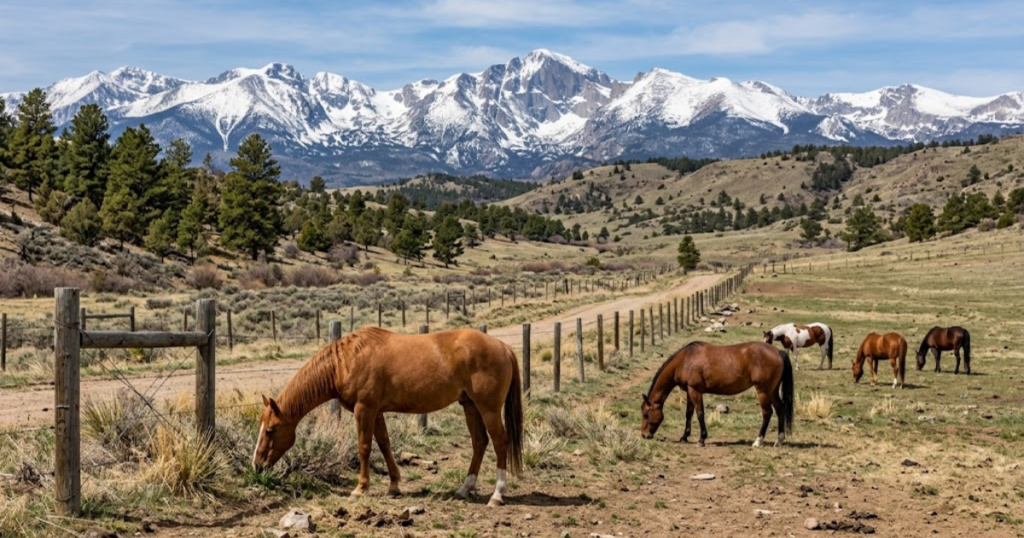
You are moving to Colorado from the Midwest, and you are ready to buy your dream farm. Back east, you kept three horses on three acres of lush, green grass without any issues. You open a real estate search portal, find a beautiful three-acre property in the Colorado foothills, and assume you can bring your entire herd.
A month after moving in, reality hits. The three acres of grass have been eaten down to the dirt, the county code enforcement officer leaves a notice on your gate stating you are violating animal density limits, and you realize you cannot turn a horse trailer around in the narrow driveway.
When searching for horse properties in Colorado, buyers most often misunderstand land capacity. In the Rocky Mountain region, a harsh climate, complex zoning regulations, and rugged topography dictate how much land you need.
To keep your horses safe, legal, and healthy, you must look far beyond the total acreage listed on a real estate flyer. Here is a comprehensive, realistic guide to how much land you actually need for horses in Colorado.
How Much Land Do You Actually Need for Horses in Colorado?
Quick Summary: Calculating Your Acreage
- The Eastern Myth: The old rule of one horse per acre does not apply in a semi-arid, high-altitude climate. In Colorado, dryland grazing often requires two to three acres per horse.
- Usable Versus Raw Land: Ten acres in the mountains might only yield two acres of flat, usable pasture. You must account for steep slopes, rock outcroppings, and required county setbacks.
- The Zoning Reality: Acreage does not guarantee permission. Colorado counties use specific animal unit formulas to dictate exactly how many horses you can legally keep on a parcel.
- Infrastructure Footprint: Barns, riding arenas, manure storage, and trailer turnarounds can easily consume one to two acres of your property before a horse even takes a single bite of grass.
1. The One Horse Per Acre Myth
If you ask a casual horse owner how much land they need, they will almost always recite the old rule of thumb, one horse per acre. In states with high annual rainfall, deep topsoil, and long growing seasons, this rule works perfectly. In Colorado, relying on this rule is a guaranteed way to destroy your property.
Colorado's climate changes everything about pasture management. We live in a semi-arid, high-altitude environment. Intense ultraviolet sunlight, low annual precipitation, and a short growing season put immense stress on native grasses. If you put one horse on one acre of dryland Colorado pasture, they will overgraze the grass down to the root system in a matter of weeks, transforming your pasture into a barren dirt lot that blows away in the wind.
To support true grazing without relying entirely on imported hay, most dryland properties in Colorado require a minimum of two to three acres of pasture per horse. If you want your horses to survive primarily on natural forage during the summer months, you need significant acreage to allow for proper rotational grazing. If you have only one acre per horse, you must accept that you are running a dirt lot and will feed hay every day of the year.
2. Usable Acreage Versus Raw Acreage
The second massive trap for buyers is equating total acreage with usable equestrian space. A real estate listing might proudly advertise a five-acre property, but you must evaluate what those five acres actually look like.
In the foothills and mountain regions, topography is your biggest enemy. Steep drop-offs, heavily wooded ravines, rocky hillsides, and protected wetlands do not count toward your grazing land. You might buy a five-acre parcel, only to discover that three acres are situated on a 30-degree slope that is completely inaccessible to your livestock. You must walk the entire property looking for flat or gently rolling areas that are actually suitable for pasture.
You must also account for the footprint of your equestrian infrastructure. Horses need more than just grass. A standard barn, attached paddocks, and a dedicated sacrifice area will consume a significant portion of your land. You must budget space for covered hay storage, a safe manure composting area located far from your water well, and equipment storage for your tractor.
If you want a riding arena, you will need even more flat ground. A standard general riding arena requires an 80-by-120-foot footprint, while a full dressage court or jumping arena requires a massively graded, perfectly level base. You also need a driveway at least 24 feet wide and a turnaround space for a truck and trailer, which requires a minimum 60-foot-diameter circle. On a small parcel, this necessary infrastructure can easily consume one to two acres, leaving very little room for actual grazing.
3. The Legal Reality, Zoning and Animal Units
You cannot determine how much land you need without consulting the local county planning department. In Colorado, having acreage does not automatically grant you the legal right to keep horses.
Counties strictly regulate livestock density to protect groundwater, manage dust, and prevent neighborhood disputes. Many jurisdictions use an animal unit system to establish equivalent density for various species. For example, in Boulder County, one mature horse equals one animal unit. If a property is zoned for a specific density, such as four animal units per acre, you are strictly capped at that number.
Other counties have baseline minimums. For example, some residential zoning districts require a contiguous tract of land exceeding one full acre to keep any livestock legally. Once you meet that one-acre minimum, the county might allow only one hoofed animal per half-acre of usable land. If you buy a 1.3-acre parcel in one of these districts, you are legally restricted to two horses, regardless of how you manage the land.
You must also account for mandatory setbacks. Counties require barns, corrals, and manure storage to be kept a specific distance from property lines, neighboring residences, and septic systems. Teller County, for instance, requires corrals and barns to be at least 50 feet from any property line. If you buy a long, narrow two-acre lot, the required setbacks might overlap, leaving you with absolutely no legal place to build your barn.
4. Managing Limited Land with Sacrifice Lots
If you cannot afford a sprawling 35-acre ranch, you can still keep horses on smaller acreage, as long as you're willing to manage the land intensively.
The secret to keeping horses on three to five acres is the sacrifice lot. A sacrifice lot is a heavily fenced, dirt or gravel paddock where you confine your horses when the main pastures cannot handle grazing. You sacrifice a small piece of land to save the rest.
In Colorado, you will use your sacrifice lot extensively. When the snow melts in the spring and the pastures turn into deep mud, you must lock the horses in the sacrifice lot to prevent their hooves from tearing up the fragile grass roots. During the intense heat of late July, when the dryland grass stops growing, the horses go back into the sacrifice lot. During the winter, when snow covers the ground for months and eliminates winter grazing, your horses will live in the sacrifice lot while eating imported hay.
If you are looking at smaller acreage, you must verify that the property has a high, well-drained area that can serve as a functional sacrifice lot. Without one, your small acreage will be destroyed within a single season.
5. Regional Acreage Expectations Across Colorado
The amount of land you need also depends entirely on where you decide to buy. Colorado features diverse geographic zones, and each requires a different approach to acreage.
The Eastern Plains: If you want to rely on natural dryland grazing, look east toward Elbert, Weld, and El Paso counties. Here, you can find 35 to 40-acre parcels that provide the massive, flat acreage required to run a larger herd. The land is more affordable per acre, making it easier to implement proper rotational grazing systems.
The Northern Agricultural Hubs: In Larimer and parts of Boulder County, you can keep more horses on fewer acres if you purchase a property with deeded irrigation water. Irrigated pastures recover from grazing much faster than dryland pastures. A five-acre parcel with dedicated ditch shares can produce significantly more forage than a ten-acre parcel on the dry, arid plains.
The Foothills and Mountains: In Jefferson, Teller, and Park counties, you must buy significantly more total acreage to secure enough flat, usable land. A 10-acre mountain property might only offer the same usable equestrian footprint as a two-acre lot on the plains. Furthermore, the steep terrain complicates manure management, as county codes strictly prohibit runoff from carrying contaminants onto neighboring properties.
We Calculate the True Capacity of Your Property
Never guess whether a property can support your herd. The financial and legal risks are too high to guess.
When Mark Eibner's team represents you, we calculate the exact usable acreage before you make an offer. We pull county zoning codes to verify legal animal units, map required property-line setbacks to ensure your arena and barn will fit, and evaluate soil drainage to ensure your horses will not be standing in a mud pit. We know how to translate a real estate listing into a functional, working farm.
Contact us today at coloradohorseproperty.com to find premium horse properties Colorado buyers trust.
Browse active Colorado horse ranches for sale or ask our team about finding a functional horse property for rent in Colorado while you search for the perfect acreage.
Frequently Asked Questions (FAQ) About Horse Property Acreage
Can I keep horses on less than one acre of land in Colorado?
It is extremely difficult and often illegal. Many Colorado counties and municipalities strictly prohibit keeping livestock on parcels smaller than one contiguous acre. Even if a specific town allows it, keeping a horse on less than an acre requires 100% hay feeding and intensive, daily manure removal to prevent serious health hazards.
Does steep, wooded land count toward my allowed animal density?
Usually, yes. Most county zoning departments calculate your allowable animal units based on the parcel's gross acreage, regardless of topography. However, in practice, steep or heavily wooded land provides no grazing value. You can't use it for turnouts, meaning your horses will be confined to a much smaller footprint.
How much space do I need to turn a horse trailer around?
You need a surprisingly large amount of space. A standard truck pulling a multi-horse gooseneck trailer requires a turnaround circle with a minimum diameter of 60 feet. You also need a driveway that is significantly wider than standard residential access, ideally 24 feet wide, to safely accommodate hay delivery trucks and heavy equipment.
What is a Conditional Use Permit for horses?
If you want to keep more horses than your specific zoning district allows, or if you want to run a commercial boarding facility on residential acreage, you must apply for a Conditional or Special Use Permit. This requires a formal application to the county, a public hearing where neighbors can object, and strict operational conditions. It is never guaranteed, so you should ideally buy land that already allows your herd size by right.