
In 2026, a property’s digital infrastructure is as critical to its long-term value as its water rights. You might find a stunning Colorado ranch with the perfect layout, but the underlying fear of purchasing a “dead zone” can stall even the most promising acquisition. Navigating the various internet options for rural colorado properties requires more than a quick signal check; it demands a thorough understanding of how current technology integrates with expansive land. We know the frustration of dropped video calls and the challenge of getting reliable Wi-Fi into a remote arena or barn.
This guide provides the clarity you need to make an informed investment. You’ll learn which Colorado counties currently boast the strongest fiber infrastructure and how to choose between the latest LEO satellite updates and 5G home internet. We’ll explore how to achieve the symmetric speeds necessary for professional conferencing while managing the costs of site-specific connectivity. By the end of this article, you’ll have a clear roadmap for ensuring your rural estate remains fully connected to the modern world.
Key Takeaways
- Understand how state-funded middle-mile programs are finally bringing high-speed parity to Front Range and mountain ranches in 2026.
- Evaluate the top internet options for rural colorado properties by comparing LEO satellite performance against the latest 5G fixed wireless expansions.
- Master the “last acre” problem by using Point-to-Point wireless bridges to bring reliable connectivity to your barns and riding arenas.
- Learn the specific technical questions and signal tests you must perform during a property walkthrough to avoid buying a connectivity dead zone.
- Discover how AI-powered search technology can identify horse properties with the specific infrastructure required for high-speed professional demands.
The Landscape of Rural Colorado Internet in 2026
The historical digital divide that once separated urban hubs from the Eastern Plains and mountain valleys has shifted toward a new era of rural parity. In 2026, high-speed connectivity is no longer a luxury; it’s a utility as foundational as water rights. For many ranch owners, evaluating internet options for rural colorado properties is now a top-three priority during due diligence. This change is driven by the necessity of remote work and the rapid adoption of smart farming technologies that monitor everything from livestock health to automated irrigation systems.
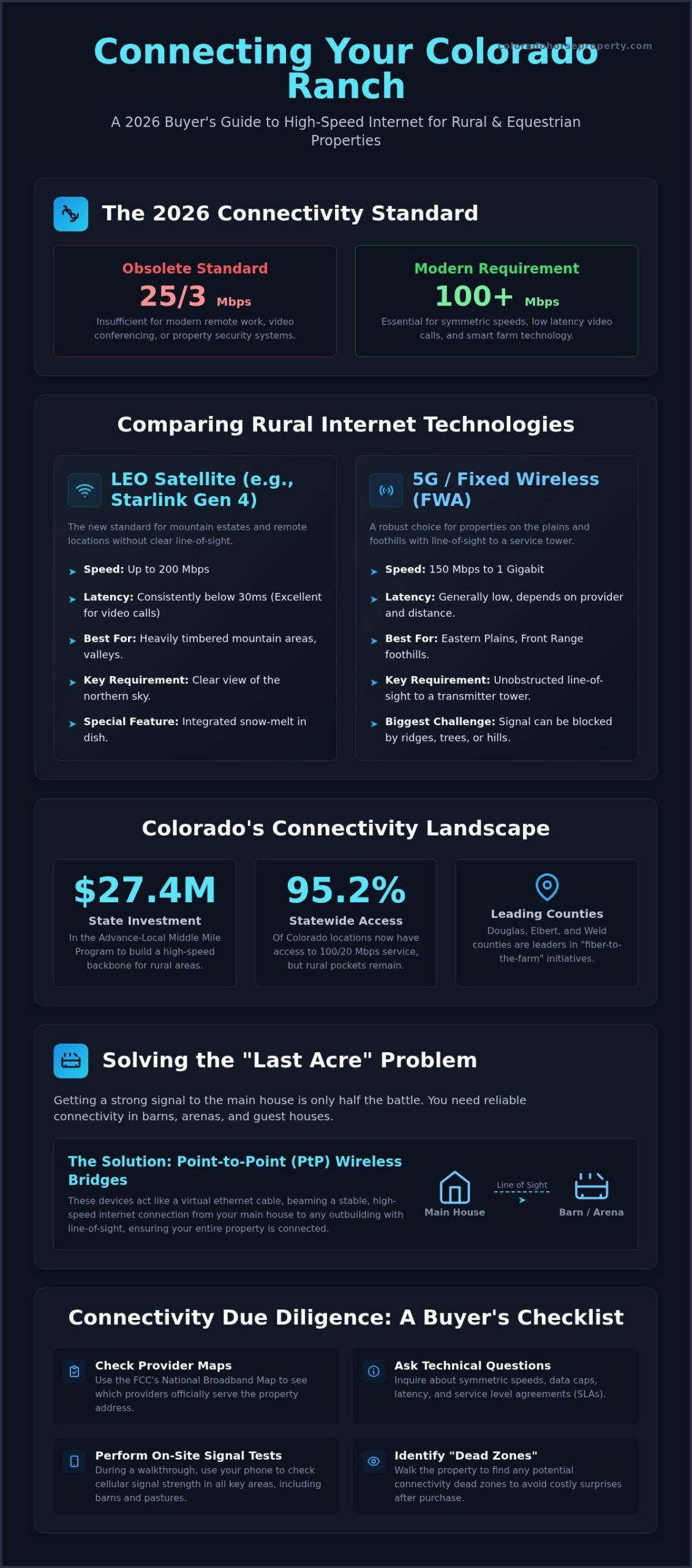
State initiatives like the Advance-Local Middle Mile Program have fundamentally changed the connectivity map for Front Range ranches. By investing $27.4 million into middle-mile infrastructure, Colorado created a backbone that allows local providers to extend high-capacity lines to previously unreachable acreage. This infrastructure supports the sophisticated data transfers required for modern land management. Understanding the various Rural Internet technologies available today is essential for any landowner looking to maintain a functional estate.
To better understand how these advancements are transforming local communities, watch this helpful video:
Defining High-Speed for Rural Needs
Colorado Counties Leading the Connectivity Race
Douglas, Elbert, and Weld counties have emerged as leaders in fiber-to-the-farm initiatives. These areas benefit from a rural-urban hybrid model where proximity to the Front Range corridor makes fiber expansion more economically viable. In contrast, high-altitude mountain properties still rely heavily on the latest satellite developments. While 95.2% of Colorado locations now have access to 100/20 Mbps service, the remaining unserved pockets are often found in these rugged terrains. When evaluating internet options for rural colorado properties, checking specific county-level grant awards is vital as local fiber projects vary significantly between neighbors.
Comparing 2026 Rural Internet Technologies
Choosing between internet options for rural colorado properties requires a technical evaluation of your specific location’s topography. While fiber optic cable is the gold standard for speed and reliability, it isn’t yet available at every pasture gate. Most ranch owners must decide between satellite, fixed wireless, or cellular solutions. To start your research, use the FCC’s National Broadband Map to see which providers officially claim to serve your address.
Satellite Internet: The LEO Revolution
Fixed Wireless Access (FWA) remains a robust choice for the Eastern Plains and Front Range foothills. Local Wireless Internet Service Providers (WISPs) like Rise Broadband utilize towers to beam signals directly to a small dish on your roof. These services offer plans ranging from 150 Mbps to 1 Gig, provided you have a clear line of sight to the transmitter. Topography is the biggest hurdle here; a single ridge or stand of cottonwoods can block the signal entirely.
5G home internet from providers like T-Mobile and Verizon has also expanded significantly across rural corridors. These services are often more affordable, with standard pricing around $50 to $60 per month. They’re excellent for horse properties near major highways, though speeds can fluctuate based on tower congestion. If you’re unsure which properties have the best infrastructure, you can use our AI-powered search to filter for listings with confirmed high-speed potential.
Fiber-to-the-Home (FTTH) is increasingly available through local electric cooperatives like Mountain View Electric Association. If fiber is an option, take it. It offers the most stable symmetric speeds available. For those in truly remote zones, we recommend a multi-provider strategy. Combining a primary Starlink connection with a cellular booster and a 5G backup ensures you stay online even if one system fails during a heavy spring snowstorm.
Solving the “Last Acre” Problem: Connectivity for Barns and Arenas
Most buyers focus exclusively on getting a signal to the main residence. They often forget that the operational heart of a horse property is the barn, the workshop, or the riding arena. Standard home Wi-Fi routers generally have a functional range of about 150 feet. When your stables sit 200 yards away across a pasture, that signal vanishes long before it reaches the stalls. This is the “last acre” problem, and solving it is essential for modern land management.
High-speed access in outbuildings enables “smart barn” technology that significantly improves livestock safety. You can install 4K foaling cameras, remote health monitors, and automated gate systems that you control from your phone. Reliability in the arena also allows for video-based training sessions or remote coaching without the frustration of lagging feeds. When evaluating internet options for rural colorado properties, you must plan for how that data will travel from the primary receiver to every corner of the estate.
Point-to-Point Wireless Bridges
Point-to-Point (PTP) wireless bridges are a ranch owner’s best friend. These systems consist of two dedicated antennas: one mounted on the house and one on the target outbuilding. They beam a high-bandwidth signal through the air, effectively acting as an invisible Ethernet cable. Hardware from reliable rural brands like Ubiquiti can maintain high speeds over several miles, provided you have a clear line of sight. If a hill or a dense stand of ponderosa pines blocks the path, you’ll need to mount the antennas on masts to clear the obstruction. This is often more cost-effective than trenching physical cable through rocky Colorado soil.
Outdoor Mesh Networks for Large Acreage
For properties exceeding 10 acres, a single PTP bridge might not provide enough coverage for mobile tasks in the paddocks. Outdoor mesh networks create a seamless Wi-Fi blanket across your entire acreage. These nodes are designed to hand off your device’s connection as you move from the house to the arena. While state-level initiatives tracked by the Colorado Broadband Office focus on bringing high-speed lines to your property line, the “last acre” connectivity remains the owner’s responsibility.
Weatherproofing is the most critical factor for these systems. Colorado’s extreme temperature swings, which can drop 40 degrees in a single afternoon, will destroy standard consumer gear. You need IP67-rated enclosures that can withstand heavy snow, dust, and high winds. Security is also a major consideration. Ensure your outdoor network is segmented from your primary home network to protect your personal data while allowing smart devices in the barn to function independently. If you’re already trenching for power or water lines, laying conduit for fiber is the most permanent solution, but wireless bridges remain the gold standard for existing estates.
Connectivity Due Diligence: A Buyer’s Checklist
Provider coverage maps are notoriously optimistic. They often use broad strokes that ignore the micro-topography of Colorado’s ridges and valleys. When evaluating internet options for rural colorado properties, you must treat the provider’s “available” status as a hypothesis rather than a fact. We’ve seen properties where one side of a hill has gigabit fiber while the other is a total dead zone. This discrepancy can significantly impact your property value and daily operations. To simplify this process, use our AI-powered horse property search to find estates with verified high-speed potential.
Verifying Service Availability
Your first step should be the Colorado Broadband Office mapping tool. It provides a more granular view of state-funded infrastructure projects than corporate websites. Don’t stop there. Contact local Wireless Internet Service Providers (WISPs) directly. Ask them if they have a clear line of sight to a tower from the specific coordinates of the home site. While on the property, look for physical evidence of connectivity. Check for orange conduit markers or utility boxes near the property line. These are the best indicators that fiber might be closer than the listing suggests.
The On-Site Speed Test
Relying on the “bars” on your phone isn’t enough for a professional-grade audit. You need to identify “dead spots” caused by heavy timber or steep terrain that could interfere with your 5G or LTE reception. Perform a thorough check at the primary home site, the barn, and any planned office spaces. Walk the property perimeter with a cellular testing app, recording signal strength at the house, stables, and high-elevation ridge points.
The “Neighbor Audit” is your most reliable source of truth. Corporate data doesn’t account for how a provider’s customer service handles a line break during a spring storm. Ask the neighbors which service they use and if they can successfully run a video call during peak hours. This local intel is often more accurate than any coverage map. Finally, factor potential installation costs into your property offer. If a property requires $10,000 in line extensions or specialized hardware to bridge the “last acre,” that should be a point of negotiation. Understanding the true internet options for rural colorado properties before you sign ensures you aren’t buying a beautiful home with zero connection to the outside world.
Find Your Connected Equestrian Dream with Colorado Horse Property
Buying a ranch in 2026 involves more than checking the fence lines or evaluating the hay yield. You’re investing in a complex ecosystem that must support your professional career and property security. Finding the right balance between secluded acreage and high-speed access requires a specialized approach that generalist brokerages often overlook. We understand that evaluating internet options for rural colorado properties is a non-negotiable step in the modern acquisition process. Our team bridges the gap between traditional land expertise and the technical requirements of a connected equestrian estate.
AI-Powered Search for the Modern Rancher
Our proprietary AI-Powered Horse Property Search is built to handle these specific infrastructure requirements. Instead of wasting time on listings that lack the potential for high-speed connectivity, you can use our platform to filter for properties within documented fiber corridors or areas with verified tower access. We go beyond the basic house description to help you identify parcels with the right topography for fixed wireless or the clear horizons needed for satellite arrays. For a deeper look at the broader market trends, our guide on equestrian real estate Colorado offers essential insights into current values and land management strategies.
Expert Representation for Your Lifestyle Goals
Mark and Alison Eibner provide a level of seasoned expertise that only comes from 40 years of navigating the Colorado Front Range market. We don’t just facilitate a sale; we act as consultants on everything from zoning regulations to utility infrastructure. Because we understand the “last acre” challenges discussed earlier, we can help you estimate the costs of extending lines or installing wireless bridges before you’re committed to a contract. Our leadership-forward approach ensures you’re working with partners who have a long-standing presence in the community and a deep network of local utility contacts.
Closing a deal on a rural estate requires specific contractual safeguards. We specialize in drafting internet contingencies that allow you to verify actual speeds during the inspection period. If the provider’s claims don’t hold up under a real-world signal audit, these clauses protect your earnest money and give you the leverage to negotiate infrastructure credits. We’re committed to making your transition to ranch life as smooth as possible by ensuring your connection to the world is as strong as your connection to the land. Search Colorado Horse Property with High-Speed Internet Access today to start your journey toward a fully connected equestrian dream.
Securing Your Digital Future on the Colorado Range
High-speed connectivity is no longer a secondary concern for ranch owners; it’s a fundamental property right that determines the utility and value of your land. By auditing the specific internet options for rural colorado properties before you buy, you ensure that your professional life and estate management remain seamless. Look past corporate coverage maps. Focus on local infrastructure, from fiber conduits at the property line to Point-to-Point bridges that connect your barns and arenas.
Finding a property that balances expansive freedom with modern connectivity doesn’t have to be a guessing game. With 40 years of Colorado real estate expertise, Mark and Alison Eibner understand the technical demands of contemporary equestrian estates. Our specialized AI-powered filters identify the infrastructure you need for your specific lifestyle goals. Don’t leave your digital life to chance when you can have direct access to seasoned experts who know every ridge and valley of the Front Range.
Find Your Connected Horse Property with Our AI Search Tool and start your next chapter with confidence. Your dream of a high-tech ranch is closer than you think.
Frequently Asked Questions
Is Starlink reliable enough for remote work on a Colorado ranch?
Starlink is highly reliable for professional remote work on Colorado ranches in 2026. The Low Earth Orbit (LEO) technology provides the low latency, often under 30ms, required for stable video conferencing and real-time cloud collaboration. With download speeds reaching 200 Mbps, it easily handles high-bandwidth tasks. It’s a standard solution for large estates where physical lines aren’t feasible, provided you have a clear northern sky view.
How much does it cost to bring fiber internet to a rural property?
The cost to extend fiber to a rural home site depends entirely on the distance from the nearest “lit” line. If fiber exists at the property line, connection fees are typically modest. However, trenching across several hundred yards of rocky Colorado soil can cost thousands of dollars. We recommend checking for existing conduits or local cooperative initiatives during your due diligence to avoid these significant infrastructure expenses.
Can I get high-speed internet in the Colorado mountains?
High-speed internet is increasingly accessible in the Colorado mountains through LEO satellites and specialized wireless providers. While traditional cable is rare in rugged terrain, 95.2% of Colorado locations now have access to at least 100/20 Mbps service. Mountain residents often rely on Starlink or local WISPs that beam signals from high-altitude towers to overcome the challenges of steep topography and heavy timber coverage.
What is the best internet provider for rural areas in the Front Range?
The best provider depends on your specific coordinates, but the Front Range offers the most diverse internet options for rural colorado properties. Fiber through cooperatives like Mountain View Electric is the gold standard for symmetric speeds. In areas without fiber, Rise Broadband provides reliable fixed wireless, while T-Mobile 5G Home Internet offers a cost-effective alternative for properties with strong cellular reception near major corridors.
How do I extend Wi-Fi from my house to my horse barn?
The most effective way to extend connectivity to a horse barn is using a Point-to-Point (PTP) wireless bridge. These systems use two dedicated antennas to beam a high-speed signal from your house to the barn, acting like an invisible Ethernet cable. This setup is far more reliable than standard mesh extenders and can cover several hundred yards. It provides the bandwidth needed for foaling cameras and health monitors.
Does having high-speed internet increase rural property value?
High-speed internet significantly increases rural property value in 2026. Connectivity is now viewed as an essential utility, similar to water or electricity. Properties with confirmed gigabit fiber or robust 5G coverage attract a wider pool of professional buyers who work remotely. Conversely, being in a “dead zone” can limit your buyer pool and may force price concessions during the sale or appraisal process.
What happens to my satellite internet during a heavy Colorado snowstorm?
Modern LEO satellite dishes, such as Starlink’s Gen 4 hardware, include integrated heating elements designed to melt snow. This feature prevents signal attenuation during heavy Colorado snowstorms. While extreme blizzard conditions with high moisture density can occasionally cause brief outages, these systems are much more resilient than the high-latency satellite dishes of the past. Proper dish placement is essential to avoid drifting snow obstructions.
Are there state grants available for rural Colorado residents to get better internet?
Colorado has allocated significant funding to bridge the digital divide through the Colorado Broadband Office. Programs like the $27.4 million Advance-Local Middle Mile Program and the $826.5 million BEAD allocation expand infrastructure to unserved areas. While grants are usually awarded to providers or municipalities rather than individuals, these state-led initiatives are the driving force behind bringing high-speed fiber lines to remote ranching and agricultural communities.