
A Waverton Ranch address doesn’t tell you whether a property can support your horses. Searches for equestrian homes for sale Waverton Ranch may surface nearby properties or vacant land, so assess each parcel on its own merits. Waverton Ranch is near Castle Rock in Douglas County, where parcel-specific rules and records matter.
Acreage can look promising in a listing, but the details that shape daily horse use matter just as much: barns, arenas, fencing, pasture, water, and permitted land use. This guide explains how to identify relevant listings, compare their features with your plans, and organize the zoning, HOA, covenant, and property-record questions to resolve before making an offer. Colorado Horse Property’s AI-powered search and acreage filters can help focus your Colorado property search, while virtual tours of many listings offer an early way to review visible features. With nearly four decades of Colorado real-estate experience, the team understands that the right property is one that fits your intended use, not simply one with the right name.
Key Takeaways
- Assess whether each property’s land and improvements fit your horse count, turnout needs, daily routine, and future plans.
- Search for equestrian homes for sale Waverton Ranch, but don’t treat a road name or nearby location as proof of horse suitability.
- Compare listed acreage, equestrian improvements, water details, and restrictions. Record missing information as questions, not assumptions.
- Review parcel-specific zoning, HOA rules, covenants, water information, and property records before making an offer.
- Use Colorado Horse Property’s AI-powered search and acreage filters to narrow or broaden your Colorado property search.
Equestrian Homes for Sale in Waverton Ranch: What the Search Really Means
The question behind a search for equestrian homes for sale Waverton Ranch is whether a specific location and property fit your horse plans. A Waverton Ranch Road address, or a listing that mentions the area, is a location clue. It doesn’t establish that the land can accommodate horses, that the improvements suit your needs, or that your intended use is allowed.
A property page for a specific Castle Rock address on Waverton Ranch Road can serve as an address-level reference, but it doesn’t establish that the property is currently listed or suitable for equestrian use. The video below features Waverly Ranchette in Larimer County. The similar-sounding name does not make it Waverton Ranch or evidence of a property’s suitability there.
This video offers separate Colorado horse-property context. It is not a tour of a Waverton Ranch property.
Waverton Ranch Road, Castle Rock, and the search area
A street address can help orient your search around Castle Rock, but it doesn’t define a neighborhood boundary or establish which rules apply to a parcel. Searching near an address and searching for a property that’s ready for your horses are different tasks. Use location as one search criterion, then evaluate each property using its listing details and records.
A result may be adjacent to an area, use a familiar road name, or appear under a broad location label. None of those details establishes that it shares another parcel’s land-use rules or equestrian features. Confirm the parcel location and applicable records for the specific property you’re considering.
What makes a home relevant to horse buyers?
A horse-friendly property is land and improvements that suit a buyer’s intended horse use, subject to applicable property restrictions. A rural home may have acreage without the facilities or permissions a horse owner needs. The right fit depends on your horse count, daily routine, turnout needs, and plans for the property.
Review the listing for stated details about acreage, barns, arenas, pasture, fencing, shelter, storage, access, and water. An acreage figure alone won’t tell you how much land is usable for turnout or whether an improvement suits your plans. Treat missing details as questions to resolve, not features to assume. The property’s specific features and applicable restrictions determine its suitability.
Your horse-care routine helps clarify what to look for. Buyers who want a refresher on horses can consult Understanding Horses, then use their own management plans to assess land, facilities, and water. The goal is not simply to find a listing with the right label. Look for a parcel whose documented features and permitted use align with how you intend to keep horses.
How to Evaluate a Waverton Ranch Property for Horse Use
Start with your actual routine, not the feature list in a listing. How many horses do you plan to keep? Do they need daily turnout or individual stalls? Will they have access to pasture? Do you plan to ride at home, store feed and equipment on-site, or expand your horse use later? Clear answers help distinguish essential features from attractive extras.
Equestrian suitability depends on your intended use and verified property features. Acreage alone can’t show how much land is usable for your purposes. A parcel’s layout, existing improvements, access, and restrictions all affect how it may work for your horses.
Match the land and improvements to your horse routine
Compare listing details with the tasks you do each day. If turnout is a priority, look for stated information about pasture and fencing. If you plan to use stalls, note what the listing says about barns, stall configuration, and storage. Consider how property access and the layout of listed facilities fit your routine.
Separate what’s already there from what you hope to add. An arena identified in the listing is an existing feature to evaluate. An area you imagine converting is a future project, not a current amenity. Don’t assume a barn, arena, fencing, or a particular water system exists unless the listing states it. Record water details as property-specific information and flag anything unclear for due diligence.
Compare listings with a repeatable checklist
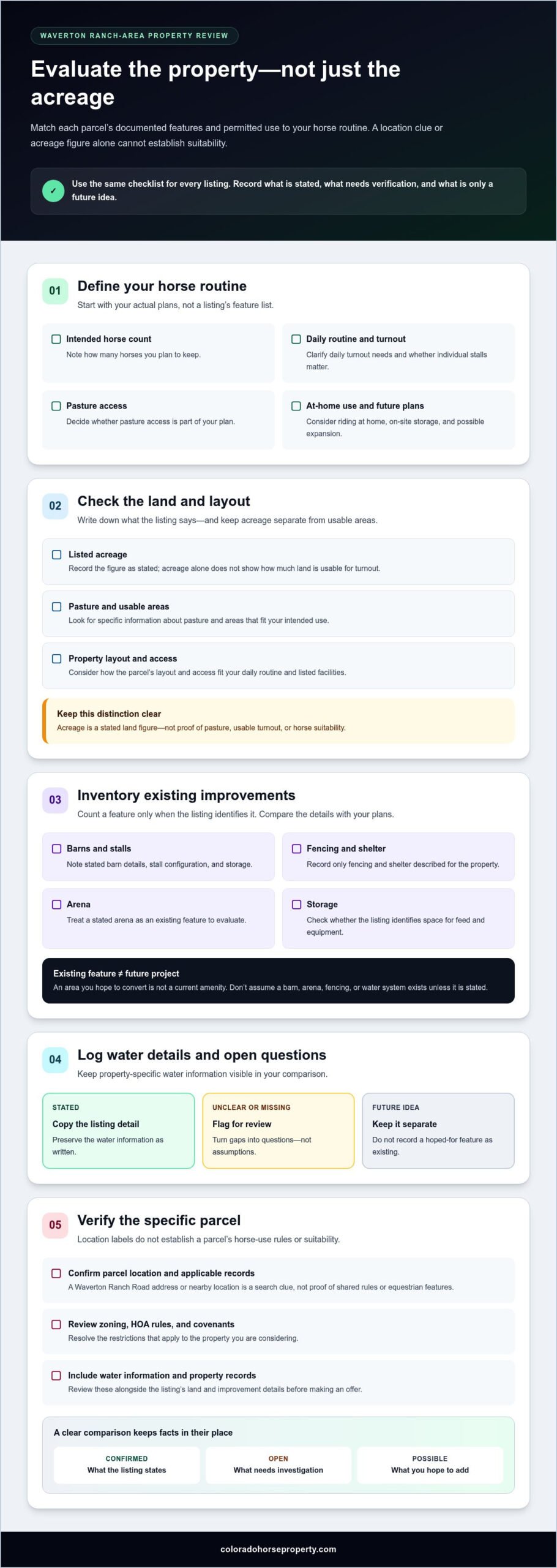
Use the same categories for every property in your Waverton Ranch-area search. A consistent comparison helps you see which options fit your priorities and which need more investigation. It also keeps a polished photo or broad acreage figure from carrying too much weight.
- Horse plans: Record your intended horse count, daily routine, turnout needs, and possible future use.
- Land: Note the listed acreage and any specific information about pasture, usable areas, and access.
- Improvements: Write down only the barns, stalls, fencing, shelters, arenas, and storage the listing actually identifies.
- Water: Copy the listing’s stated water details, then flag missing or unclear information for review.
- Decision notes: Keep confirmed facts, open questions, and possible compromises in separate columns.
For example, if a listing gives an acreage figure but says nothing about pasture, record the acreage as stated and mark pasture as an open question. Don’t treat one as evidence of the other. A horse-property buyer’s guide can also help you organize priorities before comparing listings, so your checklist reflects your own plans rather than a generic wish list.
As you refine your criteria, Colorado Horse Property’s horse-property search can help you focus on Colorado listings and relevant acreage ranges.
Compare Waverton Ranch Equestrian Listings Beyond the Photos
Photos can make a property feel like a strong match, but they rarely answer every horse-use question. For a useful comparison, record what each current listing actually states, then separate those facts from details that need follow-up. A search for equestrian homes for sale Waverton Ranch may surface properties with different features and levels of detail, so apply the same criteria to each one.
The table below is a working template, not a description of a particular property. Add a separate row for each listing you’ve confirmed is active. Enter stated details only. If a listing is silent on a point, keep that gap visible as an open question.
| Acreage | Listed equestrian improvements | Water details | Restrictions | Open questions |
|---|---|---|---|---|
| What acreage does the current listing state? | Which barns, arenas, fencing, or other improvements are explicitly described? | What water information is stated in the listing? | What restrictions does the listing disclose? | What details need property-specific review or follow-up? |
Read listing descriptions and virtual tours critically
Start with the written description, then use photos and virtual tours to understand what’s visible. A tour may help you follow the layout, view a barn or arena from different angles, and prepare focused questions before an in-person review. Colorado Horse Property offers virtual tours for many listings. Use a tour as an early screening tool, not proof of land conditions, facility function, water availability, or legal permission for horse use.
Keep observations separate from verified details. A gate or fenced area visible in a photo doesn’t establish the fencing’s extent or condition. A structure that looks like a barn shouldn’t be counted as an equestrian improvement unless the listing identifies it that way or further review establishes its use.
Compare usable value, not just headline acreage
Acreage is one comparison point, not a complete measure of fit. Consider access, terrain, stated pasture, and existing improvements separately, then judge them against your intended horse use. Avoid applying a generalized acreage rule without a property-specific basis. An existing barn and a plan to build one are different scenarios, each with its own questions about feasibility, restrictions, and future work.
- Essential: Features or conditions your horse plan depends on.
- Preferred: Improvements that would make daily use easier but aren’t required.
- Negotiable: Features you could adapt to, defer, or consider as a future project.
Use these categories to compare each listing’s documented features with your priorities. If a barn isn’t identified as an existing improvement, treat it as a possibility to investigate, not an existing asset. A horse-barn buying-versus-building guide can help frame that decision. Parcel-specific records and review determine what is practical for a particular property.
Check Horse-Use Rules, Water, and Property Records Before You Commit
A listing can describe a property’s features, but that description isn’t verified legal permission for horse use. Review each parcel on its own before making an offer. Nearby properties may have different zoning, HOA rules, covenants, or other recorded conditions. A neighbor’s horse use doesn’t establish what’s allowed on the property you’re considering.
Use this sequence to organize your due diligence:
- Define your intended use. Write down your planned horse count and whether you expect personal horse keeping, another type of use, or future changes. Specific plans help focus the records review.
- Review the listing facts. Note stated acreage, improvements, access, and water details. Keep listing claims separate from information established in property records.
- Identify applicable restrictions. Review county zoning, HOA rules, covenants, and relevant property records for the specific parcel. Confirm which local authority has jurisdiction before relying on guidance for a Castle Rock-area address.
- Assess water information. Examine what the listing and property records say, and note what remains unclear for transaction review. Give water details separate attention when evaluating a Colorado horse property.
- Document open questions. Keep a written record of unresolved items, the information needed, and any responses or documents received as you evaluate the property.
Verify horse permissions and land-use restrictions
Start with the parcel, not a general rule for the area. Check applicable zoning and land-use records, then review HOA documents, covenants, and property records for conditions that could affect your plans. If a listing mentions horse use, treat that as a prompt for review, not a substitute for the relevant records. Rely on a stated horse limit or permitted use only when it’s supported for that property.
For a Castle Rock-area search, first establish which local authority applies to the specific address. A road name or nearby community reference may not be enough to determine jurisdiction. This keeps your research focused on the right parcel and governing records.
Review water and seasonal suitability property by property
Record the water information stated in the listing, then compare it with available property records and your intended use. Don’t assume a well, water right, supply, or system exists based on acreage, photographs, or a nearby property. A Colorado water-rights guide can provide useful background, but parcel-specific details still need review. Likewise, don’t use elevation or seasonal assumptions from another Colorado region as a substitute for evaluating Waverton Ranch-area conditions.
Before committing to equestrian homes for sale Waverton Ranch, keep unresolved water, land-use, and restriction questions together for your transaction review. Explore horse-property listings and buyer representation as you evaluate properties against your documented requirements.
Find Waverton Ranch-Area Horse Properties with Colorado Horse Property
Finding a property that fits your horse plans starts with a focused search and continues with careful review of each listing. Colorado Horse Property Search is an AI-powered tool for finding Colorado horse-related properties. Use it to explore listings around your preferred location, then compare each property’s stated land and improvements with the needs you’ve identified.
Keep your location search separate from your suitability assessment. A Waverton Ranch-area result is a property to investigate, not confirmation that horse use is permitted or that its features match your plans. Current listing details and property-specific records are essential as you build a shortlist.
Narrow the search around your acreage and horse-property needs
Begin with an acreage range that suits your initial search. Colorado Horse Property’s filters include 1-10 Acres, 10-35 Acres, 35-100 Acres, and 100+ Acres. These ranges help organize options, but acreage alone doesn’t establish usable pasture, horse permissions, or a parcel’s suitability for your intended use.
Use your buyer checklist to sort each result. Mark essential needs separately from preferred features, then compare the listing’s documented details against both. A property may be worth investigating even if it lacks a preferred improvement, while an essential requirement deserves closer review before it stays on your shortlist. Don’t infer horse permissions from a Waverton Ranch Road address or area reference. Evaluate each property on its own terms.
Move from shortlist to informed next steps
Review listing descriptions first, then use virtual tours, available for many listings, as an early screening option. Tours can help you get a sense of the visible layout and identify focused questions for further review. They don’t replace an in-person assessment or a review of restrictions and records.
Colorado Horse Property brings nearly four decades of local experience and personal service to a specialized Colorado property search. Buyer representation and transaction management can support you as you evaluate options and move through the purchase process. Keep your shortlist grounded in confirmed listing facts, and carry open questions into the next stage of review.
Ready to focus your search? Search Colorado horse properties and take the next step toward finding a place that fits your plans.
Turn Your Horse-Property Goals Into a Confident Search
Before taking the next step, put your priorities into a short property brief. Note your intended horse use, the features you consider non-negotiable, and the questions that need answers before you can decide. This gives you a clear standard for judging each opportunity, including listings surfaced by a search for equestrian homes for sale Waverton Ranch.
Stay open to adjusting your search if a property’s location or features don’t align with your plans. You might broaden the area you’re considering or decide that a preferred feature is flexible. Make those choices deliberately, based on your needs, rather than letting a listing’s label or presentation set your expectations. For buyers whose property searches also encompass residential home markets in other regions, resources like lisahansenrealtor.com offer expert buyer representation and listing guidance in the Greater Twin Cities area.
When you’re ready to explore options, search Colorado horse properties and build a shortlist that reflects your goals. A well-matched property can support the way you want to live and care for your horses. Start with your priorities, take the next step with purpose, and keep working toward the right fit.
Frequently Asked Questions
Are there equestrian homes for sale in Waverton Ranch?
Listings change, so use Colorado Horse Property Search to explore current Colorado horse-property listings and narrow your search by location and acreage. Nearby listings or vacant land may also be worth considering, but they aren’t the same as a horse-ready home in Waverton Ranch. Review each listing’s current status and stated features, then assess the parcel records before deciding whether it fits your plans.
Does a Waverton Ranch address mean I can keep horses there?
No. An address or neighborhood reference doesn’t establish whether horse keeping is allowed on that parcel. Before relying on a property for your plans, identify its jurisdiction and review applicable land-use information, HOA documents, covenants, and property records. If you’re considering a specific number of horses or a commercial use, include that intended use in your property-specific review.
Is every home on Waverton Ranch Road an equestrian property?
No. A road name identifies location, not a property’s equestrian features or permitted uses. One listing might describe acreage or horse-related improvements, while another may not provide those details. For each address, review the current listing and property records. Nearby horse facilities, a rural setting, or an area label don’t prove that the home itself suits horses.
Can I tell whether a property has water rights from its listing?
A listing may state water-related information, but a brief description doesn’t prove the property has particular water rights or access. Look for the exact details provided, then review relevant property records as part of due diligence. A mention of a well and a statement about water rights are not interchangeable. Record unclear terms for transaction review.
Are virtual tours enough to evaluate a horse property?
No. A virtual tour can help you screen a property’s visible layout and prepare questions before visiting, but it can’t establish conditions that aren’t shown. A tour won’t confirm fencing condition, pasture usability, water details, or whether horse use is permitted. Use it to decide what to examine more closely, then evaluate the property and review applicable records before making a decision.
What does “horse-friendly” mean in a property listing?
“Horse-friendly” is a descriptive label, not a complete assessment of a property. Look for concrete details that explain what the listing means, such as identified barns, fencing, pasture, or acreage. Compare those stated features with your horse-care routine and plans. The label alone doesn’t tell you whether the property’s layout, improvements, or applicable restrictions fit your intended use.
Can I search Colorado horse properties by acreage?
Yes. Colorado Horse Property Search includes acreage filters for 1-10 Acres, 10-35 Acres, 35-100 Acres, and 100+ Acres. Choose a range to organize your search, then assess individual properties using their stated features and records. A filter narrows results, but it doesn’t determine how much acreage is usable or whether horses are permitted on a particular parcel.