
No HOA can sound like a green light for horses, barns, and the setup you have in mind. It isn’t. A Colorado horse property with no HOA or covenants may still be subject to county land-use rules, and a listing label alone doesn’t establish which restrictions apply.
If you’re comparing properties, start with the practical questions: where can horses be kept, what can you build, and which private restrictions or public rules apply? The answers can vary from one property to another, so “no HOA” is only one detail to consider.
This guide explains how HOAs, recorded covenants, and county rules differ, then walks through a consistent way to assess listings against your horse-related needs. You’ll also find a checklist for reviewing the details before moving forward. Colorado Horse Property’s AI-powered search and buyer representation can help you find and compare horse-friendly listings, backed by nearly four decades of Colorado real estate experience.
Key Takeaways
- Compare HOA rules, recorded covenants, and county land-use controls by who establishes them and which records can help clarify their impact.
- Assess a Colorado horse property with no HOA or covenants against your intended horse use, existing improvements, acreage, access, and applicable restrictions.
- Use the same property-by-property checklist for each listing, from clarifying your plans to comparing available information with your needs.
- Filter horse-property listings by acreage ranges of 1-10 Acres, 10-35 Acres, 35-100 Acres, and 100+ Acres to focus your search.
- Explore Colorado Horse Property Search, an AI-powered tool with acreage filters and virtual tours for many listings, to discover and compare potential properties.
What ‘No HOA or Covenants’ Means for Colorado Horse Property Buyers
A listing marked “no HOA” may appeal if you want room for horses, a barn, or changes to the property. But the phrase describes only one part of the picture. An association, recorded restrictions, and public land-use controls are separate considerations. The listing label alone doesn’t establish which horse-related activities are allowed on a particular parcel.
Treat “no HOA” or “no covenants” as a reason to look closer, not as a final answer. Write down what you plan to do on the land, then compare those plans with the property records and applicable local information.
A property tour can help you picture the possibilities, but it can’t establish which rules apply. This video shows a Colorado horse-property listing advertised as having no HOA:
An HOA is an organization that may manage shared areas, collect dues, and enforce its governing documents. Covenants are private restrictions recorded against property, and they may exist without an active association. The Homeowner Association (HOA) overview explains the general role of associations and their governing documents. For a specific property, the relevant recorded documents and applicable public land-use controls are what matter.
Does no HOA mean no covenants?
No. An association and recorded covenants are different things. A property may have recorded restrictions without an active HOA, while an HOA may administer covenants in a community. Don’t rely on either phrase alone. When evaluating a Colorado horse property with no HOA or covenants, review the available records for that parcel before drawing conclusions about its use.
What ‘unrestricted’ should mean to a horse-property buyer
“Unrestricted” is too broad to answer the practical question: can you carry out your plans here? Replace the label with questions tied to your intended setup. For example:
- Can you keep the type and number of horses you intend to have?
- Can you build or modify the barn, fencing, or other improvements you need?
- Can you use the property for personal riding, breeding, or another intended purpose?
- Are there access or land-use considerations that affect your setup?
These are questions to investigate, not assumptions about what Colorado rules allow. A seller’s description can help you identify a property, but it doesn’t replace relevant recorded documents and county information. Requirements can vary by location, so review public controls property by property. This helps you compare marketing language with the horse setup you actually want.
How Covenants, HOA Rules, and Colorado County Land-Use Rules Differ
A property can be outside an active association and still have recorded private restrictions or public land-use controls. Each layer has a different source, so review them separately rather than treating “no HOA” as a complete answer. Private restrictions and public land-use rules are distinct questions.
Use this comparison to organize an initial review. Which documents matter, and how they apply, depends on the property and its location.
| Layer | Who or what establishes it | Records to review | Horse-property questions |
|---|---|---|---|
| HOA rules | An association, under its governing documents and applicable law | Association declaration, bylaws, rules, and amendments, if applicable | Do the association’s documents address animals, structures, fencing, or exterior changes? |
| Recorded covenants | Private restrictions recorded against property; an association may be involved in administering them | Recorded declarations, covenants, amendments, and relevant title records | Does the language address livestock, barn placement, property use, or improvements? |
| County or other local land-use controls | The relevant public authority for the property’s location | Applicable zoning and land-use information, maps, and permit records | What local rules apply to the intended horse use, number of animals, or planned structures? |
What an HOA or recorded covenant may govern
Private documents may address property use, buildings, or exterior changes, but their terms and applicability can differ. If you plan to build a barn, keep livestock, or change fencing, compare each plan with the wording of the property’s records. Don’t assume that every document contains the same restrictions or applies to every parcel in the same way.
What county land-use rules may still affect
Identify the local jurisdiction for the property and find the land-use information that applies there. Horse limits, zoning permissions, and permit requirements are location-specific, so review them for the parcel instead of applying a rule from another county. The absence of an HOA doesn’t remove public oversight. A “rural” or “agricultural” description in a listing also isn’t a substitute for checking applicable records.
For a Colorado horse property with no HOA or covenants, match each intended activity to the private documents and public land-use information that could address it. If a listing says “no restrictions,” note whether that refers to an HOA, recorded covenants, public rules, or something else. Specific wording makes it easier to compare properties and identify questions that remain.
Colorado Horse Property’s horse-property search and buyer representation can help you compare listings as you assess how each property’s details align with your plans.
Compare No-HOA Colorado Horse Properties Against Your Actual Plans
A property’s acreage and “no HOA” label are only part of the comparison. Start with your intended horse use, then evaluate each listing against the facilities, access, and documented restrictions that matter to your day-to-day plans. More land isn’t automatically a better fit if the layout or existing improvements don’t work for your needs.
Match the property to your horse-keeping plans
Before touring listings, write down how you expect to use the property, which facilities you need, and what daily tasks could affect your choice. For each listing, record the features it actually describes, such as barns, arenas, pasture, access, acreage, and water information. Don’t treat an unmentioned feature as present. Your list can help identify gaps that need property-specific review.
| Comparison point | What to record | How it relates to your plans |
|---|---|---|
| Intended horse use | Your planned activities and horse-keeping needs | Identify which aspects of the property’s use and restrictions need closer review. |
| Existing improvements | Listed barns, arenas, fencing, shelters, and other facilities | Compare what’s described with your preferred setup. Don’t assume new construction or alterations are permitted. |
| Acreage | Use the search ranges: 1-10 Acres, 10-35 Acres, 35-100 Acres, or 100+ Acres | Use acreage to narrow the search, then assess the usable layout and your intended use. |
| Access and location | Listing details about property access and location | Consider how the setting fits your regular travel and property routines. |
| Restrictions | Available private documents and applicable public land-use information | Compare the documented details with your intended activities and planned improvements. |
Pay close attention to water information. Compare what the listing says, and treat the source, availability, and suitability for your intended operation as property-specific questions. Don’t infer them from acreage or photographs.
Compare practical trade-offs between listings
One listing may describe a barn and fencing, while another offers more acreage but fewer stated improvements. Neither is automatically the better choice. Compare location, access, the existing setup, and the details available for each property. Your preferred improvements may also depend on recorded restrictions and local land-use rules, so don’t assume you can add or alter facilities simply because the land appears suitable.
Keep your notes consistent across properties. The Horse Property for Sale in Colorado buyer’s guide and Equestrian Real Estate Colorado complete buyer’s guide can provide additional context as you refine your priorities. A focused search for a Colorado horse property with no HOA or covenants is most useful when it helps you compare actual property details with a clear plan, rather than acreage alone.
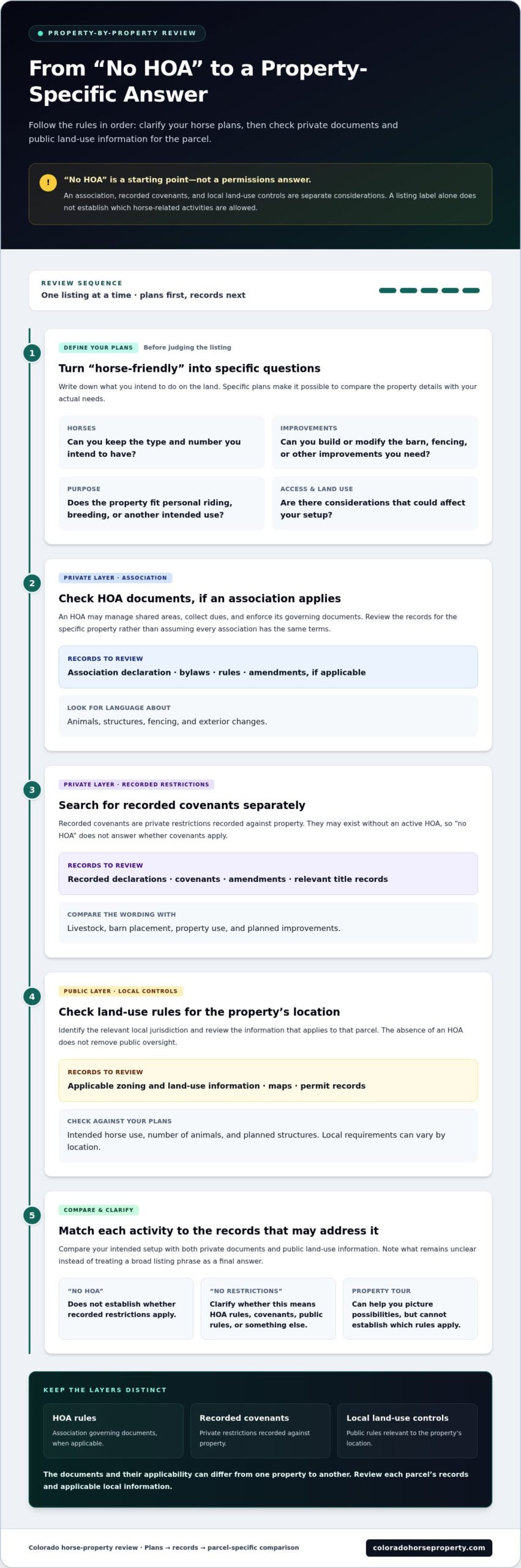
A Property-by-Property Review Checklist Before You Pursue a Listing
A “no HOA” label is a useful search clue, but it doesn’t tell you whether a property fits your horse plans. Follow the same review sequence for each listing. This makes missing information easier to spot and helps you compare a Colorado horse property with no HOA or covenants against your intended use, rather than relying on marketing language.
- Clarify your intended use. Write down how you plan to keep and use horses, the facilities you need, and any changes you hope to make. Be specific about the setup you’re seeking.
- Review the listing details. Note the acreage, access, utilities, water information, and improvements described. Treat missing details as unanswered questions, not proof that a feature is present or absent.
- Identify private restrictions. Review available recorded documents and relevant property records for information about covenants or other restrictions. Consider their wording and applicability to the parcel instead of assuming every document applies in the same way.
- Assess local land-use information. Identify the county or other relevant jurisdiction and review the public information that applies to the property. Check local statements about horse use, structures, permits, and water for that specific location.
- Compare the property with your plans. Bring your intended use, listing details, private records, and local information together. Record what appears to fit, what needs further investigation, and what could affect your decision.
Review the property information behind the listing
Compare the description with available records and recorded restrictions. If a listing mentions a barn, well, water rights, utilities, or access, note exactly what it says and look for supporting property information. Flag absent or unclear details for investigation. Don’t draw a legal conclusion from a listing phrase or assume a document applies to the parcel without reviewing its terms and context.
Check intended use against local requirements
Local rules can differ, so don’t use one county’s horse limits, zoning labels, permit guidance, or water information as a statewide standard. Identify the jurisdiction for the specific parcel, then review the public land-use information relevant to your plans. This property-by-property approach also helps you consider broader land details, such as access, utilities, and improvements, alongside private documents.
Keep a simple comparison sheet for each property. Use separate columns for confirmed listing details, recorded information, local requirements to verify, and questions that remain. This prevents an attractive feature, such as an existing barn, from overshadowing an unresolved issue that matters to your plans. It also gives you a clear record to revisit as you compare listings and decide which ones merit closer attention.
Colorado Horse Property provides buyer representation for horse-property listings to help you compare property details with your plans.
Find Colorado Horse Property That Fits Your Plans
Once you’ve set your horse-related priorities, a specialized search can help you find relevant Colorado listings and build a shortlist. Colorado Horse Property Search is an AI-powered tool for finding horse-related land and homes. Use it to discover properties, then compare listed features with your plans and review restrictions separately. A search result is a starting point, not confirmation that a property’s use will suit you.
Use specialized search to narrow the property field
Filter listings by acreage ranges of 1-10 Acres, 10-35 Acres, 35-100 Acres, and 100+ Acres. Then review each property’s details, including the land and improvements described. Virtual tours are available for many listings and can help you assess visible features before deciding which properties to explore further. They don’t replace a review of property-specific records or local land-use information.
Keep practical and documented details together as you compare options. Note what the listing says about barns, arenas, pasture, access, or water, and distinguish those details from restrictions that need separate review. For a Colorado horse property with no HOA or covenants, neither a search label nor a property photo establishes whether your intended activities are permitted. Use your shortlist to guide a focused, property-by-property assessment.
Move from shortlist to an informed next step
A useful shortlist makes the next decision clearer. For each property, summarize what appears to match your priorities, what information is available, and what questions remain about restrictions or intended use. This lets you compare listings on more than acreage or visible improvements and gives you an organized basis for deciding which property deserves closer attention.
Colorado Horse Property provides buyer representation as you compare listings and move through the real estate transaction. The company brings nearly four decades of Colorado real estate experience to the process. Buyer representation can help organize the decision and transaction steps, while property-specific restrictions and local requirements still need to be evaluated on their own terms.
- Shortlist: Save properties that align with your intended use, acreage range, and location priorities.
- Compare: Review listed features alongside available property and restriction information.
- Choose a next step: Focus on listings whose details best fit your plans and identify what remains to be reviewed.
Use Colorado Horse Property’s search and buyer representation to explore listings and compare options with your priorities in mind.
Take the Next Step Toward Your Horse Property
Your search will be more productive when you know which features are essential and which are flexible. Before pursuing a property, set your priorities: the horse use you have in mind, the facilities you need, and the details you still need to investigate. That gives you a clear basis for deciding whether a promising listing deserves a closer look.
A Colorado horse property with no HOA or covenants may be a strong candidate, but assess the specific property against your plans. Keep your shortlist focused on places that fit your priorities, and leave room to investigate unanswered questions before making a decision.
Colorado Horse Property can help you explore potential listings and move forward with buyer representation. Search Colorado horse-property listings to compare options that could support the life you want to build with your horses.
Frequently Asked Questions
Can a Colorado property have no HOA but still have covenants?
Yes. Recorded covenants can exist even when there’s no active homeowners association. A parcel may, for example, be subject to recorded restrictions established for a subdivision even if no association currently manages them. The important questions are whether recorded documents apply to the property and what their terms say. Review the parcel’s records rather than relying on a shorthand listing description.
Does no HOA mean I can keep horses anywhere on a Colorado property?
No. The absence of an HOA doesn’t establish that horses are permitted at every location or in every number. Local land-use rules may address animal keeping, and private restrictions may also be relevant. Identify the property’s jurisdiction and compare your intended use with the information that applies there. A neighboring property’s horse use doesn’t prove the same arrangement is allowed on this parcel.
How can I check whether a Colorado horse property has recorded covenants?
Start with the property’s title materials and look for recorded declarations, covenants, amendments, or references to restrictions. Match the documents to the parcel’s legal description, since a document’s title alone may not show which properties it covers. A title search can help identify recorded matters, but questions about a document’s meaning or applicability require careful review. Keep relevant records with the listing so you can compare details consistently.
What happens if county zoning allows horses but private covenants restrict them?
Don’t assume public zoning information cancels a private restriction, or that a private document changes county rules. These are separate layers, and both may need to be considered for your intended use. For example, a public land-use designation may appear compatible with horses while a recorded document raises a separate question about livestock. Review the actual wording and whether it applies to the property before relying on either source.
Are no-HOA horse properties automatically unrestricted?
No. “No HOA” describes the association status stated in the listing; it doesn’t establish that there are no recorded covenants or public land-use controls. A property marketed as unrestricted may still have details that matter to horse keeping, structures, or other planned uses. Treat broad descriptions as prompts to investigate, and compare documented property information with your plans before deciding whether a listing fits.
Can I build a barn on Colorado horse property with no HOA?
Possibly, but the no-HOA label alone doesn’t establish whether a barn can be built. Review recorded restrictions and the local land-use and permit information relevant to that parcel. The planned structure’s location and intended use may matter, so be specific about the project as you research it. Don’t assume that an existing barn, a rural setting, or an agricultural-sounding listing description means a new barn is permitted.
How do I find Colorado horse property with no HOA or covenants?
Use a horse-property search to build a shortlist, then investigate restriction details for each candidate. Colorado Horse Property Search offers acreage filters, including 1-10 Acres, 10-35 Acres, 35-100 Acres, and 100+ Acres. These filters help narrow options by land size, but they don’t establish HOA or covenant status. Compare listing details with property records and applicable local information before moving forward.