
The best-known equestrian community may be the wrong fit for your horses. A community’s reputation doesn’t tell you whether a particular property’s zoning, acreage, covenants, or water details support your plans. That’s why comparing equestrian communities in Douglas County means looking beyond names and marketing language to how you want to live and use the land.
It’s easy to see why the options can blur together. Buyers may be weighing Castle Pines’ quieter, club-oriented setting, The Pinery’s larger-lot character, and Pradera’s luxury, club-focused appeal, along with access, amenities, and neighborhood feel. This guide will help you compare those priorities and identify the property-level details to investigate before you decide.
You’ll find a practical framework for building a shortlist, assessing horse-use considerations, and moving from broad browsing to a focused search. Colorado Horse Property’s AI-powered search can help you filter listings by acreage range and equestrian features such as barns, arenas, pasture, and water. With nearly four decades of Colorado real estate experience, the team understands how community preferences and individual property details both shape a horse-property search.
Key Takeaways
- Comparing equestrian communities in Douglas County starts with your intended horse use, not a community label.
- Compare Castle Pines Village, Pradera, Colorado Golf Club, The Pinery, Timbers at the Pinery, and Perry Park Ranch by lifestyle fit and property-specific research needs.
- Separate county zoning, subdivision covenants, community rules, and property rights before deciding whether a parcel fits your plans.
- Use a clear shortlist process: define horse-use needs, rank lifestyle priorities, then compare property details against your must-haves.
- Explore Colorado Horse Property’s AI-powered search with acreage filters from 1-10 Acres through 100+ Acres to focus your listing search.
What Makes Comparing Equestrian Communities in Douglas County Different?
An equestrian community is best understood as a combination of lifestyle preferences and property fit, not a standard package of horse facilities or permissions. Buyers may want room for horses while also weighing neighborhood character, access to everyday services, and how they want home life to feel. Those priorities can point to different communities, even when buyers share similar plans for their horses.
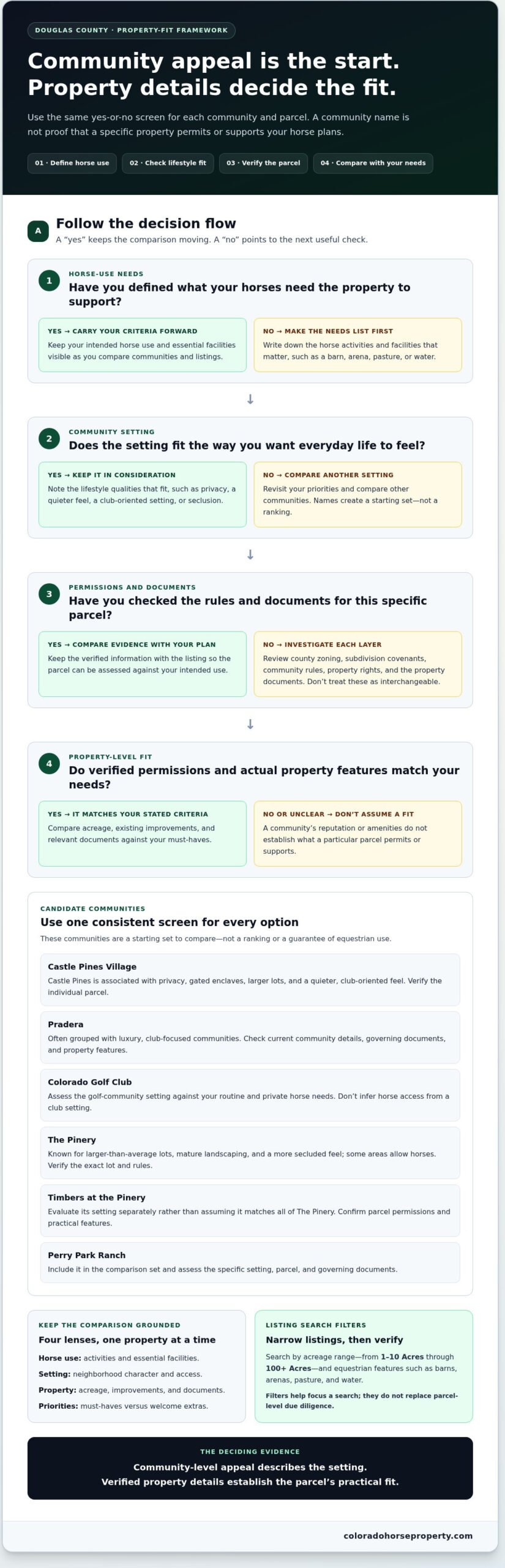
A useful comparison keeps four lenses in view: intended horse use, community setting, individual property details, and personal priorities. Douglas County includes varied communities and settings, so the balance matters. Your preferred pace of life and daily access needs can be as important as acreage or an existing barn. For general background on the county and its population, see Douglas County, Colorado demographics.
For a broad visual example of how buyers might compare equestrian communities, watch this video. It offers a general perspective, not a guide to Douglas County properties.
Community reputation versus property-level horse use
A community name can signal a certain setting or identity, but it doesn’t establish what a specific parcel permits or supports. Shared amenities and neighborhood character are different from private facilities such as a barn, arena, or pasture. Treat each listing as its own due-diligence project: assess the parcel and review its applicable zoning, covenants, community rules, and property documents.
Community-level appeal describes the setting; only verified property details establish what that individual parcel can accommodate.
Keep the evidence organized as you compare:
- Horse use: List the activities and facilities that are essential to your plans.
- Setting: Note the neighborhood character and access that fit your preferred routine.
- Property details: Record acreage, existing improvements, and relevant documents for each parcel.
- Personal priorities: Separate non-negotiables from features you’d welcome but don’t require.
Douglas County communities buyers may compare
A focused search may include Castle Pines Village, Pradera, Colorado Golf Club, The Pinery, Timbers at the Pinery, and Perry Park Ranch. These names create a starting set, not a ranking or a guarantee of equestrian use. Compare each option against the same criteria, then investigate the particular property and its governing documents. That consistent approach helps distinguish a community’s appeal from a parcel’s practical fit.
As you compare, avoid assuming that similarly described communities offer the same horse-use conditions or everyday experience. The goal of comparing equestrian communities in Douglas County is to find a setting that aligns with your priorities, then verify the property-level details that matter for your intended use. A clear comparison framework makes your search more focused and gives each candidate property a fair, practical assessment.
How Do Castle Pines, Pradera, The Pinery, and Other Options Compare?
Use the same questions for every community, then verify the answers against current information and the specific property. The table is a starting framework, not a claim that any neighborhood permits horse keeping or includes equestrian facilities. Community character can help you narrow the search; zoning, covenants, property documents, and the listing’s actual features determine whether a parcel matches your plans.
| Community | Setting to consider | Horse-use questions | Lifestyle priorities | Research needed |
|---|---|---|---|---|
| Castle Pines Village | Castle Pines is associated with privacy, gated enclaves, larger lots, and a quieter, club-oriented feel. | Does this parcel allow your intended horse use, and does it have suitable private facilities? | Privacy and a quieter setting. | Verify parcel zoning, covenants, acreage, and current community rules. |
| Pradera | Often grouped with luxury, club-focused communities. | What horse use, if any, is allowed on the specific parcel? | Club-oriented community character. | Check current community details, governing documents, and property features. |
| Colorado Golf Club | Assess the golf-community setting and its fit with your preferred routine. | Do property rules and zoning support your intended use? Don’t infer horse access from a club setting. | Weigh golf or neighborhood priorities against private horse needs. | Verify amenities, access, restrictions, and parcel details from current sources. |
| The Pinery | Known for larger-than-average lots, mature landscaping, and a more secluded feel; some areas allow horses. | Does the property’s location and applicable zoning permit your plans? | Seclusion and established neighborhood character. | Verify exact lot, zoning, covenants, and current rules. |
| Timbers at the Pinery | Evaluate its setting separately rather than assuming it matches all of The Pinery. | What are the parcel’s horse-use permissions and practical features? | Compare the specific setting with your daily priorities. | Confirm boundaries, documents, and property characteristics. |
| Perry Park Ranch | Assess the community and individual parcel on their current details. | Are the intended horse use and facilities supported by the property documents? | Compare its character and access with your shortlist. | Verify current rules, zoning, acreage, and listing details. |
Balance club appeal with horse-use priorities
A golf or club-oriented setting may matter to your household, but it doesn’t establish equestrian access. Treat shared amenities and private horse facilities as separate considerations. Confirm what a specific property and its governing documents allow; don’t assume club membership includes horse privileges or that shared spaces can be used for horses. For community context, consult Douglas County official information alongside current neighborhood and property records.
Compare acreage and daily routines
Lot size and existing improvements vary by parcel, even within a named community. The Pinery’s larger lots, often described as ranging from about one-third acre to more than two acres, don’t by themselves establish horse suitability. Consider your intended number of horses, how you’ll manage daily care, and whether the property’s layout and facilities fit that routine. The best community is the one whose verified property options support your intended horse use and match the priorities that matter most to your household.
As you continue comparing equestrian communities in Douglas County, use a consistent shortlist of lifestyle needs and property requirements. You can use horse-property search resources to focus your browsing around the features and setting you’re seeking.
Does an Equestrian Community Guarantee a Horse-Ready Property?
No. An equestrian label describes a community’s identity or reputation. It doesn’t prove that every parcel permits every type of horse use, or that a particular property has the land, water, access, and facilities you need. A listing with a barn or arena also isn’t, by itself, confirmation that the property’s current use complies with all applicable requirements.
For buyers comparing equestrian communities in Douglas County, treat suitability as a property-by-property review. Separate the public rules that apply to land use from private neighborhood restrictions, then assess the parcel’s physical features and the rights tied to it. These are distinct layers, and one document or community description can’t answer every question.
Review zoning, covenants, and community rules
Zoning is the county land-use layer. Check the parcel’s designation and the current Douglas County records that explain applicable uses. Subdivision covenants are private restrictions recorded for a subdivision or development; they may address matters beyond county zoning. Community rules can add another layer for properties subject to an association. Review the documents that apply to the exact parcel, rather than relying on a neighbor’s situation or a community-wide reputation.
Keep the sources separate in your notes. Record what county materials say, what the recorded covenants state, and what current community documents require. If the documents use terms that affect your plans, have their meaning reviewed as part of property due diligence. Don’t assume a permission or restriction transfers from one lot to another; zoning, documents, and parcel conditions can differ.
Assess water, land, and existing equestrian facilities
Water deserves its own review. Identify the property’s water source and gather the available well information and documentation for any water rights associated with the parcel. The presence of a well or a water feature in a listing description doesn’t answer questions about the source, permitted use, or rights. Colorado Horse Property’s Colorado water rights guide offers additional context for this part of a buyer’s research.
Then walk the land with your intended horse use in mind. Note the acreage and layout, and inspect pasture condition, soil, drainage, and access as relevant to your plans. If a barn, arena, fencing, or other equestrian improvement is present, assess its condition and whether it suits your intended use. Colorado State University provides Colorado equine industry insights that can help inform a broader understanding of horse-related needs, but a general resource cannot establish a specific parcel’s suitability.
- Match documents to the parcel: Keep the zoning record, covenants, and community rules tied to the property being considered.
- Match features to your routine: Consider horse numbers, daily care, access, and the facilities your plans require.
- Note unresolved details: Track missing water, land, or structure information so it can be addressed during due diligence.
The goal isn’t to label an entire neighborhood horse-ready or unsuitable. It’s to determine whether the rules, rights, land, and improvements of a particular property align with your intended use.
How Can You Choose the Right Douglas County Community for Your Needs?
A focused search starts with your routine, not a community ranking. Write down what your horses need, how you expect to care for them, and what your household needs from its location. Then use the same criteria for every candidate. This turns comparing equestrian communities in Douglas County into a practical process instead of a search guided by names alone.
Use this sequence to narrow the options:
- Define horse use. Describe the number of horses you plan to keep and the activities, facilities, and land features your routine requires. Treat these as property needs to verify, not assumptions about a community.
- Rank household priorities. Consider setting, neighborhood character, and everyday access. Mark each as essential, preferred, or flexible.
- Shortlist communities. Keep options that appear to fit your lifestyle priorities, while leaving horse-use permissions open until you review property-specific information.
- Review property details. Compare each listing’s stated acreage and features with your requirements. Include applicable records and governing documents in your due diligence.
- Compare the evidence. Identify which properties meet your must-haves, which involve trade-offs, and which lack enough information for a sound comparison.
Build a shortlist around your horse and household routines
Make the distinction between requirements and preferences explicit. A minimum acreage or a particular facility may be a must-have for your intended use. A quieter setting or preferred route for everyday errands may be important, but still flexible. Label each item so an appealing community feature doesn’t outweigh a property requirement. For broader purchase planning, use this Colorado equestrian real estate buyer’s guide and Colorado land buying guide.
A simple scorecard can keep the comparison consistent. Choose your own scale, such as “meets,” “needs review,” or “doesn’t meet,” and apply it to each listing. Useful rows might include acreage, stated equestrian improvements, property setting, access, and outstanding due-diligence questions. Leave a blank or mark “unknown” when listing details don’t answer a question. Don’t assign scores to communities without property-level evidence.
Use tours and listing details to test your shortlist
Review listing descriptions, photographs, and virtual tours against your scorecard. Virtual tours available for many listings can help you examine visible spaces remotely and decide which properties warrant closer attention. Record only what the listing states or the tour shows. A view of a barn doesn’t establish its condition or permitted use, and an image of open land doesn’t confirm pasture quality or water details.
Use what you learn to refine the shortlist, then focus due diligence on the strongest property candidates. Explore horse-property listings to compare options against your priorities.
How Colorado Horse Property Helps You Compare Douglas County Options
Once you’ve defined your preferred setting and property requirements, the next step is to turn them into a focused listing search. Colorado Horse Property’s AI-powered Colorado Horse Property Search helps buyers find horse-friendly Colorado listings and narrow options using practical filters. It supports acreage searches in four ranges: 1-10 Acres, 10-35 Acres, 35-100 Acres, and 100+ Acres.
Turn your community criteria into a focused property search
Choose an acreage range that fits your plans, then compare listing details with your shortlist. Look for stated features such as barns, arenas, pasture, water, and acreage, while keeping community setting and everyday access in view. Search results help organize listings, while the property details determine whether a candidate fits your plans. Treat each listing as a candidate for closer review.
This approach helps you move from a broad community preference to specific properties worth investigating. For example, if a particular facility is essential, use listing information to identify properties that state they have it, then examine the details rather than assuming it meets your needs. If the listing doesn’t answer a key question, record it for property-level due diligence.
Virtual tours are available for many listings and can help you make an efficient initial comparison from a distance. Use them to review what’s visible, such as the arrangement of spaces or the relationship between the home and listed improvements. A tour can inform your shortlist, but it can’t establish unseen conditions, legal permissions, or the suitability of land and structures for your plans.
Move from browsing to a confident next step
Focused buyer representation can help connect your priorities to the property search and keep attention on the details that matter to your decision. Colorado Horse Property brings nearly four decades of Colorado real estate experience to the process, along with personal, service-focused support as you compare listings and consider your next steps. For additional planning context, explore the Colorado horse property buyer’s guide and the Colorado land buying guide.
Use the search to bring your community criteria into sharper focus, then build a shortlist around the properties that merit closer review. Explore horse-property listings and discuss buyer representation with Colorado Horse Property as you move from browsing toward a decision.
Turn Your Priorities Into a Focused Search
The right next step is to turn your shortlist into a clear brief. Write down what your horses need, what your household values, and which property details still require review. That gives each new listing a practical purpose: it either fits a priority, reveals a trade-off, or helps you refine what you’re looking for.
That’s the value of comparing equestrian communities in Douglas County with your own criteria in hand. Community names can guide where you begin, but your goals should shape where you look next. Colorado Horse Property brings nearly four decades of Colorado real estate experience to the search, with an AI-powered tool, acreage-range filters, and virtual tours for many listings to help you explore options.
Take the next step with a search built around your plans and buyer representation that keeps your priorities in focus. Explore Colorado Horse Property Search and start shaping a more focused property search. Begin with a clear plan and the properties that best match it.
Frequently Asked Questions
Is Douglas County a good place to live with horses?
Douglas County can suit buyers with horses, but the right fit depends on your intended horse use, preferred setting, and the details of a specific property. As you compare communities, look beyond the neighborhood name and assess the parcel’s applicable rules, water information, and features against your plans. A property that suits one horse owner’s routine may not work for another, so define your needs before choosing where to focus.
Can you keep horses in any Douglas County equestrian community?
No community label alone establishes whether horses are allowed on every parcel. A property’s zoning, subdivision covenants, community rules, and physical details may all affect its suitability. Review the current documents that apply to the specific property, not just general neighborhood descriptions. A nearby owner’s setup or a listing’s equestrian wording shouldn’t be treated as proof that the same use is permitted on another parcel.
What should I compare when choosing an equestrian community?
Compare your intended horse use, acreage, existing facilities, water information, applicable rules, neighborhood setting, and household priorities. Rank must-haves separately from preferences. For example, a required barn or minimum land area should carry more weight than a preferred neighborhood atmosphere. When comparing equestrian communities in Douglas County, verify amenities and property features individually instead of assuming marketing descriptions apply to every home or parcel.
How do golf and equestrian communities differ in Douglas County?
Some communities may be associated with golf, equestrian living, or both, but those labels don’t establish access, membership terms, or horse-use permissions. Start by identifying which amenities matter to your household, then assess whether a specific property supports your private horse needs. For instance, valuing a golf-centered setting doesn’t answer whether the parcel has suitable acreage or allows your intended use. Confirm community details through current, reliable information.
Do virtual tours help when comparing horse properties?
Yes. Virtual tours can help you review listed properties remotely and decide which ones merit closer attention. Use them to compare visible spaces, layout, and stated improvements, then note questions the tour can’t answer. A tour doesn’t replace reviewing listing information or evaluating property-specific details such as water, land conditions, or applicable rules. Colorado Horse Property offers virtual tours for many listed properties, making them useful for an initial review.
How can I search for Douglas County horse properties by acreage?
Colorado Horse Property’s search includes acreage ranges of 1-10 Acres, 10-35 Acres, 35-100 Acres, and 100+ Acres. Choose a range that helps organize your search, then review each listing’s stated features and details. Acreage filters can narrow the field, but they don’t establish whether a property is suitable for horses. Assess each candidate on its own information.