
The busiest horse venue in Colorado may not be the community where you’d want to live. If you’re looking for Colorado horse communities with social events, distinguish places built around equestrian living from showgrounds, riding facilities, and occasional event hosts. Each can bring horse people together, but they offer different ways to take part.
You want more than a suitable barn or a scenic trail. The right location should fit how often you ride, the activities you enjoy, and how much community life you want nearby. Compare the actual event format and access rules with your routine: a packed competition calendar may be less useful than a smaller program you can attend regularly.
This 2026 guide compares Colorado’s major equestrian hubs, from the Denver metro and Northern Colorado to Durango and Steamboat Springs. You’ll get a clearer picture of each area’s equestrian character and social opportunities, along with practical points to consider before you buy. Colorado Horse Property brings nearly four decades of Colorado real-estate experience and an AI-powered horse-property search to help connect your lifestyle priorities with a focused property search.
Key Takeaways
- Tell residential horse communities apart from equestrian facilities, clubs, and competition venues before comparing their social options.
- Explore Colorado horse communities with social events by comparing activity types, access rules, and how well the schedule fits your riding interests.
- Use current event calendars and published participation rules to understand what is scheduled and who can take part.
- Compare each area’s social opportunities with your daily riding needs, horse-care routine, and household priorities.
- Turn your community preferences into property-search criteria such as location, acreage, barns, arenas, and pasture.
What Makes a Colorado Horse Community Social, and Why Does It Matter?
A residential horse community, a riding center, a club, and a competition venue can all bring horse people together, but they serve different purposes. A neighborhood is where residents live; a facility may host riding programs; a club may organize member activities; and a competition venue provides space for events. The best Colorado horse communities with social events for you depend on which setting supports your everyday routine, not simply which has the fullest calendar.
Social activity can mean organized shows and clinics, group riding opportunities, or informal ways to meet other equestrians. These connections matter alongside practical needs such as suitable land and horse facilities. A location that fits your riding interests and preferred level of participation may be a better match than one with frequent events you cannot attend or do not want to join.
For a glimpse of Colorado’s equine community, watch Colorado Horse Rescue Celebrates 40 Years:
Which kinds of Colorado equestrian settings host social activity?
Colorado Horse Park in Parker is an equestrian sport venue, not a residential neighborhood. Its event calendar is a useful way to explore competitions and related activity. Ken-Caryl Ranch offers a different model: an equestrian center within a community, with programs that include lessons, camps, clinics, and community events. A venue can offer plenty to attend without offering a place to live, while a residential setting may incorporate riding programs into local life.
Social opportunities also extend beyond a single facility. Denver’s annual National Western Stock Show includes horse shows and rodeos, bringing equestrian activity into a wider regional event. It’s an example of why “horse community” can describe a network of places and gatherings, not only a neighborhood or club.
What should horse owners expect from a social calendar?
Calendars may feature shows, lessons, clinics, camps, or community gatherings. Each format offers a different way to participate: a show centers on competition, while a clinic focuses on instruction. Don’t assume an event repeats, welcomes the public, or is open to every rider. Organizers set schedules and participation rules, which may include membership, registration, or resident requirements. Review the current published details before treating an event as part of your regular routine.
Quick definition: A social horse community combines equestrian activity with ways to connect. Event access and residential status are separate: attending a venue’s program doesn’t necessarily mean you can live there or join every activity.
Before choosing a location, consider how often you want to ride with others, which disciplines interest you, and whether you prefer organized programs or a quieter residential setting. Then weigh those preferences against your horse-care routine and property needs. Compare specific details, such as event frequency, eligibility, and travel distance, rather than relying on a calendar’s overall number of listings. The goal is to find a setting where the available activities, access terms, and everyday riding options align with the life you want to build.
Colorado Horse Communities and Equestrian Hubs to Explore
Colorado’s equestrian scene includes places to live, facilities for riding and instruction, and venues designed to host competitions. Treating them as interchangeable can lead to a mismatch: an active event calendar may suit a competitor looking for show opportunities, while a household seeking day-to-day riding access may care more about trails, facilities, and the rules attached to a residential community.
These settings also sit within a wider network of equestrian activity. Community Equestrian in Colorado focuses on supporting the state’s horse community through local initiatives and advocacy. That broader perspective can help readers understand why a regional equestrian hub may matter even when it isn’t a neighborhood or a place to keep horses.
Colorado Horse Park and the Parker equestrian-event scene
Colorado Horse Park in Parker is an equestrian sport venue, not a residential development. Its website presents the park as a setting for equestrian sport and provides an event calendar, including show listings and past events. The calendar helps illustrate the venue’s competition focus, but a past listing does not establish what is scheduled throughout 2026 or whether a particular event is open to every visitor.
Before planning around an event, review its current date, format, registration details, and participation requirements in the published information. A show venue can offer opportunities to watch or compete without providing neighborhood ties, resident access, or everyday riding facilities. For a property search, treat Parker’s event scene as one factor in the area’s equestrian appeal, not proof that a nearby property includes access to the venue or its activities.
Ken-Caryl Ranch Equestrian Center and community programming
Ken-Caryl Ranch offers a different model: an Equestrian Center within a residential community. The center’s information describes a riding school and programs such as lessons, camps, clinics, and community events. Its page also describes nearly 50 miles of private trails. Together, those features point to a community setting with equestrian programming, rather than a competition venue alone.
Program listings don’t necessarily mean every activity is currently running or available to every rider. Review the center’s current information for active offerings and participation terms, including whether access depends on residency, registration, or another requirement. For prospective residents, distinguish the community’s trails and programs from the specific rights or access that come with an individual property.
Neither model is automatically the better fit. A competition-focused venue may appeal if shows are a priority; a residential community with an equestrian center may suit someone who values local programs and trail access. In both cases, match the social and riding opportunities to your household’s routine, and don’t assume that proximity guarantees access.
As you compare Colorado horse communities with social events, keep venue access, residential life, and property features as separate questions. Colorado Horse Property’s specialized listings and AI-powered search can help you explore horse-friendly properties by priorities such as location and acreage. Start by exploring Colorado horse properties that align with the kind of equestrian setting you want to live near.
Compare Colorado Horse Communities by Events, Access, and Everyday Fit
A full calendar can signal a strong competition scene, but it doesn’t prove that a location is a horse-friendly residential community or offers regular programming for residents. Compare each setting by its purpose, published activities, participation rules, and support for riding between events. The table separates described features from details that can change and should be reviewed in current published information.
| Setting | Event formats | Access to verify | Everyday riding fit |
|---|---|---|---|
| Colorado Horse Park, Parker Equestrian sport and event venue | Its website features an event calendar and show listings. Check the current calendar for dates and formats. | Review event entry, registration, and participation requirements for each activity. A venue calendar doesn’t establish resident access. | Evaluate it as an event destination, not as proof of nearby property access or daily riding facilities. |
| Ken-Caryl Ranch Equestrian Center Equestrian center within a residential community | The center’s page describes lessons, camps, clinics, and community events. Review current information to see which programs are active. | Check current eligibility and rules for each program, including whether access depends on residency or registration. | The center’s page describes nearly 50 miles of private trails. Review who may use them and under what conditions. |
How do event formats differ between venues and residential communities?
Competition venues organize activity around shows and event dates. A residential community’s equestrian center may list lessons, camps, clinics, or community gatherings, but listed program types don’t confirm that every offering is currently scheduled. Use the organizer’s current published information, and distinguish a competition calendar from ongoing resident programming. A busy venue calendar can mean plenty to watch or enter, not a recurring neighborhood social schedule.
Can you participate without living in the community?
Access terms shape the real value of an event or program. A public show, a registered lesson, a membership activity, and a resident-only gathering are different opportunities. Don’t infer eligibility from a website’s general description. Review the rules for the specific event or trail before building it into your routine. If an activity is open to nonresidents, it may be a useful social option even if you live elsewhere; if access is restricted, proximity alone won’t provide participation.
Priorities also differ by household. A competitive rider may value show formats and dates. A horse owner focused on regular exercise may look for trail access or instruction. Families may prefer programs that fit their schedules and offer ways to participate together. Compare options against your actual riding frequency and horse-care routine, not just the number of events listed.
For a focused comparison of Colorado horse communities with social events, keep a short record for each setting: event type, current schedule, eligibility, and connection to daily riding. Mark details you haven’t verified as questions rather than assumptions. Then weigh the social opportunities alongside property needs, since an event hub and a suitable place to keep horses are not automatically the same choice.
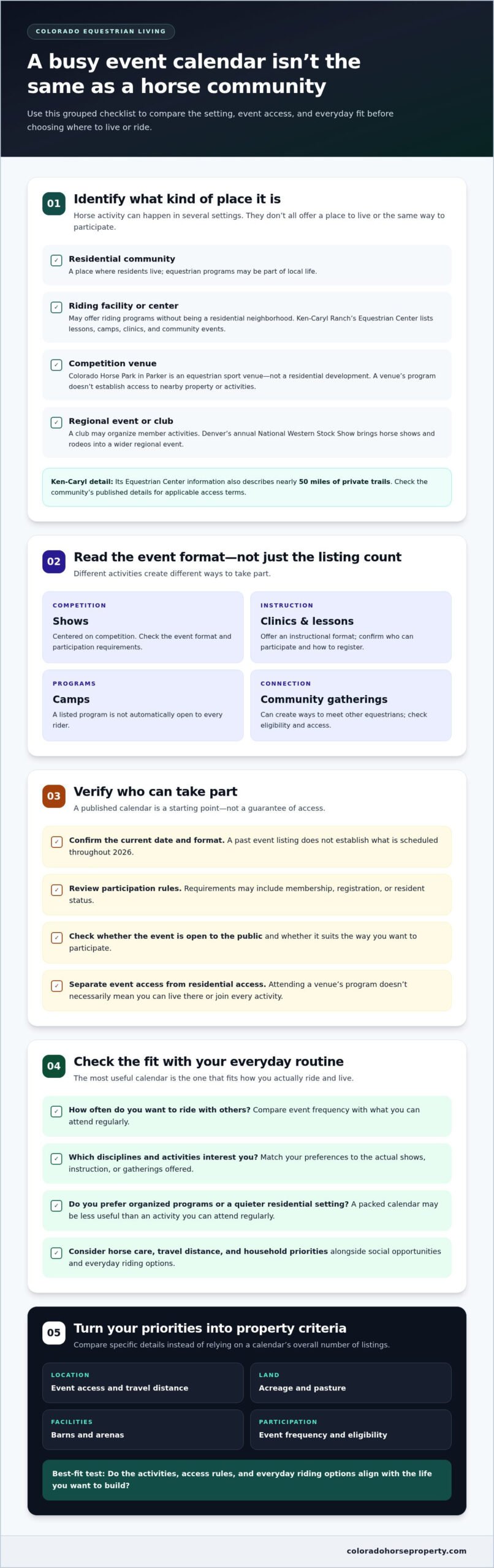
How to Evaluate a Colorado Horse Community Before You Choose
A promising calendar is useful only if the events fit your schedule and you can take part. Evaluate each setting in a consistent order, using current information from the event organizer or community. That makes it easier to distinguish a social opportunity you can realistically use from an appealing listing that doesn’t match your routine.
What should you verify in an event calendar?
Start with the event itself, not a general description of the venue. A past show or clinic doesn’t confirm that it will return, and a program page may describe offerings that aren’t currently scheduled. Review the latest calendar and participation information, then record the details that matter to your decision.
- Check the date and update status. Look for a current schedule, recent announcement, or registration page. Treat past events as history, not a promise of future dates.
- Identify the organizer and format. Distinguish a competition from a lesson, clinic, camp, trail activity, or community gathering. The format helps you decide whether it suits your interests and experience.
- Review participation rules. Look for registration steps and eligibility. Note whether the activity is public, limited to registered participants, membership-based, or restricted to residents.
- Assess the practical commitment. Note the location, travel time from a likely home base, event hours, and any schedule details published by the organizer. Consider whether you could attend often enough for the activity to matter.
How do you match community activity to your household?
Next, compare the published calendar with the way your household rides and spends time. A rider focused on competition may prioritize relevant show formats and a workable event schedule. Someone building skills may value lessons or clinics at a suitable level, much like the foundational care programs and hands-on learning championed by Texas Equine Education & Horsemanship™. Families may look for youth activities or gatherings that fit everyone’s availability. Don’t count an activity as a benefit simply because it appears on a webpage; it needs to be accessible and practical for the people who would use it.
Keep a separate list of property requirements. Social access and horse-property suitability are related, but one doesn’t establish the other. Note your priorities for location, acreage, barns, arena space, or pasture independently, then assess each property against those needs. This avoids choosing a home based on a social calendar while overlooking the land and infrastructure required for your horses.
For a broader perspective on how land and daily routines shape a rural move, explore the Colorado farm and ranch lifestyle. Use that context alongside current event details and community rules when comparing your options.
A simple comparison sheet can keep the decision grounded: list the activities you’d attend, access conditions, schedule fit, and property requirements for each location. If you’re ready to translate those priorities into a focused search, explore Colorado horse property listings.
Find Colorado Horse Property That Fits Your Community Priorities
Once you’ve compared equestrian settings, turn your priorities into property-search criteria. The goal is to find a home and land that support your horse-care routine while keeping the social opportunities you value within practical reach. A nearby event venue doesn’t guarantee access to its activities, and acreage alone doesn’t establish that a property has the facilities or community connections you want.
Turn event and lifestyle priorities into property-search filters
Separate non-negotiable property features from preferred community access before you search. This makes it easier to assess a listing on its own merits rather than letting a nearby social calendar overshadow important land requirements.
- Set property must-haves. Consider location, acreage, barns, arena space, and pasture based on your horses and daily routine. Treat each feature as a separate criterion, since a listing’s acreage doesn’t establish its facilities or event access.
- Record social preferences. Note which equestrian settings you’d like nearby, the activities that interest you, and how often you expect to participate. Keep event access separate from property features.
- Use acreage ranges to narrow the search. Search categories can help focus results on land sizes that suit your plans. They’re a starting point for reviewing individual properties, not a signal that a parcel includes access to a club, venue, or community program.
For a broader overview of purchase considerations, the equestrian real estate buyer’s guide can help you build on those initial criteria. As you review listings, compare the property details with your must-haves and assess community access separately.
Explore listings with Colorado Horse Property
Colorado Horse Property is a specialized Colorado real-estate resource for people searching for horse-friendly properties. Its Colorado Horse Property Search uses AI-powered search to help buyers explore listings according to their needs. Start with your preferred location and acreage range, then review each listing’s details for features such as barns, arenas, and pasture. The search can help narrow your options, while the listing information helps you assess each property.
Virtual tours are available for many listed properties, offering another way to explore them. Tours aren’t available for every property, so use them where provided alongside the listing’s written details.
With nearly four decades of Colorado real-estate experience, Colorado Horse Property connects a specialized property search with the practical considerations of horse ownership. If you’re ready to put your priorities into action, begin exploring Colorado horse-property listings and compare options against your community preferences, land needs, and everyday routine.
Choose a Community That Fits the Life You Want to Build
The right equestrian setting is personal. It should make sense for your riding goals, your horse-care routine, and the kind of connection you want with other horse people. As you weigh Colorado horse communities with social events, keep your priorities clear: an appealing calendar matters most when its activities are accessible and fit the way you actually live.
Use those priorities to guide your property search. Decide which features are essential, where you want to be based, and which social opportunities are worth having nearby. Then compare listings with those needs in mind, rather than expecting one property or location to meet every preference automatically.
Ready to explore your options? Explore horse-friendly properties with Colorado Horse Property and take the next step toward a home that supports your horses and the lifestyle you’re working toward.
Frequently Asked Questions
Are there horse communities in Colorado with social events?
Yes. Colorado has residential communities with equestrian programming, as well as clubs, riding centers, and event venues that bring horse people together. These settings aren’t interchangeable: a competition facility may host shows without offering a place to live, while a residential community may include local riding programs. As you explore Colorado horse communities with social events, compare the activities and access terms with your riding routine and housing needs.
Can non-residents attend events at Colorado horse facilities?
Sometimes, but access depends on the specific event and organizer. A public competition, a registered clinic, a membership activity, and a resident-only gathering can have different participation rules. Review the current event listing for registration or eligibility details before making plans. If the listing doesn’t explain who may attend, don’t assume that proximity or a public calendar means entry is open.
What kinds of social events do Colorado equestrian communities offer?
Activities may include horse shows, clinics, lessons, camps, and gatherings for residents or members. Some events center on competition, while others focus on instruction or group participation. The useful question is whether an activity fits your interests and availability. For example, a family looking for youth programming may value a camp schedule more than a show calendar, while a rider refining a discipline may prioritize clinics with relevant instruction.
How can I find current horse shows and equestrian events in Colorado?
Start with current calendars published by show venues and event organizers, then review the individual event page for schedule changes and entry information. For example, local facilities like the Littleton Equine Medical Center and regional rodeo grounds frequently update their seasonal calendars for autumn events. Discipline-specific organizations and local equestrian groups can also help surface events. Check the latest published details before traveling, since a calendar listing may not include every requirement or later update.
Is Colorado Horse Park a residential horse community?
No. Colorado Horse Park in Parker is an equestrian sport and event venue, not a residential community. Its calendar can help visitors identify competitions and other scheduled activity, but it doesn’t indicate that nearby homeowners receive access to park facilities or events. If you’re considering property in the area, assess the home and its horse-use features separately from the venue’s schedule and participation rules.
Does Ken-Caryl Ranch offer equestrian programs and community activities?
Yes. Ken-Caryl Ranch’s Equestrian Center describes a riding school, lessons, camps, clinics, and community activities. The center’s page also describes private trails. Program schedules and participation details can change, so use the center’s current information to review age or experience suitability, enrollment steps, and access conditions. This helps distinguish activities that match your household from programs that are simply listed as part of the center’s offerings.
How should I choose a horse property near an active equestrian community?
First, define the property features your horses require, such as usable acreage, shelter, fencing, or riding space. Then assess nearby activities by discipline, travel time, and participation rules. Keep legal and physical suitability in view too: review zoning, water rights, and any HOA covenants that may affect keeping horses. A nearby event calendar can add social value, but it doesn’t replace checking whether the individual property supports your plans.