
The most breathtaking views in Colorado won’t keep your horses healthy through a dry August. That’s the hard truth that separates a dream property from a functional one, and it’s the first thing experienced horse owners learn when searching for the best areas in Colorado for horse owners. Scenic acreage is abundant. Properties with senior water rights, reliable hay access, and equestrian-ready infrastructure are a different matter entirely.
You already know the challenges. Land prices in established hubs like Parker have pushed many buyers further afield, water rights in Colorado operate under a prior appropriation system that can blindside newcomers, and the state’s elevation swings mean turnout schedules can be disrupted for weeks at a time. These aren’t small details. They’re the variables that determine whether your operation is sustainable year after year.
This guide cuts through the scenery to give you a practical, county-by-county breakdown of where Colorado’s equestrian infrastructure, trail access, zoning protections, and water security actually align. Whether you’re pursuing dressage, competitive trail riding, or simply a well-run private facility, you’ll find the regional intelligence you need to make a confident, informed decision.
Key Takeaways
- The best areas in Colorado for horse owners aren’t just about scenery — water rights, zoning allowances, and soil quality are the three variables that determine whether a property is truly sustainable long-term.
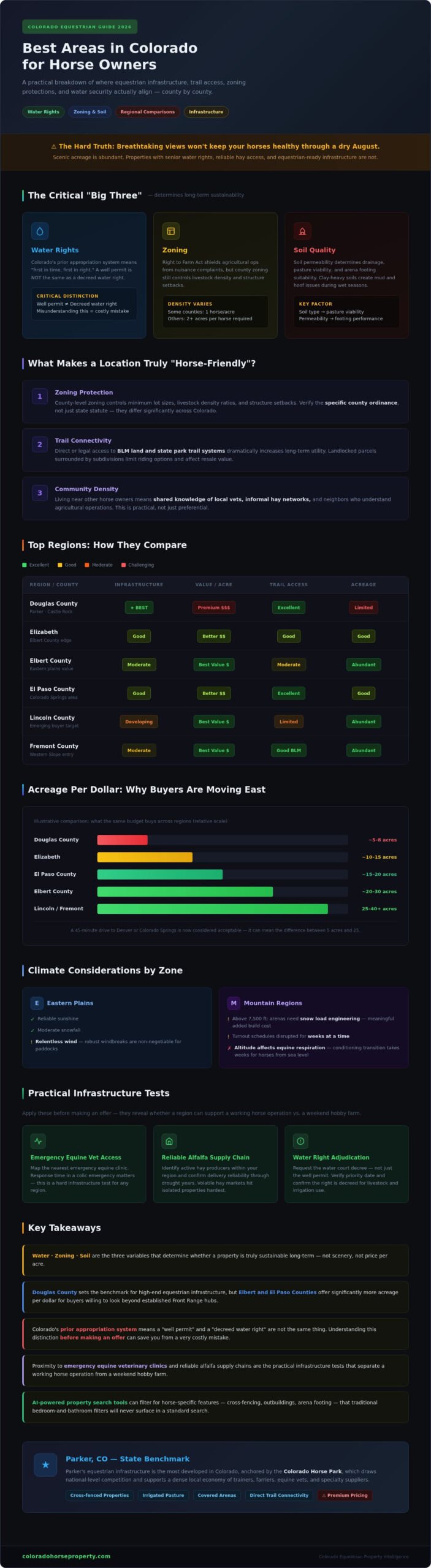
- Douglas County sets the benchmark for high-end equestrian infrastructure, but Elbert and El Paso Counties offer significantly more acreage per dollar for buyers willing to look beyond the Front Range’s established hubs.
- Colorado’s prior appropriation water system means a “well permit” and a “decreed water right” are not the same thing — understanding that distinction before you make an offer can save you from a costly mistake.
- Proximity to emergency equine veterinary clinics and reliable alfalfa supply chains are practical infrastructure tests that reveal whether a region can support a working horse operation, not just a weekend hobby farm.
- AI-powered property search tools can filter for horse-specific features — cross-fencing, outbuildings, arena footing — that traditional bedroom-and-bathroom filters will never surface in a standard listing search.
Defining the 2026 Colorado Equestrian Lifestyle
Colorado’s appeal to horse owners hasn’t faded despite a decade of rising land costs. What’s changed is who’s buying and what they’re prioritizing. The weekend hobby farm mentality is giving way to something more deliberate: buyers who want resource-secure properties that can sustain a working horse operation through drought years, hard winters, and volatile hay markets. That shift is reshaping where the best areas in Colorado for horse owners are actually found in 2026.
The pressure is real. Front Range acreage values have pushed many serious buyers into counties that weren’t on the radar five years ago. Elbert, Lincoln, and Fremont Counties are absorbing demand that Douglas County used to capture almost exclusively. Buyers who do their homework on water adjudication, soil permeability, and road access are finding genuine value there. Those who don’t are finding problems.
Proximity to Denver and Colorado Springs still matters, but the calculus has shifted. A 45-minute drive to a major metro is now considered acceptable by most equestrian buyers, especially when it means the difference between five acres and twenty-five.
What Makes a Location Truly “Horse Friendly”?
The term gets used loosely. A genuinely horse-friendly location in 2026 means three things working together:
- Zoning protection: Colorado’s Right to Farm Act shields agricultural operations from nuisance complaints, but county-level zoning still controls minimum lot sizes, livestock density ratios, and structure setbacks. Some counties allow one horse per acre; others require two or more. Verify the specific county ordinance, not just the state statute.
- Trail connectivity: Direct or legal access to BLM land and the state park trail system dramatically increases a property’s long-term utility. Landlocked parcels surrounded by subdivisions limit riding options and can affect resale value in equestrian markets.
- Community density: Living near other horse owners isn’t a soft preference. It means shared knowledge of local vets, access to informal hay networks, and a neighbor who understands why you’re running a tractor at 6 a.m.
Climate Considerations: The High Desert vs. The Rockies
Colorado’s climate isn’t uniform, and the differences matter operationally. The Eastern Plains deliver reliable sunshine and moderate snowfall, but the wind is relentless. Horses in exposed paddocks on the plains need robust windbreaks; shelter design isn’t optional. Indoor arenas in mountain regions above 7,500 feet require structural engineering for significant snow load, which adds meaningfully to build costs. Altitude itself affects equine respiratory capacity and recovery time, something competitive riders moving horses up from sea level need to account for during a conditioning transition period of several weeks.
Matching the best areas in Colorado for horse owners to your specific discipline and management style starts with understanding these regional variables, not just the price per acre.
Top Regions: From the Front Range to the Western Slope
Colorado doesn’t offer one equestrian market. It offers half a dozen, each with its own infrastructure density, climate profile, and price-per-acre reality. Treating them as interchangeable is a mistake that costs buyers time and money. Here’s how the major regions actually stack up for working horse operations in 2026.
The Front Range: Parker, Elizabeth, and Castle Rock
Douglas County remains the benchmark. Parker’s equestrian infrastructure is the most developed in the state, built in large part around the Colorado Horse Park, which draws national-level competition and anchors a local economy of trainers, farriers, equine vets, and specialty suppliers. Cross-fenced properties with irrigated pasture, covered arenas, and direct trail connectivity are genuinely available here. The tradeoff is price: Douglas County acreage commands a premium that has pushed value-focused buyers east.
Elizabeth sits at the edge of that transition zone. It still carries a suburban-to-ranch feel, with rural residential zoning that accommodates serious horse operations without the density pressure you’ll find closer to Castle Rock. Buyers who want meaningful acreage within commuting distance of Denver are finding Elizabeth a workable middle ground, provided they verify well depth and water adjudication before closing.
Castle Rock appeals to buyers who want luxury finishes alongside equestrian utility. Properties here often include high-end residential construction paired with functional barn infrastructure. The challenge is that lot sizes can be constrained by HOA covenants that don’t always align with working horse management. Read the CC&Rs carefully.
Northern Colorado and the Western Slope
Fort Collins and Loveland offer something no other Colorado region can match: direct proximity to Colorado State University’s equine veterinary program, consistently ranked among the top in the country. For owners managing performance horses or aging animals with complex health needs, that access is a genuine operational asset, not a soft perk.
Weld County, east of Fort Collins, runs deep in cattle and rodeo culture. Infrastructure is practical rather than polished, and hay supply chains are well-established. Buyers pursuing working ranch operations rather than show disciplines will find the region’s density of agricultural services hard to replicate elsewhere on the Front Range.
Grand Junction’s “Banana Belt” climate delivers more riding days per year than most Colorado locations. Lower elevation, mild winters, and proximity to BLM trail networks make it a legitimate year-round operation. Durango anchors the Southern Western Slope with a different profile: high-country ranching, wilderness adjacency, and a tight-knit equestrian community that values trail access above arena infrastructure.
The Hidden Gems: Custer and Fremont Counties
These two counties are absorbing serious buyer interest in 2026 for a straightforward reason: acreage per dollar. Properties in the Wet Mountain Valley corridor offer mountain views, reasonable water availability from senior agricultural rights, and agricultural zoning that accommodates livestock without the density restrictions common on the Front Range. The tradeoff is distance from major equine veterinary centers, which makes emergency planning a non-negotiable part of the management calculus.
Identifying which of these regions genuinely matches your operation’s requirements, not just your aesthetic preferences, is where specialized knowledge pays off. The AI-powered horse property search tools at Colorado Horse Property let you filter by the infrastructure variables that actually matter: arena type, cross-fencing, outbuilding specifications, and water rights status, so you’re comparing real candidates instead of scrolling through listings that only look the part.
For buyers serious about finding the best areas in Colorado for horse owners, the regional picture above is the starting framework. The property-level due diligence is where the real decisions get made.
The Critical “Big Three”: Water, Zoning, and Soil
Scenic acreage and a solid barn won’t save you if the water runs out in July, the county limits you to two horses on a ten-acre parcel, or your arena foundation heaves every spring. For anyone serious about finding the best areas in Colorado for horse owners, these three variables aren’t background checks. They’re the primary filters.
Navigating Colorado Water Law
Colorado operates on prior appropriation, meaning water rights are allocated by seniority, not by proximity to the source. A well permit issued by the Colorado Division of Water Resources authorizes you to drill. A decreed water right determines whether you can actually use what you pump when it matters most. Those are two different legal instruments, and confusing them is one of the most expensive mistakes a horse property buyer can make.
A household-use-only well is a dealbreaker for any working equine operation. That designation restricts water use to indoor domestic purposes. Livestock watering, pasture irrigation, and barn wash-down are all excluded. Verify the well permit’s use classification in the Division of Water Resources database before you make an offer, not after.
Senior water rights, those with earlier priority dates, hold their allocation during drought curtailments when junior rights get cut off. In a drought-conscious 2026 market, a property carrying senior agricultural rights commands a measurable premium, and it earns it. An augmentation plan is a court-approved arrangement that allows out-of-priority water use by replacing the depleted water from an alternative source, which some livestock operations rely on to maintain legal compliance during dry years.
Zoning and Land Use Regulations
County-level zoning controls what you can build, how many animals you can keep, and whether your operation is legally protected from neighbor complaints. The two designations you’ll encounter most often are A-1 (Agricultural) and Rural Residential. A-1 typically allows higher livestock density and fewer restrictions on accessory structures. Rural Residential zoning can impose density ratios as restrictive as one horse per two acres, and building permits for barns, loafing sheds, and accessory dwelling units may require separate conditional use approvals depending on the county.
Don’t assume a listing described as “horse property” has been verified against current county ordinances. Confirm the specific livestock density allowance, setback requirements for outbuildings, and ADU permissibility directly with the county planning office. For a deeper breakdown of how these designations affect purchasing decisions across Colorado’s key counties, the Equestrian Real Estate Colorado: A Complete Buyer’s Guide is a practical starting point.
Soil Quality and Arena Foundations
This is where most buyers get blindsided, because soil problems don’t show up in a listing description. Colorado’s Front Range and Eastern Plains contain significant deposits of bentonite clay, an expansive soil that absorbs moisture and swells, then shrinks and cracks when it dries. Built over bentonite without proper mitigation, an arena foundation will heave, crack, and drain poorly within a few seasons. Repair costs are substantial.
Before committing to any property where you plan to build or improve an arena, commission a geotechnical soil report. Look specifically for:
- Plasticity index ratings above 20, which signal high expansion potential
- Drainage coefficients that indicate whether the native soil will shed water or hold it
- Depth to bedrock, which affects both well drilling costs and foundation engineering requirements
Pasture viability follows the same logic. Colorado’s semi-arid environment demands supplemental irrigation to maintain forage quality. Properties with adjudicated irrigation rights tied to ditch shares or surface water decrees offer a meaningful operational advantage over those relying entirely on precipitation. Identifying that combination of water security, appropriate zoning, and buildable soil is what separates a truly functional horse property from one that simply photographs well.
Evaluating an Area’s Equestrian Infrastructure
Price per acre tells you what a property costs. Equestrian infrastructure tells you whether it’s actually workable. The best areas in Colorado for horse owners aren’t defined by listing photos; they’re defined by what’s within a 30-mile radius: emergency veterinary coverage, reliable hay supply, and a community of horse owners who’ve already solved the problems you haven’t encountered yet.
The Farrier and Vet Test
Run this test on any region you’re seriously considering. Find the nearest emergency equine clinic and map the drive. Not the nearest large-animal vet who sees horses on a scheduled basis. The nearest facility with overnight surgical capability and a dedicated equine team. In a colic emergency, that distinction is the difference between a recoverable situation and a fatal one.
Douglas and El Paso Counties score well here. The Front Range corridor supports a density of equine practitioners that rural counties simply can’t match. Custer and Fremont Counties, despite their value proposition on acreage, require a drive to Pueblo or Colorado Springs for advanced care. That’s a manageable reality for many owners, but it demands a documented emergency plan, a reliable trailer, and a relationship with a large-animal vet who does farm calls before you need one at 2 a.m.
Farrier availability follows a similar pattern. Established equestrian communities retain experienced farriers with full client books. New buyers in lower-density counties often spend months on waiting lists. Ask locally before you close.
Hay and Nutrition Logistics
Colorado’s primary alfalfa production runs through the San Luis Valley, the Arkansas River Valley, and portions of Weld County. Properties within practical hauling distance of those production zones benefit from lower delivered costs and more reliable supply during tight years. That geographic reality is what horse owners mean when they talk about the “Hay Belt.”
Storage matters as much as proximity. Colorado’s dry summers reduce spoilage risk compared to humid climates, but fire danger is real. Covered hay storage separated from barn structures isn’t just a management preference; it’s a loss-prevention requirement. Plan for a minimum of 60-day on-site inventory as a baseline buffer against supply disruptions.
Pasture carrying capacity varies sharply across the state. Eastern Plains properties in good condition may support one horse per two to three acres with supplemental irrigation. Higher-elevation mountain parcels often require more acreage per animal due to shorter growing seasons and thinner native forage. Don’t rely on visual assessment; request historical grazing records if the property has been in agricultural use.
Service Professional Proximity and Community Networks
The informal equestrian network in an area is an underrated operational asset. Owners who’ve been in a region for years carry knowledge that no listing database surfaces: which hay broker is reliable in a drought year, which farrier takes emergency calls, which county road gets impassable in March. That network is built through saddle clubs, local fairgrounds, and the kind of community density that established equestrian hubs develop over decades.
Public arena access through county fairgrounds and saddle clubs also reduces the pressure to build immediately. For buyers who need time to assess their property before committing to arena construction, proximity to a shared facility is a practical short-term asset worth factoring into your regional comparison.
For a complete breakdown of how these infrastructure variables interact with property selection across Colorado’s key counties, the Horse Property for Sale in Colorado: The Ultimate 2026 Buyer’s Guide covers the full due diligence framework in detail. When you’re ready to filter properties by the infrastructure criteria that actually matter to a working operation, Colorado Horse Property’s AI-powered search tools let you move from regional research to specific candidates without wading through listings that don’t meet your requirements.
Finding Your Foothold with AI-Powered Property Search
Standard real estate search filters were built for suburban buyers. Bedrooms, bathrooms, square footage, garage spaces. None of those parameters tell you whether a property has cross-fencing that separates a stallion paddock from a mare pasture, a barn with adequate clearance for a 17-hand warmblood, or a well permit classified for livestock use. For buyers pursuing the best areas in Colorado for horse owners, that filter gap isn’t a minor inconvenience. It’s the reason serious buyers waste weeks evaluating properties that don’t meet basic operational requirements.
That’s the problem AI-powered equestrian property search solves directly.
The Future of Equestrian Real Estate
Colorado Horse Property’s search technology filters by the variables that actually determine a property’s viability: acreage thresholds, outbuilding specifications, arena type and footing, water rights status, and cross-fencing configuration. Properties that photograph well but lack adjudicated water rights get filtered out before they consume your time. Properties with “hidden” development potential, a flat, well-drained parcel with agricultural zoning and no existing arena, surface as candidates for buyers who prefer to build to their own specifications rather than inherit someone else’s compromises.
Behind that technology is 40 years of Front Range market experience from the Eibner team at Realty Oasis. That tenure matters in ways that a search algorithm alone can’t replicate. Local knowledge identifies the counties where a seller’s disclosed water right hasn’t been exercised in years and may carry legal complications. It flags the properties where a listing’s “loafing shed” is a three-sided structure with a failing foundation that will need full replacement. That combination of AI-driven filtering and practitioner-level due diligence is what keeps buyers from acquiring a property that looks right on paper but fails in operation.
This requirement for specialized local insight is universal in high-stakes real estate; for instance, those looking into the Spanish residential market can read more about how Aedara provides similar expert guidance for buying or renting properties in the Community of Madrid.
Next Steps for Your 2026 Move
The practical starting point is setting up county-specific alerts for Douglas, Elbert, El Paso, and Weld Counties if the Front Range is your target, or Fremont and Custer if you’re prioritizing acreage per dollar over metro proximity. Custom alerts surface new listings before they accumulate days on market and attract competing offers.
From there, a direct consultation with a specialized agent lets you translate your discipline requirements into concrete property criteria. A competitive trail rider’s checklist looks nothing like a dressage trainer’s. Getting that specificity into your search parameters from the start eliminates weeks of misaligned results.
Finding the right property in the right county requires both the right tools and the right team. Search Colorado horse properties with the AI tool at Colorado Horse Property to move from regional research to real candidates, filtered by the infrastructure variables that determine whether a property actually works for your horses and your operation.
Your Next Move Starts with the Right Foundation
Finding the best areas in Colorado for horse owners comes down to three decisions made in the right order: secure the water rights, confirm the zoning, and verify the soil before you fall in love with the view. Get those three right, and the rest of the operation has a foundation to stand on.
The regional picture is clear. Front Range counties offer infrastructure density. Eastern and southern counties offer acreage per dollar. The Western Slope offers riding days and wilderness access. What matches your horses, your discipline, and your management style is a specific answer that no general list can give you.
That’s where 40 years of Colorado market experience and purpose-built search technology make a practical difference. The Eibner team at Realty Oasis understands what working horse operations actually require, and the AI-powered search filters at Colorado Horse Property surface the properties that meet those requirements instead of just the ones that photograph well. This level of local specialization is key in any market; for those seeking residential properties in Maicao, Mejía Inmobiliaria provides similar dedicated expertise for finding the right houses and patio homes.
Find your perfect Colorado equestrian estate today and start your search with tools and expertise built specifically for horse owners.
Frequently Asked Questions About the Best Areas in Colorado for Horse Owners
What is the best county in Colorado for horse owners on a budget?
Elbert County is the strongest value proposition for budget-conscious buyers who still want Front Range proximity. Properties east of Elizabeth routinely offer 20 to 40 acres at prices well below Douglas County comparables, with A-1 zoning that supports working horse operations. Lincoln County is worth a look if you can accept greater distance from metro services. The tradeoff in both cases is infrastructure density, specifically fewer farriers, fewer equine vets, and longer drives for emergency care.
How many horses can I have on 5 acres in Douglas County?
Douglas County’s zoning generally allows one horse per acre in most agricultural and rural residential designations, which would put a 5-acre parcel at a maximum of five horses. However, specific allowances vary by zoning district and can be affected by lot configuration, setback requirements, and whether the parcel carries A-1 or Rural Residential classification. Confirm the exact livestock density ratio directly with the Douglas County Planning Division before making any purchase decision, since listing descriptions don’t always reflect current ordinance requirements.
Do I need senior water rights to keep horses in Colorado?
You don’t legally need senior rights to keep horses, but their absence creates real operational risk. Colorado’s prior appropriation system cuts junior rights first during drought curtailments. A property with only a domestic-use well or a junior water right may face restrictions on livestock watering and pasture irrigation during dry years. Senior agricultural rights provide reliable access when it matters most. At minimum, verify that the well permit is classified for livestock use before closing, since a domestic-only permit excludes horse watering entirely.
Which areas in Colorado have the best access to public riding trails?
Grand Junction and the surrounding Mesa County area offer some of the densest BLM trail access in the state, with thousands of acres of rideable terrain directly accessible from properties on the valley’s edge. Durango provides strong wilderness trail connectivity through the San Juan National Forest. On the Front Range, properties with direct or legal access to the Black Forest Regional Park trail system or the Arapaho and Roosevelt National Forests offer meaningful riding without hauling. Landlocked parcels surrounded by private development significantly limit long-term utility regardless of the county.
What is the “Banana Belt” and why is it good for horse owners?
The “Banana Belt” refers to the Grand Junction area in Mesa County, where lower elevation and a sheltered position east of the Book Cliffs produce a noticeably milder climate than most of Colorado. Winter temperatures run warmer, snowfall is lighter, and the riding season extends meaningfully compared to Front Range or mountain locations. For horse owners, that translates to more outdoor training days per year, reduced shelter construction requirements, and lower feed costs during shorter confinement periods. Proximity to BLM trail networks adds to the operational appeal.
How much does it cost to build a riding arena in the Front Range?
Arena construction costs vary too significantly based on size, footing type, drainage engineering, and site-specific soil conditions for any single figure to be reliable. What’s consistent is that Front Range properties with bentonite clay deposits require additional geotechnical mitigation that adds meaningfully to base construction costs. Get a soil report before budgeting. Buyers who purchase a property with an existing arena in good condition avoid that variable entirely, which is one reason properties with verified, functional arena infrastructure command a premium in Douglas and El Paso Counties.
Are there specific areas in Colorado I should avoid due to soil issues?
Bentonite clay deposits are concentrated across portions of the Front Range and Eastern Plains, particularly in areas of Douglas, Elbert, and Weld Counties. Expansive soils in these zones heave and crack with moisture cycles, which compromises arena foundations, barn slabs, and access road surfaces over time. That doesn’t mean avoiding these counties entirely; it means commissioning a geotechnical soil report on any specific parcel before committing to construction. A high plasticity index rating on that report is the signal to either renegotiate price or factor mitigation costs into your budget.
How do I find horse-friendly properties that aren’t listed on standard sites?
Standard real estate platforms filter by bedrooms and square footage, which surfaces properties that happen to have acreage but weren’t evaluated against equestrian criteria. The AI-powered search tools at Colorado Horse Property filter by the variables that actually matter to a working operation: cross-fencing configuration, outbuilding specifications, arena type, and water rights classification. That means properties with “hidden” development potential, flat parcels with agricultural zoning and no existing improvements, surface alongside turnkey operations. Pairing that search capability with an agent who specializes in the best areas in Colorado for horse owners eliminates weeks of evaluating listings that only look the part.