
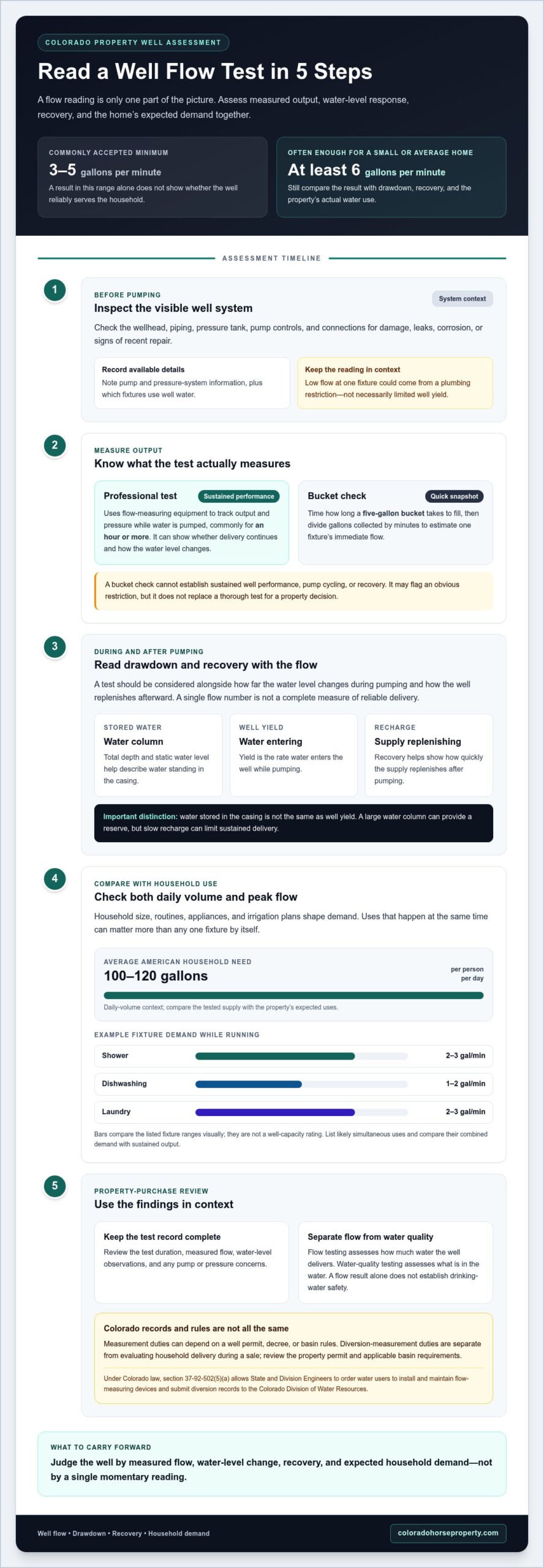
A well producing 3 to 5 gallons per minute meets the commonly accepted minimum for a residential well, but that figure alone doesn’t show whether it can reliably serve a household. For what to look for in a well flow rate test in Colorado, focus on the measured flow, how the water level changes during pumping, and how well the well recovers. A flow rate of at least 6 gallons per minute is usually enough for a small or average home.
A strong result matters when you’re weighing a property purchase: the well needs to support everyday water use, not just show a promising reading at one moment. Learn how flow and drawdown tests work, what the results can reveal about household supply, and how to assess them against the property’s needs. You’ll also see how to use the findings during the purchase process, so you can evaluate the water system alongside the land, access, and other essentials.
Key Takeaways
- Read a flow-test result alongside drawdown and recovery, not as a single momentary reading.
- Separate water quality from well yield: one concerns what’s in the water, the other how much the well can deliver.
- Compare the tested supply with the property’s household needs and planned water use.
- Use test findings during the purchase process to understand the well system before closing.
- A bucket check can offer a rough snapshot, while professional testing assesses sustained performance and pump operation.
What Is Well Flow Testing?
A well flow test measures how much water a well delivers over time and how its water level responds to pumping. When buying a property, the result helps you judge whether the system can meet the home’s everyday needs and supply its appliances.
Pretest Well System Inspection
Before running the pump, inspect the visible system. Check the wellhead, piping, pressure tank, pump controls, and connections for damage, leaks, corrosion, or signs of recent repair. Note which fixtures use well water, since household demand helps put the test results in context.
Record the pump and pressure-system details available at the property, then ask how the test will measure performance. A flow reading without context about the system can be hard to interpret. For example, a low reading at a fixture could indicate a plumbing restriction rather than limited well yield.
Professional Testing and DIY Checks
A professional test uses flow-measuring equipment to track output and pressure while water is pumped, commonly for an hour or more. It can show whether the well sustains delivery and how the water level changes. A five-gallon bucket and stopwatch offer a basic check: time how long it takes to fill, then divide the gallons collected by the minutes.
That DIY check measures one fixture’s immediate flow, not sustained well performance, pump cycling, or recovery. It can flag an obvious restriction, but it can’t replace a thorough test for a real estate decision. The price of a private well flow test depends on its scope, equipment, site access, and reporting needs; the quote is provided after a quote request.
Seller Testing Considerations
For sellers, testing before listing can document system performance and surface issues while there’s time to investigate. Keep the written results with the property records, including the test duration, measured flow, water-level observations, and any noted pump or pressure concerns.
Share the report during negotiations, and distinguish flow results from water-quality results. Flow testing assesses how much water the well delivers; water-quality testing assesses what is in it. A flow result alone doesn’t establish that the water is safe to drink, so buyers should review both types of information.
Colorado and County Requirements
For a household purchase, don’t assume a county requires one standard flow-test method. Colorado measurement duties can depend on a well permit, decree, or basin rules. Under Colorado law, section 37-92-502(5)(a) allows State and Division Engineers to order water users to install and maintain flow-measuring devices and submit diversion records to the Colorado Division of Water Resources.
Diversion-measurement duties are separate from evaluating a household well’s delivery during a sale. Regional rules vary, so review the property’s permit and applicable basin requirements when assessing legal water use. If you’re researching what to look for in a well flow rate test in Colorado, keep the transaction report separate from diversion records and understand what each document measures.
Private well yield and reliable household water delivery
Yield describes the water a well can supply; reliable delivery also depends on storage, pump performance, and household demand. To assess whether supply is adequate, compare measured output and recovery with the property’s expected uses.
Well Depth and Static Water Level
Total depth, static water level, and casing diameter help describe the water stored inside a well. Static water level is the water’s resting level before pumping. Subtract it from the total well depth to estimate the height of the water column, then use the casing diameter to estimate the volume in that column.
If you don’t have a water-level sounder, use existing well records for depth and static-level measurements. Treat those figures as context, not proof of current production. A bucket-and-stopwatch check can estimate flow at one fixture, but it can’t show how far the water level drops during pumping.
Yield, Recharge, and Water Capacity
Stored water and well yield are not the same. Water capacity estimates the volume standing in the casing; yield reflects the rate at which water enters the well while pumping. Recharge describes how quickly that supply replenishes. A well reaches its true yield when incoming water matches the amount pumped out.
Compare these measures in the test results. A large water column can provide a reserve, but slow recharge can limit sustained delivery. A modest stored volume, on the other hand, may support use if recharge keeps pace. Without a water-level reading, records and a fixture-flow estimate can’t establish the well’s recovery rate.
Household Demand and Simultaneous Uses
Daily volume matters, but peak water flow matters too. An average American household needs 100 to 120 gallons per person per day. Simultaneous uses can set the practical demand: showering requires 2 to 3 gallons per minute, dishwashing 1 to 2, and laundry 2 to 3.
List the appliances and fixtures likely to run at the same time, then compare their combined demand with the well’s sustained output. For example, a shower and washing machine operating together draw more water than either use alone. Household size, routines, and irrigation plans also affect whether delivery is adequate.
Factors Affecting Colorado Well Flow
Drought and seasonal demand can affect groundwater levels and recharge, so a test reflects conditions at a particular time and place. Elevation affects the lift needed to bring water to the surface. Local geology matters too, because water-bearing formations vary in how readily they store and transmit groundwater.
For a Colorado property, interpret the result alongside the water level, well construction records, and intended use. A reading taken in one season may not represent demand or recharge in another. Compare the test conditions with the household’s expected peak use before deciding whether supply is sufficient.
As you compare properties, Colorado acreage listings can help you assess land alongside its well records.
What Is a Good Well Flow Rate?
A suitable rate depends on the home’s peak demand, not just its average daily use. In Colorado, compare the test result with household needs and the uses authorized by the well permit.
Matching Capacity to Water Demand
Start with the well’s sustained output, then list the fixtures and appliances likely to run together. A rate that serves one shower may not also support laundry or dishwashing at the same time. The property’s intended use matters too, especially if water demand extends beyond indoor household use.
Pressure tanks store water and help maintain pressure between pump cycles. They can manage brief periods of higher demand, but they don’t increase the well’s recharge. Monitor pressure and pump cycling during testing: falling pressure or frequent cycling can help explain inadequate delivery.
Recommended Household Flow Rate
The accepted minimum flow-rate standard for residential wells is 3 to 5 gallons per minute (GPM). An average American household may need about 6 to 12 GPM, while at least 6 GPM is usually enough for a small or average home.
These figures are useful benchmarks, not a substitute for matching supply to actual use. A small household that staggers water use may need less peak flow than a home running several fixtures together. Consider sustained results, pressure, and drawdown rather than judging by a brief reading alone.
Calculating Household Flow Needs
Estimate peak demand by adding the flow needs of appliances and fixtures that may operate at once. One planning method allows 1 GPM for each appliance. For a small home with one bathroom, the example calculation is 8 GPM.
Use that estimate as a comparison with the well’s tested output. Showering uses 2 to 3 GPM, dishwashing uses 1 to 2 GPM, and laundry uses 2 to 3 GPM. If those activities overlap, their combined demand can exceed any one fixture’s flow. List likely simultaneous uses before interpreting the test.
Test Results and Authorized Uses
A flow test measures physical delivery; it doesn’t grant water-use rights or expand a permit. Compare the result with the well permit’s authorized uses and any applicable decree or rules. In Colorado, permits or rules may require diversion measurement and data submission.
For example, a strong household flow result does not by itself authorize irrigation or other uses. Read the permit’s stated uses alongside the test report, and distinguish measured capacity from legal authorization. If the property relies on a pump, review its measured output and pressure together with the permit documents.
Flow meters and pump drawdown tests
Flow meters measure a well’s water output, while a drawdown test tracks the water level during pumping. A useful report connects gallons per minute with pressure, water-level change, and recovery.
A Colorado well yield test should run for an hour or more to assess sustained production. The report should record the test period, measured flow, pressure, and water-level readings as pumping continues.
Pump Cycling and Performance
During testing, observe whether the pump starts and stops repeatedly as water is drawn. The report can show whether output remains steady or changes during the test. Frequent cycling alongside pressure changes may help explain inconsistent delivery at household fixtures.
Flow meters measure water moving through the system, while drawdown readings show how the well responds. Read these measures together. A strong initial flow that falls as the water level drops is different from steady output sustained through the test.
Also note whether the pump produces water consistently as testing continues. A single reading captures one moment; a sequence of flow and water-level measurements shows how performance changes under ongoing demand.
Pump Performance and Strain
Steady, adequate flow helps maintain water pressure and avoid pump strain. A test can reveal low output, declining water levels, or pump inefficiencies. These findings help distinguish limited well supply from a pump or system performance issue.
Compare recorded flow with pressure and drawdown at the same points in the test. If pressure drops while the pump runs, those combined readings provide more context than gallons per minute alone. The test can also note potential obstructions affecting water movement.
For a property buyer, the key question is whether the system keeps producing water as demand continues. A report showing changes in flow, pressure, or water level gives a clearer picture of performance than a fixture check alone.
Test Duration and Report Measurements
Testing for an hour or more allows time to monitor sustained flow and drawdown rather than a brief burst. Professional tests use specialized equipment to measure pressure and flow. A bucket check measures one fixture’s immediate output, not the whole well’s recovery.
Look for measured flow in gallons per minute, the test duration, and water-level readings taken as pumping continues. The report should make clear whether output remained steady, declined, or changed alongside pressure. These details help assess how the water source responds over time.
Useful context can include well depth, recharge observations, and potential obstructions. A drawdown test assesses yield by measuring pumped water while monitoring the falling water level inside the casing. The well’s true yield occurs when incoming water matches the amount pumped out.
Using test results during a property purchase
For a buyer, a well report is a decision tool, not just a pass-or-fail number. Schedule flow testing during the inspection contingency period, after the offer is accepted and before you’re fully committed to closing. This timing leaves room to understand the result and address concerns while purchase terms are still being resolved.
Many lenders, especially those financing FHA and USDA loans, require a well flow test as a financing condition. Include the test in your inspection planning and keep the report with the property’s other due-diligence records. A lender’s condition and your assessment of household demand are separate considerations, so compare measured delivery with the home’s planned use.
Read the report as a set of connected measurements. Sustained flow, drawdown, water-level recovery, pressure, and test duration each reveal a different part of well performance. Check whether recorded output stays steady or declines during pumping. Note visible sediment, but don’t treat it as a flow measurement; water-quality testing addresses what is in the water.
- Compare sustained flow with the household’s likely simultaneous uses.
- Review drawdown and recovery alongside the reported output.
- Record pump, pressure, or plumbing concerns noted during inspection.
- Keep water-quality findings separate from flow-test results.
A low result calls for diagnosis before you settle on a remedy. Possible causes include a worn or incorrectly sized pump, slow recharge, mineral buildup in pipes, a faulty pressure tank, or system leaks. Drought-like conditions can also affect supply. An experienced assessment of the test details can help distinguish a well-yield issue from a pump or plumbing problem.
If the well does not meet the property’s needs, buyers can negotiate the price, request seller remediation, or consider a storage tank. The right approach depends on the test results and how the system serves the home. A pump issue, for example, differs from slow recharge, and each affects the practical value of a proposed repair.
Before closing, organize the test report, permit information, and any repair records. Use those documents to clarify which concerns affect water delivery and which affect authorized uses. If you’re comparing rural listings, explore Colorado property listings with the well’s test results in mind.
Colorado Horse Property: AI-Powered Horse Property Search
Colorado Horse Property helps buyers search for equestrian properties with features that match their plans. Its AI-Powered Horse Property Search can narrow listings by details such as barns, arenas, water rights, and pasture sizes. Consider well-flow results alongside those property features to assess whether a rural home suits your intended use.
Buyer Representation supports your property search and purchase decisions, while Transaction Management helps coordinate the transaction process. These services can help as you compare acreage, review property details, and move toward a purchase after well testing.
Contact Colorado Horse Property to discuss your Colorado property search.
Choose a Property That Fits Your Plans
A well report is one part of deciding whether a Colorado property suits the life you want to build there. Use the findings to define what matters most: the land, the facilities, and how the property supports your plans over time. Knowing what to look for in a well flow rate test in Colorado can help you assess the water system and its place in your daily routine.
Bring those priorities into your property search. Colorado Horse Property offers AI-Powered Horse Property Search, Real Estate Listing Services, and Buyer Representation for people looking for Colorado equestrian properties. Matching your land and facility needs with the property details can help focus your next steps.
Contact Colorado Horse Property to discuss your search and move toward a property that fits your goals.
Frequently Asked Questions
How Many Gallons Per Minute Does a House Need?
About 6 to 12 gallons per minute is a useful household benchmark, and at least 6 GPM is usually enough for a small or average home. The accepted minimum for residential wells is 3 to 5 GPM. Compare the tested supply with the fixtures likely to run together. A household that often showers while running laundry needs to consider peak demand, not just daily water use.
What is a well flow rate test in Colorado and what does it measure?
A flow test measures how much water a well produces during pumping and tracks how the well responds. A flow meter records output, while drawdown readings show changes in the water level inside the casing. Look for results recorded across the test period, not just a single flow reading. The test measures delivery; a separate water-quality test evaluates what’s in the water.
Who is qualified to perform a well yield test in Colorado?
For a property purchase, choose a professional who can measure flow and pressure and record drawdown during pumping. Colorado has specific certification provisions for testers checking flow-meter accuracy or determining the Power Conversion Coefficient as an alternative measurement method. Those provisions concern these measurement tasks; they don’t mean every household yield test uses the same method. Review the report’s measurements and test description.
What are warning signs of a failing or low-yield well during a flow test?
Watch for low measured flow, a declining water level, or pump inefficiency during testing. Frequent pump cycling or changing pressure can add useful context, though one symptom alone doesn’t identify the cause. Worn or incorrectly sized pumps, slow recharge, mineral buildup in pipes, faulty pressure tanks, and system leaks can contribute to low delivery. Compare these observations with the full report before judging performance.
What should homeowners do before and after a Colorado well flow rate test?
Before testing, gather well construction records, permit documents, and notes about the property’s usual water use. For a purchase, arrange testing during the inspection contingency period, after offer acceptance and before you’re fully committed to closing. Afterward, keep the written results with the property records and compare the findings with expected use. If results are low, possible responses include adjusting the pump, adding a storage tank, or deepening the well.