
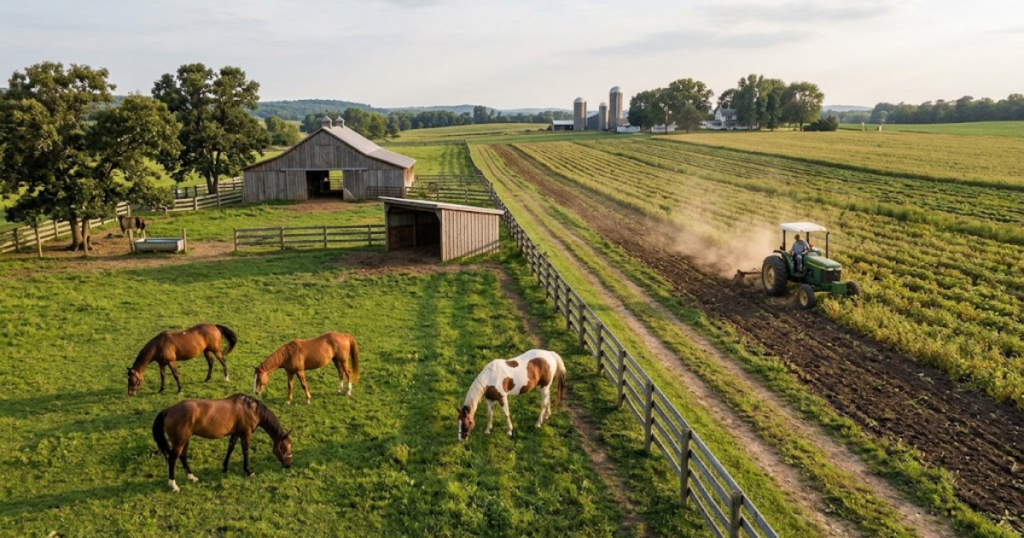
You bought a thirty-five-acre parcel on the Colorado plains or in the Front Range foothills. You have five acres dedicated to your primary residence, your three-stall barn, your outdoor riding arena, and a couple of turnouts for your horses. Looking out across the remaining thirty acres of rolling native grass or dryland hayfields, you realize an uncomfortable truth.
Managing large acreage is exhausting, expensive, and time-consuming.
Weeds spread rapidly, tractor implements break down, fuel costs climb, and property taxes on residential acreage can be financially devastating. You do not have the time, the machinery, or the desire to become a full-time hay producer or cattle operator. At the same time, you cannot afford to leave thirty acres completely unmanaged.
The logical solution for many equestrian landowners is leasing that surplus dirt to a local farmer or cattle rancher. When executed correctly, a farm lease creates a mutually beneficial relationship. The tenant farmer gains access to productive soil, while you generate passive rental income, receive free pasture maintenance, and satisfy the state requirements for agricultural tax valuation.
However, mixing commercial agriculture with private horse ownership comes with serious operational hazards. Horses are delicate, highly sensitive animals with fragile digestive systems and flight-oriented survival instincts. Modern farming, by contrast, relies on massive combines, chemical applications, and heavy equipment.
If you want to rent out land to farmers while keeping your horses safe, legal, and stress-free, you must establish clear physical boundaries, detailed operational protocols, and an ironclad lease agreement. Here is a comprehensive guide to renting out land to farmers while keeping horses on your Colorado property.
How to Rent Out Land to Farmers While Keeping Horses
Quick Summary: Balancing Agricultural Leases and Equine Safety
- The Agricultural Tax Incentive: Leasing surplus acreage to a commercial farmer or rancher is the most effective legal method to secure Colorado agricultural property tax classification, which can slash your annual tax burden by thousands of dollars.
- The Chemical and Spray Buffer: Farmers frequently apply synthetic fertilizers, pre-emergent herbicides, and pesticides to cash crops. You must establish strict, legally binding buffer zones and notification protocols to prevent deadly toxicity in your horses.
- The Ionophore Danger: If you lease land to a cattle rancher, explicitly ban cattle feed supplements containing monensin or lasalocid, as these livestock additives are instantly lethal to horses, even in microscopic doses.
- Water Infrastructure Division: Clarify who controls headgates, who maintains irrigation lateral ditches, and ensure agricultural irrigation never jeopardizes your domestic and livestock well water.
- The Written Lease Mandate: Never rely on a handshake agreement. Your lease must address gate protocols, fence maintenance liability, hunting rights, commercial insurance, and the Colorado Equine Activity Liability Act.
1. Agricultural Taxes and Land Maintenance
Before drafting an agreement, you must define your primary objective for leasing the land. Most equestrian property owners pursue farm leases for two specific reasons.
Securing Colorado Agricultural Property Tax Classification
In Colorado, property taxes on vacant residential land or luxury acreage are calculated using a high assessment rate. However, land classified as Agricultural is assessed at a fraction of that rate, based strictly on the soil's productive earning capacity rather than its speculative market value.
Securing agricultural status can save a landowner thousands, or even tens of thousands, of dollars every single year.
The trap is that simply owning horses for personal pleasure does not qualify your land for agricultural classification under Colorado law. The Colorado Constitution and county assessors require proof that the land is being used with the primary intent of obtaining a monetary profit from production agriculture.
To qualify, the land must typically have been actively used for commercial farming, such as harvesting hay, or commercial livestock grazing for the previous two consecutive years.
By executing a legitimate cash-rent or crop-share lease with a commercial farmer or rancher who files agricultural tax schedules, you provide your county assessor with the required documentation to maintain or establish agricultural valuation on your surplus acreage.
Barter Agreements and Free Pasture Maintenance
Not every lease involves direct cash payments. Many equestrian landowners enter into barter arrangements with neighboring hay producers.
In exchange for leasing twenty or thirty acres to a custom hay operator, the farmer handles all the mowing, fertilizing, weed spraying, and baling.
In return, the landowner receives a negotiated percentage of the harvest, such as two hundred small square bales of clean grass hay delivered directly into the barn loft.
This barter arrangement eliminates your annual feed bill while outsourcing the brutal physical labor of land management to someone who already owns the specialized tractors and implements.
2. Physical Separation, Buffer Zones, and Safe Fencing
You cannot simply open a gate between your horses and a commercial farming operation. The daily activities of crop production and livestock management create immediate hazards for equines.
Double-Fencing and Boundary Buffers
If you lease your back acreage for row crops, such as corn, barley, or sorghum, you must construct a permanent physical barrier between your equestrian facilities and the leased fields.
Never rely on a single fence line shared between a horse pasture and an agricultural crop. Horses will lean over fences to graze on sweet, high-starch crops, which can trigger severe grain overload, carbohydrate-induced laminitis, and fatal colic.
The standard protocol is creating an alleyway or buffer zone between the two areas. By installing two parallel fence lines separated by fifteen to twenty feet, you create a dedicated equipment access road for the farmer while ensuring your horses can never make physical contact with farm machinery, chemical sprayers, or the crop itself.
The Cattle Grazing Distinction and Fencing Styles
If you choose to lease your land to a cattle rancher rather than a crop farmer, fencing becomes your most critical legal and safety issue.
Cattle and horses have completely different containment requirements. Cattle ranchers rely heavily on four-strand or five-strand barbed wire. For cattle, barbed wire is cost-effective and functional. For horses, barbed wire is a catastrophic danger that leads to severed tendons and fatal lacerations.
Your lease must explicitly state which party is responsible for fence installation and boundary maintenance.
If a tenant runs cattle on your back pastures, you must enforce horse-safe fencing, such as high-tensile coated wire, pipe rail, or smooth wire with an offset electric line, along any shared borders.
Cattle are notorious for rubbing against posts and breaking gates. The lease must dictate that the agricultural tenant is liable for immediately repairing any breaches to keep their livestock from wandering into your horse paddocks or riding areas.
3. Pesticides, Herbicides, and Fertilizer
Commercial crop farming is rarely organic. Farmers routinely apply pre-emergent herbicides to eradicate weeds, synthetic nitrogen fertilizers to boost yields, and chemical pesticides to eliminate crop-destroying insects.
Equine Toxicity and Ingestion Risks
While modern agricultural chemicals are designed to break down rapidly in the soil, many compounds are acutely toxic to horses if ingested wet or inhaled as an airborne mist.
Exposure to certain organophosphate insecticides or concentrated weed killers can cause neurological distress, respiratory failure, organ damage, and spontaneous abortions in pregnant mares.
Furthermore, synthetic fertilizers with high nitrate concentrations pose a major poisoning risk if a curious horse licks a spilled bag or drinks from an irrigation puddle where granular fertilizer has concentrated.
Mandatory Notification and Drift Protocols
Your lease agreement must include strict chemical-application covenants that protect your horses.
Mandatory Advance Notice
The tenant farmer must be legally required to provide written or verbal notice at least forty-eight to seventy-two hours before applying any chemical spray, fertilizer, or pesticide to the leased acreage.
This notice window gives you adequate time to move your horses from outdoor paddocks into fully enclosed barn stalls.
Wind and Drift Limitations
The lease must prohibit chemical spraying when wind speeds exceed a specific threshold, typically five to eight miles per hour, or when winds blow directly toward your barn, residence, or horse pastures.
Safe Re-Entry Intervals
The tenant must provide the exact Safety Data Sheets for every product applied.
The lease must establish a mandatory withholding period, dictating that horses cannot access shared boundary fence lines until the chemicals have completely dried or been incorporated by rainfall.
4. The Deadliest Danger: Feed Additives and Ionophores
If you lease your land for cattle grazing or winter backgrounding, an invisible, lethal threat awaits every equestrian landowner who does not understand it.
The Fatality of Monensin
Commercial cattle operations frequently blend ionophores, most commonly sold under the brand name Rumensin (monensin) or Bovatec (lasalocid), into cattle feed and mineral tubs.
Ionophores alter the rumen fermentation process in cattle, dramatically improving feed efficiency, preventing bloat, and accelerating weight gain. In ruminant animals with multi-chambered stomachs, these compounds are safe.
In monogastric animals like horses, however, ionophores are violently and irreversibly toxic.
A microscopic dose of monensin, equivalent to just a few milligrams, will destroy a horse's myocardial heart muscle cells. Ingestion leads to acute cardiac failure, kidney damage, muscular degeneration, and sudden death.
Horses that survive low-level exposure are typically left with permanent, irreversible heart damage that ends their athletic careers and shortens their lifespans.
The Strict Prohibition Covenant
If your tenant brings cattle onto your acreage, your lease must contain an explicit, zero-tolerance prohibition against feeding ionophores on the property.
The agreement must state that all loose mineral mixes, protein tubs, creep feeds, and supplemental pellets brought onto the land must be certified completely free of monensin, lasalocid, and any related feed additives.
If the tenant uses communal supplement tubs, they must be inspected regularly, and the tenant must assume total financial and legal liability for the full value of your horses if cross-contamination occurs.
5. Water Rights and Irrigation Choreography
Water is the lifeblood of Colorado agriculture, and sharing a property means sharing or segregating the water systems.
Ditch Shares and Lateral Canal Management
If the acreage you are leasing includes irrigated hayfields or pastures watered through ditch company shares, you must delineate operational responsibilities.
Who Sets the Water
Changing water on flood-irrigated fields requires hours of manual labor, adjusting canvas dams, setting siphon tubes, and managing headgates.
Your lease must clarify whether the tenant farmer is solely responsible for ditch maintenance and water distribution.
Infrastructure Maintenance
Mutual ditch companies charge annual assessments, and lateral ditches frequently choke with silt and weeds.
The lease must specify who pays the ditch assessments and who is responsible for hiring the backhoe to clean the lateral ditches each spring.
Mud and Hoof Damage
Irrigating a field immediately adjacent to a horse turnout can cause water to seep through the subsoil and create deep mud.
You must coordinate irrigation schedules to ensure field flooding does not swamp your sacrifice lots or undermine the footing in your riding arena.
Protecting Your Well Permit
Under Colorado water law, agricultural irrigation cannot be powered by a standard residential well.
If your tenant needs water for cattle or equipment, you must ensure they do not pull from a well classified as "Household Use Only." Doing so violates state water decrees and puts your domestic water supply at risk of administrative shutoff.
If the tenant is grazing livestock, they must pull water strictly from an adjudicated agricultural well or a valid Domestic and Livestock well permit.
6. Heavy Machinery and Access Routes
A commercial farm is an industrial work zone. Harvesters, disc harrows, swathers, and balers are massive, noisy machines that generate significant ground vibration and dust.
Combating the Spook Factor
Horses are prey animals that instinctively flee from loud, unfamiliar noises and towering, moving objects.
A twenty-foot-wide combine harvester cutting sudangrass along your pasture fence line at sunrise will terrify unprepared horses, potentially causing them to run through fences or slip on icy ground.
Your lease should require the farmer to communicate their operational calendar. Knowing when the farmer plans to disc, plant, spray, and cut hay allows you to proactively adjust your turnout schedule, keeping sensitive horses safely indoors while heavy equipment operates nearby.
Designated Ingress and Egress Routes
Never share your primary residential driveway with a tenant farmer if you can avoid it.
Heavy semi-trucks loaded with sixty thousand pounds of round bales, dual-wheel tractors, and manure spreaders will quickly destroy standard asphalt driveways, crush culverts, and crack concrete curbs.
Your property should feature a dedicated agricultural gate and a hard-packed gravel access road leading directly from the county road to the leased fields.
The lease must explicitly restrict the farmer's equipment to this designated agricultural corridor, preventing heavy machinery from parking on your septic leach field, blocking your horse trailer turnaround circle, or tearing up your private lane.
Gate Discipline Protocols
The golden rule of rural property management is simple: leave every gate exactly as you found it.
If a farmer passes through an interior pasture gate to access a back field, they must close and latch it immediately behind them.
An open gate left unattended for five minutes is all it takes for a valuable horse to escape onto a busy county highway.
Your lease should include strict financial penalties for gate negligence, mandating that all shared access gates remain securely closed and latched at all times.
7. Key Elements of a Bulletproof Agricultural Lease
Handshake agreements with local farmers are a time-honored rural tradition, but they are a massive legal trap in modern real estate.
If a dispute arises over pasture damage, an injured horse, or an unpaid tax bill, an oral agreement offers zero legal protection.
You must execute a comprehensive, written agricultural lease prepared by an attorney who understands Colorado land and equine law. Your lease should incorporate the following vital clauses.
Legal Description and Permitted Use
Clearly define the exact boundaries of the leased acreage, excluding your personal residence, barn, arenas, and paddocks.
Explicitly state the permitted agricultural activity, whether it is dryland grass hay production, rotational cattle grazing, or small-grain farming.
Prohibit unauthorized activities, such as commercial hunting or public equipment storage.
Term and Termination Rights
Avoid indefinite multi-year leases without review periods.
Use a standard one-year lease with an automatic renewal clause, provided neither party delivers written notice of termination within sixty or ninety days of the expiration date.
Include an immediate termination clause if the tenant violates equine safety rules, leaves gates open, or introduces hazardous chemicals.
Rent Structure
Specify whether rent is paid as a fixed cash rate per acre, a percentage of gross crop sales, or a barter agreement for animal feed.
Establish clear payment deadlines and late penalties.
Insurance and Indemnification
The tenant farmer must carry a commercial general liability policy with minimum limits of $1 million to $2 million per occurrence.
The policy must name you, the landowner, as an additional insured party. The tenant must deliver an active Certificate of Insurance before moving a single tractor onto your property.
The lease must also include a strong indemnification clause that holds you harmless from injuries, crop failures, or equipment damage occurring on the leased ground.
Colorado Equine Activity Liability Compliance
In Colorado, livestock operations are governed by the Equine Activity Liability Act (C.R.S. § 13-21-119).
Your lease must reference this statute and explicitly warn the tenant that horses are unpredictable and that the landowner is not liable for injuries resulting from the inherent risks of equine activities or domestic animal behavior.
We Structure Functional Colorado Rural Properties
Managing acreage does not have to be an all-or-nothing proposition. You can enjoy the peace and beauty of the equestrian lifestyle while putting your surplus land to work.
When Mark Eibner's team represents you, we evaluate the property's full agricultural potential. We help you analyze soil carrying capacity, review county zoning regulations, verify agricultural tax status requirements, and design property layouts that separate commercial farming from private equestrian operations.
We ensure that your real estate investment is legally sound, financially efficient, and completely safe for your herd.
Contact us today at coloradohorseproperty.com to find premium horse properties Colorado buyers trust.
Browse active Colorado horse ranches for sale or ask our team about finding a functional horse property for rent in Colorado while you plan your rural acreage investment.
Frequently Asked Questions (FAQ) About Renting Land to Farmers
Can leasing my land to a farmer jeopardize my agricultural tax status?
No. In fact, it is usually the primary way to protect it. County assessors do not care whether the landowner or a third-party tenant is performing the physical agricultural work. As long as the land is actively used for commercial farming or livestock production with the intent to obtain a profit, and you can provide a copy of the written lease to the assessor, the property will meet the operational requirements for agricultural classification.
How much can I charge per acre for pasture or hay ground in Colorado?
Rental rates vary widely depending on the region, soil quality, and water availability. Dryland pasture on the eastern plains might only command fifteen to thirty dollars per acre annually. In contrast, highly productive, flood-irrigated alfalfa or orchard grass ground along the northern Front Range can command one hundred and fifty to three hundred dollars per acre. Consult with local agricultural extension agents to determine current county market rates.
Can a farmer's cattle make my horses sick?
Generally, cattle and horses are excellent complementary grazing partners because they do not share the same internal parasites. Cattle can help break the equine strongyle life cycle. However, biosecurity risks do exist. Bovine viral diarrhea, Salmonella, and contaminated water troughs can cause issues. The biggest medical danger is feed contamination from ionophores like Rumensin, which must be strictly banned.
What happens if a tenant farmer's tractor damages my horse fencing?
Your written lease agreement must contain a specific property-damage clause. The clause should mandate that structural damage to fences, automatic waterers, roads, or irrigation gates caused by the tenant or their equipment must be repaired to professional standards at the tenant's sole expense within a specific timeframe, typically within forty-eight hours of notification.
Do I have to let the farmer hunt on my property?
Absolutely not. An agricultural lease conveys only the right to produce crops or graze livestock. Include a specific reservation-of-rights clause stating that all recreational, hunting, and fishing rights remain exclusively with the landowner, and strictly prohibit the tenant or their associates from discharging firearms on the property.