
What if your search for a “ranch home” is actually a search for two entirely different lifestyles that rarely meet on a standard real estate app? In Colorado, most generic listing sites confuse architectural style with agricultural utility, leaving buyers to sift through suburban houses that don’t have a single blade of grass for a horse. Finding Colorado ranch homes with acreage for sale requires a specialized strategy that accounts for both the floor plan and the dirt beneath it. You likely already know that the market is shifting toward a more balanced state in 2026, yet the competition for turnkey equestrian properties remains fierce.
We’re here to help you bridge that gap. This guide provides the technical expertise you need to find a single-level home that ensures long-term accessibility without sacrificing the 5 to 35 acres required for your horses. We’ll break down the 2026 property tax assessment rates, explain the critical impact of new water rights legislation like HB26-1340, and clarify how to navigate local zoning for barns and arenas. By the end of this article, you’ll have a clear roadmap to secure a property that functions as both a comfortable residence and a high-country equestrian sanctuary.
Key Takeaways
- Learn the critical distinction between architectural ranch styles and functional working ranches to ensure your property meets your specific land-use goals.
- Discover how to find Colorado ranch homes with acreage for sale that include essential equestrian infrastructure like cross-fencing and proper arena footing.
- Understand why standard home inspections are insufficient for rural estates and how to navigate a specialized closing timeline for 2026.
- Evaluate property topography and pasture health to determine if a site can support your livestock long-term.
- Leverage AI-powered search technology to filter for niche requirements like senior water rights and existing loafing sheds that generic platforms overlook.
The Appeal of Colorado Ranch Homes with Acreage for Sale in 2026
Colorado’s vast horizons and rugged terrain demand a home that works with the land, not against it. In 2026, the demand for Colorado ranch homes with acreage for sale remains high because buyers recognize that these properties offer a rare combination of architectural accessibility and functional land use. The classic Ranch-style house has matured into a sophisticated estate model that serves as the essential bridge between luxury living and the equestrian lifestyle. These homes hold their value better than multi-story suburban counterparts because they cater to a wider demographic of buyers who prioritize long-term utility and expansive space.
To visualize how these architectural elements come together on a premier Colorado estate, watch this tour of a high-end equestrian property:
Why Single-Story Living Dominates the Front Range
Experienced owners on the Front Range prioritize longevity. Single-story living isn’t just about convenience; it’s a strategic move for aging-in-place. When you’re managing 20 or 30 acres and a herd of horses, you don’t want to navigate stairs at the end of a long day in the saddle. Structurally, the low profile of a ranch home is ideal for maximizing panoramic views of the Rocky Mountains. Modern engineering in 2026 also makes these single-level homes more energy-efficient. By utilizing improved thermal mass and advanced insulation techniques, these homes maintain consistent temperatures more effectively than multi-level structures during Colorado’s intense seasonal shifts.
Modern vs. Classic: Ranch Architecture in 2026
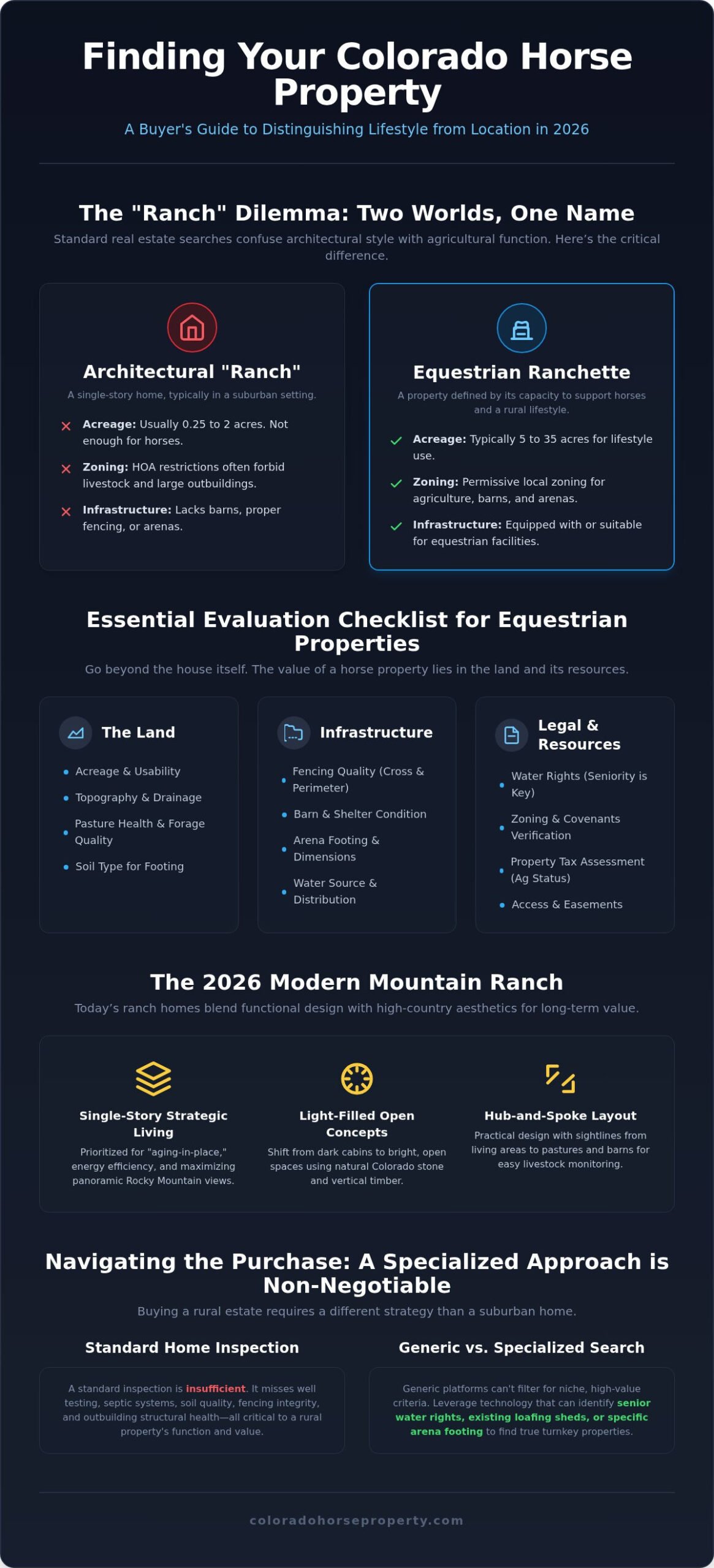
The 2026 “Modern Mountain Ranch” aesthetic moves away from the dark, heavy cabin styles of the past toward light-filled, open-concept spaces. We’re seeing a shift toward using natural Colorado stone and vertical timber accents that blend the structure into the local terrain. The most successful designs prioritize a seamless flow between the interior and the equestrian facilities. This means the layout often features a “hub-and-spoke” design where the kitchen and living areas act as a central point, providing clear sightlines to the pastures and barns. It’s a practical approach that recognizes the horse owner’s need to monitor livestock while enjoying the comforts of home. Finding Colorado ranch homes with acreage for sale that successfully integrate these 2026 design trends ensures both lifestyle satisfaction and long-term equity.
Architectural Ranch vs. Working Ranch: Defining Your Goals
In the Colorado real estate market, the word “ranch” is often used as a catch-all term, but it describes two very different assets. For some, it refers to an architectural style: a single-story home with a low-to-the-ground profile, often called a rambler or a California ranch. For others, it signifies a specific land use involving livestock, production, or equestrian activities. A Colorado ranchette is a property under 40 acres focused on lifestyle over production. Understanding these distinctions is the first step in narrowing your search for Colorado ranch homes with acreage for sale, as the search filters for a “ranch house” will yield thousands of suburban results that may not allow even a single horse.
A working ranch in 2026 is defined by its ability to generate income or support significant livestock through agricultural production. These properties usually exceed 100 acres and involve complex water rights and grazing leases. While the home on these properties might be a ranch-style structure, the value is primarily in the land’s output and resource priority.
The Suburban Ranch House
Many listings for ranch homes are located in master-planned communities with strict HOA restrictions. These properties typically sit on lots ranging from 0.25 to 2 acres. While they offer the desired single-story floor plan, they often lack the zoning required for outbuildings or large animals. If your goal is to have horses, these suburban options will almost always fall short due to restrictive covenants that forbid loafing sheds, trailers, or the noise associated with animal husbandry.
The Equestrian Ranch Property
True equestrian properties require a deeper look at county-specific zoning. Most Colorado counties, such as El Paso or Douglas, have minimum acreage requirements to keep horses, often starting at 2.5 to 5 acres. When searching for Colorado ranch homes with acreage for sale, you must distinguish between Residential-Agricultural (RA) and Agricultural (A) zoning; the latter often provides more flexibility for commercial equestrian use. Proper Equine Management requires specific infrastructure like tack rooms, hay storage, and arenas with proper drainage. When evaluating these properties, the presence of existing outbuildings can save you thousands in construction costs and permitting headaches. Our specialized horse property search allows you to filter specifically for these functional land traits.
Key Features to Evaluate in Colorado Equestrian Ranch Homes
Evaluating Colorado ranch homes with acreage for sale requires shifting your focus from the master suite to the perimeter fence. While the house provides your comfort, the land’s infrastructure dictates your horse’s health and your daily workload. You must look for properties that offer more than just a scenic backdrop. Seasoned owners know that a beautiful view doesn’t compensate for a poorly drained pasture or a barn that faces the wrong direction for winter winds.
Topography is a primary concern. While flat pastures seem ideal for grazing, they often suffer from poor drainage during the spring thaw. A slight grade is actually preferable to keep hooves dry and prevent pasture rot. If you’re looking in the foothills, ensure the sloped terrain includes enough level ground for safely turning out livestock. A high-quality riding arena requires specific footing and drainage to remain functional year-round. Without professional-grade sand or rubber mixtures and a sub-surface drainage system, a Colorado arena can quickly become a mud pit or a frozen tundra during the shoulder seasons.
Infrastructure evaluation should prioritize protection from the elements. Loafing sheds are mandatory in the high country to provide shelter from sudden hail or driving snow. Ensure these structures are positioned with a southern exposure to maximize sun and block the prevailing north winds. When inspecting barns, check for ventilated hay storage to prevent mold and fire hazards, and look for existing cross-fencing that allows for rotational grazing to preserve the health of your Colorado soil.
The Critical Importance of Colorado Water Rights
In the Rockies, land is only as valuable as the water that serves it. Understanding Colorado Water Rights is essential because the state follows the “first in time, first in right” principle. Senior water rights take priority during drought years, which are common in the Arkansas River Basin. If the property relies on a well, verify if the permit is for “domestic use only” or if it allows for “livestock watering.” New legislation, such as HB26-1340, now requires land owners in certain divisions to revegetate if they transfer agricultural water rights to other uses. You don’t want to find yourself with 20 acres and no legal way to hydrate your herd.
Zoning and Land Use Regulations
Don’t assume that ten acres automatically allows for ten horses. County-specific regulations often define “animal units” per acre based on soil type and vegetation density. For example, some areas might allow two horses on the first five acres and one for every additional two acres. You should also look for conservation easements that might restrict your ability to build additional outbuildings or subdivide the land in the future. Finally, check for existing access easements. In rural Colorado, it’s common for neighbors to have legal rights to use irrigation ditches or access roads that cut through your acreage. Finding Colorado ranch homes with acreage for sale that already have favorable zoning and clear titles is the only way to ensure your long-term peace of mind.
Navigating the Purchase of a Ranch Style Home on Acreage
Standard home inspections are insufficient for these properties. You need a team of experts to evaluate the well pump’s production rate, the septic system’s leach field health, and the structural safety of outbuildings. Specialized title and escrow partners are equally vital. They ensure that the property’s legal description matches the physical boundaries and that all historical easements are clearly documented before you sign on the dotted line. This level of scrutiny protects your investment from future legal disputes or unexpected infrastructure failures.
Soil testing is a non-negotiable step for any serious equestrian buyer. You must verify the land’s grazing capacity and its ability to support a septic system if you plan to add a guest house or a larger barn. Boundary surveys are also critical. In Colorado, it’s common to find that historical fence lines don’t align with legal property borders, leading to potential encroachments that must be resolved before closing. Finally, you must verify the status of mineral rights. In many parts of the Front Range, these rights have been severed from the surface land, which could impact your ability to prevent future surface disturbance or development by third parties.
Working with a Specialized Equestrian Broker
Niche expertise is the only way to save time in a market where inventory is limited. A generalist agent might show you beautiful homes that lack the proper zoning for your horses, wasting weeks of your search. Securing expert buyer representation ensures that every listing you visit has already been vetted for horse-readiness and legal compliance. Specialized brokers also provide access to off-market listings through deep-rooted professional networks in the Colorado agricultural community. If you’re ready to find a property that balances architectural style with functional acreage, start your search with our specialized brokerage services.
Why AI-Powered Search is Essential for Finding Colorado Horse Ranches
Generic search engines fall short when you need more than just a floor plan. They often tag any single-story house as a ranch, regardless of whether the land can support a single horse. Finding Colorado ranch homes with acreage for sale requires a tool that understands the specific infrastructure of an equestrian estate. Our AI-powered search goes beyond basic metadata to identify property traits like cross-fencing, senior water rights, and existing arena footing. By training our technology on decades of local data, we’ve created a system that filters out suburban noise and focuses on the functional utility of the land.
This technological edge is the fastest way to secure your equestrian real estate Colorado dream. Instead of manually scrolling through thousands of irrelevant listings, you can customize your parameters to match your specific livestock needs. Whether you require a minimum of 20 acres for a breeding operation or a 5-acre ranchette with an existing loafing shed, the AI identifies these features in real-time. This often happens before these details are fully categorized on national portals, giving you a head start on properties that meet your exact requirements.
Filtering for More Than Just Bedrooms and Bathrooms
Most buyers start with a bedroom count, but equestrian buyers start with the barn. Our platform allows you to search by barn type, arena dimensions, and even the quality of the pasture. We use AI to analyze land-to-home ratios across different counties, ensuring the property isn’t over-built for its acreage. You can set real-time alerts for new ranches for sale colorado listings that meet your criteria. This ensures you’re the first to know when a property with senior water rights or a professional-grade arena hits the market.
The Colorado Horse Property Advantage
Technology is only half of the equation. At Colorado Horse Property, we combine our proprietary AI search with 40 years of local experience in the Front Range market. Mark and Alison Eibner understand the lifestyle because they’re part of the community. This no-nonsense approach means we don’t just find you a house; we find you a legacy. From the initial search to the final signature, we provide a full-cycle brokerage experience, including title and escrow coordination. We focus on the technical details of Colorado ranch homes with acreage for sale so you can focus on the ride.
Securing Your Colorado Equestrian Legacy in 2026
Finding a property that balances a single-story layout with functional horse facilities requires more than a standard search. You now understand that architectural style must be matched with proper zoning, senior water rights, and horse-ready infrastructure like loafing sheds and drained arenas. By distinguishing between suburban ramblers and true equestrian estates, you can avoid the common pitfalls of the Colorado rural market. Navigating the complexities of Colorado ranch homes with acreage for sale is a long-term investment in your lifestyle and land.
At Colorado Horse Property, we back your search with over 40 years of local expertise and exclusive AI technology designed to pinpoint specific equestrian features. We provide full-cycle support, from identifying off-market listings to managing comprehensive title and escrow services. Start Your AI-Powered Colorado Ranch Search Today and take the first step toward the expansive freedom of the high country. Your ideal ranch is out there, and we’ve got the specialized tools to help you find it.
Frequently Asked Questions
What defines a ranch-style home in Colorado?
A ranch-style home in Colorado is primarily defined by its single-story architecture and low-pitched roofline. While often called “ramblers,” these homes prioritize horizontal flow and accessibility. In the local market, it’s vital to distinguish between this architectural style and a “working ranch.” A ranch-style house can sit on a suburban lot or 35 acres, but only the latter provides the land utility required for an equestrian lifestyle or agricultural production.
How many acres do I need for horses in Colorado?
Acreage requirements for horses depend entirely on county-specific zoning and soil quality. Most Front Range counties, such as Douglas and El Paso, typically require a minimum of 2.5 to 5 acres for the first one or two horses. Beyond the legal minimum, you must consider the “animal units” allowed per acre to prevent overgrazing. Properties with 35 acres or more often provide more flexibility under state agricultural guidelines compared to smaller residential-agricultural parcels.
Are ranch style homes more expensive in Colorado than two-story homes?
Ranch-style homes often command a higher price per square foot than two-story homes because they require a larger foundation and roof for the same amount of living space. In the 2026 market, the high demand for “aging-in-place” designs has further increased their value. When searching for Colorado ranch homes with acreage for sale, buyers should expect to pay a premium for turnkey, single-level properties that offer both modern luxury and functional equestrian infrastructure.
What are the most important water rights to look for when buying a ranch?
Senior water rights are the most critical asset to secure, as Colorado follows the “prior appropriation” system. You should specifically look for adjudicated rights that have an early priority date, ensuring water access during drought years. Additionally, verify if the well permit is “domestic” or “household use only,” as these typically don’t allow for livestock watering or pasture irrigation. Ditch rights and shares in local irrigation companies are also vital for maintaining healthy grazing land.
Can I build a horse barn on any ranch-style property I buy?
You can’t build a horse barn on every property, even if it has significant acreage. Construction is strictly governed by county zoning codes and, in many cases, Homeowners Association (HOA) covenants. Residential-Agricultural (RA) zoning usually permits outbuildings, but you must adhere to specific setbacks and size limitations. Before purchasing, verify that the land is not subject to restrictive covenants that forbid “livestock structures” or limit the number of outbuildings allowed on the site.
How does an AI-powered search help find horse properties?
AI-powered search tools significantly reduce search time by identifying specific equestrian features that generic platforms miss. While standard sites filter for bedrooms and bathrooms, our specialized AI scans listings for “loafing sheds,” “cross-fencing,” and “round pens.” This technology allows you to find Colorado ranch homes with acreage for sale that actually meet your livestock requirements. It analyzes property data in real-time, providing alerts for niche listings that align with your specific equestrian goals.
What is the difference between a ranchette and a large-scale ranch?
The primary difference lies in scale and intent. A ranchette is typically a property under 40 acres designed for a “hobby” or lifestyle equestrian who prioritizes a residential home with space for a few horses. A large-scale ranch usually exceeds 100 acres and is focused on agricultural production, livestock breeding, or commercial operations. Ranchettes are often found near urban corridors, while large-scale ranches are located in more remote areas with significant water rights and grazing leases.
What are the best regions in Colorado for ranch-style homes with acreage?
The best regions depend on your specific needs for city access or mountain seclusion. The Front Range, including Douglas and El Paso counties, is popular for its proximity to Denver and Colorado Springs. The foothills west of Denver, such as Evergreen and Conifer, offer mountain ranch living with higher precipitation for pastures. For those seeking larger acreage and traditional ranching environments, the Arkansas River Basin and the plains east of the I-25 corridor provide expansive land options.