
That pristine white rail fence framing a mountain pasture might look idyllic in listing photos, but in Colorado’s high-altitude climate, it can quickly turn into a five-figure replacement bill before your first winter ends. Standard search portals routinely fail to distinguish between brittle PVC, barbed wire, and secure pipe. When you search for horse property by fence type Colorado parcels demand a sharper eye for terrain resilience, frost heave, and heavy elk pressure.
You already know that livestock safety shouldn’t take a back seat to cosmetic home upgrades, yet generic search engines leave buyers guessing about actual post depth, cross-fencing condition, and perimeter liabilities. Discover how to evaluate, search, and verify pasture fencing on Colorado horse properties for physical safety, terrain durability, and state fence law compliance. We examine top fencing materials built for Front Range and High Country microclimates, key inspection red flags, and the critical open-range statutes every acreage buyer must understand.
Key Takeaways
- Differentiate high-performance materials like welded pipe and v-mesh wire from hazardous barbed wire to safeguard your herd against severe pasture injuries.
- Understand Colorado open-range statutes and lawful fence standards to protect your boundary lines from stray livestock liabilities.
- Discover how to search for horse property by fence type Colorado buyers rely on to bypass generic MLS checkboxes and identify verified containment infrastructure.
- Master on-site inspection tactics, checking post depth against high-altitude frost heave and evaluating corner braces before making an offer.
- Balance equine containment with regional wildlife corridors by adopting zoned fencing layouts tailored to Front Range and High Country microclimates.
Why Searching Colorado Horse Properties by Fence Type Protects Your Equine Investment
Equine-safe containment for Colorado Front Range properties requires tall, highly visible, and resilient physical barriers that flex under impact without sharp hardware or trapping points. While cattle can graze safely behind thin wire, horses are flight animals. When panicked, they will challenge perimeter barriers at full gallop. Standard agricultural listings rarely distinguish between these requirements, which is why an intentional search for horse property by fence type Colorado buyers use is critical to protecting livestock health and long-term capital.
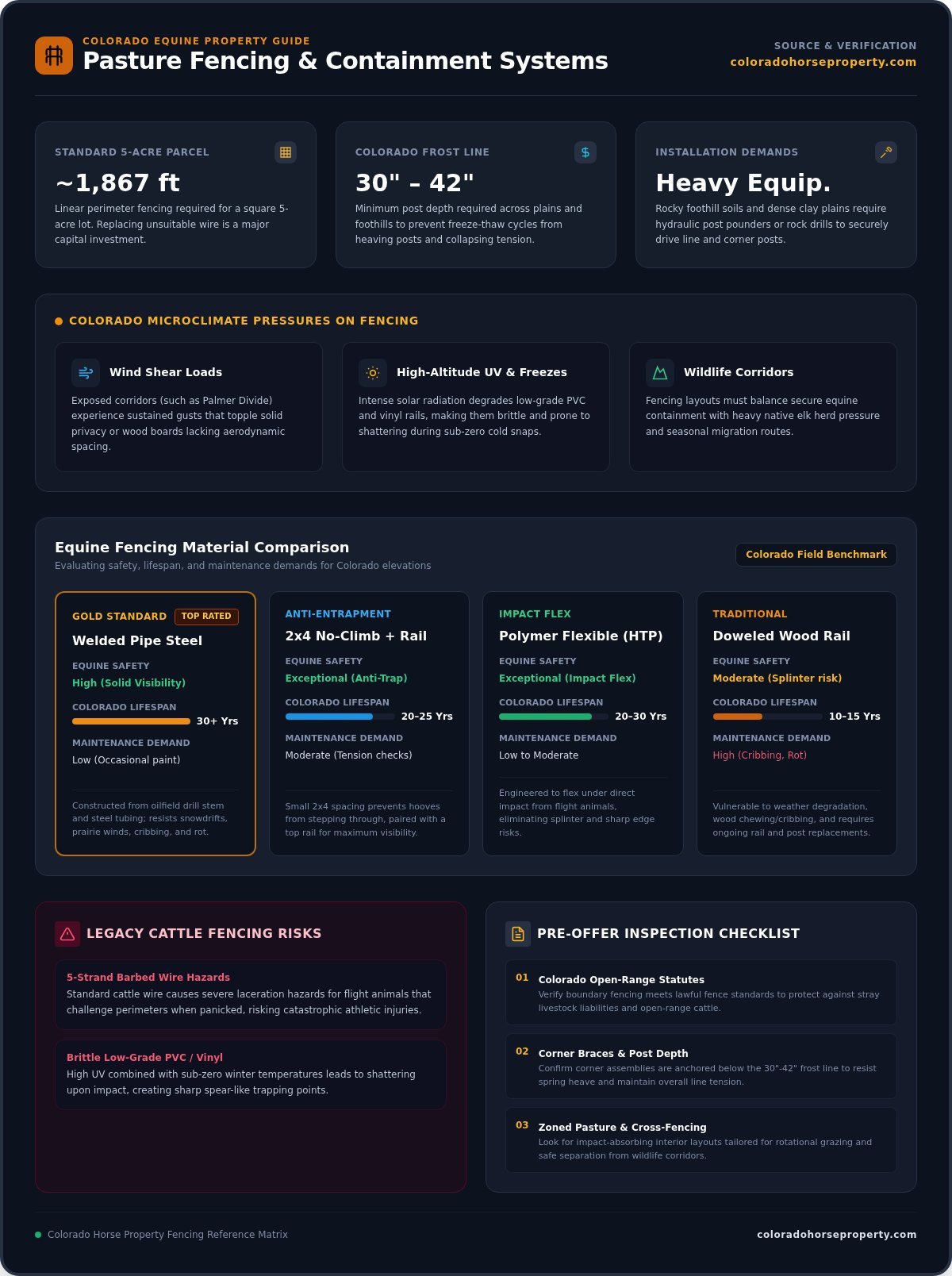
Relying on generic rural property filters often masks significant financial liabilities. A square five-acre parcel carries roughly 1,867 linear feet of boundary fencing. If that boundary features improper livestock containment, tearing it out and replacing it with specialized equine infrastructure quickly becomes a major capital expense. Historical agricultural fencing types and designs prioritize keeping livestock herds clustered, but equestrian setups demand impact-absorbing designs that mitigate leg-trap injuries, reduce pasture degradation, and handle native elk herd migrations.
The High Cost of Retrofitting Unsuitable Cattle Fencing
Legacy cattle acreage in Colorado typically features five-strand barbed wire. For horses, this material presents severe laceration hazards that can end an animal’s athletic career in seconds. Replacing these boundary lines isn’t as simple as swapping wires. In rocky Rocky Mountain foothill soils and dense clay plains, driving new line posts requires hydraulic post pounders or rock drills. These site constraints multiply labor demands and equipment rentals long before you set your first gate.
How Microclimates and Wind Loads Dictate Fence Longevity
Colorado’s regional terrain creates severe microclimatic pressures that compromise unsuitable materials:
- Wind Shear: Along exposed corridors like the Palmer Divide, sustained gusts easily topple solid privacy or wood-board fencing that lacks aerodynamic spacing.
- UV Radiation: Extreme high-altitude sunlight degrades low-grade PVC and thin vinyl rails, making them brittle and prone to shattering during sub-zero freezes.
- Frost Heave: Soil frost lines range from 30 to 42 inches across the plains and foothills. Shallow corner posts set above this freeze depth shift upward during spring cycles, collapsing line tension.
When you search for horse property by fence type Colorado acreage evaluations become far more predictable. Looking past surface aesthetics ensures your boundary structures can withstand local weather while keeping your horses sound.
Comparing Colorado Equestrian Fence Types: Safety, Durability, and Maintenance
Selecting the right pasture containment involves balancing animal safety, structural longevity, and ongoing maintenance demands. While standard three-strand wire satisfies baseline Colorado open range and fencing statutes for cattle, equine management requires dedicated designs tailored to horse behavior and elevation. Evaluating material choices early helps streamline your search for horse property by fence type Colorado acreage transactions require.
| Fence Type | Equine Safety | Colorado Lifespan | Maintenance Demand |
|---|---|---|---|
| Welded Pipe Steel | High (solid visibility) | 30+ Years | Low (occasional paint) |
| 2×4 No-Climb Mesh + Rail | Exceptional (anti-entrapment) | 20-25 Years | Moderate (tension checks) |
| Polymer Flexible Rail (HTP) | Exceptional (impact flex) | 20-30 Years | Low to Moderate |
| Doweled Wood Post & Rail | Moderate (splinter risk) | 10-15 Years | High (cribbing, rot repairs) |
Welded Pipe Steel Fencing: The Colorado Gold Standard
Constructed from thick oilfield drill stem and steel tubing, welded pipe handles aggressive herd pressure, heavy snowdrifts, and fierce prairie winds without flinching. Pipe won’t rot, splinter, or succumb to cribbing. Coated steel eliminates structural upkeep for decades, making it the premier choice for sacrifice paddocks, turnout runs, and round pens. As detailed in our guide on Horse Barns for Sale: Buying vs. Building Your Colorado Equestrian Dream, pairing pipe corrals directly with barn stalls establishes the ultimate high-traffic containment system.
Non-Climb Wire Mesh with Top Rail for Foothill Parcels
Class 3 galvanized 2×4-inch woven mesh prevents hooves from pushing through or catching shoes. Foothill horse properties in Douglas and Larimer counties benefit directly from this weave because it deters wandering predators like coyotes and loose dogs. Capping the mesh with a sturdy wood rail or steel pipe provides rigid visual boundaries, stopping horses from sagging the top edge as they graze neighboring grass.
Engineered Polymer and Vinyl Systems Under High-Altitude Sun
Intense UV radiation along the Front Range degrades cheap, rigid vinyl, causing brittle panels to break under minor impacts. In contrast, modern high-tensile continuous polymer (HTP) rails combine thick polyethylene with encased steel wires. This design flexes and cushions sudden collisions without splintering. Tensioning brackets allow lines to expand in summer heat and contract through sub-zero winter spells without buckling.
If you’re ready to review parcels featuring these exact setups, explore available ranch listings on Colorado Horse Property to pinpoint ranches built with superior turnout infrastructure.
Colorado Fence Laws, Open Range Statutes, and Wildlife Pressures
Buying rural land in the Centennial State introduces legal and environmental realities that surprise many out-of-state equestrians. Colorado operates under historic Open Range doctrine, establishing a strict “fence-out” framework. Unless local ordinances state otherwise, livestock owners have no legal duty to keep their animals off your property. If you fail to enclose your pastures properly, you cannot collect damages when neighboring cattle graze your turnout grass or damage your footing.
Balancing these state liability standards with science-backed equine fence safety guidelines requires careful architectural planning. A legal boundary fence must turn roaming cattle, yet standard ranch wire can be catastrophic to an excited horse. To navigate these intersecting priorities, structuring a precise search for horse property by fence type Colorado buyers trust helps pinpoint parcels built to handle statutory and environmental stress.
Understanding Colorado Revised Statutes (C.R.S. Title 35) Fence Classifications
Under C.R.S. § 35-46-101(1), a statutory “lawful fence” requires a well-constructed three-barbed-wire fence with substantial posts set roughly 20 feet apart, or an alternative build of equal containment strength. If a neighbor’s steer wanders through an unmaintained boundary and injures your horse, you hold no legal recourse under C.R.S. § 35-46-102 unless your lawful perimeter is fully intact. Incorporating these boundary details is fundamental when evaluating overall parcel usability, as outlined in our comprehensive guide on Land for Sale in Colorado: The Definitive 2026 Buyer’s Guide.
Note that certain residential equestrian subdivisions and incorporated municipalities in Douglas, Elbert, and Boulder counties enforce “closed-range” local ordinances. In these jurisdictions, livestock owners bear containment liability, meaning HOA rules or county zoning codes often dictate specific setback and fence design limits.
Mitigating Big Game Wildlife Pressure Along Migration Corridors
Herds of elk and mule deer travel along foothill corridors from Castle Rock down through Larkspur and Estes Park. When 800-pound bull elk challenge a pasture line, rigid boards shatter and taut high-tension strands snap. Colorado Parks and Wildlife (CPW) reports that fences taller than 40 inches account for roughly 70% of wildlife barrier mortalities, creating a clear dilemma since secure horse pens ideally stand 54 to 60 inches.
Smart property layouts resolve this tension by establishing a zoned containment model:
- Perimeter Boundary Lines: Use 42-inch wildlife-permeable fencing with a 16-inch smooth bottom wire clearance along outlying migration paths.
- Sacrifice Paddocks and Arenas: Install tall pipe rail or high-tensile flexible polymer in interior horse spaces where containment security is absolute.
- Protective Top Rails: Add rounded wood top rails or high-visibility caps on woven wire so jumping ungulates clearly gauge the clearance height.
Running a targeted search for horse property by fence type Colorado acreage shoppers use isolates ranches engineered to survive these native herd movements without recurring repair bills.
How to Search for Specific Fence Types Using Specialized Search Tools
National real estate portals treat agricultural acreage like standard residential subdivisions. In major MLS databases like REcolorado, IRES, or PPAR, listing agents frequently lump all boundary infrastructure under a single, binary “Fenced: Yes” checkbox. A multi-million-dollar equestrian parcel might feature high-end welded pipe runs, while another listing relies on failing barbed wire; standard filters present them as identical. When you execute a search for horse property by fence type Colorado buyers need tools that interpret true equine utility rather than generic property tags.
Locating turnkey acreage requires a methodical four-step filtering sequence:
- Define Functional Zones: Isolate properties with dedicated sacrifice paddocks, perimeter boundaries, and rotational pasture cross-fencing.
- Run Semantic Keyword Filters: Target listings mentioning verified materials such as “welded drill stem,” “continuous polymer,” or “2×4 no-climb.”
- Perform High-Resolution Satellite Audits: Inspect aerial imagery to trace fence lines, evaluate paddock layouts, and spot erosion around gates.
- Cross-Check Boundary Encroachments: Overlay listed fence lines onto county GIS plat maps to verify actual property corners before drafting a contract.
Leveraging AI-Powered Search to Uncover Granular Property Features
Because non-specialist agents often skip standard fencing dropdowns, critical infrastructure details remain buried inside paragraph remarks. Specialized search platforms deploy natural language processing to extract unstructured phrases like “Centaur rail,” “pipe runs,” and “stallion containment.” This semantic indexing immediately separates ornamental split-rail driveway frontage from secure turnout pens with frost-free waterers. For a broader look at evaluating acreage listings statewide, consult our Colorado Ranches for Sale: The 2026 Expert Buyer’s Guide.
Verifying Boundaries with Satellite Mapping and Plat Survey Analysis
Aerial satellite analysis prevents costly boundary surprises. A fence line in rural Colorado does not always match legal deeded boundaries. Decades of ranch adjustments frequently lead to fence placement inside utility easements, across BLM borders, or onto neighboring land. Overlaying GIS layers identifies actual grazable acreage versus steep scrub brush or conservation easements, ensuring you buy legally enclosed land rather than unpermitted fence lines.
To eliminate wasted trips to poorly fenced parcels, start your search for horse property by fence type Colorado listings using our AI-driven property engine today.
On-Site Due Diligence: Inspecting Pasture Fencing Before Making an Offer
Standard home inspectors rarely hike pasture boundaries. They check residential systems, roofs, and foundations, but assessing livestock containment falls outside standard inspection protocols. Before drafting an offer, put boots on the ground to walk the entire perimeter. A disciplined search for horse property by fence type Colorado buyers conduct starts online, but on-site due diligence confirms whether physical fencing delivers real structural integrity.
Operational utility requires hands-on verification. Test gate latch mechanisms across every pen to ensure smooth, single-handed operation while holding a lead rope. Walk slopes and drainage swales to verify the fence follows uneven ground contours without creating escape gaps beneath the bottom wire. Ground-level rot, rusted line splices, and leaning posts indicate imminent maintenance demands that should shape your purchase negotiations.
The Comprehensive Colorado Pasture Walk-Through Checklist
Systematically verify these high-wear structural points during your on-site physical inspection:
- Corner Brace Assemblies: Grab and shake wooden corner posts to confirm H-braces and diagonal tension wires have not destabilized from seasonal soil shifting.
- Weld Integrity: Check welded pipe pens along joint intersections. Look for stress fractures caused by horse impact or winter freeze contraction.
- Ground-Level Wood Rot: Prod the soil contact line on treated wooden posts with a pocketknife to detect hidden core decomposition.
- Bottom Wire Clearance: Confirm pasture mesh sits no higher than 12 to 16 inches off grade, preventing foals or resting horses from trapping limbs underneath.
Working with Specialist Equestrian Brokers to Structure Contract Protections
Specialized representation protects your capital when pasture enclosures need repair. Backed by over 40 years of Front Range real estate heritage through Realty Oasis, veterans Mark and Alison Eibner examine property lines far beyond curb appeal. They identify containment hazards and insert customized fence repair contingencies into the Colorado purchase agreement, negotiating seller credits or escrow holdbacks before closing.
From boundary line review to in-house transaction management, working with dedicated equestrian advisors guarantees legal compliance and safe containment from day one. Build your foundational knowledge by reading our Equestrian Real Estate Colorado: A Complete Buyer’s Guide. When you are ready to evaluate turnout-ready acreage, find your dream Colorado horse property with our specialized team.
Take the Guesswork Out of Your Colorado Pasture Search
Pasture fencing is far more than a boundary marker; it’s the foundation of your herd’s safety and your legal standing under Colorado open-range statutes. Whether you need heavy-duty welded pipe corrals to withstand prairie winds or wildlife-compatible mesh that respects seasonal elk paths, settling for generic acreage filters leaves your horses and your wallet exposed. Mastering how to search for horse property by fence type Colorado buyers trust ensures you invest in land that works from day one.
You don’t have to navigate property lines, county zoning codes, and soil heave alone. Backed by over 40 years of Front Range real estate heritage through Realty Oasis, veteran brokers Mark and Alison Eibner combine boots-on-the-ground inspection expertise with full-cycle transaction management. Our proprietary search tools index verified containment infrastructure so you can skip the guesswork and focus on turnout-ready land. Find your next Colorado Horse Property with AI and step onto your dream acreage with total confidence.
Frequently Asked Questions
Can I search for horse properties with pipe rail fencing in Colorado?
Yes, but traditional real estate portals rarely offer dedicated pipe filters. Standard MLS systems combine all fencing into broad generic tags. To find pipe rail properties, you need specialized platforms using natural language search to crawl listing remarks for terms like welded drill stem or steel pipe runs. When conducting a search for horse property by fence type Colorado buyers should partner with an equestrian broker who can query specific property remarks directly.
What is considered a lawful fence under Colorado Open Range laws?
Under C.R.S. § 35-46-101(1), a lawful fence consists of well-constructed three-barbed-wire fencing with sound posts set roughly 20 feet apart, or an alternative fence of equal strength. Under the state’s open-range doctrine, you must maintain this standard around your entire boundary. If unfenced, you cannot recover legal damages if neighboring open-range cattle wander onto your pastures and graze your forage.
Is barbed wire acceptable for horse properties in Colorado?
While barbed wire legally satisfies Colorado open-range containment standards for livestock, it is dangerous for horses. Equine skin tears easily, and panicked flight responses often lead to severed tendons or catastrophic lacerations against taut barbs. Equestrian buyers typically budget to replace barbed wire along active pastures with smooth high-tensile wire, welded pipe, or 2×4 no-climb mesh, keeping barbed wire strictly on remote cattle perimeter borders if necessary.
How do Colorado winter freeze-thaw cycles affect horse fence posts?
Colorado soils experience deep seasonal frost depths ranging between 30 and 42 inches along the Front Range. When moisture in clay or loam soils freezes, it expands upward, causing frost heave. Posts driven or set shallower than 36 inches get pushed out of alignment over consecutive winters. This heaving loosens corner anchor assemblies, sags wire runs, and eventually causes rigid top rails to unseat and buckle.
What is the best fencing type for rocky Front Range soils?
Welded steel pipe and driven steel T-posts or drill stem line posts perform best in rocky foothill terrain. Drilling auger holes for large wooden posts in decomposed granite or fractured rock requires heavy rock drill machinery, which drives up construction labor. Steel posts can often be pounded directly into fractured rock layers or welded to surface-anchored footings, creating rigid, fire-resistant containment that won’t shift on rocky grades.
How do elk and wildlife affect horse pasture fencing in Colorado?
Large migratory ungulates like elk and mule deer frequently crash through rigid rail barriers or catch legs in tight wire strands. To avoid routine repairs, horse owners along wildlife corridors install zoned layouts. Corrals near the barn use heavy welded pipe, while exterior pasture boundaries utilize wildlife-friendly spacing. Following state wildlife guidelines with top rails capped near 42 inches allows herds to jump safely without breaking your fence.
How does proper fencing affect the resale value of a Colorado horse property?
Turnkey, equine-safe fencing substantially boosts property value and shortens days on market. Prospective buyers recognize the high capital expenditure and labor required to fence multi-acre parcels. When you search for horse property by fence type Colorado ranches with established welded pipe corrals and intact perimeter fencing command premium offers because incoming owners can safely turn out their animals on closing day without immediate capital improvements.