
A picturesque red barn and snow-capped mountain backdrop won’t keep your homestead running if your residential well permit legally forbids watering a garden or keeping a horse. When buying a hobby farm in Colorado, legal utility and physical infrastructure matter far more than postcard views.
It’s easy to picture the freedom of wide-open acreage, homegrown food, and room for animals. Yet the reality of rural property often brings sharp headaches. Untangling Colorado’s complex water rights, strict county-level livestock limits, and hidden infrastructure pitfalls like failing septic systems or unmaintained winter roads can intimidate even experienced buyers.
You don’t have to step into that market blind. This guide gives you the tools to master local zoning rules, verify water entitlements, inspect physical utilities, and evaluate regional terrain with total confidence. Here is everything you need to know to find and secure a functional Colorado small-acreage farm in 2026.
Key Takeaways
- Understand county zoning distinctions and current agricultural tax classifications to ensure your acreage legally permits your planned livestock and outbuildings.
- Master the critical differences between household-use well permits and adjudicated water rights before buying a hobby farm in Colorado.
- Compare regional microclimates across the Front Range, Western Slope, and Eastern Plains to match your specific growing season, snow load, and pasture requirements.
- Use an on-site physical checklist to spot hidden structural, septic, fencing, and winter road access liabilities before submitting an offer.
- Bypass inaccurate generic listing portals by applying specialized search criteria focused strictly on rural acreage, irrigation, and equestrian facilities.
Understanding the Colorado Hobby Farm: Acreage, Zoning, and Regulations
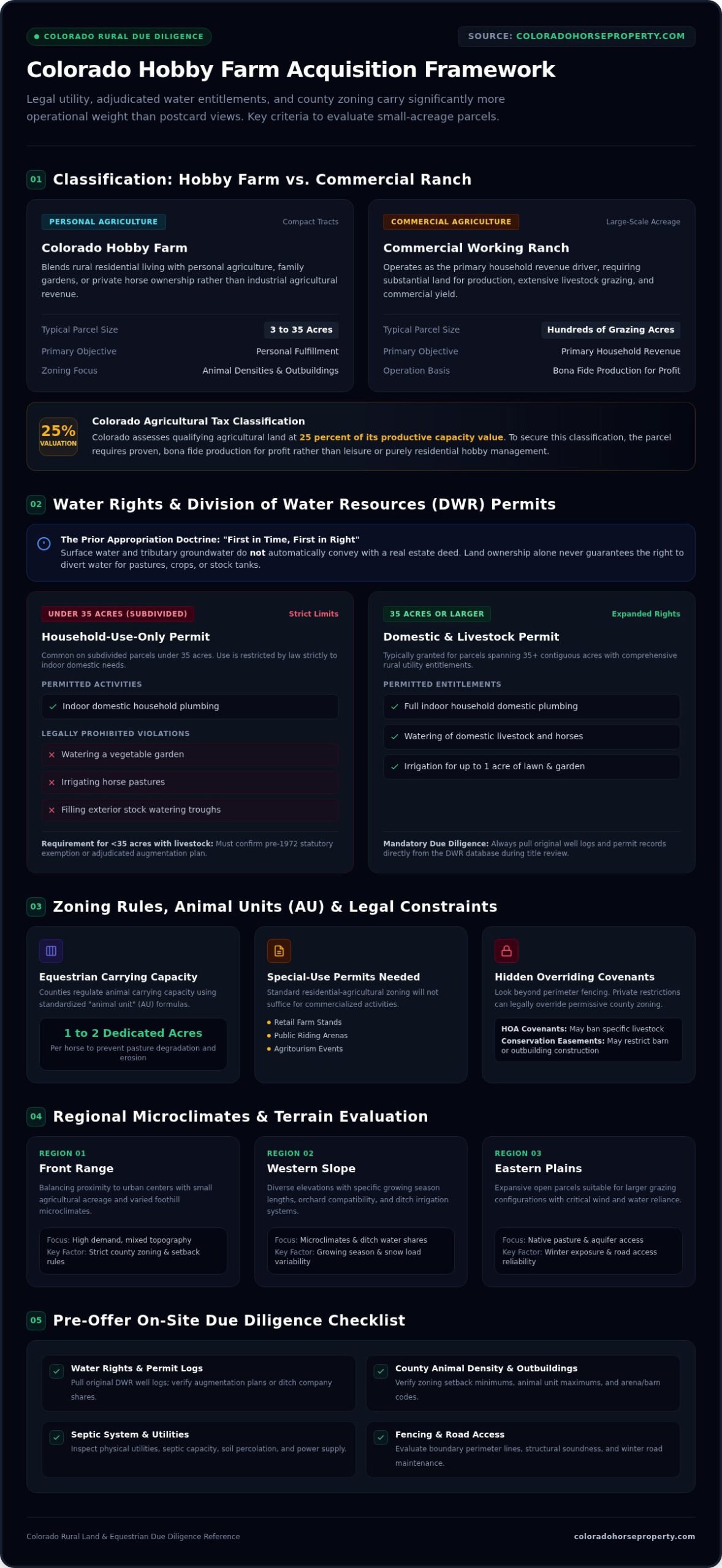
A Colorado hobby farm blends rural residential living with small-scale agricultural or equestrian activities. While broad definitions of What is a Hobby Farm? describe land managed for personal fulfillment rather than industrial output, successful operations in this state require strict adherence to local land use codes. Most parcels span between 3 and 35 acres across diverse microclimates, where county zoning dictates animal densities, setback minimums, and outbuilding dimensions.
Before making an offer, look beyond the perimeter fencing. Private HOA covenants or historic conservation easements can override permissive agricultural zoning, prohibiting specific livestock or limiting barn construction. To better understand essential legal considerations when evaluating rural property, watch this helpful overview:
Hobby Farm vs. Working Commercial Ranch in Colorado
When buying a hobby farm in Colorado, distinguishing personal agriculture from commercial ranching is essential. Commercial operations depend on agriculture as the primary household revenue driver, requiring hundreds of grazing acres. Hobby farms prioritize personal recreation, family gardens, or private horse ownership on compact tracts. Tax implications differ sharply. Colorado assesses agricultural land at 25 percent of its productive capacity value, but qualifying demands proven, bona fide production for profit rather than leisure. Review our detailed guide on buying Colorado land to evaluate these structural classifications thoroughly.
Decoding County Animal Units and Land Use Codes
Every Colorado county regulates animal carrying capacity using standardized “animal unit” (AU) formulas. Equestrian setups often require at least one to two dedicated acres per horse to prevent native pasture degradation and erosion. If your operational plans include retail farm stands, public riding arenas, or agritourism events, standard residential-agricultural zoning won’t suffice; you will need county special-use permits. Verifying these land use codes with county planning departments is mandatory before placing earnest money on any property.
Colorado Water Rights and Well Permits: Essential Due Diligence
Water determines the operational viability and market value of every rural acreage in the state. Colorado operates under the prior appropriation doctrine, establishing the legal principle of “first in time, first in right.” Under this legal framework, surface water and tributary groundwater do not automatically convey with a real estate deed. Owning the dirt beneath your boots never guarantees the right to divert water for pastures, crops, or stock tanks.
Exempt Well Permits: Household vs. Domestic and Livestock
A common pitfall when buying a hobby farm in Colorado is assuming that an existing well supports both home and barn. The Division of Water Resources (DWR) strictly governs well permits based on parcel size, aquifer depth, and intended use:
- Household-Use-Only Permits: Common on subdivided parcels under 35 acres. These permits limit water use entirely to indoor domestic plumbing. Watering a vegetable garden, irrigating horse pasture, or filling an exterior trough from this well legally violates the permit terms.
- Domestic and Livestock Permits: Typically granted for tracts of 35 acres or larger. These permits authorize indoor household use, the watering of domestic livestock, and irrigation for up to one acre of lawn and garden.
If you evaluate a parcel under 35 acres that has pasture or livestock, you must confirm whether the well holds a pre-1972 statutory exemption or ties into an adjudicated augmentation plan. Always pull original well logs and permit files from the DWR database during your title review window.
Ditch Company Shares, Adjudicated Springs, and Storage Ponds
Surface water rights require a completely separate due diligence process. Mutual ditch company shares do not transfer through standard warranty deeds; they convey via separate stock certificates that must be transferred through the ditch company secretary. You must inspect company bylaws, carriage ditch maintenance agreements, and annual shareholder assessment fees.
Senior water rights with early adjudication dates retain legal priority during dry summer calls, whereas junior rights often get shut off entirely. Take caution with unadjudicated springs or unpermitted landscape ponds. The Colorado State Engineer actively inspects and issues cease-and-desist orders against unpermitted storage ponds, which can force you to drain them entirely. When buying a hobby farm in Colorado, working alongside dedicated rural specialists at Colorado Horse Property ensures that your water decrees, well logs, and ditch certificates undergo thorough professional review before closing.
Regional Guide: Choosing the Best Colorado Farm Location
Colorado spans dramatic elevations and diverse ecosystems. A parcel at 5,000 feet on the Western Slope faces an entirely different climate than an acreage situated at 8,200 feet in the central foothills. When buying a hobby farm in Colorado, matching your agricultural goals to the right geographic region ensures your pastures produce grass, your orchard yields fruit, and your winter access stays open. To assess available properties across these distinct areas, browse current options for horse property for sale in Colorado.
Front Range and Central Foothills: Douglas, El Paso, and Larimer
The Front Range corridor attracts professionals needing an active homestead near urban centers. Counties like Douglas, Elbert, El Paso, and Larimer offer convenient access to major veterinary surgical centers, feed stores, and competition equestrian venues. High residential demand creates smaller parcel sizes and stricter private covenants. Central foothill locations introduce steep topography, thin rocky soil, elevated wildfire risk, and higher winter snow loads. These conditions reduce natural forage yields and limit horse carrying capacity per acre.
Western Slope Valleys: Delta, Montrose, and Mesa Counties
The Western Slope offers ideal conditions for market gardens, productive orchards, and high-yield irrigated pastures. Sheltered river valleys in Delta, Montrose, and Mesa counties feature longer frost-free growing seasons, fertile soils, and reliable gravity-fed irrigation ditch shares supplied by mountain snowpack. Established farm cooperatives, livestock supply outfits, and farmers markets create an interconnected agricultural community that makes small-acreage farming practical and sustainable.
Eastern Plains: Elbert, Weld, and Adams Acreage
Heading east onto the plains provides wider acreage profiles and open ground. Counties like Weld, Adams, and eastern Elbert feature level pastures suited for large barns, outdoor arenas, and multi-paddock rotations. Flat topography demands thoughtful planning for windbreaks and robust three-sided run-in sheds to shelter livestock during severe winter blizzards. Shallow irrigation ditch networks disappear here, meaning successful homesteads rely on deep aquifer formations that require dedicated well infrastructure and high-capacity pressure systems.
Every region presents distinct operational advantages. Weighing proximity to city services against water share security, topography, and seasonal weather patterns will steer you toward the right valley or plain for your lifestyle.
On-Site Due Diligence Checklist: Infrastructure, Soil, and Utilities
A thorough visual walkthrough protects your capital when buying a hobby farm in Colorado. Standard home inspectors rarely possess the specialized knowledge required to evaluate barns, pasture ecosystems, and rural utilities. Work through this physical due diligence checklist before waiving your contract inspection contingencies.
Outbuildings, Barns, and Equestrian Facilities
Start by evaluating the framing, roofing integrity, and structural foundations of every outbuilding. Check stall ventilation, stall floor drainage, kick-wall durability, and the operation of freeze-proof automatic water lines buried below the regional four-foot frost depth. Outbuilding electrical panels must use sealed agricultural conduit to prevent dust-fueled fire hazards. Hay storage areas demand dry conditions and continuous cross-ventilation to prevent internal heat buildup. If existing structures need substantial renovations, review our comparison on horse barns for sale to accurately weigh retrofitting costs against building anew.
Soil Quality, Pasture Health, and Noxious Weed Audits
Walk the full perimeter to inspect fence tension, gate hardware, and boundary corner pins. Collect soil samples across grazing paddocks to identify high-alkaline clay, salinity, or nutrient deficiencies before seeding. Colorado law requires landowners to manage invasive plant species; inspect the ground for state-mandated List A and List B noxious weeds like leafy spurge, Canada thistle, and diffuse knapweed, which carry mandatory eradication rules. Verify that fragile native dryland grasses haven’t suffered past overgrazing, and check drainage paths for contamination from upstream mining tailings or uncontained fuel tanks.
Utilities, Septic Systems, and Winter Accessibility
Hire a licensed technician to inspect the On-Site Wastewater Treatment System (OWTS), ensuring tank capacity and absorption drain fields match the property’s bedroom count. Verify propane tank ownership versus rental leases, confirm high-speed internet availability, and map buried utility lines. Winter accessibility is critical. Test whether private gravel roads, culverts, and steep driveway grades permit daily transit for propane trucks, feed deliveries, and emergency veterinary trailers during heavy snowfall. When buying a hobby farm in Colorado, let our experienced team help protect your investment; contact Colorado Horse Property to guide your on-site due diligence.
How to Search, Evaluate, and Purchase Colorado Hobby Farms in 2026
Generic real estate websites regularly fail when applied to rural acreage. Mainstream listing platforms routinely misclassify land attributes, tagging raw brush as irrigated pasture or confusing restrictive domestic wells with adjudicated commercial water supplies. When buying a hobby farm in Colorado, successful acquisitions require specialized search tools, rural lending expertise, and strict contractual due diligence.
Leveraging AI-Powered Search for Agricultural Real Estate
Standard search algorithms cannot separate a suburban house with a large backyard from an authentic, functional farmstead. That disconnect causes buyers to waste weeks traveling to properties with steep, unworkable terrain, missing utility infrastructure, or restrictive covenants that prohibit livestock.
Proprietary AI-powered search tools eliminate that frustration. By evaluating listings for specific agricultural criteria, our AI-Powered Horse Property Search filters properties by confirmed water adjudications, barn dimensions, turnout paddock layouts, and soil topography. Instead of guessing whether an outbuilding includes running water or if a parcel allows three horses, buyers can instantly isolate viable properties before scheduling an on-site walkthrough.
Partnering with Experienced Colorado Rural Property Brokers
Submitting an offer on agricultural acreage requires specialized contract terms. Standard residential contracts leave buyers vulnerable to inherited boundary disputes, unadjudicated wells, and dry irrigation ditches. Your purchase agreement must feature customized contingencies for well flow tests, ditch stock verification, environmental inspections, and structural reviews of all outbuildings.
Financing also demands early preparation. Conventional mortgage underwriters often struggle to appraise high-acreage ratios and agricultural improvements. Working with lenders who understand rural appraisals prevents closing delays and financing denials. Backed by over 40 years of brokerage leadership through Realty Oasis, industry veterans Mark and Alison Eibner provide complete buyer representation, transaction management, and coordinated title and escrow services to ensure ditch stock transfers and deed contingencies close smoothly. Connect with Colorado Horse Property today to find a property that delivers genuine agricultural capability alongside lasting peace of mind.
Secure Your Colorado Small Farm with Confidence
A successful homestead relies on verified facts rather than wishful thinking. Navigating prior appropriation water decrees, verifying well permit limits, and confirming county animal density codes are the non-negotiable steps that protect your investment. When you pair those legal checks with an on-site inspection of outbuildings, soils, and winter road access, you position your land for decades of resilience.
You don’t have to navigate this detailed process on your own. When buying a hobby farm in Colorado, specialized guidance prevents costly mistakes. Backed by over 40 years of brokerage heritage through Realty Oasis, industry specialists Mark and Alison Eibner deliver hands-on buyer representation and transaction management tailored to rural properties. With our proprietary AI-powered search tool built specifically for equestrian and farm acreage, you can cut through generic listings to pinpoint properties with the exact water, outbuilding, and terrain features you require.
Find your ideal rural acreage with Colorado Horse Property today and turn your agricultural vision into an enduring reality.
Frequently Asked Questions
How many acres do you need for a hobby farm in Colorado?
Most functional hobby farms in Colorado range from 5 to 35 acres. While a compact 3-to-5-acre parcel can support a modest family garden and small poultry coop, keeping larger livestock or grazing horses generally requires 10 or more acres to avoid complete pasture depletion. Crossing the 35-acre threshold also unlocks automatic eligibility for an exempt domestic well permit under state statute, making irrigation and stock watering far simpler.
Can I legally drill a well on a 5-acre Colorado hobby farm?
Yes, but your water usage will likely face strict legal restrictions. Parcels under 35 acres typically only qualify for an exempt household-use-only well permit through the Division of Water Resources. This permit strictly forbids outdoor garden watering, pasture irrigation, and exterior livestock troughs. To use well water outside on a 5-acre tract, you must acquire pre-existing statutory water rights, tap into a court-approved augmentation plan, or haul in supplemental cistern water.
What qualifies a small farm for agricultural property tax classification in Colorado?
Qualifying requires proving the land is actively used for agricultural production with the primary purpose of generating a profit. Personal leisure, private horse riding, and family vegetable gardens don’t qualify on their own. Under Senate Bill 26-010, the state broadened farm and ranch definitions to include pasture-based livestock grazing and small-scale operations predominantly used for commercial production. If eligible, your land assessment drops to 25 percent of its productive capacity value, generating substantial annual tax savings.
Can I keep horses and livestock on any rural land in Colorado?
No, animal keeping depends entirely on county zoning regulations and private property covenants. Even if an acreage is zoned rural or agricultural, county land use codes designate specific animal units that cap livestock density per acre. Additionally, recorded subdivision covenants or HOA rules frequently outlaw roosters, swine, or specific farm operations. When buying a hobby farm in Colorado, verify county zoning density caps and review all title exceptions before signing your purchase contract.
How do water rights transfer when purchasing Colorado farm acreage?
Water rights do not automatically convey with a standard real estate deed. Under Colorado’s prior appropriation doctrine, water is legally distinct real property. Surface water often conveys through separate mutual ditch company stock certificates signed over by the company secretary, while tributary wells require permit ownership transfers filed with the Division of Water Resources. Your real estate contract must explicitly state all adjudicated decrees, ditch shares, and well permit numbers to ensure clear title conveyance.
What is the difference between a ranchette and a hobby farm?
A ranchette primarily functions as a rural residential estate, whereas a hobby farm emphasizes active agricultural production. Ranchettes typically feature large homes on small acreage with minimal pasture management, used primarily for privacy and outdoor recreation. A hobby farm centers on functional land utility, integrating gardens, poultry coops, fenced paddocks, and livestock handling areas. While both share similar parcel sizes, hobby farms prioritize agricultural output and animal husbandry alongside residential living.
What unexpected costs should I prepare for when buying rural Colorado property?
Infrastructure maintenance, water administration, and winter access represent the largest unexpected expenses. Buyers frequently underestimate costs for ditch company shareholder maintenance assessments, septic system riser replacements, and well pump repairs. You also need dedicated equipment for winter snow removal on long private driveways, continuous perimeter fence upkeep, and state-mandated noxious weed mitigation. When buying a hobby farm in Colorado, factor these operating reserves into your initial acquisition budget to prevent financial strain after closing.